
Business News
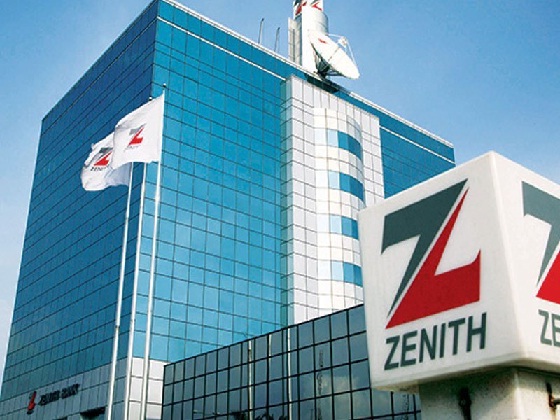
Zenith Bank Leads Financial Market With 22% First Quarter Growth

By Evelyn Terseer, Abuja
Zenith Bank Plc has announced a phenomenal growth in its first quarter operations as its unaudited results showed an impressive 22% increase in earnings of N157.3 billion reported in Q1 2021 to N191.
5 billion in Q1 2022 as at 31st March 2022.In its statement of account presented to the Nigerian Exchange (NGX) recently, the strong double-digit growth also culminated in 11% Year-on-Year (YoY) increase in profit before tax, growing from N61.
02 billion in Q1 2021 to N67.99 billion in Q1 2022.Profit after tax also grew by 10%, from N53.
06 billion to N58.19 billion over the same period. The growth in the topline arose from both interest income and non-interest income.Interest income grew by 25%, from N101.12 billion in Q1 2021 to N126.38 billion in Q1 2022, while non-interest income grew by 12%, from N51.20 billion to N57.23 billion.
The growth in interest income and non-interest income arose from the combined effects of an improvement in interest income on loans and advances (as risk assets continue to grow and pricing is gradually improving) and an improvement in non-interest income as the Bank continues to deploy its retail strategy, thereby acquiring more customers and expanding its electronic banking income from the increased volume of transactions across all its channels.
Total assets grew by 9% from N9.45 trillion to N10.32 trillion in 2022, mainly driven by growth in customers’ deposits. Customer deposits grew by 12%, from N6.47 trillion in December 2021 to N7.25 trillion in March 2022. Savings account balance, which is solely retail grew by over N68 billion and is a validation of the robust customer acquisition strategy and versatile electronic platforms and digital channels, the bank said in a recent statement.
Loans and advances also grew by 6%, from N3.5 trillion in December 2021 to N3.7 trillion in March 2022, boosting the Group’s interest income and displaying the Group’s appetite for high-yielding risk assets creation. This development also helped to boost the net interest margin (NIM), as it improved from 6.0% in March 2021 to 7.3% in the current period, while the capital adequacy ratio improved slightly from 21.1% to 22.1%.
Going into the remainder of 2022, the Group will continue to focus on sustainable growth across all its business segments and deploy technology platforms and digital assets intuitively to serve its various customers’ needs to deliver enhanced returns to its stakeholders.
Zenith Bank’s track record of excellent performance has earned the brand numerous awards, including being voted as Best Bank in Nigeria in the Global Finance World’s Best Banks Awards, for three consecutive years from 2020 to 2022, Best Commercial Bank in Nigeria in the World Finance Banking Awards 2021, Bank of the Year (Nigeria) in The Banker’s Bank of the Year Awards 2020, and Best in Corporate Governance’ Financial Services’ Africa 2020 and 2021 by the Ethical Boardroom.
Also, the Bank emerged as the Most Valuable Banking Brand in Nigeria in the Banker Magazine Top 500 Banking Brands 2020 and 2021, Number One Bank in Nigeria by Tier-1 Capital in the “2021 Top 1000 World Banks” Ranking by The Banker Magazine and the Retail Bank of the year at the BusinessDay Banks and Other Financial Institutions (BOFI) Awards 2020 and 2021.
Similarly, Zenith Bank was honoured as Bank of the Decade (People’s Choice) at the ThisDay Awards 2020 and emerged winner in four categories at the Sustainability, Enterprise, and Responsibility (SERAS) Awards 2021, carting home the awards for “Best Company in Reporting and Transparency”, “Best Company in Infrastructure Development”, “Best Company in Gender Equality and Women Empowerment”, and the coveted “Most Responsible Organisation in Africa”.



A graduate of the University of Maiduguri, Shianya Ebwaseh, said the Nigerian Education Loan Fund (NELFUND) helped improve her Grade Point Average (GPA) to 3.50 through financial support that enabled her to concentrate on her studies.
Ebwaseh, who graduated from the Department of Zoology, Faculty of Life Sciences, said this in an interview on Monday in Maiduguri.
She said financial difficulties had previously affected her academic performance, as she struggled to meet her daily needs while pursuing her degree.
The graduate said she resorted to selling fried chips and groundnuts on campus to support herself, sometimes missing lectures because of the time and energy required to run the business.
According to her, the introduction of NELFUND’s student loan scheme relieved her financial burden through tuition support and a monthly N20,000 upkeep allowance.
“Before NELFUND, I struggled with my GPA because of financial challenges. I sometimes missed lectures after spending hours frying and packaging chips for sale.
“But when NELFUND came, I stopped the business and concentrated on my studies. My GPA improved to 3.50, which is Second Class Upper,” she said.
Ebwaseh said the financial support also enabled her to attend lectures regularly, purchase learning materials and prepare adequately for tests and examinations without constant worries about money.
She added that her examination scores improved significantly after she began receiving the support, attributing the change to increased concentration and financial stability.
The graduate, who said she accessed the scheme in her third year, described the application process as simple and encouraged other eligible students to apply.
She also said the programme had helped financially disadvantaged students remain in school, particularly those whose parents could not afford tuition fees and upkeep.
Ebwaseh appealed to the Federal Government to sustain the initiative, emphasising that withdrawing the support could expose many students to financial difficulties and possible dropout.
She said the scheme had given beneficiaries an opportunity to pursue their academic ambitions with fewer financial distractions.(NAN)

The Minister of Housing and Urban Development, Dr Muttaqha Darma, has called for synergy among government agencies in the housing sector to improve coordination and accelerate housing delivery.
Darma made the call in Abuja on Monday at the stakeholders’ conference on the proposed National Real Estate Regulatory Authority (NRERA).
The conference, themed “One vision, One Ecosystem, One National Housing and Real Estate Plan”, was organised by the Office of the Speaker, House of Representatives, and the House Committee on Housing and Habitat.
The minister said the lack of coordination among government agencies had affected the effective delivery of houses to Nigerians, noting that institutions in the sector operated independently.
“The players within the industry, all of us, operate in silos.
“Federal Housing Authority (FHA) does not even know what the Federal Mortgage Bank of Nigeria (FMBN) is doing. FMBN does not know what the Ministry of Finance Incorporated (MOFI) is doing,” he said.
According to him, the various institutions must work together towards a common goal rather than operate independently.
“Our target is to build houses for Nigerians. We are wasting our time because if we fail, it is us who fail, not the President,” he said.
The minister expressed support for the establishment of NRERA, saying the proposed authority would address the regulatory gaps in the real estate sector.
He said the ministry had reviewed the proposed legislation and recognised its potential to improve the sector.
Darma also disclosed that abandoned housing projects funded by the Federal Mortgage Bank of Nigeria (FMBN) across the country were worth about N38 billion.
He said a survey conducted by the ministry revealed abandoned FMBN-funded housing developments in every state of the federation, including the Federal Capital Territory.
“We realised about N38 billion of contributors’ money, your own money, all the Nigerian workers’ money. N38 billion is wasted,” he said.
He said that the poor management of workers’ contributions could discourage Nigerians from contributing to the National Housing Fund.
The minister urged the committee handling the proposed legislation to ensure that state governments were included in the regulatory framework.
He also called for safeguards to protect homebuyers, tenants, developers and mortgage lenders, including mandatory escrow accounts for buyers and standardised tenancy agreements.
The Managing Director and Chief Executive Officer of the Ministry of Finance Incorporated (MOFI), Dr Armstrong Takang, said effective regulation was necessary to restore investor confidence in Nigeria’s real estate sector.
Takang said the sector contributed 12.71 per cent to Nigeria’s Gross Domestic Product (GDP) as of June 2026, but remained largely unregulated.
He said the absence of a national licensing system had allowed unqualified individuals to operate as estate agents and developers without adequate accountability.
“Anyone can sell land, anyone can collect off-plan payments, run into tens of billions and get away with it. There are very few countries in the world where these are allowed,” he said.
He called for mandatory licensing of real estate operators and the protection of buyers’ funds through designated project accounts.
“An operator must be licensed with the authorities. No one should be operating in the real estate sector without a licence, no matter which part of the value chain they are involved in,” he said.
He added that buyers’ funds should be kept in protected project accounts and released to developers based on evidence of progress on construction.
Takang said effective regulation would attract domestic and foreign investment, protect citizens and support the Federal Government’s one-trillion-dollar economy target.
He urged the National Assembly to ensure the passage of the proposed legislation, describing it as critical to bringing order and transparency to the real estate sector.

From Tony Nwachukwu, Lagos
Fintech company OPay has announced the postponement of its planned public offering on the New York Stock Exchange (NYSE), following careful consideration of an ongoing inquiry by a regulatory authority.
The company said the decision to postpone the offering was taken in the best interests of the business and its customers.
In a statement shared with DAILY ASSET, OPay explained that the ongoing inquiry does not affect the services it provides to customers or how it operates in Nigeria and its other business markets.
The company also reassured customers, merchants, agents and other business partners that its operations would continue as usual, with all services remaining fully available.
“Customers can continue sending and receiving money, making payments and saving without interruption,” the statement noted.
OPay expressed appreciation to its customers, merchants, agents, business partners, employees and other stakeholders for their continued trust and support.
The company also reiterated its commitment to making financial services more inclusive through technology



CBN Introduces New Regulatory Framework for Non-Security VASPs, others
ShareBy Tony Obiechina, Abuja The Central Bank of Nigeria (CBN) has introduced a comprehensive regulatory framework for non-security virtual assets...


Group tasks Women Journalists on Reporting Impact of Coal Mining in Enugu
ShareFrom Sylvia Udegbunam, Enugu A non-governmental organisation, Renevlyn Development Initiatives, has called on women journalists in Enugu State to intensify...


RMAFC Chairman Tasks Directors, Others on Accountability, Productivity
ShareBy Tony Obiechina, Abuja The Chairman of the Revenue Mobilisation, Allocation and Fiscal Commission (RMAFC), Dr. Mohammed Bello Shehu has...


NDLEA Secures 18 Convictions, Arrests 130 Suspects in Kaduna
ShareThe National Drug Law Enforcement Agency (NDLEA), Kaduna State Command, said it secured 18 convictions and arrested 130 suspects for...
Gen Z No Longer Think for Themselves, Ayra Starr’s Mother Blames Social Media
ShareNene Aderibigbe, mother of Nigerian singer Ayra Starr, has criticised the influence of social media on Gen Z, claiming that...


Davido, Chioma Arrive in Style for Zlatan, Davita’s Wedding in Morocco
ShareNigerian music star, Davido, and his wife, Chioma Adeleke, have arrived in style in Marrakesh, Morocco, for the wedding celebration...


Lessons from the 2023 Presidential Elections: Obi Vs Wike
ShareBy Sunday Adelaja My goal in this article is to go beyond promoting a particular candidate like I did in...
Certificates Without Jobs: The Uncomfortable Reality of Nigeria’s Education System
ShareBy Idris Rufai Welcome to Nigeria, where young people are highly educated, professionally qualified and, unfortunately, increasingly experienced in the...


FG Generates N33tn Revenue in 10 Months – Oyedele
ShareBy Tony Obiechina, Abuja The Federal Government generated N33tn in revenue between January and October 2026, while about 90 per...


Terrorists Flee Strongholds, Military Block New Bases – DHQ
ShareBy David Torough, Abuja The Defence Headquarters (DHQ) has dismissed reports and suggestions of a ceasefire with Boko Haram terrorists,...