
NEWS
ZMSG Denies Taking N14.2b Loan

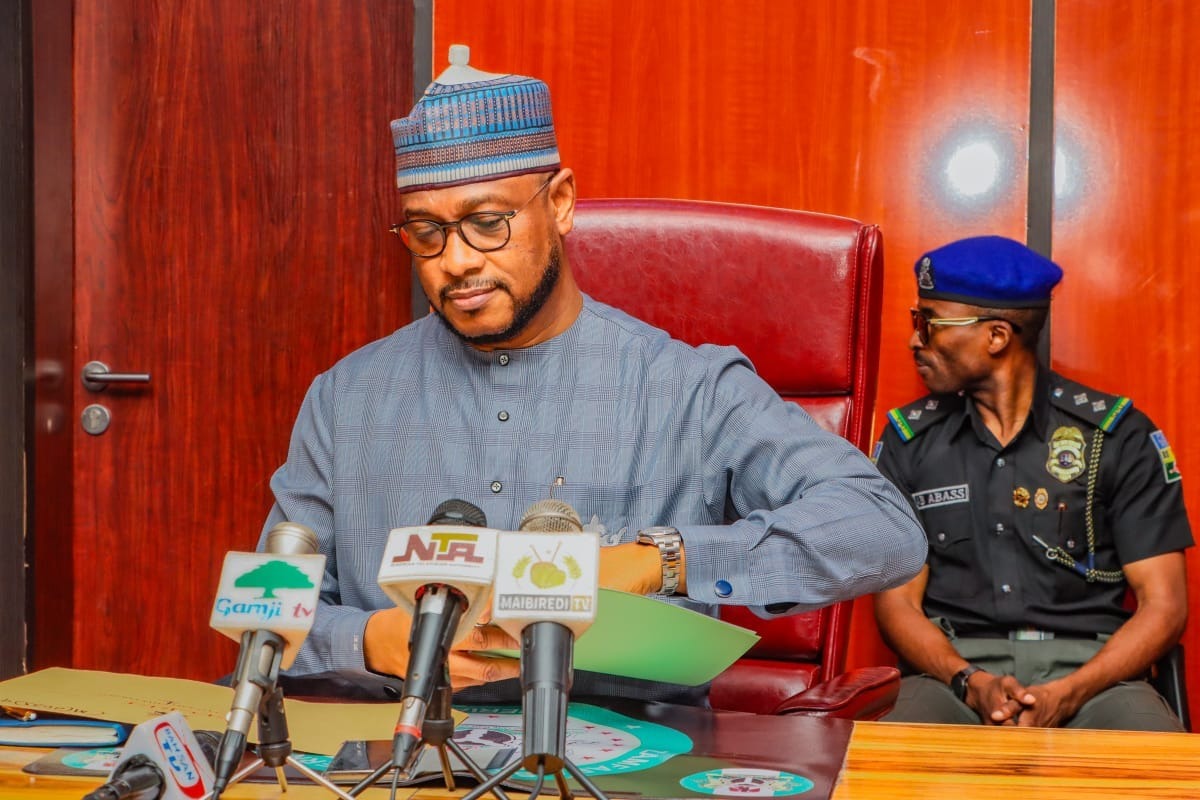
The Zamfara government on Monday denied taking a N14.2 billion loan as indicated in a report by the Debt Management Office (DMO).
A statement issued in Gusau on Monday by Sulaiman Idris, Senior Special Assistant to the governor on Media and Publicity, debunked the claim it described as false.
“This is to clarify the DMO report which said that the Zamfara state government borrowed N14.
26 billion naira.“The Zamfara government has never applied for loan or approached the State Assembly or National Assembly with such request,” Idris said.
According to the statement, the sum of 14.
26 billion, as stated in the DMO report, was not borrowed by Gov Lawal’s administration.“The amount was part of the proceeds from a 20 billion naira loan floated by previous administrations in the state.
“No domestic or external loans have been borrowed since Gov Dauda Lawal came in.
“It is important to note that the previous Zamfara state government floated a N20 billion bond but failed to collect the total amount.
“The immediate past government received N4 billion naira out of the N20 billion requested for the Zamfara Cargo Airport project, though the funds were not utilised.
“Upon assuming office, we discovered that the payment terms made terminating the bond impossible without incurring a significant loss for the state.
“The balance of N16 billion out of the N20 billion borrowed by the past administration is the N14.26 billion captured by the DMO. The value is reduced due to inflation.
“The bond balance, which is still in a government account, has not been used and will be reserved for the airport project,” he explained. (NAN)
By David Torough, Abuja
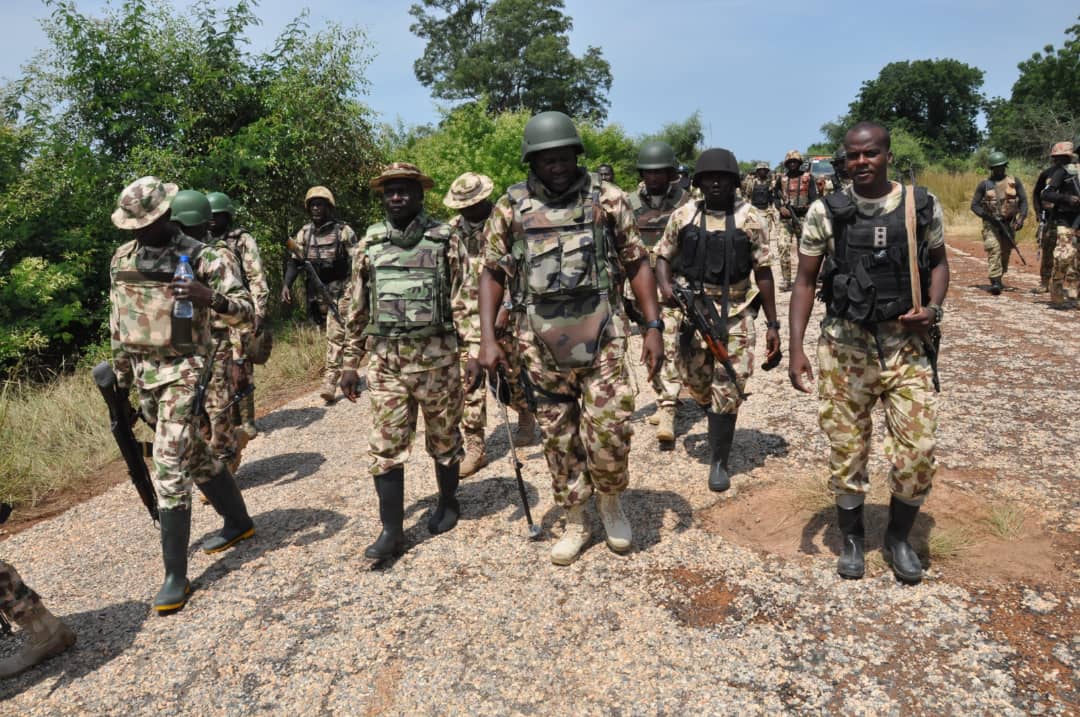
Troops of Operation Hadin Kai (OPHK) have recorded a 213 per cent increase in the number of terrorist fighters and associates surrendering in the North-East Theatre of Operations over the past week, the military has said.
The development, according to the Theatre Command, followed sustained ground operations, engagements against identified terrorist positions and disruption of logistics and supply routes aimed at weakening terrorist capabilities and restricting their freedom of movement.
The military said two high-profile terrorist members surrendered to troops on Wednesday, bringing arms, ammunition and other military items with them.
It said the recovery of the weapons further indicated the impact of sustained military pressure on the cohesion, morale and operational capacity of terrorist groups.The Theatre Command also disclosed that other terrorists surrendered to troops of 202 Battalion in Bama on August 7 at New Abaram, following continued military operations and internal disagreements within the terrorist enclave.
The surrendering individuals were screened, while mobile phones and other items were recovered before they were handed over for further action in line with established procedures.
According to the military, the rising number of surrenders reflects not only individual decisions to abandon terrorism but also the cumulative effect of sustained attacks and the disruption of terrorist logistics and supply networks.
The Theatre Command said its multi-dimensional strategy of offensive ground operations, precision engagements and disruption of supply routes was increasingly limiting terrorists’ ability to manoeuvre, regroup and replenish their resources.
Operation Hadin Kai said it would continue applying military pressure on terrorist elements while maintaining channels for fighters and associates willing to surrender.
The command urged members of the public to support security operations by providing timely and credible information to security agencies. It also encouraged terrorists and their associates to abandon violence and make use of established surrender channels.
The statement was signed by Captain Mohammed Goni, Acting Military Information Officer, Headquarters Joint Task Force (North East), Operation Hadin Kai, Maiduguri, on August 12, 2026.

By Tony Obiechina, Abuja
The Central Bank of Nigeria (CBN), has reversed its seven-year restriction on local investors’ participation in Open Market Operations (OMO), opening the market to individuals, corporates and non-bank financial institutions.
The restriction was introduced in 2019, in a bid to reduce pressure on the Naira, direct more lending to the real sector and drive down interest rates.
The reversal of the restriction was contained in a circular titled “Review of Discount Window Restrictions and Open Market Operations Participation Framework,” dated August 12, 2026 and signed by Okey Umeano, Ag.
Director, Financial Markets Department.Under the revised framework, the CBN said: “OMO participation (primary and secondary markets) shall be open to all eligible investors through Deposit Money Banks (DMBs).”
It specifically listed “individuals, corporates and non-bank financial institutions” among eligible investors, adding that DMBs “shall continue to submit bids and settle transactions on behalf of their customers.”
The apex bank also removed restrictions on access to its Discount Window arising from participation in the Nigerian Foreign Exchange Market, NFEM, and primary auctions of government securities.
According to the circular, “Restrictions on access to the Discount Window arising from participation in the Nigerian Foreign Exchange Market (NFEM) are hereby removed.
“Restrictions on access to the Discount Window arising from participation in the primary auctions of Government securities are hereby removed.
“The Central Bank of Nigeria (CBN) has reviewed existing market practices and developments in the foreign exchange, money, and fixed-income markets. The Bank has also reviewed the framework governing access to the Standing Lending Facility (SLF), Tenored Repo Operations and participation in Open Market Operations (OMO).”
The apex bank also lifted the suspension of Tenored Repo Operations, allowing it to conduct repo transactions across approved tenors of between four and 90 days.
It said: “The suspension of Tenored Repo Operations is hereby lifted,” the CBN stated, adding that the operations would support “effective liquidity management, improve money market functioning and enhance monetary policy implementation.”
The reopening of the OMO market to domestic investors is expected to provide individuals, companies and non-bank financial institutions with another avenue for investing in short-term securities, while potentially deepening activity in the money market.
The CBN, however, retained control over the scale and timing of OMO issuance, stating that “the volume, tenor and frequency of OMO issuances shall continue to be determined by the CBN in line with prevailing liquidity conditions and monetary policy objectives.”
It also retained the existing single-bid auction structure for OMO transactions.
The new framework takes immediate effect, with the CBN directing all banks, authorised dealers and market participants to ensure strict compliance.
By Dan Amasingha, Minna
The Niger State Government and Northern Senators’ Forum have called for lasting measures to tackle the recurring flooding ravaging communities across Niger State, particularly Shiroro and other riverine areas.
While the state government is developing a two-abode system that will allow residents of flood-prone communities to relocate temporarily to designated upland settlements during the rainy season and return home in the dry season, the Northern Senators’ Forum is demanding a comprehensive Shiroro Flood Management Master Plan to address the root causes of the perennial disaster.
The Chairman of the Northern Senators’ Forum, Senator Abdulaziz Musa Yar’Adua (Katsina Central), said the proposed master plan should provide a scientifically determined flood-buffer operating strategy for the Shiroro, Kainji and Jebba dams.
The senators also called for a permanent flood forecasting and early-warning system, trained local volunteers in downstream communities, and a comprehensive floodplain resettlement programme that would provide planned settlements, compensation and livelihood support for affected residents.
They further demanded an independent technical review of dam operations, reservoir capacity and spillway performance in view of changing climate conditions, saying the exercise would help determine how water releases should be managed in the future.
The forum noted that flooding had become a recurring threat to Shiroro and other riverine communities, stressing that emergency measures must be implemented alongside long-term solutions.
It urged the Federal and state governments, in collaboration with local authorities, to ensure prompt distribution of relief materials to verified victims, provide temporary shelters with basic health and sanitation facilities, and deploy emergency evacuation and early-warning teams to flood-prone communities before the peak of the rainy season.
The senators also urged residents to heed safety advisories and desist from building on waterways and natural drainage channels.
They cited the 2025 Mokwa flood tragedy and a 2025 vulnerability study which found that 32 per cent of Shiroro Local Government Area was highly prone to flooding as evidence of the urgent need for action.
Meanwhile, the Niger State Commissioner for Humanitarian Affairs and Disaster Management, Dr. Ibrahim Ahmed Inga, said the state government had conceived the two-abode system as a practical response to the annual displacement of riverine communities by floods.
Under the initiative, residents would move to designated upland settlements during the rainy season and return to their ancestral communities when the flood season ends.
Inga explained that the arrangement was necessary because many residents were reluctant to permanently abandon their ancestral homes, particularly because their livelihoods depend heavily on water resources.
He said the government was committed to protecting lives and property, noting that women and children were often among the worst affected during disasters.
Speaking on the recent flash flood in Minna, which destroyed hundreds of houses following a heavy downpour, the commissioner described the incident as a major disaster.
He said the government was compiling data on victims and assessing the extent of damage to determine the appropriate assistance required.
Inga also blamed part of the flooding on indiscriminate construction along waterways, warning residents that blocking natural drainage channels would inevitably worsen the impact of heavy rainfall.
“We want to advise people to be more conscious of their attitude towards the environment,” he said, warning that water would naturally find its way through blocked channels and could destroy houses and other property.
The commissioner appealed to development partners and the Federal Government to provide additional support after the ongoing assessment by the Niger State Emergency Management Agency.
He disclosed that emergency management help desks and offices had been activated across the state to enable residents to report flood-related incidents and obtain timely assistance.
According to him, the activation followed the inclusion of Niger State among areas identified by the Nigerian Meteorological Agency as being at risk of flooding during the current rainy season.
With the state government pursuing seasonal relocation and emergency-response measures, and the senators pushing for a comprehensive dam-management and resettlement strategy, both efforts point to the need for Niger State to move beyond annual relief operations towards a coordinated, long-term flood management system.


Dangote Cement Ibese, FRSC Strengthen Strategic Partnership to Advance Road Safety in Ogun
ShareEfforts aimed at further enhancing road safety in Ogun State has received a boost following fresh collaborative engagement between the...


Sustained Military Pressure Drives 213 Per Cent Rise in Terrorist Surrenders in North-East
ShareBy David Torough, Abuja Troops of Operation Hadin Kai (OPHK) have recorded a 213 per cent increase in the number...
Nigeria’s Oil Production Drops 4 Per Cent in July – NUPRC
ShareNigeria’s crude oil production fell by four per cent month-on-month in July, but the country still met its Organisation of...


CBN Reverses OMO Restriction, Opens Market to Local Investors
ShareBy Tony Obiechina, Abuja The Central Bank of Nigeria (CBN), has reversed its seven-year restriction on local investors’ participation in...
Northern Senators Seek Enduring Solution to Flooding in Niger
ShareBy Dan Amasingha, Minna The Niger State Government and Northern Senators’ Forum have called for lasting measures to tackle the...

Osun Election Tension Deepens as Accord Petitions EU over Alleged Killings
ShareFrom Ayinde Akintade, Osogbo Tension has heightened in Osun State ahead of Saturday’s governorship election, with the Accord Party alleging...


Rethinking the CBN’s Mandate: Lessons from Malaysia for Nigeria
ShareBy Uche Uwaleke During a recent academic study tour of key financial institutions in Malaysia with some of my PhD...


Tinubu, Shettima not Elected by Muslims Alone, Northern Christian Chair Slams Cleric
ShareChairman of the Northern Christian Association, NCA, Rev. Joseph Hayab, has said President Bola Tinubu and Vice President Kashim Shettima...


Dangote Confident on Group’s Projected $100bn Revenue Target By 2030
ShareAliko Dangote, has expressed confidence in his company meeting estimated revenue growth in the next four years. He said detailed...


Chevron Says Competitive Local Capacity Devt to Define Nigeria’s Energy Future
ShareThe Managing Director of Chevron Nigeria Limited, Jim Swartz, has highlighted key areas that would sustain Nigeria’s energy transition growth...