
Education
EU Awards Scholarships to 40 Nigerian Students


By Martin Paul, Abuja
The European Union (EU), under it ErasmuaT Programme, has awarded 40 Nigerian university students scholarships to study in European countries.
The Erasmus+ is a European Union flagship programme for higher education.
It offers opportunities to students and staff to attend or work with European Higher Education Institutions.The Ambassador of the European Union delegation to Nigeria, Ketil Karlsen, who spoke about the scholarship during the pre-departure orientation for the students in Abuja, said the EU had supported young Nigerians who got the scholarship with 6.
6 million Euros, about N2.6 billion since inception of the programme in 2014.Larlsen said over 1000 students applied for the 2019 scholarship programme but only 40 of were selected.
“The students will be going to 10 different European Union countries. Among the countries are Italy, Spain, Denmark, the Czech Republic, Belgium, France, Poland, Netherlands and Germany.
“We have seen a high record because there has been a consistent increase in the number of students coming to Europe since 2014. This year’s scholarship scheme experienced an increase of 25 per cent. I cannot see a better way of investing in development opportunities for the youth. Over the decade, we have 12,000 Nigerians who have studied in Europe on a different scheme,” he said.
The diplomat said the EU has supported Nigeria with about N600 million for development programmes across in the country.
Speaking on migration, Larlsen said the EU has seen a drop in irregular migration and an increase in regular migration.
“This is a very powerful message because we want to engage Nigerians and we are not closing our borders. We are only saying there should not be irregular migration, people should not risk their lives,” he said.
He said the only challenge the EU faced was tracking some of the alumni of its educational programmes.

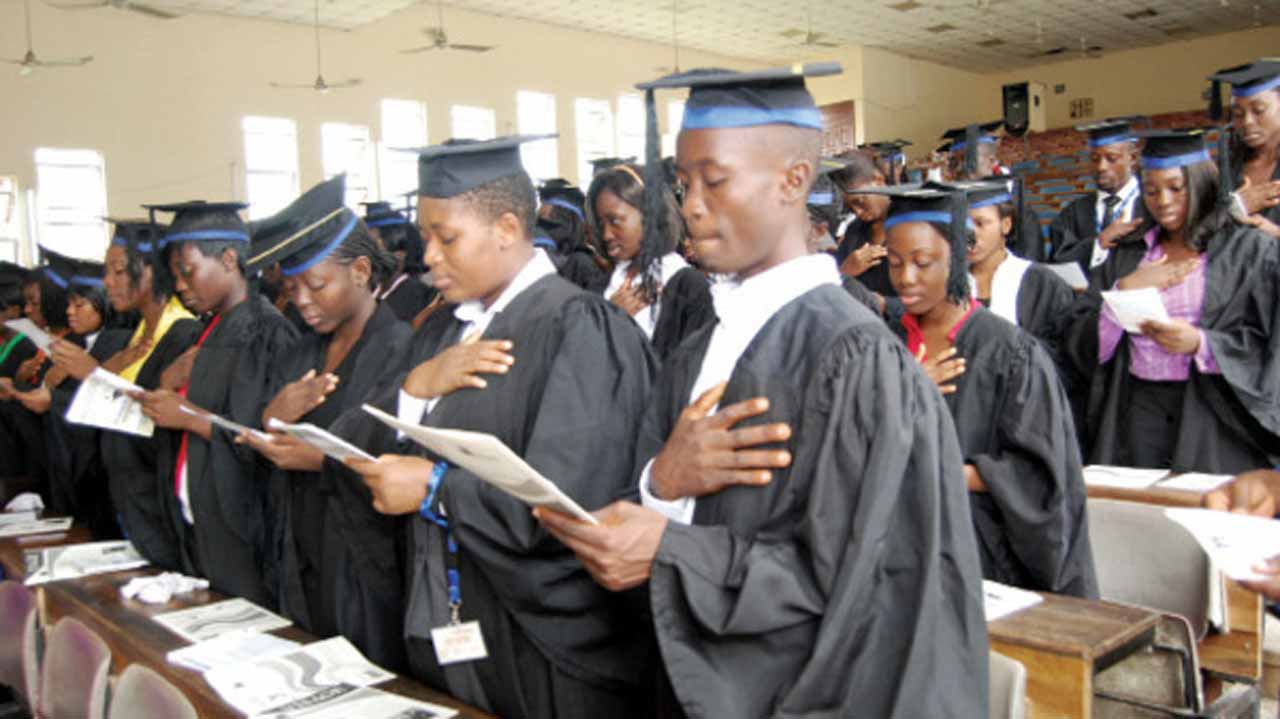





The Joint Admissions and Matriculation Board (JAMB) has warned universities against issuing admission letters to candidates, insisting that only admissions processed through its Central Admissions Processing System (CAPS) are legally recognised.
The Board said universities had no statutory authority to issue official admission letters, warning that candidates who accept admission offers outside the approved system risk obtaining documents that may not be recognised for official purposes, including mobilisation for the National Youth Service Corps (NYSC).
JAMB Registrar, Prof. Segun Aina, gave the warning when he received a delegation from Veritas University, Bwari, Abuja, during a courtesy visit to his office.
Aina said the Federal Ministry of Education had expressly directed that all admissions into tertiary institutions be processed through CAPS, stressing that any admission conducted outside the platform was illegal and invalid.
He explained that JAMB remained the only body statutorily empowered to issue official admission letters to candidates seeking entry into universities, polytechnics and colleges of education across the country.
The registrar expressed concern that candidates often assume admission letters purportedly issued by universities are authentic simply because they carry the institutions’ identities.
He urged universities engaging in the practice to desist, while directing them to ensure that candidates obtain the appropriate admission documents from JAMB.
Aina further stressed that institutions could not substitute their own admission letters for the official documents issued by the Board after candidates had accepted their offers on CAPS.
He warned that admissions not processed through the approved platform would not be recognised for purposes such as NYSC mobilisation, underscoring the need for institutions and candidates to comply with established admission procedures.
Education
Makurdi Old Boys Association Inaugurates BOT October 17, Launches N1bn Secretariat Project Fund
Government College Makurdi Old Boys Association (MOBA) has completed arrangements to inaugurate its Board of Trustees (BOT) October 17, at the school premises.
The high profile event will also witness the launch of N1billion Appeal Fund for the construction of its National Secretariat Project.
A statement by the Association’s National President, Dr Cletus Akwaya and the Central Planning Committee Chairman Cmrd.
Stephen Tadawus, reminded all members of the National Executive Committee (NEC), Board of Trustees Members-designate, invited Guests, and the entire MOBA family to attend the event punctually at Government College Assembly Hall, Makurdi beginning by 10:00AMThe statement said the Governors of Benue state, Rev.
Fr. Dr. Hyacinth Iormem Alia; Plateau state, Barr. Caleb Manasseh Mutwang; Nasarawa, Engr. A. A. Sule and Bauchi, Sen. Bala Abdulkadir Mohammed are expected to grace the occasion as distinguished guests of Honour.Similarly, the Commissioner for Education and Knowledge Management, Benue State, Dr. Adamu Margaret Ijaguwa and Executive Secretary, Teaching Service Board, Benue State, Dr. Bem Tseen have been invited as Special Guests, the statement said.
It named members of the Board of Trustees (BOT) to include Prince Yandev Amaabai, Senator Joshua Chibi Dariye, Senator Gabriel Torwua Suswam, Hon Hassan El Yakub SAN- Hon, Alhaji Abubakar Giza, Prof. Terna Yawe, Chief Rebo Usman, Dr. Dader Mazadu Bako, Engr. Ali Rabiu, Prof. John Wade, Arc. Terseer Dankaro and Titus Ihunduas Secretary of the Board.
This event marks a new chapter in the life of the Association. We request all Old Boys to massively turn out and support the cause of giving back to their Almamater,” the statement further said adding, All concerned are therefore, requested to come together to make this historic event a success and to contribute generously towards the completion of Makurdi Old Boy’s Associations’ National Secretariat Project.”
Maryam Umar, a limb difference student, is set to graduate with a Bachelor of Science degree in Economics from the Gombe State University.
Umar, who successfully completed her Level 400 course work, examinations and project, achieved this feat after overcoming educational and financial challenges.
In an interview on Monday in Gombe, Umar said that the intervention by the Academic Staff Union of the University (ASUU) made her journey to attain university education a reality.
Umar recounted that she started primary education at the age of 11 at Hammadaji Primary School in Gombe metropolis, adding that she could not immediately proceed to secondary school due to challenges.
The foot-writer student later attended Government Day Secondary School, Nasarawo, Gombe, where she obtained a senior school certificate.
“Many people doubted my ability to attend university because of physical and financial challenges.
“Nevertheless; I sat for the Joint Admissions and Matriculation Board (JAMB), and National Examinations Council (NECO) examinations, and passed both, but could not proceed due to lack of sponsorship.
“Apparently, my predicament widely circulated in the national dailies attracted the attention of the ASUU,” she said.
She said that the union visited her family home, verified her educational credentials, and subsequently offered her scholarship.
Umar said that handwriting proved to be a major obstacle because she writes with her toes during lectures, tests and examinations.
“During my first test, I couldn’t finish within the allocated time and reported the matter to the union.
“The ASUU chairman subsequently wrote to my Head of Department, requesting an additional time for me during tests and examinations. The department granted the request and continued to support me throughout my studies,” she said.
Umar also commended her lecturers for their support and understanding.
She recalled that when a journalist visited the university, and inquired about her academic performances, the records rated her as being more punctual than most of the able-bodied students.
Umar also expressed joy over the successful completion of her degree programme without any academic failure.
“I am happy that I am about to graduate. I give God the glory because I have had no problem academically.
“Some students who I started schooling together had withdrawn or dropped out,” she said.
While urging people living with disabilities not to allow their conditions to distract them from pursuing their dreams, Umar enjoined them to shun street begging.
“You should not see begging as the only option. I once begged on the street, but now I am about to achieve my dream of becoming a graduate.” (NAN)



2027: Benue People Are Not ‘Shenanigans’, Alia Owes You No Apology, Ex-Ambassador Tells Ortom
ShareFrom Attah Ede, Makurdi A former Nigerian Ambassador to Namibia, Terhemen Tarzoor, has criticized former Benue State Governor Samuel Ortom...


JPMorgan’s Entry into Nigeria: Turning Global Finance into a National Development Opportunity
ShareBy Uche Joe Uwaleke The proposed establishment of JPMorgan Merchant Bank Nigeria Limited presents Nigeria with an important opportunity to...


WAHO Steps Up Regional Health Surveillance After Ebola Case Confirmed in Abuja
ShareBy David Torough, Abuja The West African Health Organisation (WAHO) has intensified regional health surveillance following the confirmation of an...


2027: Don’t Call Benue People Shenanigans, Alia not answerable to you- Ex- Amb, Tarzoor Tells Ortom, Wike.
ShareFrom Attah Ede, Makurdi Ex -Nigeria’s Ambassador to Namibia, Terhemen Tarzoor, has warned the immediate past Governor of Benue State...


DBN Signs $61m Credit Deal With AfDB, Unveils Support Initiative Report
ShareBy Tony Obiechina, Abuja The Development Bank of Nigeria Plc (DBN) has launched DAWN: DBN Action for Women in Nigeria,...

NLC Threatens Nationwide Action as Talks With FG Collapse
ShareBy Tambaya Julius, Abuja The Nigeria Labour Congress (NLC) has threatened possible nationwide industrial action following the failure of talks...

Top10 Magazine Names Umaru Kwairanga as Man of the Year 2026
ShareAlh. (Dr) Umaru Kwairanga, Group Chairman, Nigerian Exchange Group (NGX Group), has been named as the Top10 Magazine’s Man of...


UK, Nigeria to Deepen Defence, Security Cooperation
ShareThe United Kingdom has reaffirmed its commitment to deepening defence and security cooperation with Nigeria, with emphasis on military training,...


2027: INEC Steps Up Preparations, Completes Nine Activities
ShareBy Tambaya Julius, Abuja The Independent National Electoral Commission (INEC) has completed nine of the 14 activities on its timetable...


2027: Tinubu Accords Benue Security Top Priority, Tompolo Tells Supporters
ShareLeader of the PBAT Door-to-Door Movement, Government Tompolo, has called on the people of Benue state to come out enmasse...