
Economy
6.7% Borno housewives use modern contraceptives – Commissioner


The Borno Commissioner for Health, Prof. Baba Gana, says only 6.7 per cent of married women in the state are using modern contraceptive methods.
Gana made this known on Tuesday in Maiduguri while speaking at an event to commemorate 2023 World Contraceptive Day (WCD).
“In Borno, only 6.
7 per cent of currently married women are using the modern contraceptive methods and unmed needs for contraceptives is 17 per cent.“This figure shows the need to invest, improve and promote the use of contraception.
“We know the appropriate use of contraception is very important to the health and wellbeing of women, as well as the outcome of the newborn baby, ” Gana said.
He said that government health providers and sexual reproductive health partners like UN Population Fund (UNFPA) remain committed in providing the needed awareness and contraceptive services.
Also speaking on family planning in Borno, the Deputy Director, State Primary Health Care Development Agency (SPHCDA), Dr Mala Abdulwahab, said there is apathy towards it until the agency changed the name from “Family Planning” to “Child Spacing”.
“We made them realised that it’s not about reducing a community population but about addressing maternal mortality and morbidity,” Abdulwahab said.
He said that out of the 436 health facilities in Borno, only 269 are offering family planning services.
In his remarks on behalf of UNFPA, Mr Kelvin Chukwuemeka, said access to variety of contraceptive methods would ensure that Borno women have access to choose what works best for them, taking into consideration factors such as lifestyle, health considerations and future plans.
“Family Planning, Child Birth Spacing, Contraceptive methods range from hormonal options like birth control pills, patches, and injections, to barrier methods such as condoms and diaphragms, and Long-Acting Reversible Contraceptives (LARCs) like intrauterine devices (IUDs) and implants.
“Each of these method comes with its own set of benefits and potential risks, and by offering options, the people of Borno State can find what suits their preferences and needs.
“This diversity calls for a comprehensive array of contraceptive methods that cater to the unique requirements of everyone. This approach not only empowers the people of Borno to plan their families but also enhances their overall well-being and autonomy,” Chukwuemeka said.
Other stakeholders who spoke on the importance of child spacing include religious and traditional leaders.
This year’s theme for the WCD is: “The Power of Options”. (NAN)


By Tony Obiechina, Abuja
The Federal Government has reaffirmed its commitment to strengthening Nigeria’s bilateral relations with Germany, with renewed focus on economic cooperation, investment promotion, energy partnerships, and the effective implementation of existing agreements.
Minister of Budget and Economic Planning, Senator Abubakar Atiku Bagudu, made this statement during a visit to the Ministry in Abuja on Monday by the Ambassador of the Federal Republic of Germany to Nigeria, Stefan Rössel.
The minister welcomed the ambassador and his delegation, expressing Nigeria’s appreciation for Germany’s longstanding partnership and support for the country’s economic reform programme, particularly in the early stages of implementation.
He recalled that when German Chancellor Olaf Scholz visited Nigeria, the Federal Government was pursuing significant economic reforms that required support from international partners, including Germany, the World Bank, the International Monetary Fund and the European Union.
The minister said Germany’s support has contributed to Nigeria’s progress in its reform efforts, adding that the country remains grateful for the cooperation and assistance it has received from its development partners.
He also acknowledged Germany’s role in facilitating high-level engagements between the two countries, particularly in trade, investment and energy cooperation, noting that discussions during the Nigerian President’s visit to Germany advanced talks on key energy agreements.
Senator Bagudu further commended Germany’s commitment to multilateral cooperation and international engagement, emphasising the importance of sustained partnerships to address evolving global economic and political challenges.
He noted that Nigeria and Germany had built a strong foundation for bilateral cooperation over the years, with significant opportunities to expand their partnership in areas that support economic growth and development.
The minister disclosed that discussions had covered cooperation involving €25 million and €300 million in export credit guarantees, identifying these as important areas for continued engagement as Nigeria seeks to expand investment opportunities and strengthen its capacity to utilise available resources effectively.
According to him, Nigeria’s reform efforts have created an opportunity to place greater emphasis on attracting investment, strengthening productive capacity, and translating international partnerships into tangible economic outcomes.
He assured the German ambassador that the ministry was prepared to work closely with the German government and its relevant institutions to deepen bilateral relations and broaden areas of mutual interest.
Earlier, Ambassador Rössel expressed appreciation for the warm reception he received, describing the relationship between Nigeria and Germany as strong and longstanding.
The ambassador, who arrived in Nigeria a few weeks ago, reaffirmed Germany’s commitment to building on the partnership’s achievements and to exploring opportunities for further cooperation.
He acknowledged that both countries were operating in an increasingly complex global environment characterised by evolving strategic, political and economic challenges.
Despite these circumstances, Ambassador Rössel expressed confidence that the longstanding relationship between Nigeria and Germany would provide a solid foundation for addressing emerging issues and sustaining mutually beneficial cooperation in the years ahead.
He also welcomed the ministry’s readiness to continue working with Germany, noting the importance of maintaining established partnerships while adapting to evolving circumstances.
In her remarks, the Minister of State for Budget and Economic Planning, Dr Doris Uzoka-Anite, congratulated Ambassador Rössel on his appointment, welcomed him to Nigeria, and expressed the ministry’s readiness to collaborate with him and with relevant German agencies.
She emphasised the importance of translating bilateral agreements and shared commitments into practical outcomes, noting that effective implementation remained critical to achieving the partnership’s objectives.
Dr Uzoka-Anite assured the ambassador that the ministry would continue to facilitate collaboration and support efforts to ensure joint initiatives progressed efficiently and delivered meaningful results.
The Permanent Secretary of the Federal Ministry of Budget and Economic Planning, Dr Deborah Odoh, also welcomed the German delegation, describing Germany as a reliable partner whose technical expertise, knowledge exchange and experience had contributed to Nigeria’s development.
She said the ministry expects the ambassador’s tenure to create further opportunities to strengthen cooperation and to advance the longstanding relationship between the two countries.
The courtesy visit reaffirmed Nigeria and Germany’s shared commitment to sustaining bilateral engagement, deepening economic cooperation, and exploring opportunities for expanded investment and development collaboration.

The Nigerian Export Promotion Council (NEPC) says exporters in Imo generated a total of 1,244,095 dollars as proceeds from export trade in 2025.
The Imo Coordinator of the council, Mr Anthony Ajuruchi, disclosed this during a follow-up engagement with cocoa farmers in the state on Thursday in Owerri.
50 cocoa farmers and exporters in Imo received 30 cocoa seedlings each in 2025 as part of interventions to boost production for export.
Ajuruchi said the amount was derived from proceeds of both formal and informal export transactions carried out by the farmers within the 2025 fiscal year.
He commended the Executive Director of NEPC, Mrs Nonye Ayeni, and the management team for their support and commitment to the growth of the export market in Imo and across the country.
According to him, the council recorded notable achievements in 2025, including the organisation of capacity-building programmes on non-oil export, product packaging and labelling.
“In addition to our interventions for cashew farmers, we conducted trainings on product development and adaptation, export contracts, market penetration, product certification and export documentation procedures.
“We also trained about 600 exporters and small and medium-scale enterprises,” he said.
Ajuruchi said the engagement with the cocoa farmers was aimed at obtaining feedback and brainstorming on strategies to increase production and export volume in 2026.
One of the beneficiaries, Mrs Sophia Orji, said the cocoa seedlings she received were doing well and had started fruiting after 17 months.
Another farmer, Mrs Mary Okeke, said her cocoa plants were thriving and appealed to NEPC to extend similar support to farmers during the rainy season.
Also speaking, Mr Canice Nze, Director of Produce in the Imo Ministry of Trade, Commerce and Investment, urged the farmers to register with the ministry to enable them benefit from cooperative structures and access possible government grants. (NAN)
By David Torough, Abuja
In line with the consumer-focused objectives of the Nigerian Communications Commission (NCC) and the Central Bank of Nigeria (CBN), the two regulators have drawn up a framework to address consumer complaints arising from unsuccessful airtime and data transactions during network downtimes, system glitches, or human input errors.
The framework is the outcome of several months of engagements involving the NCC, the CBN, Mobile Network Operators (MNOs), Value Added Service (VAS) providers, Deposit Money Banks (DMBs), and other relevant stakeholders.
According to the NCC, these engagements were prompted by a rising incidence of failed airtime and data purchases, where subscribers were debited without receiving value and experienced delays in resolution.
“The Framework represents a unified position by both the telecommunications and financial sectors on addressing such complaints. It identifies and tackles the root causes of failed airtime and data transactions, including instances where bank accounts are debited without successful delivery of services. It also prescribes an enforceable Service Level Agreement (SLA) for MNOs and DMBs, clearly outlining the roles and responsibilities of each stakeholder in the transaction and resolution process,” a statement by Head of Public Affairs of NCC, Nnen Ukoha said.
Under the new framework, where a purchaser is debited but fails to receive value for airtime or data—whether the failure occurs at the bank level or with an NCC licensee—the purchaser is entitled to a refund within 30 seconds, except in circumstances where the transaction remains pending, of which the refund can take up to 24 hours.
The framework further mandates operators to notify consumers via SMS of the success or failure of every transaction. It also addresses erroneous recharges to ported lines, incorrect airtime or data purchases, and instances where transactions are made to the wrong phone number.
Director of Consumer Affairs at the NCC, Mrs. Freda Bruce-Bennett in a comment on the development said the framework also establishes a Central Monitoring Dashboard to be jointly hosted by the NCC and the CBN. According to her, the dashboard will enable both regulators to monitor failures, the responsible party, refunds, and track SLA breaches in real time.
“Failed top-ups rank among the top three consumer complaints, and in line with our commitment to addressing these priority issues, we were determined to resolve it within the shortest possible time,” she said.
“We are grateful to all stakeholders—particularly the Central Bank of Nigeria and its leadership—for their tireless commitment to resolving this issue and arriving at this framework, and for ensuring that consumers of telecommunications services receive full value for their purchases.
“So far, pending the approval of management of both regulators on the framework, MNOs and banks have collectively made refunds of over N10 billion to customers for failed transactions” she explained .
Mrs. Bruce-Bennett further noted that implementation of the framework is expected to commence on March 1, 2026, once the two regulators have made final approvals, and technical integration by all MNOs, VAS providers and DMBs is concluded.



Former Delta Governor Uduaghan Dies at 70
ShareFrom Francis Sadhere, Delta Former Governor of Delta State, Dr. Emmanuel Eweta Uduaghan, has died. Uduaghan, who governed the state...


Customs Opens Review for Disqualified Recruits, Flags 397 Applicants
ShareBy Tambaya Julius, Abuja The Nigeria Customs Service (NCS) has opened a review process for applicants disqualified during its recent...

World Bank Tasks FG, States on Sustainable Cash Transfers
ShareBy Tambaya Julius, Abuja The World Bank has urged the Federal Government and state governments to establish a sustainable social...

NDLEA Nabs 85-year-old Woman, Seizes 407kg Cannabis
ShareThe National Drug Law Enforcement Agency (NDLEA) has arrested an 85-year-old grandmother and five other suspected drug traffickers during coordinated...
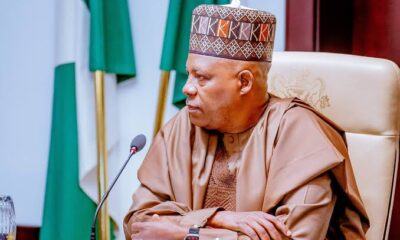

Economy would’ve Collapsed without Tinubu’s Reforms, Says Shettima
ShareVice President Kashim Shettima has said Nigeria’s economy would have collapsed had President Bola Tinubu not taken what he called...


House of Reps Seeks 90-Day Fuel Reserve for Nigeria by 2027
ShareFrom Rabiu Sanusi, Kano The House of Representatives has backed plans to increase Nigeria’s strategic petroleum reserve from 20 days...

56,000 Candidates Register for 2026 Private WASSCE
ShareThe West African Examinations Council (WAEC) said no fewer than 56,000 candidates registered for the 2026 West African Senior School...


JAMB Warns Varsities Against Issuing Admission Letters
ShareThe Joint Admissions and Matriculation Board (JAMB) has warned universities against issuing admission letters to candidates, insisting that only admissions...
Beyond Survival: Building A Healthier Nigeria For A Longer Life
ShareBy Yussuf Mubaraq Damilare What does it mean to live a long life if access to basic medical care remains...


Jigawa to Increase Corps Members Allowance – Namadi
ShareThe Jigawa government has announced plans to increase monthly allowance for the National Youth Service Scheme (NYSC) members posted to...