
NEWS
Wike Question Atiku, Obi, Contributions to Rivers State

By Laide Akinboade Abuja
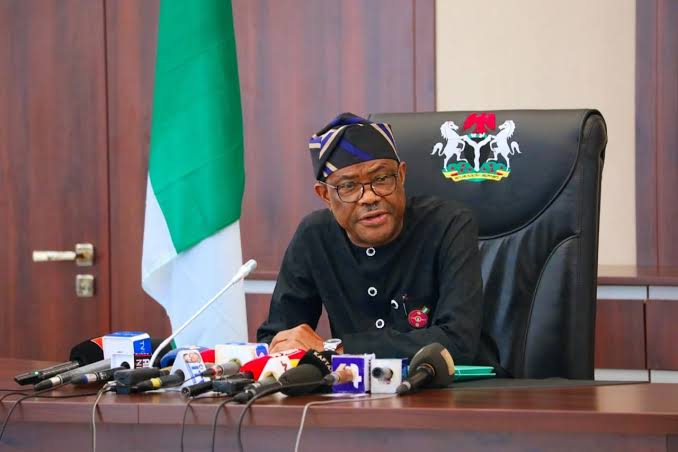
Minister of the Federal Capital Territory, Nyesom Wike, has challenged former Vice-President Atiku Abubakar and former Anambra State Governor Peter Obi to show what they did for Rivers State, questioning their contributions to the people of Tai and Ogoni.
Wike spoke at a town hall meeting in Tai Local Government Area of Rivers State, where he mobilised support for President Bola Tinubu ahead of the election.
The former Rivers State governor questioned Atiku’s record during his eight years as vice-president under former President Olusegun Obasanjo, asking whether he had done anything for the people of Tai and Ogoni.
“Atiku, you have been vice president for 8 years, is that not correct? Is it not correct? Do you remember the Thai people? Do you remember the Ogoni people?” Wike asked.
He also dismissed the social media popularity of Obi, arguing that online visibility was not enough to qualify anyone to lead the country.
“Yes, Peter Obi everywhere in social media, everywhere in social media. Peter Obi, what did he do? No, go and ask him,” he said.
Wike urged the people to look beyond political popularity and assess candidates based on their records and contributions, particularly to the development of their communities.
He cited the establishment of the Federal University of Environment in Tai as an important development for the Ogoni area, saying the institution would create employment and educational opportunities as it grows.
The minister urged residents not to underestimate the benefits of the university, noting that establishing a federal institution required considerable effort and legislative backing.
He urged residents to consider the development opportunities available to the area when deciding whom to support, maintaining that political leaders should be judged by their records rather than their popularity.
Chairman of Tai Local Government Area, Mbakpone Friday Okpe, highlighted his administration’s efforts to support the university and expand educational opportunities for local students.
Okpe said the council had completed the screening of postgraduate students for bursaries and grants, explaining that the intervention was intended to help students take advantage of the institution’s presence in the area.
He said the council had also constructed the university’s entrance gate and a dual-carriageway within the institution, alongside a one-kilometre tarred road, to complement the Federal Government’s efforts.
The chairman listed markets and lodge facilities among projects completed by his administration, adding that other projects, including a health centre, a modern town hall and community roads, were planned.
Okpe said the university represented an important opportunity for Tai and the wider Ogoni area, adding that the local government would continue to support its full take-off.

The Federal Capital Territory Police Command has arrested a Deputy Superintendent of Corps with the Nigeria Security and Civil Defence Corps, Onoja Samuel, for allegedly firing shots into the air during a confrontation with traders at a market in the Kubwa area of Abuja.
According to the police, Samuel had gone to the market armed with a pistol following reports that some traders had assaulted his wife.
In a statement on Wednesday, the FCT Police Public Relations Officer, SP Josephine Adeh, said operatives attached to the Kubwa Police Division were promptly deployed to the scene and arrested the suspect after disarming him.
“On 25th October, 2026, at about 1:50 pm, a distress call was received at Kubwa Police Division reporting that an unidentified man, armed with a pistol, was firing sporadically into the air at a market in Kubwa, Abuja.
“Upon receipt of the report, Police operatives attached to Kubwa Division were promptly deployed to the scene. Following concerted efforts, the suspect was successfully disarmed and arrested.
“Preliminary investigations identified the suspect as one Onoja Samuel, a Deputy Superintendent of Corps with the Nigeria Security and Civil Defence Corps.
“Further findings revealed that the suspect had gone to the market armed with a pistol following reports that some traders had assaulted his wife. During an ensuing argument with the traders, he fired several shots into the air,” Adeh said.
The police spokesperson said a CZ pistol and 17 rounds of live 9mm ammunition were recovered from the suspect during his arrest.
She added that the NSCDC officer remained in police custody and would be charged to court upon the conclusion of investigations.
The Commissioner of Police in the FCT, Ahmed Sanusi, urged personnel of sister security agencies to exercise restraint and notify the police divisions responsible for areas where they intend to conduct authorised operations.
“Operatives of sister security agencies are urged to exercise restraint and notify the Police Divisions responsible for the areas in which they intend to conduct sanctioned operations within the FCT, to ensure proper coordination and prevent avoidable clashes,” he said.
By Tambaya Julius, Abuja
The World Bank Group has projected a 23 per cent increase in global commodity prices in 2026, warning that escalating tensions in the Middle East, declining oil inventories and disruptions to food supplies could worsen inflation and deepen food insecurity worldwide.
The projection is contained in the bank’s latest Commodity Markets Outlook, released on Wednesday, which cautioned that rising energy and food costs could undermine economic growth, particularly in vulnerable countries.
According to the report, energy prices are expected to rise by 32 per cent in 2026, reversing three consecutive years of decline, before moderating in 2027.
Brent crude oil is projected to average $91 per barrel in 2026, compared with $69 in 2025, before falling to $79 per barrel in 2027.
Food commodity prices are also forecast to increase by about 10 per cent in 2026 and a further seven per cent in 2027, bringing the cumulative increase to 18 per cent over the two years.
The bank attributed the anticipated rise to disruptions to grain shipments linked to the Middle East conflict, the threat of El Niño to agricultural harvests, and higher fuel and fertiliser costs.
However, overall commodity prices are expected to decline by seven per cent in 2027, provided there is no major escalation of conflicts affecting global supplies.
The World Bank warned that the outlook could worsen if the Middle East conflict intensifies and damage to Russia’s oil infrastructure persists.
It said a combination of higher-than-expected energy prices, attacks on grain shipments in the Black Sea and a particularly strong El Niño could trigger a food crisis, pushing more people into extreme poverty.
“Under an adverse scenario in which the risks materialise simultaneously, Brent crude could average $105 per barrel in 2027, while food commodity prices could rise 12 per cent above the baseline forecast, exceeding their 2022 levels,” the report stated.
The report further projected that global oil supply would decline by 5.2 per cent in 2026, representing the largest drop in more than four decades outside the 2020 global recession.
Oil consumption is also expected to fall by 2.5 per cent, marking the third-largest annual contraction on record after 2020 and 1980.
According to the bank, high prices amid supply shortages are curbing demand, while electrification is contributing to lower oil consumption, particularly in China.
Despite the projected decline in consumption, oil production is expected to remain below demand, forcing further withdrawals from inventories and exposing global markets to additional supply disruptions.
The report also forecast a 14 per cent increase in fertiliser prices in 2026 following an early-year surge in urea prices, which has since eased. Prices are expected to return to their 2025 levels in 2027.
Metal prices are projected to rise by 25 per cent in 2026, reaching a new high as aluminium, copper and tin prices hit record levels.
The bank attributed the increase to strong demand from investments in renewable energy, electric vehicles and data centres, alongside supply disruptions. Metal prices are expected to decline by three per cent in 2027.
Precious metal prices are also forecast to rise by 40 per cent in 2026 as demand for safe-haven assets remains elevated amid geopolitical and policy uncertainty.
Although prices are expected to moderate in 2027, they are projected to remain more than three times their average levels between 2015 and 2019.
Reacting to the outlook, the World Bank’s Deputy Chief Economist and Director of the Prospects Group, Ayhan Kose, said rising energy costs and trade disruptions were driving up prices across a broad range of commodities.
“This is threatening to worsen inflation, food insecurity, and economic growth.
“The priority must be to protect the poorest people and support low-income countries already struggling with heavy debt burdens,” Kose said.
He disclosed that the World Bank Group had made between $50 billion and $60 billion available through existing financing instruments, including $25 billion in pre-arranged financing, to help countries manage the effects of higher prices.
According to him, the financing could support social safety nets for vulnerable populations, strengthen governments’ fiscal capacity and provide working capital and liquidity support for businesses and farms.
Kose added that the institution had made substantial progress in accelerating and simplifying its ability to mobilise private capital alongside its financing and knowledge services.
He said the bank was well positioned to invest in the next generation of young people in developing countries, particularly by improving the conditions necessary for job creation.

By Tambaya Julius, Abuja
The Nigerian Education Loan Fund (NELFUND) has announced plans to strengthen its payment and monitoring systems to address cases of students benefiting from its loan scheme, while their parents continue to pay their school fees.
The Managing Director of NELFUND, Akintunde Sawyerr, disclosed this on Wednesday during a press briefing, saying the fund had identified cases in which students allegedly received support under the scheme while their parents continued to shoulder their tuition costs.
Sawyerr said the development had prompted the fund to improve transparency and educate students, parents and tertiary institutions on how the loan scheme operates.
He explained that NELFUND planned to introduce a system that would enable parents to confirm whether their children’s school fees had been paid without necessarily disclosing the amount involved.
According to him, the initiative would provide clarity for parents who remain financially responsible for their children’s education and help them understand the payment process.
The Federal Government introduced the student loan programme to reduce financial barriers to tertiary education and enable eligible Nigerian students to pursue higher education without the immediate burden of paying institutional fees.
Under the scheme, NELFUND provides loans to cover school fees, while upkeep allowances are processed separately to support beneficiaries’ living expenses.
Sawyerr said the fund would organise re-education workshops across the six geopolitical zones to explain changes to the payment system, address misconceptions and ensure that stakeholders understand the procedures.
He said the exercise differed from the fund’s regular sensitisation campaigns, which mainly focus on informing students about the availability of the loan scheme.
The managing director added that the workshops would help students and tertiary institutions understand the revised processes, noting that journalists might be invited to some of the engagements to observe the exercise.
He also urged the media to help disseminate accurate information about the changes, stressing that the workshops might not reach every student who needed the information.
Meanwhile, NELFUND’s Executive Director, Mustapha Iyal, said the fund had designed its payment system to minimise intermediaries in the transfer of institutional fees.
Iyal explained that the system uses students’ application identification numbers and associated wallet numbers for institutional payments rather than relying directly on their bank account numbers.
He said institutional fee payments were processed separately from upkeep allowances, which were transferred to beneficiaries’ personal bank accounts through designated payment channels.
According to him, NELFUND uses platforms such as NIBSS Instant Payments and Paystack to process upkeep allowances because the fund is not a banking institution and does not provide beneficiaries with bank accounts.
Iyal disclosed that about 400,000 students were involved in the pilot phase of the payment system, while approximately 20,000 additional students were recorded between the previous week and the week of the briefing.
He added that the system processed transactions for nearly 5,000 students daily.
The executive director further explained that the platform operates a tokenised system linked to each student’s application identification number, with a wallet attached to the application.
He also clarified that students could download receipts from the NELFUND platform after their school fees had been processed.
However, he distinguished between receipts generated by the fund and those issued by individual institutions, explaining that tertiary institutions maintain separate systems for issuing receipts and clearance documents required for departmental registration and other academic activities.
The clarification comes as NELFUND continues efforts to improve the administration of the student loan scheme, strengthen transparency and ensure that students, parents and institutions better understand tuition payments, upkeep allowances and the documentation required for academic registration.




Wike Question Atiku, Obi, Contributions to Rivers State
ShareBy Laide Akinboade Abuja Minister of the Federal Capital Territory, Nyesom Wike, has challenged former Vice-President Atiku Abubakar and former...


Police Arrest NSCDC Officer for Firing Gun at Abuja Market
ShareThe Federal Capital Territory Police Command has arrested a Deputy Superintendent of Corps with the Nigeria Security and Civil Defence...


World Bank Projects 23 Per Cent Surge in Global Commodity Prices
ShareBy Tambaya Julius, Abuja The World Bank Group has projected a 23 per cent increase in global commodity prices in...

NELFUND Mounts Tight Monitoring System over Students Loan Payment
ShareBy Tambaya Julius, Abuja The Nigerian Education Loan Fund (NELFUND) has announced plans to strengthen its payment and monitoring systems...

TUC Rejects FG Wage Award, Demands N300,000 Minimum Salary
ShareBy Tambaya Julius, Abuja The Trade Union Congress of Nigeria (TUC) has rejected the Federal Government’s proposed N70,000 wage award,...

NCS Warns Drug Smugglers After N5.8m Seizure
ShareBy Tambaya Julius, Abuja The Nigeria Customs Service (NCS), Sokoto/Zamfara Area Command, has intercepted unregistered pharmaceutical products worth ₦5.8 million...


Customs Coach Backs Team to Win CGC Volleyball League
ShareBy Tambaya Julius, Abuja The Nigeria Customs Service volleyball team is targeting victory in the final phase of the 2026...


PETAN Advocates Indigenous Capacity Development to Address Oil Industry Technical Gaps
SharePetroleum Technology Association of Nigeria (PETAN), has strongly encouraged indigenous oil and gas companies to strengthen technical capability in order...
Pandemic Profiteering Demands More Than a Doctor’s Prosecution
ShareBy Fransiscus Nanga Roka A patient was treated every ninth second, which alone would suggest that there were problems with...

FG Reaffirms Commitment to Energy Security through Domestic Refining
ShareThe Federal Government has reaffirmed its commitment to strengthening energy security through domestic refining, improved crude supply and increased investment...