
NEWS
World Bank Projects 23 Per Cent Surge in Global Commodity Prices

By Tambaya Julius, Abuja
The World Bank Group has projected a 23 per cent increase in global commodity prices in 2026, warning that escalating tensions in the Middle East, declining oil inventories and disruptions to food supplies could worsen inflation and deepen food insecurity worldwide.
The projection is contained in the bank’s latest Commodity Markets Outlook, released on Wednesday, which cautioned that rising energy and food costs could undermine economic growth, particularly in vulnerable countries.
According to the report, energy prices are expected to rise by 32 per cent in 2026, reversing three consecutive years of decline, before moderating in 2027.
Brent crude oil is projected to average $91 per barrel in 2026, compared with $69 in 2025, before falling to $79 per barrel in 2027.
Food commodity prices are also forecast to increase by about 10 per cent in 2026 and a further seven per cent in 2027, bringing the cumulative increase to 18 per cent over the two years.
The bank attributed the anticipated rise to disruptions to grain shipments linked to the Middle East conflict, the threat of El Niño to agricultural harvests, and higher fuel and fertiliser costs.
However, overall commodity prices are expected to decline by seven per cent in 2027, provided there is no major escalation of conflicts affecting global supplies.
The World Bank warned that the outlook could worsen if the Middle East conflict intensifies and damage to Russia’s oil infrastructure persists.
It said a combination of higher-than-expected energy prices, attacks on grain shipments in the Black Sea and a particularly strong El Niño could trigger a food crisis, pushing more people into extreme poverty.
“Under an adverse scenario in which the risks materialise simultaneously, Brent crude could average $105 per barrel in 2027, while food commodity prices could rise 12 per cent above the baseline forecast, exceeding their 2022 levels,” the report stated.
The report further projected that global oil supply would decline by 5.2 per cent in 2026, representing the largest drop in more than four decades outside the 2020 global recession.
Oil consumption is also expected to fall by 2.5 per cent, marking the third-largest annual contraction on record after 2020 and 1980.
According to the bank, high prices amid supply shortages are curbing demand, while electrification is contributing to lower oil consumption, particularly in China.
Despite the projected decline in consumption, oil production is expected to remain below demand, forcing further withdrawals from inventories and exposing global markets to additional supply disruptions.
The report also forecast a 14 per cent increase in fertiliser prices in 2026 following an early-year surge in urea prices, which has since eased. Prices are expected to return to their 2025 levels in 2027.
Metal prices are projected to rise by 25 per cent in 2026, reaching a new high as aluminium, copper and tin prices hit record levels.
The bank attributed the increase to strong demand from investments in renewable energy, electric vehicles and data centres, alongside supply disruptions. Metal prices are expected to decline by three per cent in 2027.
Precious metal prices are also forecast to rise by 40 per cent in 2026 as demand for safe-haven assets remains elevated amid geopolitical and policy uncertainty.
Although prices are expected to moderate in 2027, they are projected to remain more than three times their average levels between 2015 and 2019.
Reacting to the outlook, the World Bank’s Deputy Chief Economist and Director of the Prospects Group, Ayhan Kose, said rising energy costs and trade disruptions were driving up prices across a broad range of commodities.
“This is threatening to worsen inflation, food insecurity, and economic growth.
“The priority must be to protect the poorest people and support low-income countries already struggling with heavy debt burdens,” Kose said.
He disclosed that the World Bank Group had made between $50 billion and $60 billion available through existing financing instruments, including $25 billion in pre-arranged financing, to help countries manage the effects of higher prices.
According to him, the financing could support social safety nets for vulnerable populations, strengthen governments’ fiscal capacity and provide working capital and liquidity support for businesses and farms.
Kose added that the institution had made substantial progress in accelerating and simplifying its ability to mobilise private capital alongside its financing and knowledge services.
He said the bank was well positioned to invest in the next generation of young people in developing countries, particularly by improving the conditions necessary for job creation.

By Tambaya Julius, Abuja
The Nigerian Education Loan Fund (NELFUND) has announced plans to strengthen its payment and monitoring systems to address cases of students benefiting from its loan scheme, while their parents continue to pay their school fees.
The Managing Director of NELFUND, Akintunde Sawyerr, disclosed this on Wednesday during a press briefing, saying the fund had identified cases in which students allegedly received support under the scheme while their parents continued to shoulder their tuition costs.
Sawyerr said the development had prompted the fund to improve transparency and educate students, parents and tertiary institutions on how the loan scheme operates.
He explained that NELFUND planned to introduce a system that would enable parents to confirm whether their children’s school fees had been paid without necessarily disclosing the amount involved.
According to him, the initiative would provide clarity for parents who remain financially responsible for their children’s education and help them understand the payment process.
The Federal Government introduced the student loan programme to reduce financial barriers to tertiary education and enable eligible Nigerian students to pursue higher education without the immediate burden of paying institutional fees.
Under the scheme, NELFUND provides loans to cover school fees, while upkeep allowances are processed separately to support beneficiaries’ living expenses.
Sawyerr said the fund would organise re-education workshops across the six geopolitical zones to explain changes to the payment system, address misconceptions and ensure that stakeholders understand the procedures.
He said the exercise differed from the fund’s regular sensitisation campaigns, which mainly focus on informing students about the availability of the loan scheme.
The managing director added that the workshops would help students and tertiary institutions understand the revised processes, noting that journalists might be invited to some of the engagements to observe the exercise.
He also urged the media to help disseminate accurate information about the changes, stressing that the workshops might not reach every student who needed the information.
Meanwhile, NELFUND’s Executive Director, Mustapha Iyal, said the fund had designed its payment system to minimise intermediaries in the transfer of institutional fees.
Iyal explained that the system uses students’ application identification numbers and associated wallet numbers for institutional payments rather than relying directly on their bank account numbers.
He said institutional fee payments were processed separately from upkeep allowances, which were transferred to beneficiaries’ personal bank accounts through designated payment channels.
According to him, NELFUND uses platforms such as NIBSS Instant Payments and Paystack to process upkeep allowances because the fund is not a banking institution and does not provide beneficiaries with bank accounts.
Iyal disclosed that about 400,000 students were involved in the pilot phase of the payment system, while approximately 20,000 additional students were recorded between the previous week and the week of the briefing.
He added that the system processed transactions for nearly 5,000 students daily.
The executive director further explained that the platform operates a tokenised system linked to each student’s application identification number, with a wallet attached to the application.
He also clarified that students could download receipts from the NELFUND platform after their school fees had been processed.
However, he distinguished between receipts generated by the fund and those issued by individual institutions, explaining that tertiary institutions maintain separate systems for issuing receipts and clearance documents required for departmental registration and other academic activities.
The clarification comes as NELFUND continues efforts to improve the administration of the student loan scheme, strengthen transparency and ensure that students, parents and institutions better understand tuition payments, upkeep allowances and the documentation required for academic registration.
By Tambaya Julius, Abuja
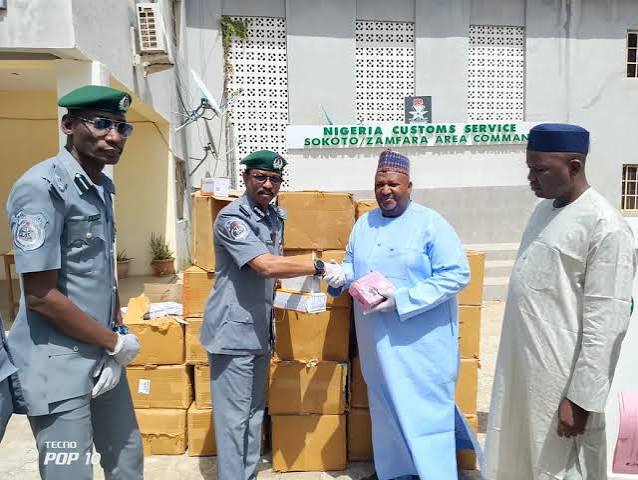
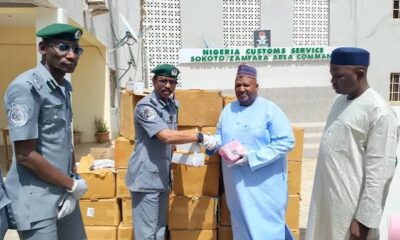
The Nigeria Customs Service (NCS), Sokoto/Zamfara Area Command, has intercepted unregistered pharmaceutical products worth ₦5.8 million in Sokoto State.
The products were handed over to the National Agency for Food and Drug Administration and Control (NAFDAC) on Wednesday for further investigation and necessary action.
The Acting Customs Area Comptroller, Halliru Abdullahi, said the drugs were intercepted by Customs patrol teams along the Illela-Sokoto road following credible intelligence.
He said the operation was part of efforts to curb smuggling, protect public health and enforce relevant laws, in line with the directive of the Comptroller-General of Customs, Bashir Adeniyi.
Abdullahi said the handover demonstrated the continued cooperation between the two agencies in tackling the circulation of unregistered pharmaceutical products.
The seized items included 360 packages of anti-cold medication, each containing 50 cards of four tablets; 500 packages of Amodiaquine, each containing 25 cards of three tablets; 140 packages of Paracetamol, each containing 100 cards of 10 tablets; and 100 packages of Quinine, each containing 10 cards of 10 tablets.
According to him, the importation of the unregistered drugs contravenes Section 55 of the Nigeria Customs Service Act, 2023, as well as relevant NAFDAC regulations.
He warned that unregistered medicines could pose serious health risks to consumers because they had not been certified for consumption.
“Let me use this opportunity to warn smugglers and those who deal in such unwholesome products that Sokoto/Zamfara Command, under my watch, will not tolerate any form of smuggling,” Abdullahi said.
He added that the command remained committed to protecting the health of Nigerians and safeguarding the nation’s economy.
The comptroller commended the officers involved in the seizure for their diligence and bravery and appreciated NAFDAC for its continued partnership with the Customs Service.
Receiving the products, NAFDAC’s Sokoto State Coordinator, Abdeslam Lawal, thanked the Customs Service for the seizure and its sustained cooperation with the agency.
Speaking on behalf of NAFDAC Director-General, Prof. Mojisola Adeyeye, and the agency’s management, Lawal said collaboration between the two organisations was essential to preventing unsafe and unregistered products from circulating in the country.
He commended the Customs officers for their efforts and called for sustained cooperation between the agencies to strengthen the protection of public health.
Petroleum Technology Association of Nigeria (PETAN), has strongly encouraged indigenous oil and gas companies to strengthen technical capability in order to close existing gaps in the country’s oil and gas industry.
The group said that as an association of indigenous technical oilfield service companies, it will pursue partnerships across the sector to broaden technical gaps and entrench skills and knowledge acquisition among members.
Making his remarks on Monday during its round Media Roundtable, in Lagos, Publicity Secretary of the PETAN, Dr. Joan Faluyi, said the event’s technical capability would form an integral part of discussion.
He said the theme, The State of Nigeria’s Oil and Gas Industry: Opportunities and Challenges,” provides an opportunity to examine where we are, what needs attention, and what it will take to move forward.
The conversation brings the perspective of businesses and professionals directly involved in delivering the work of the industry.
That perspective connects investment plans and policy ambitions with the people, equipment, skills and services needed to put them into practice.
Faluyi, remarked, “When we speak about indigenous capacity, we are speaking about the engineer solving a difficult problem, the technician maintaining critical equipment, the fabricator producing to the required standard, and the young professional gaining the experience to take on greater responsibility.
“We are also speaking about entrepreneurs who invest in facilities, develop their teams and carry the responsibility of delivering work safely, reliably and competitively.”
He argued that the opportunities and challenges before these businesses deserve attention because their ability to grow has implications for employment, skills development and the value Nigeria retains fromits petroleum resources.
“As we consider the industry’s future, we should therefore ask practical questions. How can investment create more opportunities for capable Nigerian companies? What will enable these businesses to strengthen their expertise and compete on quality? How can young Nigerians gain the practical experience needed to build lasting careers in the sector?
He said these are questions worth examining carefully, with evidence and with an understanding of the realities of doing the work.
According to him, Technical experience is valuable, and so is the ability to explain that experience clearly, answer questions and listen to different perspectives.




World Bank Projects 23 Per Cent Surge in Global Commodity Prices
ShareBy Tambaya Julius, Abuja The World Bank Group has projected a 23 per cent increase in global commodity prices in...

NELFUND Mounts Tight Monitoring System over Students Loan Payment
ShareBy Tambaya Julius, Abuja The Nigerian Education Loan Fund (NELFUND) has announced plans to strengthen its payment and monitoring systems...

TUC Rejects FG Wage Award, Demands N300,000 Minimum Salary
ShareBy Tambaya Julius, Abuja The Trade Union Congress of Nigeria (TUC) has rejected the Federal Government’s proposed N70,000 wage award,...

NCS Warns Drug Smugglers After N5.8m Seizure
ShareBy Tambaya Julius, Abuja The Nigeria Customs Service (NCS), Sokoto/Zamfara Area Command, has intercepted unregistered pharmaceutical products worth ₦5.8 million...


Customs Coach Backs Team to Win CGC Volleyball League
ShareBy Tambaya Julius, Abuja The Nigeria Customs Service volleyball team is targeting victory in the final phase of the 2026...

PETAN Advocates Indigenous Capacity Development to Address Oil Industry Technical Gaps
SharePetroleum Technology Association of Nigeria (PETAN), has strongly encouraged indigenous oil and gas companies to strengthen technical capability in order...
Pandemic Profiteering Demands More Than a Doctor’s Prosecution
ShareBy Fransiscus Nanga Roka A patient was treated every ninth second, which alone would suggest that there were problems with...

FG Reaffirms Commitment to Energy Security through Domestic Refining
ShareThe Federal Government has reaffirmed its commitment to strengthening energy security through domestic refining, improved crude supply and increased investment...


NMDPRA Moves to Improve Market Efficiency, Unveils New Gas Code
ShareThe Nigerian Midstream and Downstream Petroleum Regulatory Authority (NMDPRA) on Monday in Lagos, unveiled its Revision 2 of the Nigerian...


Ex-AfDB President Adesina Meets Tinubu, Says He’s Ready to Serve Nigeria
ShareThe immediate past President of the African Development Bank, Dr. Akinwumi Adesina, on Tuesday in Abuja said he is ready...