
Metro
Irregular Migration: Foundation Calls on FG, Others to Create Productive Skills for Youths

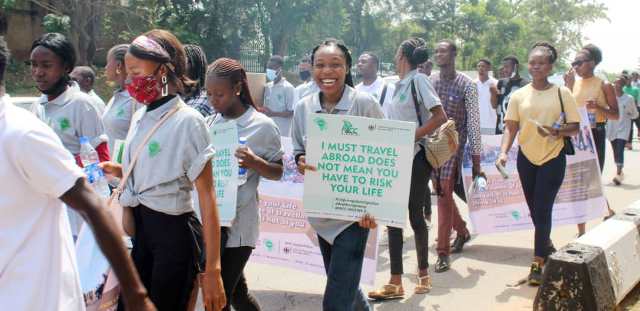
An NGO, Africa Youth Growth Foundation (AYGF), has underscored the need for government at all levels to create productive engagement skills for youths to guard against irregular migration.
The Executive Director, AYGF, Dr Arome Salifu, made the call at a Townhall meeting of its Migration Information Communication Campaign (MICC), Nigeria – Part two project on Thursday in Abuja.
The theme of MICC is: “Migration is not a crime, just do it the right way for your own safety and dignity’’.
Salifu said that the three tiers of governments should be able to reduce poverty of the people, create employment for them to make them productive in the country.
“So we are calling on the Nigerian government at the local, states and federal levels to put in place the enabling environment for Nigerians to stay back at home.
“They should be able to reduce poverty of the people, create employment for the people; create enabling skills that can facilitate productive engagement of these massive young people we have on the street.
“These are some of the sustainable measures government must put in place to see that irregular migration is addressed and human trafficking is confronted across the nation.
“This is a clarion call; it is indeed time to declare state of emergency in terms of economic support for young people, who are currently having hopelessness in their chances of surviving the hardship that we are currently experiencing as a people.’’
He further advised the youths to look at the possibility of taking their time to get sufficient resources to go through the regular pathway.
He said “this is because a lot is happening within the ecosystem of migration.
“organs are being harvested; excess exploitation is taking place on daily basis; labour exploitation, sex slavery and many others,’’ he said.
Gov. Ifeanyi Okowa of Delta noted that the concern for humanity and the understanding that all humans were equal before God lent sufficient justification to the campaign for regular migration.
Okowa, who was represented by his Senior Special Assistant on Internal Affairs, Dr Genevieve Mordi, said that regular migration was a major component in the fight against human trafficking.
“Indeed, Migration is as old as history itself but it must be done following the laid down protocols of the country one has an interest in migrating to.
“The goal is to realise and promote a global society that upholds human dignity and sanctity of human life: a society which means actualisation is built on a foundation of equal respect for all mankind.”
He, therefore, commended the leadership of AYGF for raising awareness on regular migration.
“As well as enlighten the uninformed of the pitfalls of irregular migration such as conditions faced by victims of human trafficking and ills associated thereto world over.
“Events of this nature will help to sensitise the populace, and push for protection of the rights of victims and therefore, deserve our
collective support.
“As at the last count, indigenes of Delta constituted 667 out of the thousands of victims of human trafficking that were kindly evacuated in a Federal Government sponsored programme from Libya.
“The fallout of irregular migration cannot be over-emphasised.’’
According to him, the 2018 Global Slavery Index (GS) contains shocking figures that should awaken the empathy and
consciences of people of goodwill around the world.
“The index indicates an estimated 40.3 million men, women and children are victims of modern day slavery on any given day in 2016.
“Of these 24.9 million people were in forced labour and 15.4 million were forced marriages.
“Sadly, women and girls make up 71 per cent of these victims. These figures as grim as they are do not include victims who are trafficked for black market organ harvesting.
“The GSI estimates 126, 670 solid organ transplants were performed in 2015 and the World Health Organisation estimates that illegal organ trade comprise approximately 10 per cent of the global transplant activity.
“This brings to fore the importance of traveling legally,’’ the governor added.
Ms. Elizabeth Poage, the National Project Officer, Labour Migration and Diaspora, International Organisation for Migration said that people were trafficked for exploitative purposes including labour and sexual exploitation.
Poage said that sexual exploitation remained the most common motive for trafficking but the share of those trafficked for forced labour had grown from 18 per cent to 38 per cent among detected cases.
Speaking on AYGF pilot project, she applauded AYGF for the successful implementation of the pilot project.
Poage noted that the outcome of the project would contribute to improving the overall labour migration governance in Nigeria.
“And will also inform the Federal Ministry of Labour and Employment of some of challenges of labour migration management in Nigeria and how to mitigate them.”
The Africa Youth Growth Foundation (AYGF) marked its 15 anniversary and the launch of the project “Extension of Labour Inspection Activity and Labour Law Enforcement to Sectors and Workplaces where Migrant Workers may be Present”.(NAN)









The Adamawa Government has inaugurated a Social and Behaviour Change Communication (SBCC) Strategy for Child Nutrition to commemorate the 2026 World Breastfeeding Week.
The wife of the governor, Lami Fintiri, inaugurated the strategy on Wednesday in Yola as part of activities marking the global event.
The 2026 theme is: “Breastfeeding for a Sustainable Start in Life: Strengthen What Works.
”Fintiri said the strategy would provide a practical roadmap for promoting positive healthcare and nutrition practices across the state.
She described exclusive breastfeeding as the simplest, most effective and affordable way of providing infants with adequate nutrition.
“Every child deserves the best start in life through exclusive breastfeeding and proper nutrition.
“Breastfeeding protects babies against illnesses, while helping mothers recover faster after childbirth and reducing postpartum bleeding” she said.
She reaffirmed the state government’s commitment to improving maternal, newborn and child health through sustained investments in primary healthcare and nutrition programmes.
She said the government was creating an enabling environment for mothers and children to survive and thrive.
Fintiri also commended UNICEF and other development partners for supporting healthcare service delivery in Adamawa.
Executive Chairman, Adamawa State Primary Healthcare Development Agency, Dr Sulaiman Bashir, said the agency was promoting exclusive breastfeeding and tackling misconceptions surrounding the practice.
Bashir said the agency had intensified public awareness campaigns on the benefits of breastfeeding for child survival and healthy development.
A beneficiary, Augustina Sunday, said exclusive breastfeeding also reduced mothers’ risk of breast cancer and other childbirth-related health complications.
Healthcare kits were presented to breastfeeding mothers and pregnant women during the event.
The World Health Organization recommends exclusive breastfeeding for the first six months and continued breastfeeding with complementary foods up to two years or beyond.
The National Emergency Management Agency (NEMA) said Nigeria is targeting full coverage of all citizens with a multi-hazard early warning system by 2027, through the “Early Warnings for All” (EW4All) initiative.
Director-General (D-G) of NEMA, Zubaida Umar, stated this on Tuesday in Abuja, during a coordination meeting ahead of the official launch of EW4All in Nigeria.
EW4All is a global initiative that aims to ensure that every human on Earth is protected from hazardous weather, water, and climate events by life-saving early warning systems by 2027.
The meeting brought together Chief Executive Officers of National Space Research and Development Agency (NASRDA), the Nigerian Meteorological Agency (NiMet), the Nigeria Hydrological Services Agency (NIHSA) and the Nigerian Communications Commission (NCC).
Umar said the meeting was convened to align roles for Nigeria’s multi-hazard early warning system, strengthen Nigeria’s disaster risk management architecture and ensure seamless inter-agency collaboration.
She noted that Nigeria continues to face increasing risks from floods, droughts, windstorms, heat stress and disease outbreaks.
“In 2025 alone, over 1.2 million people were affected by floods in Nigeria.
“The Secretary General of the UN has called EW4All a ‘survival agenda for humanity’ and for Nigeria, it is also a national security and development agenda.
“We therefore gather today to agree on a common pathway towards a successful national launch, and more importantly, to ensure that in Nigeria, every person is covered by an early warning system by year 2027,” Umar said.
She explained that the initiative has four pillars with clear institutional leads.
She said that NEMA and NASRDA would lead on Disaster Risk Knowledge pillar, NiMet and NIHSA would lead Detection and Forecasting, while NCC would lead Warning Dissemination.
Umar added that NEMA would also coordinate the Preparedness and Response pillar.
She said that the meeting was also organised to resuscitate quarterly coordination meetings among the agencies to review hazards, assess preparedness and resolve operational challenges early.
She said the collaboration aligns with the Sendai Framework, SDGs, Paris Agreement and the Renewed Hope Agenda of President Bola Tinubu, urging the agencies to approach the deliberations with openness.
“NEMA is ready to coordinate but will only succeed if we move as one,” she said.
In his remarks, Executive Vice-Chairman of NCC, Aminu Maida, commended NEMA for bringing the agencies together.
Maida said early warning systems were critical to protecting citizens from unplanned disasters, adding that joint action would deliver results with fewer resources.
On his part, Director-General of NASRDA, Matthew Adepoju, said the agency would provide technical support through data and space technology.
Adepoju noted that NASRDA’s mandate includes disaster management, promising that the agency would support the fulfilment of Tinubu’s Renewed Hope Agenda.
Also speaking, the D-G of NIHSA, Alhaji Umar Mohammed, described early warning as “national corps for preparedness”.
Mohammed said the goal is to prepare before disasters occur and reduce impact to the barest minimum.
Regional Representative of the United Nations Office for Disaster Risk Reduction, Muliro Mashauri, described the platform as “unique” in West Africa.
Mashauri noted that bringing regulators like NCC into disaster planning was important and urged the agencies to harmonise warnings into “one bulletin” to avoid confusion.
He added that Nigeria has the capacity to meet and exceed the 2027 target, citing Nigeria’s satellite support during the Katrina event as evidence of existing capacity.
By Tony Obiechina, Abuja
The Nigerian Economic Summit Group (NESG) has approved the appointment of Dr. Nonny Patricia Ugboma as its Executive Director, Policy and Programmes & Chief Summit Officer.
In a statement by Dr Tayo Aduloju NESG CEO on Wednesday, her appointment took effect on Monday, August 3, 2026, following the approval of the Board of Directors.
The appointment reflects the NESG’s continued commitment to strengthening its executive leadership with accomplished professionals whose expertise and experience will support the Group’s mission of promoting sustainable economic development, inclusive growth, and private sector-led transformation in Nigeria.
In her dual executive role, Dr Ugboma will provide strategic leadership for the NESG’s policy programming, public-private dialogue, Policy Commissions and Platforms, major programmes, strategic convenings, and the Nigerian Economic Summit. She will also oversee stakeholder engagement, programme and partnership development, and the monitoring and implementation of summit and policy recommendations to strengthen the Group’s dialogue-to-execution agenda.
Dr Ugboma is a corporate leader, public-value strategist, board director, and scholar-practitioner with more than 25 years of professional experience spanning finance, telecommunications, corporate social investment, institutional development, energy, innovation policy, and sustainable development.
Before joining the NESG, Dr Ugboma built an accomplished career across finance, strategy, telecommunications, and corporate social investment. She joined MTN Nigeria in 2003 as a Business Planner and Financial Analyst before serving as Executive Secretary of the MTN Nigeria Foundation from January 2009 to March 2021.
During her tenure, she led large-scale social investments in education, healthcare, youth and economic empowerment, and arts and culture, working with governments, communities, educational institutions, healthcare organisations, private-sector partners, and other stakeholders to deliver impactful programmes across approximately 850 project locations nationwide.
Dr Ugboma’s career has been distinguished by her ability to lead complex, multi-stakeholder initiatives that deliver measurable social and institutional impact. Her experience spans programme strategy, partnership development, institutional strengthening, innovation policy, and sustainable development, with a strong focus on translating strategy into implementation and creating long-term public value.
She holds a PhD in Innovation and Public Policy from the University College London Institute for Innovation and Public Purpose, where her doctoral research explored the role of public sector dynamic capabilities in implementing reforms, coordinating complex stakeholder ecosystems, and creating sustainable public value. She also holds a Master of Public Administration, completed with Distinction, from University College London; an MSc in International Management from King’s College London; and a BSc (Hons) in Accounting and Financial Analysis from the University of Warwick.
As Executive Director, Policy and Programmes & Chief Summit Officer, Dr Ugboma will lead the NESG’s efforts to strengthen policy coherence, deepen public-private dialogue, enhance programme delivery, and reinforce the implementation of summit outcomes. Her appointment brings together the strategic discipline of a finance and corporate executive, the delivery experience of a national programme leader, and the intellectual grounding of a public policy scholar, positioning the NESG to further strengthen its role as Nigeria’s leading policy think tank and a trusted platform for driving evidence-based reforms.
The NESG is confident that Dr Ugboma’s wealth of leadership experience, strategic insight, and commitment to institutional excellence will further strengthen the Group’s policy, programme, and summit delivery capabilities while advancing its mission of shaping reforms that promote investment, competitiveness, productivity, and sustainable economic growth in Nigeria.



Makarfi Marks 70th Birthday Anniversary, Appreciates Massive Solidarity
ShareFormer Governor of Kaduna State, Senator Ahmed Mohammed Makarfi, has said he didn’t bargain for the “deluge” of good will...


NYSC Swears in 1,760 Corps Members in Bayelsa
ShareFrom Mike Tayese, Yenagoa The National Youth Service Corps (NYSC) has sworn in a total of 1,760 Corps members for...


Tears Flow as Benue Buries 16 Victims Killed by Suspected Herdsmen
ShareFrom Attah Ede, Makurdi Members of Efeyi community in Ugboju district in Otukpo Local Government Area of Benue State, on...


FG Donates 100 Vials of Anti-snake Venom Benue
ShareFrom Attah Ede, Makurdi The Federal Government through Federal Ministry of Health and Social Welfare, has donated 100 vials of...
Presidential Media Team’s Road Journey and Reality of Benue’s Security Narrative
ShareBy Rotimi Ijikanmi For four days, the road into Benue became a moving test of perception, with a presidential media...

INEC Extends Deadline for Submission of Nominations for State Elections Aug 11
ShareIndependent National Electoral Commission (INEC) has extended the deadline for the submission of the list of candidates for the governorship...


NGO Set to Empower Residents of Kabusa District
ShareBy Raphael Atuu, Abuja A non-governmental organisation, Regy and Henry Amazing Grace Foundation, in conjunction with the National Commission for...


NDCCITMA Accuses Ken-Eva CEO of Plot to Scuttle 2026 Niger Delta Investment Summit
ShareFrom Mike Tayese, Yenagoa The Niger Delta Chambers of Commerce, Industry, Trade, Mines and Agriculture (NDCCITMA) has accused Kenule Nwiya,...


How FCT Can Finance Abuja Infrastructure through Capital Market – SEC
ShareBy Tony Obiechina, Abuja The Director-General of the Securities and Exchange Commission (SEC), Dr. Emomotimi Agama, has outlined how the...


Lionel Messi Bids Farewell to Father who Guided His Career
ShareArgentina football icon Lionel Messi bid farewell Sunday to his father, the global star’s emotional anchor and agent since childhood...