
NEWS
Aisha Buhari Graces 2024 Calabar Carnival in Style


Former First Lady Aisha Buhari on Saturday made a stunning appearance at the 2024 Calabar Carnival Street Party with an impeccable style and elegance.
Her presence added a touch of sophistication to the carnival, renowned for its colourful costumes, mesmerising performances, and infectious energy.
Mrs Buhari’s fashion sense was on point, as she donned a pink outfit that showcased her taste and style.
The former first lady sat at the VIP area with other dignitaries to enjoy the beautiful sights and sounds as seven competitive and seven non-competitive bands thrilled revellers with series of performances.
Her attendance at the carnival showed her commitment to promoting Nigerian culture.
The event was also attended by Gov. AbdulRahman AbddulRasaq of Kwara and Gov. Ahmed Ododo of Kogi, some National Assembly members and foreign countries’ ambassadors. (NAN)
By Tambaya Julius, Abuja
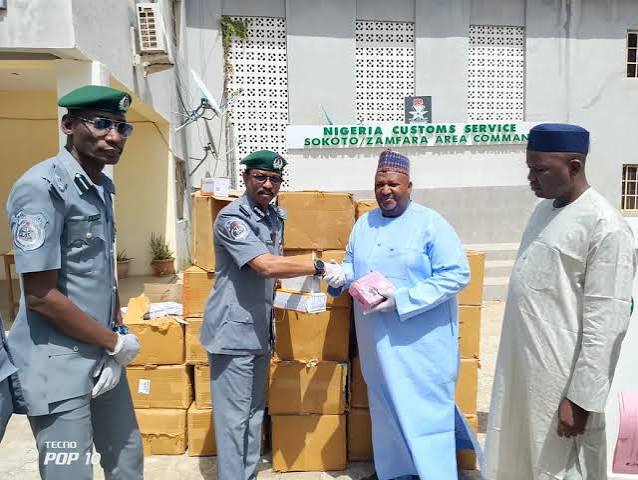
The Nigeria Customs Service (NCS), Sokoto/Zamfara Area Command, has intercepted unregistered pharmaceutical products worth ₦5.8 million in Sokoto State.
The products were handed over to the National Agency for Food and Drug Administration and Control (NAFDAC) on Wednesday for further investigation and necessary action.
The Acting Customs Area Comptroller, Halliru Abdullahi, said the drugs were intercepted by Customs patrol teams along the Illela-Sokoto road following credible intelligence.
He said the operation was part of efforts to curb smuggling, protect public health and enforce relevant laws, in line with the directive of the Comptroller-General of Customs, Bashir Adeniyi.
Abdullahi said the handover demonstrated the continued cooperation between the two agencies in tackling the circulation of unregistered pharmaceutical products.
The seized items included 360 packages of anti-cold medication, each containing 50 cards of four tablets; 500 packages of Amodiaquine, each containing 25 cards of three tablets; 140 packages of Paracetamol, each containing 100 cards of 10 tablets; and 100 packages of Quinine, each containing 10 cards of 10 tablets.
According to him, the importation of the unregistered drugs contravenes Section 55 of the Nigeria Customs Service Act, 2023, as well as relevant NAFDAC regulations.
He warned that unregistered medicines could pose serious health risks to consumers because they had not been certified for consumption.
“Let me use this opportunity to warn smugglers and those who deal in such unwholesome products that Sokoto/Zamfara Command, under my watch, will not tolerate any form of smuggling,” Abdullahi said.
He added that the command remained committed to protecting the health of Nigerians and safeguarding the nation’s economy.
The comptroller commended the officers involved in the seizure for their diligence and bravery and appreciated NAFDAC for its continued partnership with the Customs Service.
Receiving the products, NAFDAC’s Sokoto State Coordinator, Abdeslam Lawal, thanked the Customs Service for the seizure and its sustained cooperation with the agency.
Speaking on behalf of NAFDAC Director-General, Prof. Mojisola Adeyeye, and the agency’s management, Lawal said collaboration between the two organisations was essential to preventing unsafe and unregistered products from circulating in the country.
He commended the Customs officers for their efforts and called for sustained cooperation between the agencies to strengthen the protection of public health.

Petroleum Technology Association of Nigeria (PETAN), has strongly encouraged indigenous oil and gas companies to strengthen technical capability in order to close existing gaps in the country’s oil and gas industry.
The group said that as an association of indigenous technical oilfield service companies, it will pursue partnerships across the sector to broaden technical gaps and entrench skills and knowledge acquisition among members.
Making his remarks on Monday during its round Media Roundtable, in Lagos, Publicity Secretary of the PETAN, Dr. Joan Faluyi, said the event’s technical capability would form an integral part of discussion.
He said the theme, The State of Nigeria’s Oil and Gas Industry: Opportunities and Challenges,” provides an opportunity to examine where we are, what needs attention, and what it will take to move forward.
The conversation brings the perspective of businesses and professionals directly involved in delivering the work of the industry.
That perspective connects investment plans and policy ambitions with the people, equipment, skills and services needed to put them into practice.
Faluyi, remarked, “When we speak about indigenous capacity, we are speaking about the engineer solving a difficult problem, the technician maintaining critical equipment, the fabricator producing to the required standard, and the young professional gaining the experience to take on greater responsibility.
“We are also speaking about entrepreneurs who invest in facilities, develop their teams and carry the responsibility of delivering work safely, reliably and competitively.”
He argued that the opportunities and challenges before these businesses deserve attention because their ability to grow has implications for employment, skills development and the value Nigeria retains fromits petroleum resources.
“As we consider the industry’s future, we should therefore ask practical questions. How can investment create more opportunities for capable Nigerian companies? What will enable these businesses to strengthen their expertise and compete on quality? How can young Nigerians gain the practical experience needed to build lasting careers in the sector?
He said these are questions worth examining carefully, with evidence and with an understanding of the realities of doing the work.
According to him, Technical experience is valuable, and so is the ability to explain that experience clearly, answer questions and listen to different perspectives.
By Fransiscus Nanga Roka
A patient was treated every ninth second, which alone would suggest that there were problems with emergency health care spending before the use of federal money from the U.S.
Treasury. Dr. Joseph A. Montes’ prosecution in Houston has raised concerns regarding how well emergency health care spending could distinguish between legitimate medical services and possibly a fraudulent billing scheme.Montes, 66, was indicted on twelve federal charges on September 30, 2026. The indictment was unsealed on October 6, 2026 by the Justice Department. Prosecutors allege that from 2020 to 2022, Montes’ clinics were reimbursed approximately $20 million out of the $30 million that the clinics claimed to receive from the Health Resources and Services Administration.
As of now, these allegations are merely charges, and therefore Montes remains presumed innocent.The prosecutors state that how he was able to commit these offenses was quite straightforward. He established pop-up COVID-19 clinic locations using his own name; collected nasal swabs from individuals attending those clinic locations; and submitted billing to insurance companies for “office visits” which the prosecutors allege did not occur. From January to November 2021, the prosecutors believe he submitted approximately 3,000 evaluation-and-management claims during at least 29 separate time
frames. Along with the claims, prosecutors are also alleging he paid for a purchase of a high-end vehicle from a car dealer and items from Tiffany & Co.
If this is indeed correct, it would represent a massive breach of confidence that has been placed upon physicians. This would indicate that all people that had gone to seek testing during the time period of the pandemic were being used as mere tools to extract money from the public.
The mathematics of this situation are extremely important to ensure the accuracy of the data. For example, simply because there were 9,000 claims submitted in a single day doesn’t necessarily mean that 9,000 consultations occurred that same day. In many cases, a legitimate provider can send in multiple claims at once as part of a batch. Therefore, investigators will need to determine when services were provided; who was responsible for providing those services; what percentage of the total number of employees working during the period of service provision; whether documentation exists regarding the services provided; and if patients were actually seen by clinicians.
This is intended to provide greater responsibility for your actions. When you discover something unusual or out of place (an anomaly), this should encourage you to delve deeper into the matter. To establish evidence of fraud, you need to provide supporting documentation.
This is a much broader policy question that cannot be avoided. Although emergency reimbursement needs to occur quickly, when quick reimbursements occur without a reasonable degree of verification, there are many opportunities for abuse. At the same time, if all reimbursements were frozen indiscriminately, then we may create a great deal of financial stress for legitimate health care professionals and limit patient access to necessary care. Therefore, an appropriate level of monitoring must distinguish between suspected fraudulent billing practices and the high-volume use of tests. Washington needs five concrete reforms.
The next generation of emergency program administrators, including HRSA, must develop and use billing validation systems to check whether the billed service is consistent with the documented clinical capability. When a large volume of services is billed, and it appears highly unlikely that such a service can be delivered given the clinical capability documented, then an immediate human review is required. For the purpose of protecting legitimate providers from unfairly having their payments reduced or withheld, the human reviews will have time limits for responses and a formalized appeal process.
The second condition is that there needs to be an identifiable relationship between each of the encounters being reimbursed, the date of service, the clinician performing the service, and any other pertinent documentation. In addition, the billing agent may not use their authority to convert a diagnostic test into a separate consultation and then bill separately for that diagnostic test.
The third way to help patients identify fraudulent claims is to send patients simple, clear notifications about which services they received that are being charged to them. Also, providing an easy-to-use way for patients to challenge those charges will help patients spot potential fraudulent claims without sharing too much of their personal health information.
The fourth step for both Congress and the Inspector General at HHS is to have an outside entity conduct an assessment of the program’s control mechanisms (e.g., how often people receive warning notices, if people acknowledge receiving warning notices, what the payment contractor did once they received warning notices) using an objective analysis. There is enough evidence in the indictment to indicate that the program’s control mechanisms were insufficient, however there is no evidence that indicates negligence on the part of regulatory agencies.
Fifth, prosecutors must pursue every participant as established through evidence, and once their guilt is determined, the prosecutor may use the law to recover the criminal proceeds. Each disciplinary action against a professional will be based on an independent review of the evidence and in order to safeguard the right to due process.
Successful performance of a program is measured by the reduction of incorrect payments, resolution time of alerts, money collected from fraud, and continuous availability of legitimate healthcare services for individuals who require them rather than solely through the number of arrests.
A global lesson about emergency medical services funding has been learned from outside of Houston. Each government which provides financial assistance to emergency medical service providers must create a governance framework as part of its funding application.
A criminal court will determine whether one physician is accountable for what occurred. At the same time, a public inquiry should establish whether the system created to protect emergency healthcare funding was adequate enough to accomplish this. The taxpayers would like to have answers from the government as well. The patients are looking for a system that can understand its mistakes before the next crisis occurs.
Fransiscus Nanga Roka




NCS Warns Drug Smugglers After N5.8m Seizure
ShareBy Tambaya Julius, Abuja The Nigeria Customs Service (NCS), Sokoto/Zamfara Area Command, has intercepted unregistered pharmaceutical products worth ₦5.8 million...


Customs Coach Backs Team to Win CGC Volleyball League
ShareBy Tambaya Julius, Abuja The Nigeria Customs Service volleyball team is targeting victory in the final phase of the 2026...

PETAN Advocates Indigenous Capacity Development to Address Oil Industry Technical Gaps
SharePetroleum Technology Association of Nigeria (PETAN), has strongly encouraged indigenous oil and gas companies to strengthen technical capability in order...
Pandemic Profiteering Demands More Than a Doctor’s Prosecution
ShareBy Fransiscus Nanga Roka A patient was treated every ninth second, which alone would suggest that there were problems with...


FG Reaffirms Commitment to Energy Security through Domestic Refining
ShareThe Federal Government has reaffirmed its commitment to strengthening energy security through domestic refining, improved crude supply and increased investment...


NMDPRA Moves to Improve Market Efficiency, Unveils New Gas Code
ShareThe Nigerian Midstream and Downstream Petroleum Regulatory Authority (NMDPRA) on Monday in Lagos, unveiled its Revision 2 of the Nigerian...


Ex-AfDB President Adesina Meets Tinubu, Says He’s Ready to Serve Nigeria
ShareThe immediate past President of the African Development Bank, Dr. Akinwumi Adesina, on Tuesday in Abuja said he is ready...


2027: Uzodimma Launches Door-to-door Campaign for Tinubu
ShareImo state Governor, Hope Uzodimma yesterday, launched the President Bola Ahmed Tinubu Door-to-Door Movement in the state, promising to ensure...


Ogbodo Seeks FG, Benue Intervention in Deplorable Otukpo–Obi–Oju Road
ShareBy David Torough, Abuja An illustrious son of the Igede nation, medical doctor, author and Medical Director of Lydia Memorial...


Kane Wins 2026 Ballon d’Or, Ends 25-year Wait for England
ShareHarry Kane has become the first English player in 25 years to win the prestigious Ballon d’Or after emerging victorious...