
POLITICS
APC: Guber Candidate in Niger Congratulates Sen. Shettima


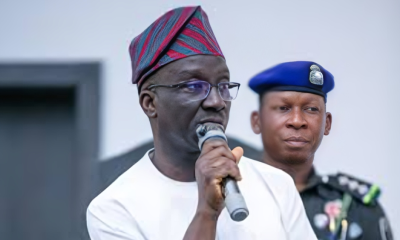
The APC gubernatorial candidate in Niger, Alhaji Umar Bago, has congratulated Sen. Kashim Shettima over his nomination as the 2023 vice presidential candidate of the party.
Bago, currently performing the 2022 Hajj exercise in Saudi Arabia told News men in a telephone interview on Monday that the choice of Shettima as running mate to the party’s Presidential Candidate, Sen.
Bola Tinubu is the best thing that happened to political growth of the party.“We are praying for the success of our candidates in the forthcoming general election as well as for peace, progress and political stability of our great country,’’ he said.
He described Shettima as highly trusted and committed party man who had done a lot in repositioning Borno as two term governor.
Bago, noted that during the pre-presidential primary campaign, he shared common experience with Shettima who played a major role and brought to the fore, his qualification, competence and exposure to move the country forward.
He expressed confidence in the ability of Shettima to work with the presidential candidate to take Nigeria to greater heights.
Bago commended the APC flag bearer, for making a choice in Shettima, and described the combination as `an assurance’ for success of the party at the polls.
The gubernatorial candidate urged Nigerians and particularly members of the APC to rally round its presidential candidate and his running mate to ensure its success.
He reminded members of party that one could only vote or be voted for when he or she had registered and obtained a Permanent Voter’s Card (PVC).
“The continuous voter registration is a great opportunity to enable voters to validate their temporary voter’s card, ensure their names appeared in the voters’ register, and allowed those that had relocated to another state, town or to community rectify their details on the register.
“All you need to do is to visit the local government offices of the Independent National Electoral Commission (INEC) where you reside or any designated PVC Centre close to you.
“To make your task easier as a new voter, one can Pre-Register online, or as a registered voter, you can review your voter registration, request to update your information or transfer your voter registration to another polling unit at https//cvr.inecnigeria.org.
“Haven done that and filled the document, a printout should be made and you could proceed to the nearest INEC CVR Centre for biometric capture,’’ he said.
The gubernatorial candidate urged APC members to make themselves eligible to vote in the 2023 general elections and beyond by acquiring the permanent voter’s card.
“We have reached out to our campaign organisation across the 25 LGAs to do more in mobilising our teaming supporters on the need to acquire, revalidate and save PVCs for the success of our party candidates in 2023,” he added. ( NAN)


By Ubong Ukpong, Abuja
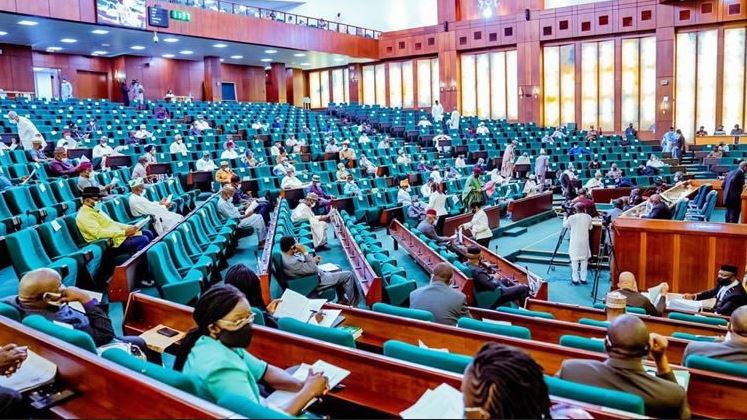
The House of Representatives yesterday raised fresh concerns over Nigeria’s worsening security situation, warning that the nation’s service chiefs should consider honourably resigning if they fail to restore public confidence and reverse the tide of insecurity within a reasonable period.
The lawmakers also called on President Bola Tinubu to immediately deploy a comprehensive and aggressive security strategy aimed at dismantling bandit, terrorist and kidnapping networks operating across the country.
The resolution followed the adoption of a motion of urgent public importance moved by Rep.
Ibe Osonwa during plenary. The motion highlighted the rising cases of banditry, mass abductions, attacks on schools and places of worship, and the growing sense of insecurity among Nigerians.Leading the debate, Osonwa lamented the continued targeting of vulnerable communities, educational institutions and worship centres by criminal groups, warning that the situation was disrupting education, deepening poverty and threatening constitutional rights.
The House reminded the Federal Government of its constitutional obligation to protect lives and property, stressing that the security and welfare of citizens remain the primary responsibility of government.
Lawmakers condemned the persistent wave of kidnappings and attacks across the country and resolved to formally appeal to President Tinubu, in his capacity as Commander-in-Chief, to intensify efforts to secure schools, communities and religious centres while ensuring the rescue of citizens held captive by criminal elements.
The House further directed its Committees on Defence, National Security and Intelligence, and the Army to strengthen oversight of security operations and report back within two weeks.
Meanwhile, prominent Islamic cleric, Sheikh Ahmad Gumi, has defended his visit to Ibadan, Oyo State, dismissing allegations that he was promoting the Islamisation of the South-West or advancing northern religious interests in the region.
Responding to criticisms in a social media post, Gumi said his attendance at an Islamic gathering in Ibadan was in his capacity as a representative of the Coalition of Northern Muslim Ulama and not at the invitation of any South-West Muslim group.
The cleric maintained that no individual or organisation could prevent him from travelling to any part of Nigeria, insisting that his constitutional rights entitled him to move freely across the country.
Gumi also linked the controversy surrounding his visit to what he described as growing Islamophobia in parts of the South-West, arguing that his participation in the event had been unnecessarily politicised.
His comments came amid renewed public debate over security and religious issues following reports surrounding the abduction of residents in Oyo State, although one of the victims recently dismissed claims that the kidnappers demanded the introduction of Sharia law as a condition for their release.
The developments underscore growing national concerns over security, social cohesion and the need for stronger government action to address the challenges confronting the country.
By Mike Odiakose, Abuja
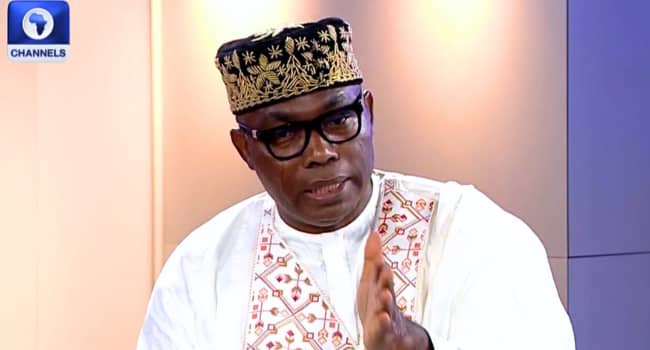
As Nigeria moves closer to renewed constitutional conversations around the creation of state police, comments made about four years ago by former Social Democratic Party (SDP) presidential candidate, Prince Adewole Adebayo, are drawing fresh relevance.
In an interview conducted during the build-up to the 2023 presidential election, Adebayo strongly defended the creation of state and local government policing, arguing that Nigeria’s highly centralised security structure had become ineffective and disconnected from local realities.
According to him, any level of government empowered to make laws should also possess the authority to enforce them.
He argued that it was contradictory for states to legislate on issues including criminal offences, sanitation, public order and local administration while depending almost entirely on a centrally controlled police system headquartered in Abuja.
Adebayo maintained that most offences affecting everyday life — including murder, theft, arson and other serious crimes — are prosecuted under state laws, raising questions about why states have little operational control over policing.
Using Lagos as an example, he questioned situations where incidents occurring entirely within a state still require intervention and decisions from federal authorities.
He said such arrangements weaken accountability and delay justice.
The former presidential candidate also called for wider police reforms beyond decentralisation, arguing that policing in Nigeria should move away from what he described as a culture of force toward one rooted in public service and community trust.
According to him, police should belong to the people rather than function as an extension of government power.
He further proposed stronger institutional links between policing and the justice system, including reforms that would reinforce the role of legal institutions in ensuring accountability.
Beyond security, Adebayo linked Nigeria’s security challenges to broader failures in economic governance.
He rejected arguments that Nigeria’s fiscal problems stem primarily from insufficient taxation, insisting instead that the country loses substantial revenue through leakages, resource theft and weak administration.
He argued that government should prioritise recovering legally due revenues rather than imposing additional tax burdens on citizens and businesses.
Adebayo pointed to crude oil theft and illegal extraction of solid minerals as examples of areas where stronger governance could significantly improve national income.
He also criticised arbitrary tax practices, warning that unrealistic assessments discourage productivity and encourage corruption.
According to him, economic recovery requires efficient revenue collection, transparent administration and stronger protection of public resources.
While the interview was held years ago, many of the issues raised — particularly around decentralised policing, insecurity and economic management — remain central to Nigeria’s ongoing governance debate.
With discussions on state police once again gaining policy attention, Adebayo’s earlier arguments are returning to public conversation as part of wider calls for security and structural reforms.

From Sylvia Udegbunam, Enugu and Yagana Ali, Yola
Political activities intensified across the country on Monday as the Labour Party challenged its exclusion from the forthcoming Enugu North Senatorial District by-election in court, while electoral authorities in Adamawa State confirmed preparations for local government elections involving 11 political parties.
The Labour Party filed a suit at the Federal High Court in Abuja against the Independent National Electoral Commission (INEC), alleging wrongful exclusion from the June 20, 2026 Enugu North Senatorial District by-election.
The seat became vacant following the death of Senator Okey Ezea in November 2025.
According to the party, it duly notified INEC of its intention to conduct a primary election, which was held on May 25 and produced Ambassador Simon Ejike Eze as its candidate. However, the party claimed it was denied access to the commission’s nomination portal for the submission of its candidate’s details despite complying with stipulated electoral requirements.
In a statement issued by its National Publicity Secretary, Ken Asogwa, the party attributed the development to alleged administrative lapses by INEC officials in Enugu State, including the failure to transmit reports of the primary election.
The party maintained that it fulfilled all legal obligations under the Electoral Act and INEC guidelines and described its exclusion from the contest as unjust. It also called for an investigation into the conduct of the commission’s officials in the state while expressing confidence that the judiciary would ensure justice.
Meanwhile, preparations have reached an advanced stage for Saturday’s local government elections in Adamawa State, with 11 political parties set to participate in the exercise.
The Commissioner in charge of Logistics and Field Operations at the Adamawa State Independent Electoral Commission (ADSIEC), Emmanuel Abba, said all sensitive and non-sensitive election materials had been secured and would be distributed to the 21 local government areas before the poll.
Abba also disclosed that security agencies had assured the commission of adequate protection for electoral personnel, voters and election materials, adding that the commission remained committed to conducting a peaceful and credible election.
He noted that while the commission would heed security advice in areas of concern, it was fully prepared for the exercise.
The developments underscore heightened electoral activities across the country as political parties and election management bodies navigate preparations and disputes ahead of crucial polls.



APC Is Losing Stakeholders Because Internal Democracy Has Been Compromised — Otaru Douglas
ShareFormer Nasarawa All Progressives Congress (APC) Publicity Secretary and Chairman, Conference of APC State Publicity Secretaries (CAPs), Chief Otaru Douglas,...
Gunmen Kill Civil Defence Officer, Abduct Daughter in Fresh Attack in Kogi
ShareFrom Joseph Amedu, Lokoja Odo-Ere, the headquarters of Yagba West Local Government Area of Kogi State, came under attack from armed bandits, resulting in...
Sea Drone Rescues US Army Helicopter Crew near Strait of Hormuz
ShareTwo crew members of a US army helicopter that crashed near the Strait of Hormuz on Monday were rescued by an American sea drone, US officials have said. It was the first such operation carried out...
Benue Assembly Extends Suspension of Former Speaker, Majority Leader by Three Months
ShareFrom Attah Ede, Makurdi The Benue State House of Assembly has extended the suspension of former Speaker, Aondona Dajoh, and former Majority Leader, Saater Tiseer, by...
C’River Recovers N1bn from Cocoa Estate Clean-up
ShareFrom Ene Asuquo, Calabar The Cross River State Government said it has recovered about N1 billion in revenue from the Etung Cocoa Estates and...


IMF Warns Nigeria against N7trn Loan Deal with First Abu Dhabi Bank
ShareBy Tony Obiechina, Abuja The International Monetary Fund (IMF) has warned Nigeria that its planned $5bn (approximately N7tn) financing deal...

Insecurity: Reps Give Marching Orders to Service Chiefs
ShareBy Ubong Ukpong, Abuja The House of Representatives yesterday raised fresh concerns over Nigeria’s worsening security situation, warning that the...

Democracy Day: Tinubu Seeks Patience as Reforms, Security Pains Persist
ShareBy David Torough, Abuja President Bola Tinubu has assured Nigerians that his administration is steadily addressing the country’s economic and...

Julius Berger Records Strong Growth Ahead 56th AGM
ShareBy Mike Odiakose, Abuja Construction giant, Julius Berger Nigeria PLC, has reported strong financial performance for the 2025 financial year,...

COAS Urges Media to Lead Fight Against Fake News, Dominate Information Space
ShareBy David Torough, Abuja The Chief of Army Staff (COAS), Lieutenant General Waidi Shaibu, has called on media professionals to...