
POLITICS
Benue APC Constitutes Post-election Reconciliation Committee.

From Vincent Nyinongu, Makurdi.
The Benue State chapter of the All Progressives Congress(APC) has constituted a nine-member committee to carry out a post-election analysis and reconcile existing differences with a view to repositioning the party in the state toward achieving better results in 2023.
Inaugurating the committee at the state secretariat of the party in Makurdi ON Wednesday, the state Chairman, Comrade Abba Yaro, said the party’s outing in 2019 was not encouraging due to acts of omission or commission.
He charged the committee to reappraise the party’s status and correct the missteps which cumulatively blurred the party’s electoral success in the 2019 polls.
” It is obvious that our party would have performed better to pull itself out of the ring of opposition political party in the state.
“However, we are aware of the various constraints which hindered our deserved success in the last general elections.
Briefly, we know that through acts of omission or commission most of our members were bruised in many ways and had to dump the APC for rival political parties; while even those who resisted the temptation to abandon us had dampened spirits and refrained from working very hard for the electoral success of the party in 2019,” Yaro stated.
Among the the terms of references given to the committee were for the committee to do a postmortem analysis of the 2019 general elections; reconciliation of any existing differences and see to the formation of standing committees.
The committee was also asked to mobilize resources in levies, dues etc as well as attend to general issues on party management.
In a remark on behalf of the committee, Elder Vincent Uji who serves as its chairman promised that the committee would do everything within its reach to return the party to its glory in 2023.
Other members of the committee include chief Akange Audu, Mrs Patricia Kupchi, Hon. Matthew Damkor, Barr. Vangerbee Uhamber, Hon. Seember Gbam, Mr. Desmond Atov, Hon. Austin Agada and Amb. Philip Eche as Secretary.


By David Torough, Abuja
Leaders of the African Democratic Congress (ADC) and the New Nigeria Peoples Party (NNPP) have called on the National Assembly to begin a fresh process to amend the Electoral Act.
Speaking on behalf of the opposition at a press conference in Abuja on Thursday, the NNPP National Chairman, Ajuji Ahmed, urged lawmakers to expunge all objectionable provisions contained in the Act.
Under the Electoral Act 2022, political parties were permitted to nominate candidates through direct primaries involving all registered members, indirect primaries conducted by delegates, or consensus arrangements reached by party leaders.
However, the Electoral Act 2026, recently passed by the National Assembly and assented to by President Bola Tinubu on February 18, restricts parties to only direct primaries and consensus options.
In addition, the new law shortens campaign periods and timelines for primaries, while funding for the Independent National Electoral Commission will now be released six months before an election instead of the previous 12 months.
Ahmed stated that opposition leaders view certain provisions of the Electoral Act 2026, which was signed into law by Tinubu with what they described as undue haste, as an alleged deliberate move by the All Progressives Congress-led administration to undermine the will of the people ahead of the 2027 general elections.
He said, “We therefore state unequivocally that the new Electoral Act is anti-democratic, and its implementation will undermine electoral transparency and the sanctity of the ballot, which are fundamental to free, fair and credible elections and the bedrock of participatory democracy.
“The introduction of the provision in Section 60(3), which allows wide and undefined discretionary powers to the presiding officer, overrides and negates the purpose of introducing electronic transmission of election results from polling units. This negation is unambiguously intended to provide a blank cheque to those who seek to manipulate election results by delaying the electronic transmission of results from the polling units to the IReV on the pretext of network failure.
“The premise of the provision in Section 60(3) is the unavailability or possibility of network failure. We find this premise dubious and inconsistent with reality. The immediate past INEC Chairman, Prof. Mahmud Yakubu, stated on record that the BVAS equipment, which operates offline, had worked with over a 90 per cent success rate across the nation, and in the event of network failure at the point of transmission, the transmitted results would be delivered successfully whenever the network became available.
“This position has been further confirmed most recently by a former INEC Commissioner, Festus Okoye, as widely reported, that every polling unit in Nigeria has internet access. Indeed, these statements by those who have been in a position to know provide a counterfactual to the lies that are being fed to the Nigerian people by a government that has lost respect for reason and reality.”
Ahmed added that the accounts of the two INEC officials were strongly corroborated by data available in the public domain.
He said, “According to the Nigerian Communications Commission, as of 2023, Nigeria had achieved more than 95 per cent 2G coverage, which is more than sufficient for the transmission of election results from polling units.
“By that same period, Nigeria already had more than 159 million internet subscribers and more than 220 million telephone subscribers using the 2G network. It is also noteworthy that this capacity provides 24-hour coverage of the entire country. This goes to show that denying mandatory real-time transmission of election results from polling units on the basis of a lack of a communication network is not supported by evidence.
“Fortunately, millions of our people who transact business daily with various financial platforms, even from the remotest parts of the country, know that the no-network argument is fraudulent and is merely part of the APC game plan to rig the election in 2027.
“Indeed, we find it quite ironic that the same APC that strongly agitated for electronic voting only a few years ago is now opposed to the use of technology for the mere transmission of results. The game at hand is very clear.”
On party primaries, the opposition leaders stated that the amendment to Section 84 of the Act, which confines political parties to direct primaries and consensus in selecting candidates, amounts to an encroachment on the constitutionally guaranteed autonomy of parties in managing their internal affairs.
They further argued that the National Assembly cannot rely on Section 228(b) of the Constitution as a basis to limit political parties to only two methods of nomination.
Ahmed said, “There is nothing undemocratic about indirect primaries, which create an electoral college for the selection of candidates in an objective, transparent and orderly manner.
“Our position, therefore, is that as political parties, we do not need legislation that prescribes which mode of party primaries political parties must adopt. In other words, the mode of nominating candidates should be strictly the internal affair of political parties.
“It is obvious that the objective of the APC government and its accomplices in the legislature is to provide the legal pretext for the corruption of the electoral system. They harbour neither plans nor intentions to conduct free and fair elections in 2027 because, even in their arrogance and self-delusion, they are acutely aware of their growing unpopularity across the length and breadth of Nigeria, despite the recent gale of coerced and procured defections to their party.
“We demand that the National Assembly immediately commence a fresh amendment to the Electoral Act 2026 to remove all obnoxious provisions and ensure that the Act reflects only the will and aspirations of Nigerians for a free, fair, transparent and credible electoral process in our country. Nothing short of this will be acceptable to Nigerians.”
Opposition leaders in attendance included the National Chairman of the African Democratic Congress, David Mark; NNPP chieftain Buba Galadima; former Vice-President Atiku Abubakar; and the 2023 presidential candidate of the Labour Party, Peter Obi.
Also present at the Lagos/Osun Hall of Transcorp, Abuja, were the ADC National Secretary, Rauf Aregbesola; former Rivers State Governor, Rotimi Amaechi; and the party’s National Publicity Secretary, Bolaji Abdullahi, among other stakeholders.
Others included Senator Dino Melaye, former ADC National Chairman Ralph Nwosu, and former Cross River State Governor Liyel Imoke, among others.
By David Torough, Abuja
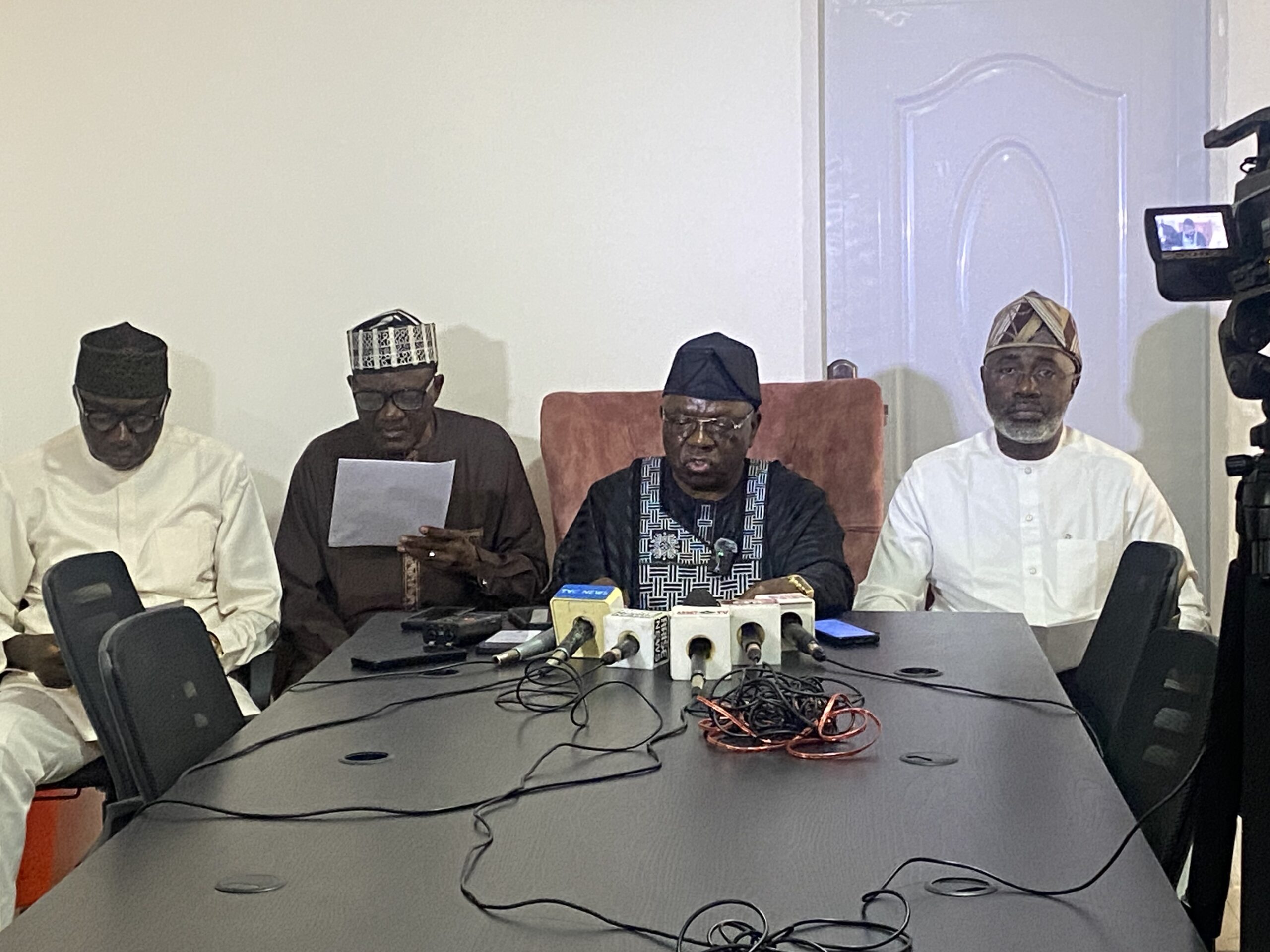
A former Nigerian senator and diplomat, Iyorwuese Hagher, has accused armed herdsmen and bandits of carrying out what he described as a “genocide” in the Sankera axis of Benue State, alleging that more than 2,600 people have been killed and over half a million displaced since 2015.
Addressing journalists on Wednesday, Hagher said the violence across Sankera, a chiefdom in Benue northeastern, amounts to crimes against humanity under international law.
He claimed that 3,580 square kilometres of land, nearly 59 percent of the area, had been seized by armed groups, leaving vast stretches of once-thriving farming communities deserted.
“The scale of this genocide is undeniable,” Hagher said, arguing that the sustained attacks on villages, mass displacement, and destruction of livelihoods reveal a systematic campaign targeting civilian populations.
Hagher recounted an emotional visit on February 18 to his ancestral home in Kasar, in Katsina-Ala Local Government Area, after years of being unable to access it due to insecurity.
Accompanied by Nigerian soldiers, he said he traveled through what he described as a “corridor of silence”, abandoned villages, charred homes, and freshly dug graves.
“There were no humans except decomposing corpses protruding from a pit on the main road,” he told reporters. “This was organised violence and terror that emptied an entire corridor of human civilisation.”
He described Kasar as the “epicentre” of the atrocities, adding that multiple wards across Katsina-Ala, Ukum, and Logo local government areas had been overrun.
Hagher accused the Benue State Government of downplaying the crisis and misdirecting resources. He criticised a recent request by the state government seeking federal approval to establish a rehabilitation centre for bandits, arguing that such a move prioritises perpetrators over victims.
He further alleged that official silence and inadequate documentation have obscured the scale of the crisis, warning that denial could amount to complicity under the Genocide Convention, which Nigeria has signed.
While noting that the administration of President Bola Ahmed Tinubu is collaborating with the United States on counterterrorism support, Hagher said efforts must focus first on returning displaced communities to their homes and ensuring justice.
According to Hagher, more than one million people have been displaced across Benue State, including in Gwer West, Gwer East, Guma, Agatu, and Kwande local government areas. Border communities near Cameroon were also described as occupied.
He cited reports from UNICEF indicating alarming levels of malnutrition and stunted growth among displaced children. Many schools and health facilities across Sankera, he said, have been closed for nearly a decade, leaving children without access to education and exposing young girls to forced marriages and boys to recruitment by armed groups.
“Benue State is Nigeria’s food basket. A war on farmers is a war on food,” Hagher said, warning that prolonged instability threatens regional food security in West Africa.
Hagher called on the Federal Government to declare a state of emergency in the Sankera axis and deploy sufficient, rights-respecting security forces to restore control. He also urged the establishment of an independent judicial peace and reconciliation commission to investigate atrocities and ensure accountability.
Beyond Nigeria, he appealed to the African Union, Economic Community of West African States, and the United Nations Human Rights Council to conduct fact-finding missions and review the situation.
“If fifty square kilometres of once-thriving communities can vanish in silence, the world’s moral architecture is at risk,” Hagher said. “Let this mark the end of silence and the beginning of the global conscience’s response.”
FG Targets 12 Per Cent Annual Growth Rate, Eyes $1trn Economy Landmark
By Tony Obiechina, Abuja
The Federal Government has mapped out a comprehensive roadmap to transition Nigeria into a $1 trillion economy.
Minister of State for Finance, Dr.
Doris Uzoka-Anite who revealed this on Wednesday said the target is a “specific, measurable decision” rather than a mere political slogan.Speaking while declaring open the 2025 Financial Correspondents Association of Nigeria (FICAN) Annual General Meeting held in Abuja on Wednesday, the Minister of State for Finance further stated that achieving this milestone will require the nation to maintain a sustained GDP growth rate of between 10% and 12% annually over the next decade.
The theme of the AGM is: “Realizing President Bola Tinubu’s $1 Trillion Economy Agenda.”
The Minister, who was represented by Uloma Amadi, Assistant Director of Media and Public Relations, noted that while the current GDP stands at approximately $275 billion, the administration is committed to the “ambitious targets that move nations.”Restoring Market IntegrityReflecting on the administration’s journey since 2023.
The Minister highlighted the “politically difficult” but necessary decisions to remove the fuel subsidy—which previously consumed over $5 trillion annually—and unify the foreign exchange windows.”Investors could not trust the signals our market was sending”.
“Today, those reforms are being vindicated. In January 2026, S&P Global revised Nigeria’s outlook to positive, affirming a high level of confidence in our fiscal and monetary trajectories.
” The “Second Wave”: DGAS Framework, the government is currently transitioning into a “second wave” of reform known as the Disinflation and Growth Acceleration Strategy (DGAS). This nine-pillar framework is designed to move Nigeria away from a consumption-based economy toward productive capacity.Key pillars of the DGAS include:Industrialization: Moving away from exporting raw materials (which currently account for 70% of inputs) to domestic processing, modeled after the success of the Dangote Refinery.Infrastructure: Expanding broadband, data centers, and the Nationwide Energy Expansion Program (solar, hydro, and gas).
She disclosed that the federal government is targeting a pipeline technical training program for 3 million young Nigerians annually.
The minister also disclosed that the government is launching a platform to make financing for housing, education, and healthcare accessible to ordinary citizens.Global Re-entry and Compliance
Dr. Uzoka-Anite also listed that significant progress in international financial standing, highlighting Nigeria’s recent exit from the Financial Action Task Force (FATF) grey list.”This matters because it directly reduces compliance costs for foreign investors,” the Minister explained.
“Capital flows more freely to countries that international regulators trust.”The minister added that with a commitment to transparency, the Ministry of Finance now treats investment expenditure as a distinct pillar of public finance to ensure every naira spent builds long-term value for the Nigerian people.
In its goodwill message, the Ministry of Finance Incorporated (MOFI) detailed a massive 1 trillion Naira private-sector-led intervention aimed at restructuring Nigeria’s mortgage landscape and stimulating the broader economy.
Speaking at the event, Sani Yakubu, Executive Director at MOFI, revealed that 75 billion Naira has already been deployed into the mortgage sector following the successful raising of an initial 250 billion Naira tranche.Addressing the “Life or Death” Supply GapYakubu highlighted that the Nigerian housing market faces a dual crisis of demand and supply.
According to him, the mechanism is to ensure that developers can access cheaper capital by proving to financiers that buyers are already lined up through pre-approved mortgages.”The toughest question the developers face is: who is going to buy the houses?” Yakubu stated, comparing the security of a pre-ordered product to a speculative one.
“By giving an off-take guarantee, we stand ready to provide mortgages to Nigerians to buy those units, making developers more bankable”, he enthused.
According to him, since the program’s inception—a figure exceeding the total volume of business the Year-old institution had conducted in its entire previous history.Digital Transparency and Market AccessTo foster a nationalized market, MOFI has launched an interactive platform currently featuring nearly 5,000 housing units across Nigeria.
The portal allows Nigerians, including those in the diaspora, to view properties and initiate mortgage applications digitally, bridging the geographical gap between developers and potential homeowners.The 1 trillion Naira program, registered with the Securities and Exchange Commission (SEC), is expected to continue in tranches, providing a sustainable roadmap for affordable housing and capital flow within the Nigerian economy.




Investigation begins into Death of Chimamanda Adichie’s Son
ShareLagos State Judiciary has scheduled April 14, 2026, for the commencement of a coroner’s inquest into the death of Nkanu,...
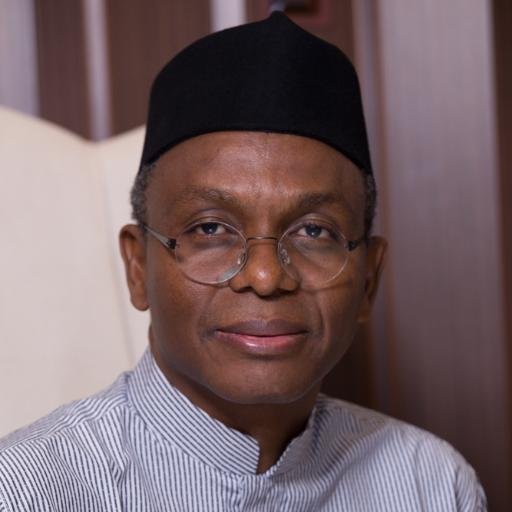
El-rufai Probe: Protesters Back EFCC, ICPC, Demand over 400b Refund
ShareFrom Nicholas Dekera, Kaduna Hundreds of protesters under the auspices of Nasiriya Movement on Thursday stormed Kaduna State Capital supporting...
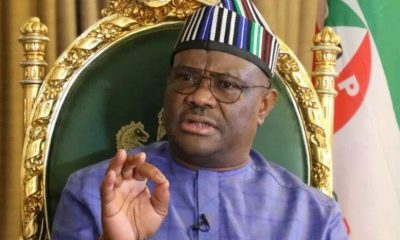

Wike, Rivers’ Leaders Pay Condolence Visit to Mpigi’s Family in London
ShareBy Laide Akinboade, Abuja Minister of the Federal Capital Territory (FCT), Nyesom Wike has described the death of the senator...


NEPC Warns 50 Per Cent Post-harvest Losses threaten Nigeria’s Export Drive
ShareThe Nigerian Export Promotion Council (NEPC) has expressed concern over high post-harvest losses threatening Nigeria’s export competitiveness. NEPC Regional Coordinator,...

FG Democratizes Credit Access, Inaugurates CREDICORP Board
ShareVice President, Kashim Shettima has inaugurated the Board of the Nigerian Consumer Credit Corporation (CREDICORP) to enhance access to consumer...


NCPC Commends FCT in 2025 Pilgrims Screening
ShareBy Laide Akinboade, Abuja The Federal Capital Territory (FCT) Christian Pilgrims Welfare Board has been commended for its coordination of...


Senate Slams Arrest Warrant for CAC Registrar-General over Refusal to Honour Invitations
ShareBy Eze Okechukwu, Abuja The Senate, through its Committee on Finance has issued a warrant of arrest against the Registrar-General...
NAAT, NASU, Others Shut UniCross Offices over Unpaid Salaries
ShareFrom Ene Asuquo, Calabar Activities at the University of Cross River State (UniCross) have been disrupted as four staff unions...


Senate Seeks Replacement of Envelope with Priority Based Budgeting
ShareBy Eze Okechukwu, Abuja The senate has sought for the replacement of the envelope budgeting system with priority or performance...


ShareBPE Projects N189.1bn Revenue in 2026 By Tony Obiechina, Abuja The Bureau of Public Enterprises (BPE) said it has an...