
Foreign News
Buhari Approves 50 Volunteers For Liberia

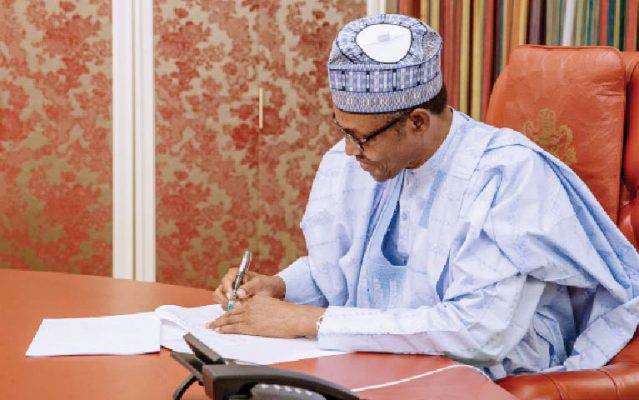
By Mathew Dadiya, Abuja
President Muhammadu Buhari on Friday in Monrovia, Liberia said that Nigeria will this year provide 50 volunteers in the field of education and health to support Liberia addresse its challenges in those field.
This, the President said would be done through the nation’s Technical Assistance Programme.
President Buhari also assured that the continent’s largest nation was also prepared to deploy additional volunteers in the other fields, in order to contribute to the capacity building in Liberia.
Buhari who conveyed the felicitations of Nigerians to their brothers in Liberia, said “Today represents yet another significant milestone in the life of the brotherly nation of Liberia.
“Nigerians rejoice with all Liberians on this momentous occasion. It is a matter of pride that Liberia, the first country in Africa to gain its Independence, has successfully preserved its unity and cohesion, despite the tragic events that culminated in an unfortunate civil war.
“I am here to celebrate with you this remarkable achievement while at the same time recalling the enormous contributions and sacrifices made by Nigeria in your recent history.”
The Nigerian leader further assured Liberians of continued support of the country to its development: “As Liberia sustains its notable efforts towards economic recovery, I wish to assure you of Nigeria’s commitment to continue to partner with the country, for all possible assistance with a view to making our modest contributions that will positively impact on the security and economic well-being of the Liberian people.
Speaking on Nigerian experience, the president explained that having realised the futility in continuing to subject the Nigerian economy to the vagaries of its mono-product dependence, his administration has instituted policies aimed at diversifying the national economy which were yielding positive results.
He added that the Economic and Recovery Growth Plan launched by his administration in 2017 was creating the enabling environment for growth, security and economic revival.
“Our government had to adopt appropriate measures including diversification and reforms to address such underlying causes exemplified by our continued dependence on a single-commodity, crude oil, lack of fiscal buffers, leakages, corruption and high governance costs.
“Furthermore, in our efforts to stimulate the economy, our government initiated bold policy interventions that are beginning to yield positive results,”he stated.
Buhari, who was honoured at Liberia’s 172nd Independence Anniversary occasion with the country’s highest award, the “Most Venerable Order of the Knighthood of the Pioneers of the Republic of Liberia with Grade of the Knight Grand Cordon”, said he accepted it ” on behalf of all Nigerians and as a tribute to all our country men who paid the supreme price in aid of Liberia’s unity and stability.”
He also thanked the Government and people of Liberia and expressed his resolve to continue to strengthen cooperation within the sub region.
Buhari added that, “This gesture can only strengthen my resolve to rededicate myself to the service of my country, work for the prosperity of our people in the sub-region.”
The President likened the Liberian economic situation to what obtained in Nigeria when he assumed office in 2015 and praised the administration of President George Weah for its social intervention programme.
He told President George Weah that, “I am fully aware that on assumption of office, your country was experiencing severe economic challenges occasioned by the fall in commodity prices, the main source of revenue for Liberia. This situation is akin to what I inherited on my election in 2015. That was a difficult period for the Nigerian economy which later lapsed into recession.”
He commended Weah’s leadership and vision for initiating since coming to office, people oriented projects and programmes including the “Pro-Poor Agenda for Prosperity and Development” (PAPD) launched in 2018.
“I am convinced that this well-articulated programme which is quite similar to our Government’s Economic Recovery and Growth Plan 2017-2020, if well implemented, could bring the desired transformation and sustainable development to Liberia.”
The President encouraged his Liberian counterpart to take decisive actions to further stimulate the economy of the country: “Mr. President, Liberia under your leadership may wish to learn from our experience by taking courageous steps to diversify its economic base by developing the productive sector that would complement earnings from rubber, iron ore and the increasingly dwindling funds from Development Partners.
“In this regard, the need for proper management of human resources and investment in agriculture, solid minerals and other sectors such as tourism where the country has comparative advantage, cannot be overstated.”
Meanwhile, the Ambassador of Nigeria to Liberia, Mer. James Dimka told newsmen that the what was deserving because, “We have done what no other African President has done to the country. We have had close relations (Nigeria and Liberia) and this has only strengthen our relations. Liberia was in war for 14 years and the major country that stood by them was Nigeria. Our military just left this country about a month ago. At some point the United Nations, ECOWAS were but Nigeria stayed till the end.
“And so you will recognize that there is a strong relations between Nigeria and Liberia.”
Governor Kayode Fayemi of Ekiti said, Nigeria has sacrificed so much for the country even though Liberia is older going by flag independence record.
He said: “Nigeria has done a lot to keep Liberia one. This is the first country we sent the first ECOMOG to and several Nigerians lost their lives to. Uptil very recently, a Nigerian, Gen. Abdulrahman was Chief of Defence Staff here and he lost his life in the course of serving this country. Before him other Nigerians headed their military, Gen Obiakor was the head of mission. I spent sometime here on the flip side of the conflict as the mediator and negotiator in the difficult days here. President Obasanjo was critical in the management of the conflict and President Buhari followed on in that capacity and he is still doing a lot for peace in West Africa as Chairman of ECOWAS.
“So, it is a fitting and proper honour done to him and by extension to all of us in Nigeria. Because, somethings Nigerians wonder why we do so much in the subregion and Africa without getting much in return. Return comes in various forms and recognizing with the highest honour in the land shows how grateful the Liberians are in the role Nigeria continues to play in the country.
Governor Mai Mala Buni of Yobe said, the honour is for President Buhari and Nigeria considering the role he is playing in the west Africa subregion and the continent.
He said the award shows how much respect the President commands from his counterparts in the region.
The Senior Special Assistant on Media and Publicity, Garba Shehu said award is in recognition of all the country has done to help Liberia.
“This country with the longest history of independence but couldn’t hold together and was helped majorly by Nigeria, with everything we had, our armed forces, resources in other to help them to remain as one united people.
“It is also in recognition of Nigeria’s support for Liberia to rebuild. He has offered 50 technical aid corp to Nigeria and has promised many more in case there is need.”


By Eze Okechukwu, Abuja
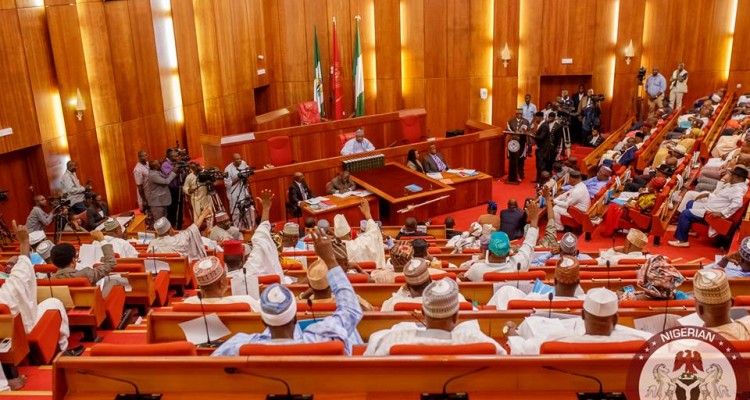
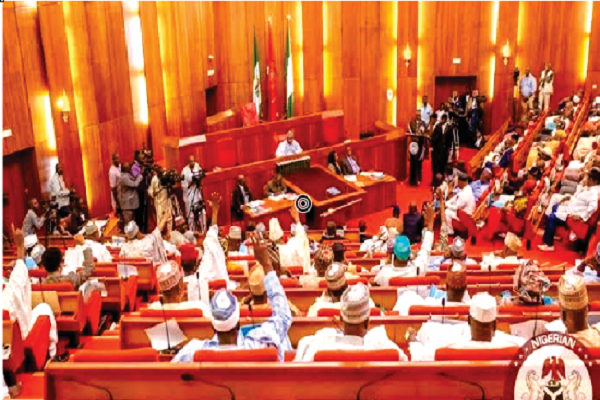
The Senate yesterday ordered mandatory health screening for every international passenger arriving Nigeria airports, seaports, land borders as Ebola resurfaces in the Democratic Republic of Congo with a scare case reported in the FCT.
The resolution followed an urgent motion by Senator Francis Fadahunsi, who warned that with Lassa fever already ravaging states, Nigeria cannot afford another outbreak.
“Protecting our entry points is far cheaper than managing Ebola,” Fadahunsi told the chamber.
Lawmakers insisted screening must be total and indiscriminate — no exemptions based on nationality or departure country because infected travellers can transit through safe-listed nations.
Senator Diket Plang raised the stakes further, demanding immediate funding for NCDC and Port Health Services, including release of withheld funds and emergency budget.
Senate President Godswill Akpabio said the Federal Government has started releasing Ebola response funds but ordered relevant committees to track every kobo.
“Ascertain whether the funds were released and judiciously utilised. Any outstanding debt must be released by the Finance Ministry without delay,” Akpabio directed.
At least 72 civilians who had been prospecting for gold in a border region of Sudan have been killed in air strikes, a regional rights group said.
Emergency Lawyers, based in the Sudanese capital, Khartoum, said jets targeted the so-called artisanal miners at a popular gold mining site on Saturday.
Neither the Egyptian government nor the de facto Sudanese authorities have so far commented.
Cairo has previously faced accusations of deadly strikes on gold prospectors as part of a crackdown on illicit activity along its southern border.
Emergency Lawyers noted the previous alleged attacks and said they represented not only a violation of Sudan’s sovereign territory but demonstrated the government’s lack of control over the region.
“The deliberate targeting of unarmed civilians violates international humanitarian law and the right to life,” it said in a statement on Sunday. “These acts may constitute war crimes.”
It noted that its death toll was provisional and could rise.
The Paris-based Sudan Tribune reported that the death toll could far exceed the number reported by Emergency Lawyers, citing a survivor of Saturday’s attack who said many more people had been injured.
Eyewitnesses said the attack began around 06:00 local time (04:00 GMT), with the aircraft firing more than five missiles directly at the miners’ camps, destroying them and excavation pits with people still inside, the newspaper wrote.
The Sudan Tribune reported claims in June that Egyptian forces had used drones and artillery to target artisanal mining sites in the same region, killing several, after sporadic incidents of Egyptian border guards of burning equipment, torching temporary shelters, and firing live ammunition to disperse mine workers.
Days later, Egypt’s border agency announced that it and the military had begun a sweeping security campaign along the border to foil illegal migration, drug smuggling and illegal mining.
At the same time, Sudan’s de facto leader announced an investigation into the alleged strikes, which were said to have killed dozens.
Gold lies at the core of the border tensions.
Sudan’s ongoing civil war has led to a surge in artisanal mining – and often risky practice conducted by civilians with rudimentary tools and without official permission – particularly in remote areas near its borders.
Gold-rich areas lie along porous borders in terrain historically associated with cross-border smuggling routes, with artisanally mined gold potentially feeding into those channels.
Egypt’s border force said in June that it had seized 86 tonnes of gold ore along with amateur prospecting equipment.
Artisanal mining has also reportedly continued in Sudan’s conflict zones and smuggled gold may be a source of income for armed insurgent groups.
This has raised concerns of illicit Sudanese gold undermining the legitimate Egyptian gold market.
Several German fighter jets will take part in the Northern Atlantic Treaty Organisation (NATO) annual nuclear defence exercise this week as troops from 17 countries take part in the Steadfast Noon drill.
The German Air Force said three Tornado jets will take part in the exercise hosted by Italy, which starts Tuesday and runs for about a week and a half.
The jets are normally stationed in Büchel in the German state of Rhineland-Palatinate.
NATO has not revealed the exercise scenario but said its scale would be comparable to last year’s drill, which involved around 2,000 personnel and more than 70 aircraft.
Last week, NATO’s head of nuclear policy, Nassima Barrows, said the exercise was designed to demonstrate the alliance’s readiness and ability to defend its territory.
No real nuclear weapons will be used, she added.
NATO said the exercise was not linked to current events or directed at any specific country.
Military experts say the drills, held regularly in October, include practising the safe transport of weapons from underground storage facilities to aircraft and mounting them on fighter jets.
Only practice bombs without real nuclear warheads are used during the drills.



UK, Nigeria to Deepen Defence, Security Cooperation
ShareThe United Kingdom has reaffirmed its commitment to deepening defence and security cooperation with Nigeria, with emphasis on military training,...

2027: INEC Steps Up Preparations, Completes Nine Activities
ShareBy Tambaya Julius, Abuja The Independent National Electoral Commission (INEC) has completed nine of the 14 activities on its timetable...

2027: Tinubu Accords Benue Security Top Priority, Tompolo Tells Supporters
ShareLeader of the PBAT Door-to-Door Movement, Government Tompolo, has called on the people of Benue state to come out enmasse...


Senate Demands Compulsory Screening of Foreign Arrivals
ShareBy Eze Okechukwu, Abuja The Senate yesterday ordered mandatory health screening for every international passenger arriving Nigeria airports, seaports, land...

Reps Summon Telecom Operators over Poor Network Services
ShareBy Ubong Ukpong, Abuja The House of Representatives on Wednesday, summoned telecommunication operators in the country to appear before it...


Bill to Design, Manufacture, Commercialize Drones Passes Second Reading in Reps
ShareBy Ubong Ukpong, Abuja A bill for an Act to move the nation to developing the capacity to design, manufacture...


Otu Presents N987.8bn Budget Estimate to Assembly
ShareFrom Ene Asuquo, Calabar Cross River State Governor, Sen. Bassey Edet Otu, has presented a proposed budget of ₦987, 808,...
Borno Police Arrest Six Suspects over Mobile Phone Theft, Recover N5.65m
ShareThe Police Command in Borno has arrested six suspects over alleged mobile phone theft and fraudulent withdrawal of ₦5.65 million...
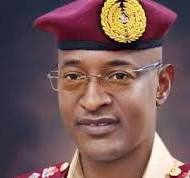

Election Campaigns: FRSC Bars Officers from Politicians’ Escort
ShareThe Federal Road Safety Corps (FRSC) has barred its personnel from escorting politicians during campaigns for the 2027 general elections....

2027: NITDA Raises The Alarm Over AI-driven Election Manipulation
Share By Elijah Oguche, Abuja The National Information Technology Development Agency (NITDA) has warned that artificial intelligence (AI)-powered misinformation, deepfake...