
DEFENCE
COVID-19: NAF Unveils Two-locally Made Ventilators

By Gom Mirian, Abuja
In a bid to provide local solutions to tackle the COVID-19 pandemic, the Nigerian Air Force (NAF), has called on private sector’s involvement to achieve mass production of emergency ventilators in the country.
The Chief of Air Staff (CAS), Air Marshal Sadique Abubakar, made the call while unveiling two locally – made emergency ventilator, produced by a team of Researchers from the Air Force Research and Development Center (AFRDC), Air Force institute of Technology (AFIT) in collaboration with the Faculty of Veterinary Medicine, Ahmadu Bello University (ABU), Zaria.
The emergency ventilators, tagged ‘NAF E-Vents’, were unveiled Wednesday in kaduna.
A statement by the Director of Public Relations and Information, NAF, Air Commodore Ibikunle Daramola said, the prototype E-Vents had been subjected to successful animal testing using both canine and porcine test subjects.
Adding that the objective of the animal testing was to demonstrate the capacity of the Ventilators to support recovery of patients with respiratory diseases, including Acute Lung Injury and Acute Respiratory Distress Syndrome.
Daramola said the tests were also necessary to validate the effectiveness of the ‘Assist Ventilation Mode’, where the ventilator detects a breath from a patient being treated and synchronizes the equipment with the patient’s breathing.
The NAF E-Vents, which are intended for use when conventional invasive respiratory support resources have been exhausted, were found to deliver very satisfactory performance in air volume control and assist control modes and are now ready for human testing and further certification by relevant agencies,” he added.
I a speech during the unveiling ceremony, the CAS, who was represented by the NAF Chief of Standards and Evaluation (COSE), Air Vice Marshal (AVM) Remigius Ekeh, explained that the devastating effects of the COVID-19 required that ingenious and proactive steps be taken in order to protect lives and avert any form of national tragedy.
He noted that the NAF had continued to vigorously pursue a robust and result-oriented Research and Development (R&D) policy with emphasis on the provision of indigenous technological solutions.
In this regard, he said, the NAF had engaged in strategic partnerships with some Ministries, Departments and Agencies so as to reduce dependence on other nations. “Our modest efforts have yielded results and positively impacted our operations”, the CAS added. The CAS stated that in the quest to contribute towards self-reliance in the battle against COVID-19, a team, comprising NAF personnel and researchers from partner institutions, was convened to research into the production of the emergency ventilators.
He noted that the team commenced work in early April 2020 and within 3 weeks had developed 2 prototypes.
According to him, “having seen the progress made, it became necessary for the prototypes to undergo animal testing to ascertain their capacity for use on patients with respiratory illness.
Accordingly, the NAF partnered with the Faculty of Veterinary Medicine, ABU to test the effectiveness of the Ventilators using a dog and a pig as test subjects. I am glad to note that the tests were successfully completed and the equipment is now ready for human testing and certification by relevant agencies”.
He, however, emphasized that private sector investment would be required for mass production of the ventilators. The CAS also noted that the unveiling ceremony was a further demonstration of his resolve to ensure that NAF continues to make significant contribution to the development of the Country and thus become an Air Force that is the pride of every Nigerian.
He assured that the Service would continue to invest in R&D to promote, enhance and optimize indigenous innovations and technologies for national development.
In anaddress, the NAF Director of R&D, AVM Paul Jemitola, stated that the NAF had made giant strides in the area of R&D under the visionary leadership of the CAS to the extent that R&D had become the norm in the Service.
“By investing in high quality training of personnel, innovative approaches to issues and encouraging out-of-the-box thinking, a lot of solutions to operational challenges in the NAF have been locally developed through R&D thereby saving huge resources,” he said.
According to him, the culture of creativity engendered by the CAS is in line with his Vision of self-reliance and self-sustenance in defence and other aspects of national life, especially at a time like this when all hands are on deck to confront the COVID-19 Pandemic.


From Ifeanyichukwu Nwannah, Gusau
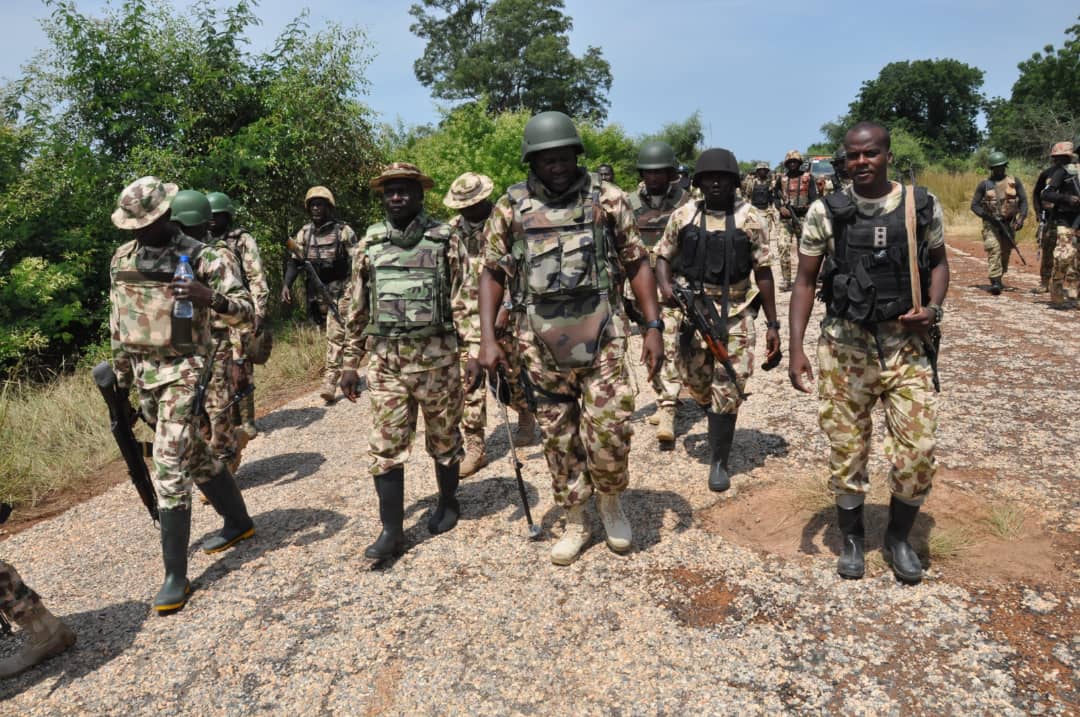
The troops of Operation Fansan Yamma (OPFY) have neutralised Explosive Devices Planted along Magami–Hannutara–Dansadau road, Maru, in Zamfara State.
Reliable military sources revealed that the troops of Sector 2, Operation Fansan Yamma, have recovered and neutralised explosive devices planted by terrorists in the axis.
It was gathered that the devices were reportedly planted to kill and endanger the commuters plying the busy route.
According to the sources, the troops, acting on credible intelligence, secured the affected area and conducted a thorough search, and identified two locations where explosive devices were said to have been planted.
It was also learnt that an Explosive Ordnance Disposal (EOD) team was quickly deployed to handle the threat, saying that the team successfully destroyed one of the devices and safely recovered and rendered the second device useless.
The sources noted that the troops have intensified patrols and surveillance along the road and surrounding communities to secure the lives and properties of the residents, ensure the safety of commuters and prevent further insecurity in the area.
The management of Operation Fansan Yamma has urged members of the public to remain vigilant and timely report suspicious objects or activities to the nearest security agency.
The operation underscores the importance of timely intelligence and proactive security measures in preventing attacks and safeguarding lives and property in Zamfara State.

The Nigeria Air Force (NAF) has released the names of personnel and passengers in the crashed NAF 931 aircraft.
This is contained in a statement on Tuesday in Abuja, by the Director of Public Relations and Information, NAF Headquarters, Air Commodore Ehimen Ejodame.
The crew members and passengers lost their lives in the crash involving Nigerian Air Force (NAF) ATR-42 aircraft, NAF 931, in Igbokoda area of Ondo State on Monday.
Ejodame listed the crew members as Sqn. Ldr MI Aburime (Flight Captain), Sqn. Ldr AP Man-Ugwueje (Co-pilot), Flt.-Lt. IS Bako (Co-pilot), Warrant Officer Abubakar A (Aircraft Technician) and Cpl.
Uguru HC (Aircraft Technician).He said the passengers included Flt.-Lt. TL Lazarus, Flt.-Lt. M Akinloye, Flying Officer IM Adeshina, Master Warrant Officer Onwuka F, Master Warrant Officer Matini BA, Warrant Officer Nuhu FS, Flight Sergeant James RB and Flight Sergeant Mohammed AI.
Others he said were Sgt. Ani AE, Sgt. Izibenikien SI, Sgt. Alafuka C, Sgt. Mbadugha AN, Lance Cpl. Ugwuba FC, Lance Cpl. Eledan GE, Mrs Ezeh Nneka, Godstmine Tarabina, Joy Micheal, Sunday Micheal, Ukeme David and Gideon Omotola.
The NAF director of public relations and information also said that the Chief of the Air Staff (CAS), Air Marshal Sunday Aneke had expressed condolences to the families of the personnel and passengers.
He quoted Aneke as describing the incident as a deeply painful moment for the NAF and the nation.
The CAS expressed heartfelt sympathies to families, loved ones and colleagues of those who lost their lives.
He assured the bereaved families of the service’s full support during the difficult period, while also directing a comprehensive investigation to establish circumstances surrounding the accident.
He also assured that the NAF would continue to provide timely and verified updates as investigation progresses and urged the public to refrain from speculation and circulation of unverified information, while respecting privacy and dignity of affected families.
“A condolence register has been opened at Headquarters NAF, Abuja, for senior government officials, members of diplomatic corps, heads of security agencies, and other well-wishers who may wish to pay respects and convey messages of sympathy to families of the deceased and the NAF,” he said.
25 persons comprising five crew members and 20 passengers were onboard the aircraft which was on a routine mission from Benin to Lagos when the crash occurred.
It was reported that search and rescue procedures were immediately activated in coordination with relevant authorities to locate and account for all persons on board.(NAN)

The Police Command in Lagos State says it apprehended 32 suspects and recovered 10 firearms, 43 vehicles and N2.5 million during various operations across the state in September.
The Lagos State Commissioner of Police(CP), Fatai Tijani, disclosed this on Monday while briefing newsmen on the command’s achievements for the month at the Command Headquarters, Ikeja.
Tijani said the command also impounded 43 vehicles during an early-morning enforcement operation on Monday against vehicles with covered number plates and unregistered vehicles, adding that further checks were ongoing.
He said the command arrested the suspects in connection with armed robbery, cultism, unlawful possession of firearms, stealing, breaking and entering, public disturbance and other violent crimes.
The CP said the command recovered 20 live ammunition and cartridges, 15 expended ammunition, two cutlasses, suspected criminal charms and other incriminating exhibits.
He added that the firearms comprised five pump-action guns and five locally made pistols.
Tijani said a 32-year-old suspect was arrested during a routine patrol along Oko Oba Road after some suspected hoodlums allegedly fled on sighting the police.
“A search of the suspect led to the recovery of a locally made cut-to-size pistol, radiator, car jack, engine block and a bag containing vehicle spare parts and tools,” he said.
The commissioner said a 29-year-old suspected armed robber was also arrested in connection with the alleged robbery of a man at Ghost and Spirit Lounge, Ekoro Road, Abule Egba.
“The suspect was arrested at the Toll Gate, Lagos-Ogun boundary, following investigation into the Sept. 26 incident, in which armed men allegedly robbed the victim of his gold wrist chain and rings.
“Efforts are ongoing to arrest other members of the gang and recover the remaining exhibits,” he said.
He said police also arrested a suspect in connection with an alleged conspiracy and stealing case involving a gang that reportedly travelled from Idi-Oro, Mushin, to the Chevron area of Lekki-Ajah.
According to him, the suspect led operatives to a hotel room in Idi-Oro, where N2.5 million and three mobile phones were recovered.
The CP said three suspected robbers were also arrested in Idi-Oro, while intelligence obtained during investigation led to the recovery of a pump-action gun and 11 live cartridges at Igbogbo, Ikorodu.
He added that another suspect was arrested in Olorunsogo, Mushin, where a locally made Beretta pistol and four live 9mm ammunition were recovered.
Tijani said the suspect allegedly confessed to membership of the Eiye Confraternity, while two other suspected cultists, aged 27 and 35, were arrested at Ganyigbo Beach Yard.
He said 12 suspected members of the Eiye Confraternity were also arrested in Imeke, Badagry, with a Mercedes-Benz vehicle, two vehicle keys, a locally made cut-to-size gun and suspected criminal charms recovered.
According to him, seven of the suspects had been charged to court, while investigation continued to apprehend other members and recover additional arms.
The commissioner further disclosed that police arrested a 15-year-old suspected arms courier at Capa, Oshodi, while allegedly transporting firearms and ammunition concealed inside a loaf of bread.
He said a locally made Beretta pistol, four rounds of unexpended 9mm ammunition and a locally made single-barrel cut-to-size gun were recovered from the suspect, while further investigation led to the recovery of an additional cut-to-size gun and 11 cartridges.
Tijani said the command also arrested a 53-year-old man in Ojo for alleged unlawful possession of a locally made pistol and six suspected hoodlums over alleged breaking, looting and destruction of property along Ejigbo–Idimu Road.
He said another suspect was arrested in Badagry for alleged unlawful possession of a firearm and public disturbance, adding that two victims had so far made statements against him.
Tijani said the command would continue to protect police personnel lawfully carrying out their duties while holding accountable officers whose conduct fell below expected standards.
He commended the officers and operatives for the breakthroughs and appreciated members of the public for their cooperation and timely provision of credible information. (NAN)



Pope Leo to Have Surgery after Lump Found on Lung
SharePope Leo XIV has announced he will be operated “in the coming days” after a nodule was found on his...


Motorists Express Worry over Non-access to NNPC Petrol Discount
ShareMany motorists said in spite of the discount in pump price of petrol at the Nigerian National Petroleum Company Ltd...


Tuberculosis: Benue Assembly Passes Law, to Protect Patients from Discrimination
ShareBy Laide Akinboade, Abuja The Benue State House of Assembly has passed into law a landmark legislation aimed at eliminating...


President Tinubu’s 30-Day Fuel “Discount” Cannot Repair the Damage of Subsidy Removal
ShareBy Daniel Nduka Okonkwo The Federal Government has issued a stark warning: restoring petrol subsidies could push the exchange rate...


Troops Neutralize Explosive Devices planted in Zamfara Community
ShareFrom Ifeanyichukwu Nwannah, Gusau The troops of Operation Fansan Yamma (OPFY) have neutralised Explosive Devices Planted along Magami–Hannutara–Dansadau road, Maru,...


Mbah Reaffirms Enugu’s Commitment to Trade, Investment, Industrial Growth
ShareFrom Sylvia Udegbunam, Enugu Enugu State Governor, Dr. Peter Mbah, has reaffirmed his administration’s commitment to creating an enabling environment...


Concerns About the 2027 General Elections
ShareBy Jibrin Ibrahim As the countdown to the 2027 elections reached 100 days this week Tuesday, Joash Amupitan, chairman of...


World Bank Report Confirms Economic Reforms Yielding Results – Tinubu
SharePresident Bola Tinubu said the World Bank’s October 2026 Nigeria Development Update confirms his administration’s economic reforms are yielding results...

Bandits Burn Houses, Business Premises in Niger Border Community
ShareFrom Dan Amasingha, Minna Suspected bandits have attacked Kigbera village in Konkoso Ward, Borgu Local Government Area of Niger State,...


Fuel Price Discount and Monetary Policy Recalibration: Communicating Policy Change Without Undermining Reform Credibility
ShareBy Uche Joe Uwaleke Economic reforms are rarely judged solely by their immediate outcomes. They are also assessed by the...