
Agriculture
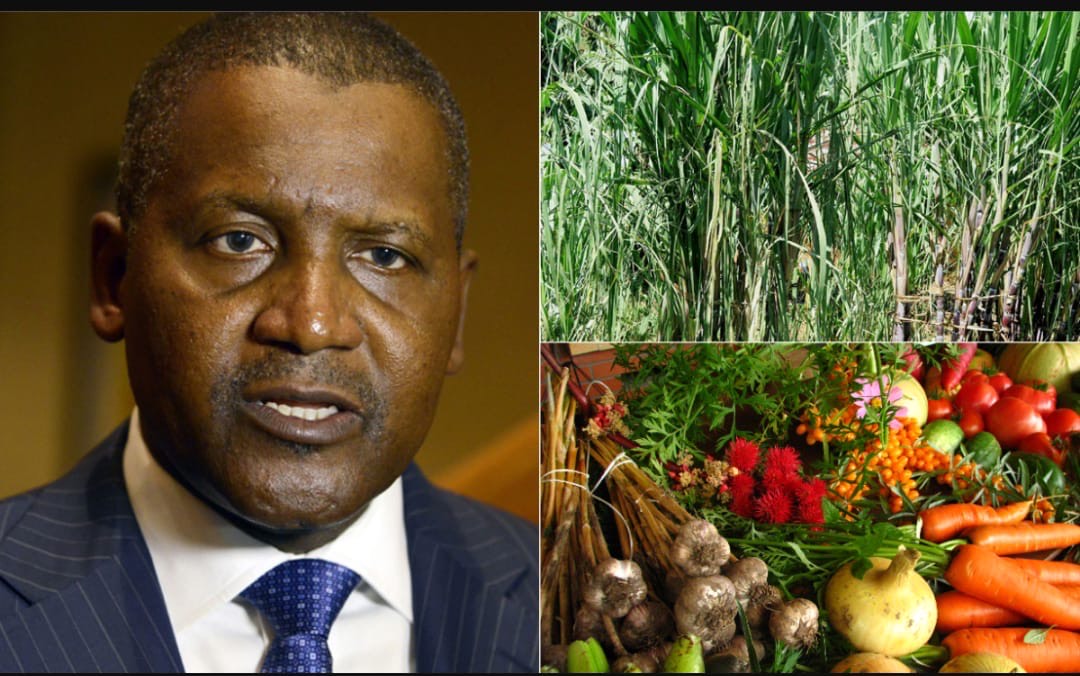
Dangote Restoring Value to Agriculture, Sponsors 2025 Agric Show

By David Torough, Abuja
The Dangote Group has said that it is collaborating with strategic partners to revitalise and strengthen the agricultural sector of the Nigerian economy.
This development comes as the company sponsors the 17th National Agricultural Show, which opens on Tuesday, November 25, 2025, in Keffi, Nasarawa State.
The company’s spokesman, Anthony Chiejina, stated that expanding mechanised agricultural practices will play a critical role in boosting Nigeria’s GDP while creating meaningful employment opportunities for the country’s growing youth population.
“Through this partnership, the company aims to encourage greater participation in commercial agriculture and reinforce its role in advancing Nigeria’s economic growth,” he said.
He said the theme for this year’s Show: Employing Smallholder Farmers: Restoring Value, Ensuring Productivity will Ensure Attainment of Food Security in Nigeria, is apt.
Chiejina said: “Restoring the value of agriculture offers Nigeria more than nostalgic appeal; it provides a pragmatic route to economic renewal. With the right incentives and modern practices, agriculture can once again serve as a reliable engine of growth, anchoring jobs, stabilising markets and giving the economy a sturdier foundation.”
The Agricultural Show, a fixture in Nigeria’s agricultural calendar, offers a platform for showcasing innovation across the value chain.
The statement said the company is currently developing rice mills in Kano, Jigawa, Niger, Kebbi, and Sokoto States, with a combined total milling capacity of 1.5 million tonnes per annum.
It noted that the effort is intended to support the government’s broader push for food security.
The statement quoted the Senior Adviser to the President of the Dangote Group, Mrs. Fatima Wali-Abdurrahman, as saying that, in line with the company’s commitment to restoring value to agro-allied industrialisation in Nigeria, it is investing heavily in its backward-integration projects in the sugar sub-sector in Nasarawa and Adamawa States.
She said as part of its contribution to the agricultural sector, the company has a fertilizer complex in Lagos, located in the Lekki Free Trade Zone, with a production capacity of 3 million metric tonnes per annum of urea.
On the participation of the Dangote Group, Chairman, Board of Trustees (BoT), National Agricultural Foundation of Nigeria, organizers of the annual National Agric Show, Arc Kabiru Adamu, said: “Dangote Group has been our greatest ally from inception and we have enjoyed tremendous and invaluable support from them such that without them we will not be able to continue to hold the show efficiently.”
Adamu, who is also the President, All Farmers Association of Nigeria (AFAN) urged the Dangote Group to focus on agriculture, after its success in the oil and gas sector.
He added that: “This year we envisage a tumultuous turn out of farm machinery manufacturers, processors, researchers and youth and women farmers answering the clarion call to bolster Nigeria’s food system.”

Some residents in Lagos State have expressed concern over the recent surge in the price of tomatoes, forcing many households to adopt alternatives.
The residents made their views known in separate interviews on Wednesday in Lagos.
A market survey showed that a 50kg basket of tomatoes now sells between N115,000 and N125,000, compared to between N35,000 and N40,000 recorded last month.
Olachi Igwe, a resident of Ago Palace, said the scarcity and high cost of tomatoes had disrupted her household’s meal plans.
“I contacted my usual vendor, but she said tomatoes were scarce and difficult to source.
“A small bowl we used to buy for between N3,500 and N4,000 now sells for as high as N6,000 to N7,000, when available.
“For now, my family will resort to palm nut stew (ofe akwu) until prices stabilise,” she said.
Another resident, Mercy Okeleye of FESTAC, said although her family prefers fresh tomatoes, rising prices have forced her to consider cheaper options.
“I cannot do without fresh tomatoes because of the taste, but I may have to buy broken ones, popularly called ‘esha’, which are relatively cheaper.
“I do not consider tomato paste a suitable substitute because it is not purely made from tomatoes,” she said.
Also speaking, Tope Babalola from Dopemu, said she might adjust her cooking methods if prices remain high.
“I have not bought tomatoes in over a month, but if the price is still high, I will use more onions and peppers.
“I will not resort to artificial additives; I prefer natural ingredients for my meals,” she said.
Joan Ogugua, another resident, said she had already switched to tomato paste to cope with the situation.
“I asked my son to buy tomato paste for our meals. I cannot justify spending excessively on fresh tomatoes when other basic needs must be met,” she said.
Also, Oge Ugwu, a civil servant at Lekki, said she would resort to cucumber stew with the recent price hike.
The Tomatoes Growers and Processors Association of Nigeria (TOPAN) has predicted a steady increase in the price of the produce between May and June 2026.
The Kaduna State Chairman TOPAN, Rabiu Zuntu, disclosed this in an interview recently in Lagos.
Zuntu noted that although there is no particular time for tomatoes planting season up north, seasonal weather variations can affect the production of the produce.
“Although we can plant tomatoes all-year-round, we cannot assure quality harvest all-year-round.
“Some farmers are harvesting now, while others are transplanting, and others are harvesting.
“Tomatoes are still available for sale but the price of the produce is gradually on the increase.
“Come May/June, the prices of tomatoes will be very expensive, so now is a good time to stock up the produce. There’s always a scarcity within that period.
“This is because of the nature of the weather in the north around that period, the weather is usually very hot and tomatoes cannot resist such hot temperature,” he said.
Zuntu said the price of tomatoes have started rising up in the north.
“A 50kg rafia basket of tomatoes sells from N20,000 as against N7,000 to N10,000 that was sold earlier in the year.
“While a crate of tomatoes up north is sold between N10,000 and N15,000 as against N5,000 to N6,500 sold earlier in the year.
“In most part of Kano State, where there is bumper harvest, they are rounding off their harvest. So, tomato is not that available there and most buyers have turned to where they can find it now, mostly within Kaduna State and some parts of Plateau State.
“So, that’s why the supply has decreased and the tomato supply and cost is determined by the law of demand and supply,” he said.
A 50kg basket of tomatoes in Lagos, at the moment, sells between N40,000 and N60,000 depending on the size and quality.

The Smallholder Women Farmers Organisation in Nigeria (SWOFON), Oyo State chapter, has said that the lack of irrigation facilities had become a major obstacle to dry season farming in the state.
The Chairperson of SWOFON in Oyo State, Atinuke Akinbade, said this in an interview in Ibadan on Monday.
Akinbade, who shared the experiences of women farmers in the state during the 2025 dry season, said that inadequate access to water for irrigation significantly affected the performance of many farmers during the period.
“It hindered many older farmers from participating in dry season farming and also prevented younger farmers from doing as much as they could in cultivating large acres of land,” she said.
Akinbade explained that farmers who managed to plant during the season struggled to access sufficient water to irrigate their farms, a situation worsened by the effects of climate change.
“Many farmers who depended on streams and wells to water their crops suffered major setbacks because those sources could not provide enough water for irrigation.
“Some farmers had to resort to buying water from commercial water tankers, which increased the cost of production, while at times it was even difficult to get water from the tankers,” she said.
The SWOFON chairperson warned that failure to address the problem could worsen food insecurity in the coming months.
“Even now, rainy season farming has not fully commenced because of the irregular rainfall pattern.
“This is a double burden, and if nothing is done, it may lead to serious hunger later,” she said.
Akinbade, however, acknowledged that the government had organised training for members of the association on home gardening.
She, however, said that little support was provided to address the challenges of dry season farming.
The chairman said that the home garden support package given to members consisted mainly of seedlings and one sprayer.
“They gave us two packs each of maize and pepper seeds, with six seeds in each pack, as well as one sprayer, so that we can grow food for household consumption,” she said.
Earlier, Oluwatoyin Oyedeji, SWOFON Coordinator in Oyo East, explained the severe hardship members of the organisation experienced in sourcing water for irrigation.
“Many farmers are already counting their losses because water was not available to irrigate their farms.
“Those who depended on streams and brooks were badly affected because many of them dried up, while the few that still had water had so little that farmers had to dig deeper into the ground in search of more,” Oyedeji said.
In the same vein, the Women Leader for farmers in Saki East, Musiliu Ashiru, said the absence of irrigation facilities also hampered dry season farming in her area.
According to her, many farmers still engaged in dry season farming have had to pay for water to keep their crops alive.
“Many of them buy water from the dam here to irrigate their crops. It has not been easy for them this year,” Ashiru said.




Stakeholders Seek Better Healthcare Access for Benue Adolescent Girls
ShareBy Attah Ede, Makurdi Adolescent Girls and Young Women (AGYW) in Benue State have been urged to speak out against...


Nigeria Customs Hosts Diplomatic Reception to Strengthen Global Partnerships, Trade Relations
ShareBy Tambaya Julius, Abuja The Nigeria Customs Service (NCS) on 3 June 2026 hosted a high-level diplomatic cocktail reception in...


Tinubu To Commission Fruit Juice Factories, BIPC Motorcycle Assembly Plant In Benue
ShareFrom Attah Ede, Makurdi President Ahmed Bola Tinubu is set to visit Benue State to commission the newly built ultra modern Bensono Concentrate Plant, Benva Juice Factory, and the Motorcycle Assembly...


Dangote Refinery Surpasses Capacity Target, Eyes 1.4m bpd Expansion
ShareBy David Torough, Abuja Dangote Petroleum Refinery and Petrochemicals has achieved a major operational milestone by increasing its crude oil processing capacity to 700,000 barrels...


Alia Appoints New Acting Head of Service in Benue
ShareFrom Attah Ede, Makurdi Benue State Governor, Rev Fr .Hyacinth Alia has approved the appointment of Dr. Ihu Eunice Ogbenyi as new Acting Head of Service (HoS)...
Oshonaike Hails Steady Progress of Nigerian Table Tennis Players
ShareSeven-time Olympian Olufunke Oshonaike said Nigerian table tennis players are making steady progress in spite of the challenges they face in competing...

Poland Bans Smartphones in Primary Schools
SharePoland plans to ban mobile phones in all primary schools from next academic year under draft legislation approved by the government on Tuesday. The...
Reps Minority Picks Ugochinyere as New Leader
ShareBy Ubong Ukpong, Abuja Following the defection of the former minority Leader of the House of Representatives, Kingsley Chinda, the minority caucus has nominated Hon. Ikenga...
Kano Revokes Private School Licences over Sexual Abuse
ShareFrom Aliyu Askira, Kano The Ungogo Local Government Area of Kano State has withdrawn the licences of all private schools within its jurisdiction following allegations that...


CBN Approves Regular Commercial Operations for Abbey Mortgage Bank
ShareBy Tony Obiechina, Abuja Abbey Mortgage Bank Plc, one of Nigeria’s longest‑standing primary mortgage banks, has secured regulatory approval from...