
JUDICIARY
EFCC Re-arraigns Adoke Over $1.2bn Malabu Oil Deal

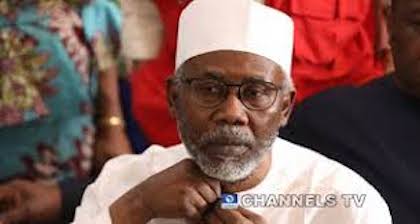
Mohammed Adoke, former Attorney General of the Federation (AGF) and Minister of Justice, was, on Monday, re-arraigned by the economic and Financial Crimes Commission(EFCC) in the Federal High Court, Abuja, on fresh charges bordering on money laundering to the tune of N900 million.
The EFCC is prosecuting Adoke and one Aliyu Abubakar on seven counts bordering on money laundering before Justice Binta Nyako.
The former AGF and Abubakar were, however, granted bail by the judge after taking arguments from counsel to the parties.
While Adoke is the 1st defendant and he is being charged on a six-count charge, Abubakar is the 2nd defendant and he is being charge on one-count charge in the suit number: FHC/ABJ/CR//89//17.
The duo however pleaded not guilty to the seven counts read against them.
Following their not guilty plea to the charges, counsel for the EFCC, Bala Sanga, urged the court to remand the defendants in the commission’s custody pending the hearing of the matter.
However a team of counsel to the defendants drew the court’s attention to the bail application filed by the defendants.
Chief Mike Ozekhome, SAN, who argued the bail application of Adoke, prayed the court to grant Adoke bail in self recognizance being a former AGF, pending the hearing of the charges.
He said in the alternative, Adoke should be granted bail on favourable and liberal terms, or better still to allow Adoke enjoy bail terms as already granted him by an FCT High Court presided over by Justice Abubakar Idris Kutigi, where Adoke is facing a 42-count charge.
He said Adoke has never been convicted of any crime and that the charges before the court are bailable offences.
While submitting that bail is constitutional, the senior lawyer said a defendant should not be denied his right of freedom of free movement until when he is convicted.
Similarly, Chief Wole Olanipekun, SAN, counsel to the second defendant, aligned with the submissions of Ozekhome to urge the court grant the second defendant bail.
He argued that a suspect is presumed innocent until proven contrary by the court of law.
In his response, prosecution counsel, Sanga, urged the court to use its discretionary power to grant the defendants bail.
Delivering ruling on the bail applications, Justice Nyako however, admitted the defendants to bail in the same terms granted them earlier by Justice Kutigi.
Recall that Justice Kutigi had, on January 30, admitted both Adoke and Abubakar to bail in the sum of N50m each.
The court, in addition, ordered them to provide a surety each in like sum to their bail.
The sureties who must be responsible citizens of Nigeria, must reside within the jurisdiction of the court.
They must be owners of verifiable property in the FCT and also show evidence of tax payment in the last three years.
In addition, the sureties are to sign an undertaking that the defendants would always be in court at every proceedings of the trial, while the defendants on their part are to undertake that they would not jump bail nor interfere with the trial.
The defendants were also ordered to submit their international passport to the court and would not travel without the court’s permission.
Justice Kutigi also ordered that the defendants be kept in custody of the EFCC pending the perfection of their bail.
However, Ozekhome told Justice Nyako that despite meeting the bail conditions by the sister court, the defendants were yet to be released by the EFCC.
He expressed fear that the anti-graft agency might rearrest the defendants after the proceeding.
On his part, the EFCC lawyer argued that the defendants were unable to meet all the bail terms since their international passports were still in the custody of the commission.
Counsel to 2nd defendant, Olanipekun, told the court that the anti-graft agency had failed to release them, even when the court made the order, “on the grounds that they were to be arraigned on a separate charge.”
The judge, who cautioned the EFCC against flouting court order, directed that the travel passports of the defendants be deposited at the FCT High Court in compliance with the bail terms.
“Tell your principals to try and obey court order,” she said.
Justice Nyako, then, adjourned until April 1 and April 2 for commencement of trial. (NAN)








Gov. Douye Diri of Bayelsa says the judiciary remains the hope of the common man in the society, charging officers in the temple of justice to always strive to be upright.Diri said this on Friday in Yenagoa at a Thanksgiving/Valedictory Court Section for the commencement of the 2025/2026 Legal Year in the state.
The governor said: “It has become an annual ritual but we all know that the bible says seek ye first the kingdom of God and all other things shall be added on to thee. “Today we are handing over this new legal year to God for His protection to the judiciary. I believe you are going to do beyond our expectations with God on your side.“In this country today without exception, I appeal to us Nigerians, Bayelsa people to allow the judiciary to be used by God, to be allowed to work to the best of their ability and conscience to deliver incorruptible and sound judgement.”Diri said that the trust of the public lies with the judiciary which demands justice for all manner of people, irrespective of the class in the society.The governor urged the judiciary especially the judges to always stand tall on what is right, as they are highly autonomous as an arm of the government.On her part, Justice Matilda Ayemieye, the Chief Judge of Bayelsa, commended the Bayelsa government for the support in various ways to ensure that the judiciary is autonomous.She said that the judiciary enjoys cordial working relationship with the Nigeria Bar Association, the Legislature and the Executive.The chief judge said that the new legal year allows them to assess the previous year, adding that it is a day of accountability towards the people they serve and to strengthen the rule of law.Ayemieye said that the Bayelsa judiciary aspires to be one of the best judiciary as they have earned respect among other judiciary in the country.Also, Mr Biriyai Dambo (SAN) the Attorney General and Commissioner for Justice, expressed happiness over the commencement of the new legal year.He said that they are committed to service delivery in Bayelsa and commended the bar and the bench for their hard work to ensure that justice is served in Bayelsa.The Commissioner said that for the past years the judicial system had changed and that the welfare of the judiciary and that of the Ministry Justice is one of the priorities of Diri’s administration which has paid in full all monies owed law officers.“This current administration has boosted the morale of law officers, as they have contributed to the justice delivery in Bayelsa state.“This current administration has equally assisted the NBA Yenagoa and Sagbama branches respectively. My office is wide open to enhance the justice system in Bayelsa state,” he said. (NAN)
The Federal High Court in Abuja has dismissed cybercrime charges filed by the Inspector-General of Police against a female medical doctor, Bolanle Aseyan. Delivering judgment on Friday, Justice Peter Lifu discharged and acquitted Aseyan, stating that the police failed to prove the essential elements of the alleged offences.
The Inspector-General had arraigned Aseyan on a four-count charge of defamation, harassment, and intimidation against another doctor, Olufunmilayo Ogunsanya. The police alleged that Aseyan used social media platforms to harm Ogunsanya’s reputation. He was said to be her former boyfriend. The charges were filed under Section 24 of the Cybercrime (Prohibition, Prevention) Act, which addresses online threats and cyber harassment. To support the case, the police presented three witnesses. Aseyan also called two witnesses to testify in her defence during the trial. Justice Lifu, while reviewing the matter, noted both doctors were once in a romantic relationship before it turned sour. He further observed that the two had sexual relations while in the United Kingdom and later made conflicting social media posts against each other. The judge held that the prosecution failed to prove its case beyond reasonable doubt and therefore could not secure a conviction. Specifically, the judge said the defendant’s alleged Twitter handle used in the cyberbullying was not tendered as evidence before the court. Justice Lifu also said there was no proof of threats or intimidation, but rather evidence of a previous affectionate relationship. Consequently, the judge dismissed all four charges, discharged and acquitted Aseyan, and declared the case closed. He ordered the police to immediately return all seized items, including her international passport, upon service of the judgment. Aseyan said she met Ogunsanya online in 2019 and travelled to the United Kingdom in 2020, where she claimed she was raped. She stated that upon arrival in Leeds on March 7, 2020, tired and disoriented, Ogunsanya offered her wine shortly after she got to his home. She alleged that after taking the drink, she passed out and later woke up to find that he had allegedly had sex with her without consent. Aseyan further claimed that Ogunsanya maltreated her before she returned to Nigeria shortly after the alleged incident. (NAN) From Abdullahi Abubakar, Ilorin.
A Kwara State High court sitting in Ilorin has sentenced Abdulrahman Bello, a self-acclaimed cleric and the killer of Hafsoh Lawal, a final year student of the Kwara State College of Education to death, by hanging. This was contained in a judgement delivered by Justice Hannah Ajayi on Thursday, in which, four other defendants were set free and cleared of any wrongdoings.
Charged with five-count, the judge started by acquitting the four out of the five defendants namely Ahmed Abdulwasiu, Jamiu Uthman, Suleiman Muyideen and Abdulrahman Jamiu of any complicity, subsequently setting them free of taking part in the death of the victim (Hafsoh Lawal).
However, Justice Ajayi, while delivering judgment on the main culprit, described Bello’s act as cruel, wicked, and an extreme display of human wickedness, saying all evidence proved that Hafsoh was killed in order to be used for money ritual and trading in human parts.
The judge further noted that Abdulrahman’s confession of love and plan to marry the victim, are all concocted lies to lure her to his residence in order to kill her. She therefore sentenced Abdulrahman Bello to death by hanging while setting free the other four suspects not guilty.
It would be recalled that the victim went missing, sometimes in February 2025, shortly after attending the naming ceremony of a family member. When she left, but didn’t return later in the day, her parents went into panic mode, and search party was raised, and a complaint was lodged at the police station.
Her phone line was tracked, and traced to the suspect’s (as it were) area. Upon invitation and interrogation, it was discovered that he is a serial killer, who had killed many victims before Hafsoh.



Tinubu Congratulates UNIJOS Graduands, Pledges Support for Education
ShareFrom Jude Dangwam, Jos President Bola Tinubu has congratulated graduands of the University of Jos (UNIJOS) at the institution’s 35th...


2027 Election: Igbo’s Community Promises Votes for Eno
ShareFrom Christopher Tom, Uyo Non-indigence in Akwa Ibom State especially the Igbo’s community has promised to give the highest number...


Zamfara Reaffirms Commitment to Address Gender-based Violence
ShareBy Ifeanyichukwu Nwannah, Gusau The Zamfara State Government has reaffirmed its commitment to addressing gender-based violence (GBV) and other forms...


Nentawe, Alia, Suswam, Others Bag Chieftaincy Titles from Tiv Kingdom
ShareFrom Attah Ede, Makurdi The Tiv Kingdom has conferred honorific chieftaincy titles on prominent sons, daughters and friends of the...


World Human Rights Day: NGO Takes Medical Outreach to Okaka Correctional Center
ShareFrom Mike Tayese, Yenagoa The 8th edition of Prof. Seiyefa Brisibe Outreach has celebrated the 2025 World Human Rights Day...


Coup in Guinea-Bissau and the Dilemma of ECOWAS
ShareBy Hakeem Jamiu In his seminal work, Political Order in Changing Societies (1968), Professor Samuel P Huntington argues that political...


Chelsea End Winless Run with Comfortable Brighton Victory
ShareChelsea ended their four-game winless streak in the Women’s Super League with a comfortable 3-0 away victory against Brighton. A...


Liverpool ‘United as One’ after Salah Return – Van Dijk
ShareCaptain Virgil van Dijk said Liverpool “are absolutely united and go forward as one” after Mohamed Salah returned to the...
Mikaelian Beats Jack to Regain WBC Title
ShareNoel Mikaelian beat Badou Jack by a unanimous points decision in Los Angeles to regain the WBC cruiserweight title. Mikaelian...

Mobile Phone Association Pillar of Modern Commerce, Driving communication, Says Mamas
ShareFrom Ayinde Akintade, Osogbo The National President of Association of Mobile Phone and Allied Products Traders of Nigeria (AMPAT), Hon....