
Education
FG Okays N4bn to Settle Stranded Nigerian Scholars’ Allowances


The Federal Government has approved N4bn for the payment of allowances to Nigerian students studying abroad under the Bilateral Education Agreement.
The approval follows outcries from the beneficiaries who had lamented that they were being pushed into forced labour and prostitution due to prolonged hardship occasioned by the nonpayment of their allowance by the Federal Government.
The Minister of Education, Tunji Alausa, disclosed that the fund, representing part of the N8bn budgeted for the programme this year, had been released as the first tranche to address outstanding payments owed to the scholars.
“The Federal Ministry of Finance has approved N4bn to pay the first tranche, and I am working with the Minister of Finance to settle the remaining N4bn. Hopefully, in the next few weeks, they will receive all their allowances for 2025 and 2026.
According to him, efforts are ongoing between both ministries to ensure that all outstanding payments are cleared, with the balance expected to be released within four weeks.
The development follows a disturbing viral video from affected students across countries, including Russia, Serbia and Venezuela, who said delays in stipends spanning over a year had left many struggling to survive, with some resorting to menial jobs while others claimed female students had been forced into prostitution.
The outcry comes barely a year after the Federal Government terminated the scholarship programme and promised to ensure that current students are funded to complete their studies.
In 2025, the minister cited inefficiency and misallocation of national resources as reasons for terminating the programme, following similar complaints from previous beneficiaries.
The programme, established through diplomatic partnerships, had enabled Nigerian students to study in countries such as China, Russia, Hungary, Morocco, Algeria, Egypt and Serbia.
He explained that the scheme had become unsustainable, noting that the government planned to spend about N9bn on just 1,200 students in 2025.
However, the minister assured that all current beneficiaries of the scheme would continue to receive full government support until they complete their studies and return to Nigeria.
Despite assurances that current beneficiaries would not be affected, several students said they had not received stipends for over two years, leaving them stranded.
In the viral video, about 16 Nigerian scholars in Russia appealed to the government for urgent intervention, describing their situation as dire.
One of the students, a fifth-year medical student in Rostov, said many had been pushed into extreme conditions to survive.
A student leader in Russia, who spoke on condition of anonymity, confirmed the development recently, lamenting that the rising cost of living and currency challenges had worsened their situation.
She added that restrictions on student work permits in some countries further limit their ability to earn income.
Another student in Venezuela described the situation as abandonment, noting that scholars from other countries receive regular support from their governments.
He said, “It is only Nigerians that are abandoned. Other countries like Mozambique, Burkina Faso, and Brazil, send delegates to check on their students and pay them, but no one comes from Nigeria.
A parent of an affected scholar, who spoke anonymously with our correspondent, said relevant government agencies had been engaged to facilitate the payment.
“The situation requires prompt attention. These children were sent abroad through a government programme. There have been delays in stipends despite repeated appeals to the Ministry of Finance, Ministry of Education and other agencies.”
The Federal Government had earlier, in January, dismissed claims that Nigerian scholarship students in Morocco were abandoned, following a viral video that showed some students facing hardship, including homelessness and lack of medical support.
The video, shared on X by activist Martins Otse, featured interviews with Nigerian students in Morocco who alleged they had gone for years without receiving financial support despite being beneficiaries of government scholarships.
Reacting, the Federal Ministry of Education, in a statement signed by its Director of Press and Public Relations, Boriowo Folasade, insisted that no student on a valid Federal Government scholarship had been neglected.
Alausa was quoted as saying that all beneficiaries enrolled under the Bilateral Education Scholarship Programme before 2024 had received payments up to the 2024 budget year in line with government obligations.
The statement noted that any delays in outstanding payments were due to fiscal constraints and were being addressed through ongoing engagements between the Ministry of Education and the Ministry of Finance.

The Joint Admissions and Matriculation Board (JAMB) has warned universities against issuing admission letters to candidates, insisting that only admissions processed through its Central Admissions Processing System (CAPS) are legally recognised.
The Board said universities had no statutory authority to issue official admission letters, warning that candidates who accept admission offers outside the approved system risk obtaining documents that may not be recognised for official purposes, including mobilisation for the National Youth Service Corps (NYSC).
JAMB Registrar, Prof. Segun Aina, gave the warning when he received a delegation from Veritas University, Bwari, Abuja, during a courtesy visit to his office.
Aina said the Federal Ministry of Education had expressly directed that all admissions into tertiary institutions be processed through CAPS, stressing that any admission conducted outside the platform was illegal and invalid.
He explained that JAMB remained the only body statutorily empowered to issue official admission letters to candidates seeking entry into universities, polytechnics and colleges of education across the country.
The registrar expressed concern that candidates often assume admission letters purportedly issued by universities are authentic simply because they carry the institutions’ identities.
He urged universities engaging in the practice to desist, while directing them to ensure that candidates obtain the appropriate admission documents from JAMB.
Aina further stressed that institutions could not substitute their own admission letters for the official documents issued by the Board after candidates had accepted their offers on CAPS.
He warned that admissions not processed through the approved platform would not be recognised for purposes such as NYSC mobilisation, underscoring the need for institutions and candidates to comply with established admission procedures.
Education
Makurdi Old Boys Association Inaugurates BOT October 17, Launches N1bn Secretariat Project Fund

Government College Makurdi Old Boys Association (MOBA) has completed arrangements to inaugurate its Board of Trustees (BOT) October 17, at the school premises.
The high profile event will also witness the launch of N1billion Appeal Fund for the construction of its National Secretariat Project.
A statement by the Association’s National President, Dr Cletus Akwaya and the Central Planning Committee Chairman Cmrd.
Stephen Tadawus, reminded all members of the National Executive Committee (NEC), Board of Trustees Members-designate, invited Guests, and the entire MOBA family to attend the event punctually at Government College Assembly Hall, Makurdi beginning by 10:00AMThe statement said the Governors of Benue state, Rev.
Fr. Dr. Hyacinth Iormem Alia; Plateau state, Barr. Caleb Manasseh Mutwang; Nasarawa, Engr. A. A. Sule and Bauchi, Sen. Bala Abdulkadir Mohammed are expected to grace the occasion as distinguished guests of Honour.Similarly, the Commissioner for Education and Knowledge Management, Benue State, Dr. Adamu Margaret Ijaguwa and Executive Secretary, Teaching Service Board, Benue State, Dr. Bem Tseen have been invited as Special Guests, the statement said.
It named members of the Board of Trustees (BOT) to include Prince Yandev Amaabai, Senator Joshua Chibi Dariye, Senator Gabriel Torwua Suswam, Hon Hassan El Yakub SAN- Hon, Alhaji Abubakar Giza, Prof. Terna Yawe, Chief Rebo Usman, Dr. Dader Mazadu Bako, Engr. Ali Rabiu, Prof. John Wade, Arc. Terseer Dankaro and Titus Ihunduas Secretary of the Board.
This event marks a new chapter in the life of the Association. We request all Old Boys to massively turn out and support the cause of giving back to their Almamater,” the statement further said adding, All concerned are therefore, requested to come together to make this historic event a success and to contribute generously towards the completion of Makurdi Old Boy’s Associations’ National Secretariat Project.”
Maryam Umar, a limb difference student, is set to graduate with a Bachelor of Science degree in Economics from the Gombe State University.
Umar, who successfully completed her Level 400 course work, examinations and project, achieved this feat after overcoming educational and financial challenges.
In an interview on Monday in Gombe, Umar said that the intervention by the Academic Staff Union of the University (ASUU) made her journey to attain university education a reality.
Umar recounted that she started primary education at the age of 11 at Hammadaji Primary School in Gombe metropolis, adding that she could not immediately proceed to secondary school due to challenges.
The foot-writer student later attended Government Day Secondary School, Nasarawo, Gombe, where she obtained a senior school certificate.
“Many people doubted my ability to attend university because of physical and financial challenges.
“Nevertheless; I sat for the Joint Admissions and Matriculation Board (JAMB), and National Examinations Council (NECO) examinations, and passed both, but could not proceed due to lack of sponsorship.
“Apparently, my predicament widely circulated in the national dailies attracted the attention of the ASUU,” she said.
She said that the union visited her family home, verified her educational credentials, and subsequently offered her scholarship.
Umar said that handwriting proved to be a major obstacle because she writes with her toes during lectures, tests and examinations.
“During my first test, I couldn’t finish within the allocated time and reported the matter to the union.
“The ASUU chairman subsequently wrote to my Head of Department, requesting an additional time for me during tests and examinations. The department granted the request and continued to support me throughout my studies,” she said.
Umar also commended her lecturers for their support and understanding.
She recalled that when a journalist visited the university, and inquired about her academic performances, the records rated her as being more punctual than most of the able-bodied students.
Umar also expressed joy over the successful completion of her degree programme without any academic failure.
“I am happy that I am about to graduate. I give God the glory because I have had no problem academically.
“Some students who I started schooling together had withdrawn or dropped out,” she said.
While urging people living with disabilities not to allow their conditions to distract them from pursuing their dreams, Umar enjoined them to shun street begging.
“You should not see begging as the only option. I once begged on the street, but now I am about to achieve my dream of becoming a graduate.” (NAN)




Former Delta Governor Uduaghan Dies at 70
ShareFrom Francis Sadhere, Delta Former Governor of Delta State, Dr. Emmanuel Eweta Uduaghan, has died. Uduaghan, who governed the state...


Customs Opens Review for Disqualified Recruits, Flags 397 Applicants
ShareBy Tambaya Julius, Abuja The Nigeria Customs Service (NCS) has opened a review process for applicants disqualified during its recent...


World Bank Tasks FG, States on Sustainable Cash Transfers
ShareBy Tambaya Julius, Abuja The World Bank has urged the Federal Government and state governments to establish a sustainable social...


NDLEA Nabs 85-year-old Woman, Seizes 407kg Cannabis
ShareThe National Drug Law Enforcement Agency (NDLEA) has arrested an 85-year-old grandmother and five other suspected drug traffickers during coordinated...
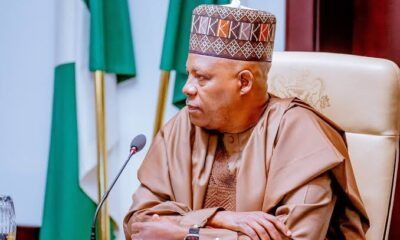

Economy would’ve Collapsed without Tinubu’s Reforms, Says Shettima
ShareVice President Kashim Shettima has said Nigeria’s economy would have collapsed had President Bola Tinubu not taken what he called...


House of Reps Seeks 90-Day Fuel Reserve for Nigeria by 2027
ShareFrom Rabiu Sanusi, Kano The House of Representatives has backed plans to increase Nigeria’s strategic petroleum reserve from 20 days...

56,000 Candidates Register for 2026 Private WASSCE
ShareThe West African Examinations Council (WAEC) said no fewer than 56,000 candidates registered for the 2026 West African Senior School...


JAMB Warns Varsities Against Issuing Admission Letters
ShareThe Joint Admissions and Matriculation Board (JAMB) has warned universities against issuing admission letters to candidates, insisting that only admissions...
Beyond Survival: Building A Healthier Nigeria For A Longer Life
ShareBy Yussuf Mubaraq Damilare What does it mean to live a long life if access to basic medical care remains...


Jigawa to Increase Corps Members Allowance – Namadi
ShareThe Jigawa government has announced plans to increase monthly allowance for the National Youth Service Scheme (NYSC) members posted to...