
Foreign News
Health Specialist Urges Women to take Care of their Health, Serve Society Well

From Sylvia Udegbunam, Enugu
A health specialist and founder (O.A.K) diabetic foundation USA, Uche Emeson has charged women to take care of their health so that they can take care of others and be available for their family and community.
Emeson made this call during the celebration of International Women’s day by Refreshing hope unique women at New haven Enugu, noting that women take their health for granted because they are the caregivers of the family.
She encouraged the women not to neglect themselves no matter how much they give to others, advising them not to be the last one to take care of themselves but rather go for annual physical exams.
According to her “Are you in a healthy relationship? I know you take care of someone that is your children, families, communities but at the end of the day, you don’t take care of yourself. You have to be alive and healthy to take care of others”, she said.
Refreshing hope unique women are there to empower women to take care of their community but at the same time, they are the centre of that community. Be in a healthy relationship whether they are married, single or young. Make sure your health counts so that you can give your best.
She further advises women to know their family history. “If cardiac arrest, diabetes or any sickness is in your family, it is very important that you trace it from your mother, grandmother, sisters and your siblings. If you find out that you have cardiac arrest in your family, you make sure you check your blood pressure at least every month”.
“If you know your family history early, you will start to manage it with lifestyle modification. Check the kind of food you eat, the portion of food you eat, if you have to increase your physical activities, monitor your numbers, know the nutrition plans you are giving to your family.
The Chief executive officer of Refreshing Hope Initiative, Adaena Ngozi said that the organization commemorates the women’s day annually which is known as Refreshing hope unique women.
She noted that it is a celebration where women and youths gather to align with what every woman is doing. A period to encourage, appreciate women and check and see how far they have gone in the struggle and fight to be heard, seen and given the opportunity to develop and be a part of developing Society.
However she pointed out that giving is not only cash or material things but one can give out time, advice, commitment, sacrifices and smile to someone depending on the need at that period.
The founder Heroine Foundation, Onyinye Mama in a panel discussion explained that this year’s International Women’s day themed “Give to Gain” connotes Justice, actions and Right. One has to give out something before gain.
“Whatever you expect to get from another person and you have not given to the society, you don’t have to demand for it. You have to give out justice, action and right to another person in your own small living circle so that you can gain something also.
She further advises women to exhibit good character in their various homes stressing that it is the spice of every marriage.
The event featured panel discussion, presentation of goodwill messages and dance by Solidarity school new haven Enugu.
A fire at a nursing home in Chile has killed 16 people, authorities said Saturday.
The blaze began on Friday night at the nursing home in the Araucania region, 640 kilometers (400 miles) south of the capital Santiago, and was extinguished in the early hours of Saturday.
Images shared on social media showed massive flames rising above the building in the darkness.
“We express our sorrow and dismay at the deaths of 16 elderly people in this tragedy,” authorities in the municipality of Pitrufquen said in a statement.
A total of 26 elderly residents were in the nursing home.
Ten of them survived and were taken to the local hospital, the statement said.Local mayor Jacqueline Romero said that municipal health and public safety teams, firefighters and police were deployed in response to the blaze.
“It is a situation that fills our souls with great sorrow and pain. We have been… providing support to the families,” she said.
The cause of the fire remained unclear.
“We are currently carrying out investigative procedures, including examining the scene and conducting inquiries, to determine the origin and cause of the fire, as well as to rule out third-party involvement,” Jorge Granada, the prosecutor assigned to the case, told local media.
Oil prices rose past $100 (£74) a barrel on Wednesday after further strikes in the conflict between the US and Iran and continuing Houthi attacks in Saudi Arabia.
In back and forth attacks, the US hit five Iranian tankers in reprisal strikes after Tehran targeted one of its warships.
Brent crude – which is the global benchmark for prices – has not been as expensive since the end of July, when a ceasefire between Iran and the US collapsed.
Yemen’s Iran-backed Houthi movement also attacked oil facilities in Saudi Arabia on Tuesday and have been targeting tankers in the Red Sea.
Brent crude did dip back down to $99.90 a barrel, but any fresh flare-ups in the Middle East could see it pushed higher again.
Tit-for-tat strikes between Iran and the US have escalated in the past week, more than six months after conflict broke out when the US and Israel launched attacks on Iran on 28 February.
Oil prices have fluctuated wildly since the war began, and pressure on the industry has been exacerbated by wider regional instability.
Before the conflict Brent crude had been priced at about $70 (£52) a barrel.
But the war has seen the effective closure of the Strait of Hormuz, which carries 20% of the world’s oil and liquefied natural gas (LNG).
The rising costs have sparked huge price leaps in petrol around the world for motorists at the pumps.
The US strikes on the five Iranian tankers saw four in the Gulf of Oman linked to Iran’s Revolutionary Guards Corps (IRGC) hit as well as another near Kharg Island.
Tehran responded by launching missiles at a US base in Jordan – most of which were shot down – and said it attacked two US vessels and eight oil tankers in the Strait of Hormuz.
The Houthis and Saudi Arabia have also been exchanging strikes since July after their own informal ceasefire unravelled.
On Monday the Houthis accused Saudi Arabia of bombing a prison in al-Hazm and killing 11 people.
Then on Tuesday the Saudi authorities said Houthis had struck civilian and economic sites in the cities of Abha, Khamis Mushait, Jazan and Najran.
The latest round of escalation comes after Iran targeted a US warship with ballistic missiles, which Centcom said were “successfully evaded”. It added that no American troops were harmed during the attacks.
In response, the US said that the five Iranian oil tankers it targeted were “part of a multi-billion-dollar shadow network that funds the IRGC and its regional proxies”.
One of the ships it had struck, the M/T Riesco, sunk in the Gulf of Oman, Centcom later said, posting a video on X of the damaged vessel.
Kharg Island – where one Iranian tanker was attacked in the latest round of US strikes – hosts Iran’s main terminal for exporting oil.
Some 90% of the country’s crude oil passes through the island in the Gulf, transported through pipes from the mainland.
Also on Tuesday, Yemen’s Iran-backed Houthi movement attacked energy facilities and civilian infrastructure in Saudi Arabia, injuring 73 people, according to Saudi authorities.
The drone and missile attack caused fires at oil facilities and installations that led to a temporary halt in operations, Saudi Arabia’s military and energy ministry said.
When asked by reporters about the latest tit-for-tat strikes between the US and Iran, US Secretary of State Marco Rubio on Tuesday said the situation was “pretty straightforward”.
“Iran continues to try to hit US naval ships. And, for every time they do that or try to do that, they’re going to lose tankers. And I think you’ll see that again today,” Rubio told reporters during a trip in Colombia.
The US strikes on Tuesday came hours after Iran’s Navy claimed it had seized an uncrewed US submarine in the Strait of Hormuz.
US Navy Capt Tim Hawkins, a spokesperson for Centcom, said that the “underwater drone operated by US forces malfunctioned more than a day ago” and was used to survey regional waters “in support of ongoing operations”.
The defective drone was “an older model that neither collected sensitive data nor carried any classified sonar or radar equipment”, he said, adding that US operations in regional waters were ongoing.
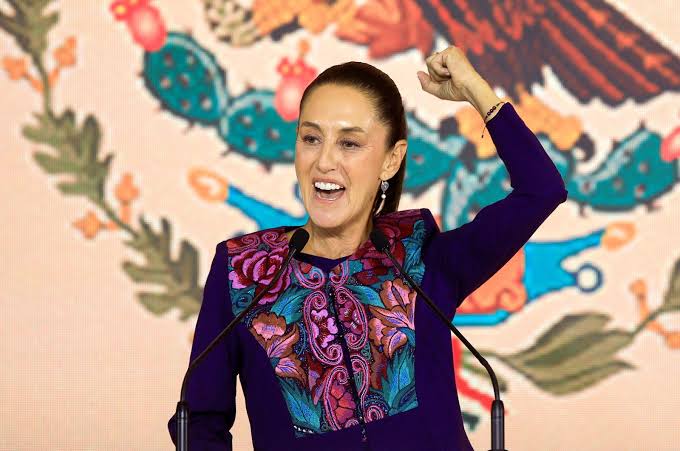
The United States must do its part in the fight against drug trafficking, Mexican President Claudia Sheinbaum said, following recent revelations of corruption at the U.S. Drug Enforcement Administration.
“We insist that they have a very important part to play over there and they shouldn’t just keep pointing the finger at Mexico,” Sheinbaum said at a press conference in the National Palace.
She said Mexico has succeeded in slashing the flow of fentanyl into the United States by more than 70 per cent, a figure acknowledged by U.
S. authorities.She added that the United States is also where the distribution of drugs and money laundering take place on a massive scale due to the high rate of drug consumption.
Sheinbaum also noted that Sara Carter, director of the U.S. Office of National Drug Control Policy, has acknowledged that drug abuse in the United States is a public health issue.
In May, Carter’s office released a document in which the U.S. federal government acknowledges the need for a national public health policy to address drug addiction.
Earlier this year, Carter visited Mexico and expressed interest in the Mexican government’s initiatives aiming to tackle the root causes of violence and prevent drug use.


Equities Market Sustains Gain with N315bn
Share The Nigerian stock market extended its positive momentum on Wednesday, marking the fifth consecutive bullish session. The market’s upward movement...
Nigeria’s Doctor Deficit and Surplus Unplaced Medical Graduates
Share By Abujah Racheal Every morning, Dr Adamu Inusa checks his phone, hoping to find the email that will define the...
Nigeria, Spain Move to Deepen Trade, Investment Ties
ShareNigeria’s Ambassador to Spain, Okezie Ikpeazu, has called for the revitalisation of existing bilateral agreements with Spain, including the Bilateral...

World Bank Group Appoints New Chief Economist
ShareWorld Bank Group President, Ajay Banga, has announced the appointment of Nobel laureate, Michael Kremer, as the institution’s Chief Economist...
Efficient Ports Key to Nigeria’s $1trn Economy Target, Says Akutah
ShareThe Director-General of the Nigerian Ports Economic Regulatory Agency (NPERA), Dr. Pius Akutah, said efficient and competitive seaports are critical...
Kano Police Arrest 10 Suspected Inter-state Car Thieves
ShareThe Kano State Police Command has arrested 10 suspected members of an inter-state motor vehicle theft syndicate and recovered 12...
GOC Tasks Troops on Vigilance, Commitment to Tackling Insecurity
ShareThe General Officer Commanding (GOC) 2 Division, Nigerian Army, Maj.-Gen. Auwalu Mahmuda, has advised troops to be vigilant and committed...
Troops Rescue Seven Kidnap Victims in Benue
ShareTroops of Operation Whirl Stroke (OPWS), in collaboration with the Nigerian Police Force and local vigilantes, have rescued seven kidnapped...
Bayelsa United Ex-players Donate Jerseys Ahead of NNL Season
ShareFormer players of Bayelsa United on Wednesday donated a set of jerseys to the club to support their preparations for...
Fernandez Signs New London City Contract
ShareLondon City Lionesses defender Jana Fernandez has signed a new contract, keeping her at the club until 2029. The 24-year-old...