
OPINION
Is Ibadan Tinubu’s 2027 Strait of Hormuz?

By Festus Adedayo
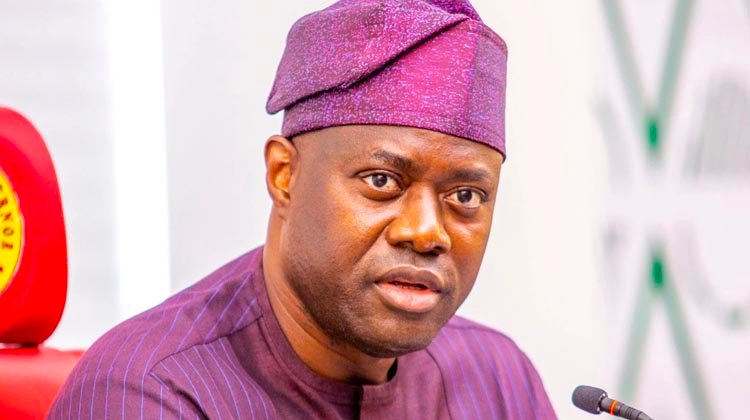
Yesterday, Seyi Makinde, governor of Oyo State, rallied Nigeria’s opposition political parties to Ibadan. According to him in his welcome address, the summit was to rescue Nigeria from the stranglehold of Nigeria’s apparent descent into autocracy, “a pattern where the space for real political competition is disappearing.
” Ibadan summit’s message is an echo of a famous proverbial phrase and song of late Yoruba broadcaster and actor, Papa Adebayo Faleti, in the classic film, Saworoide. Faleti warned the maximalists of Jogbo country, especially its ruler, Lapite, a corrupt and ambitious king who skips traditional rituals to rule selfishly and perhaps forever, that there will be consequences for inordinate ambition. “Òrò yìí yó mà l’éyìn, àjàntièlè,” Faleti sang.To underscore Ibadan’s historical centrality in recalibrating a drifting Nigeria and warning its rulers of calamity ahead, Makinde made reference to a similar summit held on Ibadan soil in 1950 and the calamity of Operation Weti e. A Yoruba word for “drench it” during the violent political crisis in Western Nigeria between 1962 and 1965 which led to the “Wild Wild West” anarchy tag. It was hallmarked by riots, arson and drenching of political opponents with petrol as a result of an attempt to rig elections. That crisis became the precursor of the 1966 coup.
From January 9 to 28 of 1950, a review of the Nigerian Constitution took place in Ibadan to address shortcomings of the 1946 Richards Constitution. Ibadan welcomed fifty members of the Legislative Council where the push for greater autonomy and regional representation that laid the groundwork for the 1951 Macpherson Constitution was made.
Same summit was held in Ibadan on October 19, 1954. On this day, some of the most influential nationalist figures of mid-20th-century Nigeria gathered in Ibadan. The mercurial Adegoke Adelabu was there. So also were figures like T.O.S. Benson, Dr. M. I. Okpara, Dr. Nnamdi Azikiwe, Dr. Okechukwu Ikejiani and another NCNC top-shot, Mr. Arimah. That gathering was a reflection of the importance and dominance of Ibadan as a major political force and battleground.
From the 1950 summit, to that of 1954, Ibadan has always been a hot-seat of roiling politics and attempt to reshape a broken Nigerian space. Ibadan never looked back. Its party politics is a hotbed of intense rivalry, shifting coalitions, alignment and realignment of interests. One of its markers was the infamous First Republic phrase, “If you see my hand, you cannot see the inner of me; Demo (NNDP) is the party I support” “B’òo r’ówó mi, oò rí’nú mi, Demo n’mo wà”. The Mabolaje-NCNC alliance conversation, held in Ibadan, prepared grounds for Nigeria’s October and December regional and federal elections. NCNC and the Mabolaje, a dominant Ibadan-based political movement, led by Adelabu, was mordantly opposed to Chief Obafemi Awolowo’s Action Group.
Music had a place of pride in this electrifying politics. In pre-colonial Africa, not only were musicians custodians of history, they were defenders of political figures. Their songs addressed political, social, and economic issues of society. At the Mabolaje-NCNC alliance of 1954 venue, though I have no empirical fact to back it up, I am almost sure Odolaye Aremu, Ilorin Dadakuwada music exponent, would be on the bandstand. As Hubert Ogunde was AG’s official musician, so also was Odolaye for the NCNC. You will recollect Ogunde’s Yorùbá Ronú song, a politically motivated rendition which was a total condemnation of SLA Akintola’s government. Odolaye also shot back with his adulatory dirge for SLA and Adelabu when both died.
Wrapped up in a unique traditional Yorùbá musical genre originating from Ilorin, Kwara State, which combines Oríkì (praise chanting), Òwe (proverbs), and Àròfò, (poetry) Odolaye delivered lacerating punches to counter the Action Group. One of such was his mockery of Awolowo’s free education policy which he claimed was not well thought out. He sang, “e jé ká ra léèdì (pencil) k’a si ra’we, iwe ti won ò rà télè télè láti kékeré o, ìgbà wo l’àá kà’wé t’ó di baba?”. On Adelabu’s car crash in 1958 while returning to Ibadan from Lagos, which led to riots and many deaths because he was believed to have been murdered, Odolaye made a cryptic quip insinuating he was murdered: “Death came for Adelabu suddenly… must we set trap for ourselves?” – “Ó kù dèdè k’ó w’Olúyòlé l’olójó dé o/Njé ó ye ká de tàkúté de’ra wa?”
In a few days’ time, I will be doing a public review of the book, Black Esther: The Tales of Ìyá Olóbì, My Grandmother. Written by Kayode Samuel, veteran journalist and former Chief of Staff to ex-Governor Gbenga Daniel of Ogun State, Samuel’s grandmother was a profoundly witty woman. Her grandson, the author, must have inherited her spellbinding wits. Ìyá Olóbì (Woman trader in Kolanut) was most times very prickly, especially on issues that had to do with Omo Yíbò (the Igbo). She was a willing accomplice of the then spiraling mutual mistrust between Yoruba and Igbo which gained notoriety shortly before independence. Often times, Ìyá Olóbì manufactured other wordly-like stories that ended up as ethnic profiling of the Igbo. Undoubtedly, however, she was a parlour heroine, a victim of her own animus, a woman whose daily life was an admixture of women wiles, humour and mastery of the power of the Yoruba language.
Black Esther is full of Ìyá Olóbì’s linguistic nuggets. Let me single out two of those which exhibit her Yoruba mastery. They flashed through my mind two Saturdays ago immediately I saw the musical tantrums of Saheed Osupa, Yoruba Fuji music icon, whose real name is Akorede Babatunde Okunola.
On that Saturday, Ibadan attempted to erupt again. Not because of the catalyst for the eruption, a gubernatorial intention declaration, tucked away in an innocuous part of the city. It was Osupa’s descent into needless talkaholism.
As I said earlier, Ibadan has an unmatchable historical pedigree as epicenter of electrifying politics. Its politics has evasiveness and flamboyance. It is equally garnished with volatile swear words and name-calling. This gives it a remarkably competitive edge, more than many other cities in Nigeria. You may wonder why two gubernatorial aspirants in the same APC, Sharafa Alli and Bayo Adelabu, have declared and counter-declared to govern the state; why a neutralizing force in the person of Teslim Folarin is waiting patiently like a vulture to harvest their mutual destruction. Having captured 32 states, I am told, Ibadan is so important to Bola Tinubu that, he might personally relocate to Oluyole to monitor its 2027 gubernatorial election.
Back to the Ibadan Saheed Osupa tantrums. The two poignant words from Ìyá Olóbì I referenced above taste differently. While one related closely to the Osupa issue, the other, more of a symbiotic philosophical cause and effect, is tangentially related to it. Ìyá Olóbì’s first hypnotic word came when family members, seeking resolution to how her nephew, who had just graduated from learning a printing trade, was discovered to have put a teenage girl in the family way. How the boy could have become that aberrant, the family wondered, concluding that the Ìyá Olóbì nephew was seized by the spirit of wrongdoing. Unable to countenance the unscience behind that reasoning, Ìyá Olóbì’s retort was, in her Yoruba Egba dialect: “Eni yìí kìí báá máa mu sìgá, ìsòro ni kí wón fi igbó seé” translated to mean, it is almost an impossibility to have someone who does not smoke cigarette get afflicted by a marijuana-smoking addiction.
The second Ìyá Olóbì retort actually came before the first. It was her first magisterial pronouncement about this nephew of hers, immediately she heard of his rascally libido. For a boy who was still being fed at home to find the energy to impregnate a girl, Ìyá Olóbì reasoned mockingly, it was a sign of an over-filled belly. In the same Egba dialect, she said, matter-of-factly, “Eni kò bá yó okó rè kíí le”. It means, an erect manhood is a fallout of a full belly.
If you saw the way Osupa hyper-ventilated at the said Ibadan political rally, you would conclude that it was a cause and effect. His bellyful catalyzed the uncontrollably erect manhood of arrogance he advertized. Or that, one of the spirits of his people had taken hold of him: a harmful magical spell (Àránsí); spirit of wrongdoing (Àṣìṣe); a charm or curse (Àsàsí) or Èèdì (a malicious spell that hexes one to bring bad luck). You could also suspect substance influence.
Many African indigenous musicians are routinely labeled “praise songsters” due to their thematic concentration on adulation. Right from his first ad-lib, Osupa had no one in doubt that he had come for a musical warfare. Then, he began to exhibit one of those afflictions above, which got him into trouble with denizens on the social media. As if Ibadan are serfs of monarchies, he sang that “Wherever OIubadan is headed is where the people will,” maintaining that only Ibadan bastards would vote against the man who paid for his presence at the rally. Then, to excite his partisan audience, he threw barbs at the governor of the state. Immediately, Netizens brought out clips of effusive praises he earlier showered on the governor for gifting him an SUV. His attempt to clarify further worsened people’s perception of him as an inherently reversible personality. It reinforced the narrative of ingratitude. So, because of his transactional disagreement with his erstwhile benefactor, a public arena became ground for ventilation of personal grouse?
Thereafter, Osupa was thoroughly tongue-lashed by Netizens, so much that, a while after, he had to take a space on the information highway to explain his misspeak. Some of the respondents said he was afflicted by the spirit of àsìse. But, as Ìyá Olóbì would say if she was on this divide, no one should make excuse for him. Osupa should carry the cross of his irresponsible dabbling into a turf where he knows little about.
While many who watched the Osupa show were thoroughly disappointed in him, most of those who knew the historical pedigree of traditional African praise singers were not caught unawares. From ancient times, praise singers or griot were usually like flies hovering on kings’ palmwine calabash mugs in palaces. They also always perched on homes of influential people in society to be dashed used clothes and shoes. Indeed, they were called Alù’lù gb’omi èko – those who drummed to be paid with bric-a-brac. While bards served as court historians, helping to codify ethnic groups’ genealogy for posterity, a pall of general perception as beggars, “alágbe” hangs over them till today. It doesn’t matter that, over the century, many of them have transformed due to acquisition of education, wealth and have become pretentious gentlemen. They still are like the uniquely smelly vegetable called ebòlò, which my people say it is impossible to pluck from the dumpsite and have it smell uncontaminated, without the filthy odour of the dumpsite oozing out of it. Osupa’s recent degree certificate apparently serves little effort to cleanse him of a historical malaise.
I dwelled on the nature of Osupa’s doublespeak in earlier pieces I did. I concluded that it was a manifestation of tendencies of Yoruba musicians to oscillate from praise to dispraise. Permit me to regurgitate previous references. To explain this binary, I cited Alamu Atinsola Atatalo, one of the pioneers of Dùndún and Sèkèrè traditional music in post-colonial Yoruba Nigeria. Atatalo reinforced the transition of the tongue from one superlative extreme to the other, as defined by the musicians’ esophagus and passion. At a small level, Atatalo mirrored the typical Ibadan, whose tongue cuts through rough edges like hot knife on butter. Born into the Ajáláruru family of Òópó Yéosà in Ibadan, the 1950s and 1960s saw Atatalo dominating the Ibadan musical scene, first as a Sèkèrè and Dùndún drummer, and much later as singer and drummer.
In two of his songs, within a short time span, Atatalo shot a woman friend of his down from the echelon of praise to the abyss of dispraise. In the first song, apparently struck by the sweet piercing arrow of Cupid, he advertised this woman friend of his’ restaurant in such superlatives that you would want to visit it to have a taste of her highly burnished culinary prowess. Tatalo described the restaurant as located in Ayéyé, Ibadan. He wasn’t done. It was the best place where quality àmàlà and ewédú soup could be found in the whole of the city, he sang. The restaurateur garnished her soup with fish and shrimps, he sermonized. Tatalo’s melodious rendering of these lines was done in a typical Yoruba superlative, so gripping that, finding the right word to explain it may be a barren exercise. He sang: “Sokotoyòkòtò l’ó fi ńp’èèlò è, edé l’ó fi ńpa’ta/Ìyàwó Atátalò tí ńbe l’Áyéyé!”
Not long after, however, as he sang in a later album with the title, Àá fì’dí kalè ni, a passing train would seem to have put a wedge to the two lovebirds’ affair. Tatalo then flipped 360 degree. He sang of how this same woman, who had now become his ex, in alliance with her mother, had become a disgrace to motherhood. He was not done. Both mother and daughter engaged in shameless prostitution, he revealed. The restaurant, which Tatalo once praised to high heavens, had now, in his words, become so slovenly in appearance and smelly that it was fly-ridden. Indeed, sang Tatalo, off-putting smell of gonorrhoea (àtòsí) urine oozed out of the restaurant, so much that no one could enter it! The immediate question you would want to ask Tatalo is, how different does gonorrhoea urine smell from other smell?!
For Osupa, also an Ibadan like Tatalo, how a benefactor suddenly swings from a positive superlative to negative superlative is a shifty mind that meanders from praise to dispraise, defined by personal benefit and patronage and not public good.
It may however be unfair to restrict Osupa’s cheap moral reversal to musicians alone. In a fragile world like ours, loyalty, friendship and ability to stay the course are collapsing. In the face of Mammon and filthy lucre. Politicians manifest it. Friends betray friends at daggers drawn. Brothers stab brothers in lethal strikes more painful than Brutus and Julius Caesar’s.
As Ibadan gradually gravitates towards its political decision day, in the words of Babatunde Fashola, loyalties will be tested and will collapse. Shifting alliances will occur, shifted by love of selves and cash. Osupa may need to reverse himself and sing the adulation of Bayo Adelabu, the Minister of Power, who just returned to Ibadan for a consequential political tango with Sharafadeen Alli. Osupa may be needed to reverse the damaging investiture of “the King of Pitch Darkness” which Netizens hung on the minister’s neck with his reversible tongue. He may even sing the panegyrics of the most lethal political tactician among them, Teslim Folarin, who will give both a run for their monies. Or even Makinde’s gubernatorial choice.
Whichever way, Ibadan is answering to its political pedigree as epicenter of electrifying politics. More importantly, it was the place where Nigeria faced the fatal comeuppance of First Republic politicians’ political sacrilege. Could yesterday’s summit be another warning against a similar political sacrilege of a potential Fourth Republic one-party state Nigeria? Could it be Nigeria’s own Iranian Strait of Hormuz threatening to unravel our own Donald Trump?
As Makinde said in Ibadan yesterday, those who fail to learn from the poignant episode that took place on the soil of Ibadan 60 years ago may catalyze a re-enactment of the anger of history in year 2027. The butterfly that runs inside a thick mass of thorns will have its cloth torn in shreds. An impala that defies the Kinihun (Lion), Chief Circumciser of the Forest (Oloola Iju), who incises without a scalpel, will bathe in a puddle of its own blood. History’s cudgel, used to whip the older political wife of the First Republic, is on the rafters for the younger wife, political maximalists and their surrogates.
When Adeolu Akande was rounding off his doctoral thesis at the University of Ibadan in 1995, Wale Adebanwi, Remi Aiyede, myself and other academic kindred spirits were battling the rigour of a Master’s degree in same political science department. We were all under the umbrella of an ecumenical academic figure, Prof Adigun Agbaje, who later supervised Adeolu’s, mine and Adebanwi’s doctoral theses. Akande thereafter became a professor at the Igbinedion University, Okada, studied for an LLB and was called to the Nigerian Bar.
The charge against academic-minded persons like Akande, for which some of us became recipients, being guilty as charged, is that we are married to theory and isolated, in a mis-matrimony, from praxis. By leaving politics in the hands of the flotsam and jetsam of society – apologies to Chief Obafemi Awolowo – they say, we have left our plates unwashed and cannot complain when they are marooned with flies. Akande later heeded this clarion call, became the Chairman of the Nigerian Communications Commission (NCC) and is today desirous of serving his people as Senator representing Oyo North constituency. Unlike Akande, some of us are yet to be purged of that distancing of selves from the murky waters of Nigerian politics.
Brilliant, clear-minded, purposeful-thinking, Akande, who hails from Otu in Oyo State, is the kind that a people desirous of development should have as their legislator. Dangerous it may seem for anyone to vouch for a Nigerian politician, I can vouch for Professor Akande as capable of bringing a difference to the politics and development of his Oyo North District. A beacon of intellect, he embodies wisdom in service. His vision transcends classrooms, reaching the heartbeat of his people. With courage and clarity, he stands ready to transform his constituency’s aspirations into lasting progress.
As Nigeria gradually enters the political season ahead of the 2027 general elections, there is a growing temptation among politicians to return to the familiar playbook: aggressive campaigns, endless promises, political propaganda, ethnic calculations, religious sentiments and the mobilisation of money and machinery.
But if the political class is paying attention, the recent Osun election should offer a sobering lesson.
Elections are no longer simply contests between political parties or exercises in political arithmetic. They are increasingly becoming referendums on performance, credibility, organisation and the relationship between politicians and the people.The Osun experience should therefore be more than another election victory or defeat to be celebrated by one camp and rationalised by another. It should be a warning to every politician preparing for 2027.
The first lesson is that the people are watching.
For too long, Nigerian politicians have behaved as though voters can be permanently manipulated with slogans, inducements and election-day theatrics. But voters are becoming more discerning. They may still respond to material incentives, but they also remember who governed well, who failed, who showed up and who disappeared after collecting their votes.
The second lesson is that political structures cannot replace public trust.
A party may possess powerful godfathers, influential leaders, vast resources and impressive campaign machinery, but these cannot indefinitely compensate for a credibility deficit. Political structures are important, but they work best when they are reinforced by genuine voter confidence.
The third lesson is that incumbency is not an automatic guarantee of victory.
Those who occupy political offices must understand that public office comes with a political bill that eventually falls due. Roads, schools, healthcare, jobs, security, salaries, infrastructure and the general welfare of citizens are not merely governance issues; they increasingly shape electoral decisions.
The politician who assumes that occupying government gives him an irreversible advantage may discover, rather painfully, that voters have the final word.
There is also a lesson for opposition parties. Winning elections requires more than criticising the government. Nigerians are increasingly interested in alternatives. Opposition parties must articulate credible programmes, build strong grassroots structures and demonstrate that they have the competence and discipline required to govern.
Perhaps the most important lesson is that 2027 cannot be approached as politics as usual.
Nigeria is facing an electorate that is younger, more digitally connected and increasingly vocal. Social media has changed political communication. Citizens can challenge official narratives in real time. Political mistakes can become national conversations within minutes. Candidates can no longer depend entirely on traditional campaign rallies and carefully managed media appearances.
The political class must also recognise that Nigerians are tired of being treated as statistics during elections and forgotten citizens afterwards.
The road to 2027 will undoubtedly produce the usual alliances, defections, endorsements and political realignments. There will be new coalitions and old rivalries. There will be attempts to weaponise identity, manipulate emotions and redefine political narratives.
But the real question is whether politicians will learn from Osun.
Will they understand that voters deserve respect? Will they realise that performance matters? Will political parties begin to prioritise competence over loyalty? Will candidates campaign on ideas rather than insults? Will politicians understand that democracy is not simply about winning elections but earning the legitimacy to govern?
These are the questions the Osun election should force the political class to confront.
The 2027 election is approaching. The campaign season may only be beginning, but the lessons have already arrived.
The politicians who choose to ignore them may do so at their own peril.
Nigeria’s voters are watching. And this time, they may be keeping a much longer memory.
Kokome, a communications strategist and public affairs analyst, writes from Lagos via kokomejohn@yahoo.com
By John Chibuzo Emmanuel
The realm of Nigerian politics today is a chessboard where our bones and dripping blood are recklessly tossed from one end to another. This is why one of the most quoted phrases in the history of our nation is “politics is a dirty game.
” Well, from the days of Azikiwe right to the days of Asiwaju, from Balewa to Buhari, from Gowon to Goodluck, from Obafemi to Obasanjo, corruption scandals have never ceased to dominate our headlines.Achebe summed it all up when he lamented: “The trouble with Nigeria is simply and squarely a failure of leadership.
There is nothing basically wrong with the Nigerian character. There is nothing wrong with the Nigerian land or climate or water or air or anything else. The Nigerian problem is the unwillingness or inability of its leaders to rise to the responsibility, to the challenge of personal example which are the hallmarks of true leadership” (Achebe 1).And in these trying times of ours, when the blood of our children flow in the thick green forest, when the cries of our raped mothers do nothing but chase away the watching birds that perch on the tall trees, when the screams of our brave soldiers that echo in the forests serve as their untimely and only goodbye; we must remember General Murtala Muhammad. In this era when inhumanity has replaced our sense of religion and empathy, we must not forget a man who truly loved, lived and died for Nigeria. We must not forget the bravest and most fearless leader to have walked the brown earth of this barren land endowed with the greatest mineral deposits. Do not laugh at this paralyzing but profound and truthful paradox.
It is indeed a national tragedy that the most distinguished and excellent individuals in our short history have either been relegated to the background of oblivion, persecuted by the majority, or slaughtered on the altar of envy. It is a national tragedy that our school children know nothing of their history or heroes. It is even a greater tragedy that they are being robbed of noticeable examples of distinguished leadership from our history. The painful consequence of this is that we have come to accept stupidity and ideological bankruptcy in politics as our national guiding principles.
Mothers in the marketplace, children in malpractice-ridden schools, students in dilapidated institutions, brave soldiers dying in the thick enclaves of Sambisa, intellectuals tired from years of doing battle with the federal and state governments, do not forget General Murtala Muhammad. Do not forget General Murtala for he is a reminder of all we can achieve if we eradicate the different manifestations of corruption unique to our lives.
General Murtala was born on November 8, 1938, and became one of the youngest generals throughout the history of Nigeria. At the age of thirty-six he took over the reins of government from General Yakubu Gowon on July 29, 1975, through a bloodless coup d’etat, and ruled the country for just two hundred days before he was assassinated by Lieutenant Colonel Bukar Suka Dimka on February 13, 1976.
However, in his two hundred days of power, he implemented some of the most impactful and iconoclastic social and economic reforms ever seen in the history of this country. In his two hundred days of power, he sacked more than ten thousand corrupt and incompetent civil servants. In his two hundred days of power, he conceived and began implementing a vision of a central capital city other than Lagos. This city is now known as the city of Abuja.
In his two hundred days in power, he championed African Liberation Movements throughout Africa as well as opposed apartheid and neo-colonialism virulently. In his two hundred days of power he did what even democratically elected leaders have always hesitated to attempt: decentralization of the national executive. He decentralized his executive powers into a military triumvirate consisting of himself, Olusegun Obasanjo and Theophilus Danjuma.
In his two hundred days in power, the University of Jos—my alma matter—became a degree awarding institution. In his two hundred days of power he set Nigeria on the path of democracy before his tragic and untimely end. In his two hundred days in power he taught Nigerians the definition of true leadership.
No wonder Achebe once popularly wrote: “On the morning after Murtala Muhammed seized power in July 1975, public servants in Lagos were found “on seat” at seven thirty in the morning. Even the “go-slow” traffic that had defeated every solution and defied every regime vanished overnight from the streets.” How can one man wield such a positive influence in our national culture?
General Murtala Muhammed never allowed his ideas to rot in the bureaucratic files of government “experts”. For this, his signature phrase “with immediate effect” has become one of the most used and sadly, abused phrases by Nigerian politicians.
Do you know that the expression “fellow Nigerians” which has been bastardized by Nigerian leaders today was a term he coined and used to address ordinary Nigerians on the street whom he truly cared for? Do you know that upon his ascension to power he cut down the heavy security and military convoys that have come to characterize modern Nigerian politics? Do you know that in his two hundred days of power corrupt military officers and even military governors faced the wrath of the law just like every other Nigerian citizen on the streets? Do you know that all this was achieved by a man of just thirty-seven years?
If we forget Murtala Muhammad, we forget the dream of the poor hawker on the street, the prayer of the sun bathed keke driver, the hope of the unemployed graduate on the verge of suicide, or the resilience of the Northern girl child in her quest for education. If we forget Murtala Muhammad, we forget the Nigerian dream. The dream of living a peaceful and happy life.
On this historic day, we must remember General Murtala Muhammed and all he stood for so that we can eternally realize and regret the depth of our profound ignorance if we make a mistake on the 2027 ballot box. We cannot afford to make a mistake in the ballot box unless we want to eternalize the pain and tragedy of our lives. Vote for the future; our future, next year. Thank you for listening.
John Chibuzo is a Nigerian writer, literary critic, educator and multi-instrumentalist based in Jos city. His poetry and essays have been published in The National Scholar, Lolwe, Beyond the Pages, Nestle on the Rock and the anthology: Letters to the Union We Hope to Become. He co-founded The Excellent Magazine in 2024 and served as it’s first editor-in-chief. He studied English and Literature at the University of Jos.
By Tochukwu Jimo Obi
The rate at which public infrastructure is being vandalised and stolen across Nigeria, particularly in the Federal Capital Territory, Abuja, has reached an alarming level that can no longer be ignored.
What was once regarded as isolated acts of petty criminality has gradually become a serious threat to public safety, government investment and the effective functioning of cities. Across Abuja, the brazen removal of public infrastructure has become so widespread that urgent and coordinated action is now required.One of the most disturbing examples is the widespread theft of manhole covers.
In several parts of Abuja, open manholes have become a common sight following the removal of their metal covers by vandals. This poses a serious danger to pedestrians, motorists and other road users, particularly at night. Beyond the immediate safety risks, the theft of these covers demonstrates the extent to which public property is being systematically stripped for the purpose of making quick money.The problem, however, goes far beyond manhole covers. Bridge rails, railway tracks, underground cables, solar street lights, electrical installations and other public facilities have also become targets. Infrastructure installed with taxpayers’ money is being dismantled and carted away, often with little or no resistance. The consequence is that facilities designed to improve public safety, transportation, security and the quality of life of citizens are being destroyed by individuals motivated by short term financial gains.
A major destination for these stolen materials is the network of makeshift scrap markets popularly referred to as “pantaker markets” in Abuja and its environs. These markets provide an avenue through which stolen public infrastructure can allegedly be disposed of with relative ease. The existence and continued operation of such markets should therefore be treated not merely as a commercial issue, but as a security and public infrastructure concern requiring the attention of relevant authorities.
Even more troubling is the role of those who purchase these materials. It is difficult to accept that buyers of manhole covers, cables, bridge components, railway materials and other government infrastructure would always be unaware of their origins. Where such materials are offered for sale under suspicious circumstances, buyers should be expected to exercise due diligence. Anyone who knowingly purchases stolen public property is not merely engaging in commerce; such a person is helping to sustain the criminal network responsible for the theft.
It is therefore worrying that successive administrations in Abuja have not appeared to give this problem the level of attention it deserves. Government agencies responsible for infrastructure, environmental enforcement and public safety must work closely with the police, civil defence authorities and other relevant security agencies to identify and raid locations where stolen public infrastructure is being traded. Such operations should not be limited to the arrest of street level vandals. Dealers, middlemen and buyers who knowingly participate in the illegal trade must also face investigation and prosecution.
The economic cost of this criminality is enormous. Every manhole cover, street light, cable, bridge rail or railway component stolen from public infrastructure must eventually be replaced. Money that could have been used to construct new roads, improve healthcare, provide schools, expand public transportation or address other pressing social needs is instead spent repeatedly replacing facilities that have already been provided. This creates a vicious cycle in which the government invests in infrastructure, criminals destroy it, and taxpayers are forced to finance its replacement.
There is also a broader question of public responsibility. Citizens should not remain passive when they witness the destruction or suspicious sale of public property. Communities have an important role to play in reporting vandals and suspicious dealers to the appropriate authorities. Government, on its part, must create effective reporting mechanisms and ensure that information supplied by citizens is acted upon. Enforcement will be difficult if citizens look the other way while stolen public property is openly traded in their communities.
The Federal Government, states and the FCT Administration and security agencies must therefore treat public infrastructure theft as a serious national security and economic issue. There should be a sustained crackdown on vandalism, proper regulation of scrap markets, effective monitoring of critical infrastructure and swift prosecution of those found culpable. Most importantly, enforcement must be consistent rather than occasional, because criminal networks quickly return whenever they discover that government attention has waned. Nigeria cannot afford to continue losing scarce public resources to vandals while millions of citizens struggle with inadequate infrastructure. The time to act decisively is now.
Tochukwu Jimo Obi, a concerned Nigerian writes from Obosi Anambra state.



NCS, WCO, UK Intensify Anti-Corruption Drive, Strengthen Customs Integrity
Share By Tambaya Julius, Abuja The Nigeria Customs Service (NCS), in collaboration with the World Customs Organisation (WCO) and the...
Bayelsa Receives Twon-Brass Draft Constitution
ShareFrom Mike Tayese, Yenagoa The Bayelsa State Government has received the final draft copy of the constitution of Twon-Brass Kingdom...
Nigeria’s Reforms Must Now Deliver Jobs, Higher Incomes – CPPE
ShareCentre for the Promotion of Private Enterprise (CPPE) has urged the Federal Government to shift its economic reform focus from...
NICA Seeks N2trn Credit Guarantee Fund to Unlock Nigeria’s Economy
ShareThe National Institute of Credit Administration (NICA) has called for the immediate capitalisation of the Nigerian Credit Guarantee Company (NCGC)...
Aiyedatiwa Won’t Support Candidate against APC – Aide
ShareSteve Otaloro, the Senior Special Assistant (SSA) on Public Engagement to Gov. Lucky Aiyedatiwa of Ondo State, has dismissed rumours...

2027: NDC Affirms Sule-Garo as Kano North Senatorial Candidate
ShareThe Nigeria Democratic Congress (NDC) has affirmed Nasiru Sule-Garo as its senatorial candidate for Kano North Senatorial District in the...
Insecurity: Sokoto Gov’s Aide Urges Unity against Banditry
ShareThe Special Adviser on Security Matters to Sokoto State Governor Ahmed Aliyu, Col. Ahmed Usman (retd.), has called on political...
Lagos Community Seeks Intervention over Lingering Refuse
ShareSome residents and shop owners in Orile, Iganmu, Lagos, have appealed for urgent intervention over persistent refuse accumulation. They said...

Nollywood Actor, Taiwo Hassan ‘Ogogo’ Dies
SharePopular Nollywood actor, Taiwo Hassan, better known as Ogogo, is dead. The news of the actor’s death was confirmed by...


FRSC Evacuates 15 to Hospital in Kano-Zaria Road Crash
ShareThe Federal Road Safety Corps (FRSC), Kano Sector Command, has rescued 15 persons following a lone road traffic crash involving...