
OPINION
Mbah and Enugu Governorship Seat


By Chuks Iloegbunam
There is this social media skit on democracy that is forever entertaining. In it, a teacher tells his students that, despite Abraham Lincoln’s classic definition, democracy was actually “the government of some people by some people and for some people.
” Government, stressed the teacher, was for those with “bastard money. ” He soon proved the point, for the principal decrees the class must have a prefect. Two students vie for the position. The female student gets a majority of the votes. His male opponent receives a single vote. But he had boasted that his father was stupendously rich and had demonstrated it by giving the teacher a backhander. The teacher announces the briber, the class prefect. To the class’s protestations, he asks them to go to court and storms out.That is Nigeria – a huge joke for which it is the world’s laughingstock. But who really cares? As Georgi Plekhanov, the Soviet Marxist theoretician, said, the dominant ideology in any society is that of the ruling class. Thus, the stench runs through the system – from top to bottom. The courthouse is an amphitheatre for abracadabra. The professorship is for sale, and the Ph.Ds abound that cannot render a single correct sentence. The preacher’s utterances from the pulpit are powered by the highest bidder’s whim. The policeman’s post is a turnpike. Examination scores of the Joint Admissions and Matriculations Board (Jamb) are for manipulation. Nothing is sacred. After all, what money cannot do, more money can effortlessly accomplish.
Still, things cannot forever remain hopeless because they are terrible today. Recent political developments, especially the youth-powered Obidient Movement, have underscored the imperative of Nigeria taking a redemptive turn. The current chant is that he who comes into equity must come with clean hands. The maxim insists that Nigeria’s elective offices should no longer be confiscated and annexed with the bludgeon of money or the sword of subterfuge. Henceforward, anyone in an elective position must be seen to have attained it on the strength of the people’s mandate. That is the democratic imperative. It dictates, for instance, that the Governor of Enugu State must be someone qualified and deposited in that post by the vote.
The world waits for the Election Tribunal to pronounce anathema on the political heist that passed for the Enugu State gubernatorial election on Saturday, March 18, 2023. The Governor of Enugu State must not be a politician shown conclusively to have lied under oath through the dissemination of fabricated documents. The Election Tribunal must advance democracy by supporting the Nigerian Constitution, which abhors usurpation.
I am yet to have the pleasure of meeting Barrister Peter Mbah; the man pronounced the elected Governor of Enugu State by the Independent National Electoral Commission (INEC). Long may he live. I hold nothing personal against him. If we met, I should greet him with a warm handshake and, possibly, hold a conversation with him. But I will remind him that in a democracy, elective offices may not be attained by contrary means. I have, on a few occasions, encountered the Mbah guy in the media. Once, someone watching a video with me suggested that he was charming. They, of course, missed the point severally. Apart from beauty being in the beholder’s eyes, an election is far from a beauty pageant. If elections were indexed on a charm offensive, there is today a man occupying a prime estate around Abuja’s Three Arms Zone that would have been chased from its precincts by koboko -wielding musclemen.
Only last week, Barrister Mbah granted an extensive interview to an online publication in which promises tumbled on additional promises. He would transform hilly and patched Enugu into watery essence! He would seize the state’s obsolete economy by the scruff of the neck and drag it straight into modernity. Take a read: “Peace, progress, and sustainable prosperity are inextricably linked. Without sustainable peace, there can be no sustainable development. We need urgent programmes to turn our youths into productive assets for economic growth and social progress, not sources of fragilities in our communities. Through integrated rural development programmes, we will transform our villages and rural communities to become zones of economic productivity and youth development, not zones of insecurity and misery.”
Even if the above isn’t horsewallop, how is electoral injustice going to birth sustainable peace? How does the crowning of an underserving pate negate fragility? The arguments against Peter Mbah’s governorship are formidable. On April 5, 2023, Barrister Chijioke Edeoga, the Labour Party gubernatorial candidate, and the Labour Party petitioned the Enugu State Governorship Election Tribunal on the governorship election. The Respondents are the INEC, Mr. Peter Mbah, and the Peoples Democratic Party (PDP). The Petitioners are seeking these reliefs: (a) An order invalidating the return and declaration of the 2nd Respondent as the winner of the Enugu State Governorship Election held on March 18, 2023. (b) An order withdrawing the Certificate of Return issued by the 1st Respondent to the 2nd Respondent, allegedly as the winner of the Enugu State Governorship Election. (c) An order directing the 1st Respondent to issue forthwith to the 1st Petitioner the Certificate of Return as the winner of the Enugu State Governorship Election, and (d) And for such further Order as the Honourable Tribunal may deem fit to make in the circumstances.
The Petitioners argue that: (i) The 2nd Respondent was, at the time of the election, not qualified to be a contestant. (ii) The 2nd Respondent was not duly elected by a majority of lawful votes cast at the election. (iii) The Election was not conducted in compliance with the Electoral Act.
What are the arguments in support of the Petitioners’ case? INEC’s records showed that voting in 16 of Enugu State’s 17 local government areas produced the following results for the two leading candidates: Chijioke Edeoga (Labour): 155,697 votes; Peter Mbah (PDP): 143,938 votes. This meant that Mr. Edeoga was leading Mr. Mbah by 11,759 votes. What remained were the votes from Nkanu East, the home of Mr. Mbah. At Nkanu East, the number of registered voters was 36,976. The number of voters that collected their PVCs was 27,594. The number of voters accredited to vote on election day was 7,453. This meant that, even if Mbah won all the votes from his local government and the other 16 candidates each scored zero, he still would have lost to Edeoga by 4,306 votes.
But what happened? INEC posted the following results for Nkanu East: Edeoga: 1,855 votes; and Mbah 30,560 votes. This meant that, just between the two leading candidates, overvoting had taken place by a colossal 24,962 votes in the local government area! People screamed blue murder and INEC suspended further collation of figures, claiming that it needed to go review things. When INEC came from the review three days later, Edeoga retained the 1,855 votes the electoral body had allocated to him, while Mbah’s score was slashed to 16,956 votes. How could this reflect the true count in a local government area that posted only 7,453 accredited voters? Why should this flagrant abuse of the electoral process be abided?
Clearly, INEC had urinated on Ndi Enugu while lying to them that there had been a torrential downpour. This affront is beyond toleration! The Election Tribunal has absolutely no option but to redress this blatant ballot bastardisation.
The other issue is equally fundamental. Was Peter Mbah qualified to contest the election? The Abuja-based law firm Omars & Partners wrote to the National Youth Service Corps (NYSC), seeking confirmation on the status of the NYSC discharge certificate Mr. Mbah submitted. By a letter dated February 1, 2023, the NYSC’s Director of Corps Certification, Mr. Ibrahim A. Muhammed, told Omas & Partners that, “the Certificate of National Service belonging to Mbah Peter Ndubuisi with Certificate Number: A808297 forwarded for verification was not issued by the NYSC.”
The NYSC went further. On May 19, 2023, Brigadier General Yusha’u Ahmed, the Director General of the NYSC, appeared on Arise Television’s breakfast programme and pronounced the discharge certificate Peter Mbah was parading to be fake. “(Peter Mbah) came to me and I called my director to confirm the certificate and we discovered that it was fake, and I told him. I wonder how elites who have gone to school will resort to black-market certificates.”
That was not all. On July 7, 2023, the NYSC appeared at the Election Tribunal as the Petitioners’ first witness. It tendered under oath “the alleged forged discharge certificate, as well as the original discharge certificate which Mbah ought to have collected…”
Judges especially, but the generality of Nigerians must learn from the DG of the NYSC that honourable people still exist and that a glorious dawn remains possible for the country. It may be that, in some climes, national honours are reserved by owners of “bastard money.” In Nigeria, however, it should be the reward of gentlemen like General Yusha’u Ahmed. As for the Election Tribunal, it must flash the red card. The Governor of Enugu State must be someone qualified and armed with the people’s mandate.
Iloegbunam is the author of Ironsi, the biography of Nigeria’s first military Head of State.

By Catherine Agbo
In the unfolding drama of Nigerian political discourse, few things excite the commentary circuit quite like a prominent figure stepping decisively into the political arena.
The recent media frenzy surrounding the activities of the High Chief Government Ekpemupolo-led PBAT Door-to-Door Movement is a classic study in selective outrage.
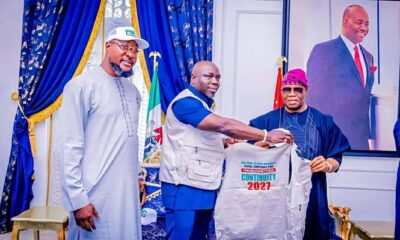
Ekpemupolo, popularly known as Tompolo, is the Grand Patron of the movement.
From editorial columns in national dailies to online commentary, critics have been relentless in dishing out opinions about the group’s activities targeted at mobilising support for President Bola Tinubu’s re-election campaign.
Yet, beneath the righteous indignation lies a fundamental misinterpretation of constitutional rights and democratic principles.
The narratives being spun across several opinion pieces, such as those asking why Tompolo should be actively involved in partisan politics or phoney groups labelling his endorsement as “deceptive,” are all built on shaky foundation.
Critics point to his role as a major security stakeholder in the Niger Delta and argue that a person of his background should remain politically passive or detached from party politics. Others question the deployment of operational vehicles and logistics to coordinators of the movement across states for the campaign, framing legitimate political mobilisation as an overreach.
However, this wave of criticism ignores a fundamental truth, that Nigeria is a constitutional democracy governed by the rule of law.
Section 39 and 40 of the 1999 Constitution of the Federal Republic of Nigeria (as amended) guarantee every citizen the right to freedom of expression and the right to peaceful assembly and association.
These rights are not reserved exclusively for career politicians, armchair intellectuals, or media commentators, they belong to every Nigerian citizen in equal measure.
Critics who have raised the alarm over campaign spending have also conveniently ignored the provisions of Nigeria’s statutory electoral framework.
The way I see it, High Chief Ekpemupolo has not gone against the Electoral Act 2026 in any way.
The Electoral Act 2026 sets clear financial caps on direct spending by individual candidates and limits on direct monetary donations to political parties or candidates’ accounts.
It also limits the amount a donor can make to a candidate or political party to N500 million.
The Electoral Act 2026 does not, however, specify, mandate, or place any financial spending ceiling for independent third-party support groups, non-governmental movements, or citizen-led mobilisation platforms.
Because the law contains no statutory cap on what an independent group can spend to mobilise voters, logistically equip its coordinators, or advocate for a candidate, Tompolo’s support group operates entirely within the legal limits of the Nigerian electoral law.
To invent non-existent legal infractions simply to tar a political support group is a disingenuous exercise in bad faith.
Tompolo has not been indicted by any court of competent jurisdiction, nor has he violated any law of the land by supporting a presidential candidate of his choice.
He has not been found wanting in any legal measure whatsoever for exercising his democratic suffrage and organising a political support group.
To, therefore, suggest that he should sit on the sidelines while other private citizens and influencers exercise their constitutionally guaranteed right to endorse and fund candidates is to demand a double standard that borders on hypocrisy.
Political association in a democratic society is rooted in choice, conviction, and interest.
If Tompolo believes that the current administration’s policies, particularly in stabilised oil production, maritime security, infrastructure, increased allocation to states, security, especially the State Police bill which 25 state Houses of Assembly have already approved, among others, align with the long-term prosperity of his constituency and the nation, he is within his full constitutional rights to persuade others to share that vision.
Mobilising grassroots support at the ward, household, and polling-unit levels through peaceful door-to-door engagement is the very essence of citizen participation in governance. It is political organising at its most fundamental level.
Those rushing to judge him prematurely are mistaking political enthusiasm for wrongdoing.
A citizen’s choice to donate campaign vehicles, set up organisational structures, and hold political rallies across different geopolitical zones is standard practice in presidential politics globally. In democratic climates, such actions are celebrated as evidence of civic investment and grassroots empowerment. Why should a different standard be constructed when the participant happens to be an influential opinion leader like Tompolo?
The online backlash and critical editorials reveal a deeper prejudice.
Nigeria’s democracy matures when citizens participate freely without fear of unwarranted public trial by the media.
The PBAT Door-to-Door Movement is operating entirely within the boundaries of civil political engagement and statutory electoral law. Rather than attacking the messenger, critics would do well to focus their energy on robust policy debates, engaging the electorate on ideas rather than seeking to curtail the lawful rights of individuals.
Tompolo has broken no law, breached no electoral act provision, and violated no constitutional mandate. He is simply exercising his fundamental right as a free citizen of Nigeria to associate, express his preference, and campaign for the candidate he trusts to lead the country. The misplaced outrage and hasty judgments filling opinion pages ought to be laid to rest.
In a free nation, the right to choose belongs to everyone and Tompolo is no exception.
Agbo, a strategic and development communication expert writes from Abuja.

By Uddin Ifeanyi
Much of the palaver over the recent meeting of the Central Bank of Nigeria’s policy committee was exercised by how well the apex bank is doing its job. Against its primary goal of maintaining price stability, the CBN’s Monetary Policy Committee’s decision to recalibrate its monetary policy rate (MPR) in order to align it with the market invited the most attention.
First, there is the question of what the MPR anchors.
In reality, nothing. Ideally, however, the CBN’s policy rate should transmit price signals through the financial system, influencing saving, borrowing, liquidity, inflation expectations, and in the end, the naira’s exchange rate. It should, in other words, signal the central bank’s intentions. Yet, we have had years in which the MPR stoically remained unchanged even as inflation ran riot, and the naira’s exchange rate came under severe downward pressure.The CBN has regularly papered over this crack with an often-bewildering arsenal of tools — including some eccentric flimflams that it has deployed in recent times. But this only raises further questions as to how useful even these are. Take the cash reserve requirement.
At 45 percent for deposit money banks, it means that nearly half of banks’ qualifying deposits are warehoused with the central bank at any given time. While these sums may not, therefore, be available to build bubbles in the foreign exchange and equity markets, they are not likewise available for lending. Even if we argue that long-term lending ought properly to be funded by equity, banks and not shareholders should bear the burden of financing businesses’ working capital needs. Then, there is the small matter of how the CBN’s cash reserve requirement might be just as orphaned as its policy rate.
Banks raising naira deposits end up paying the CRR tax. In an economy that has witnessed considerable dollarisation — “the process where a country uses a foreign currency (most often the greenback) alongside or completely in place of its own domestic currency” over the years, does it matter that deposits into domiciliary accounts are not CRR compliant? And how?
Might the “dollarisation” phenomenon hold the key to the CBN’s toolkit’s redundancies? Countries formally adopt the dollar in place of their domestic currencies when locals lose faith in the latter. This process restores the stability that struggling economies often find unable to achieve with their currencies and drives investment inflows.
Nigeria’s dollarisation is only partial and barely adjacent. Yet, while the country may not have lost the gains — seigniorage — from printing its own currency that is one consequence of dollarisation, the CBN looks to have partially lost control of the monetary policy space, with the sums that Nigerians increasingly park in their dollar accounts.
There are, thankfully, many ways to regain this control without having to nationalise dollar deposits. Neither the CBN nor the government can talk their way out of this, though. You cannot tell Nigerians to keep their savings in naira while offering them a savings rate below inflation. The smart choice in this circumstance is for domestic economic actors to move their savings into dollars, property, equities, commodities, inventory, or other assets.
Giving Nigerians a reason to save in naira should thus be the central goal of a policy reset. How to do this? We have got to keep inflation low. At 30% year-on-year a while back, the CPI numbers were an outrage. At a little over 15 percent today, it is still doing great injury to the naira. N100 today has roughly the purchasing power of only ₦50 after five years. The solution here goes beyond the CBN setting a credible, explicit medium-term inflation target.
It also transcends the CBN laying out incentive structures that make deviations from this target costly both politically and institutionally. More than this, the national commitment to the CBN not financing fiscal deficits must be religious and total. While this means that monetary policy is no longer subordinate to the federal government’s financing requirements, it must aim at positive real interest rates for savers.
Still a spectre haunts monetary policy in Nigeria. It is unfortunately not in the CBN’s gift to exorcise the nightmare that the federal government’s financing requirements have become.
How do we persuade our public sector boffins that a government that persistently spends more than it can sustainably pay for creates pressure for any of higher taxation, additional borrowing, monetary accommodation, inflation, or the naira’s depreciation? If the naira is only as strong as Nigeria’s balance sheet, then the task of getting both the fiscal and monetary authorities to operate under a common nominal inflation anchor must begin with reducing recurrent expenditure, broadening the tax base instead of increasing the tax rate, returning off-budget borrowing back to the budget, publishing complete fiscal accounts, improving the quality of public investment, establishing a credible medium-term strategy, and ceasing to use the CBN as a piggy bank.
Hopefully, this should help the economy produce more tradable goods and services. Because the naira represents a claim on the economy by anyone holding it, we cannot permanently defend the currency’s exchange rate through interest rates and reserves, if the economy continually uses up more foreign exchange than it earns. In other words, then, the economy must work for the naira to work.
Uddin Ifeanyi, a journalist manqué and retired civil servant, can be reached @IfeanyiUddin.
By Prince Charles Dickson Ph.D
There is an old story about a lawyer who sold his well to a teacher, then returned demanding payment for the water inside it. The teacher smiled. If the water still belonged to the lawyer, he replied, perhaps the lawyer should remove it or pay rent for storing it in somebody else’s well.
Suddenly, the lawyer remembered he had only been joking.It is funny until we recognise ourselves as lawyers.
We tell people with disabilities that public spaces belong to everyone. Then we demand an additional price for entering them.
We give them citizenship, but charge for the ramp. We promise education, but make the classroom unreachable. We proclaim equal opportunity, then construct the doorway too narrow for their wheelchair.That contradiction came home to me when Grace shared her story with me, she titled Public Place Accessible Report for Inclusion. It contained no sentimental appeal. It simply insisted that public places should allow everyone to enter, move, communicate, receive services and participate independently, safely and with dignity.
I listened to it in her voice once as a report. Then, I read it again as an indictment.
Behind every line was somebody’s ordinary day made unnecessarily difficult. A mother arrives at a hospital, already frightened for her child, discovering that the entrance has steps but no ramp. A young man preparing carefully for an interview, only to find his opportunity waiting upstairs without a lift. An older woman confronting a pavement that has forgotten her legs cannot move as quickly as they once did.
These are imagined scenes, but the barriers Grace identified are painfully real. Poorly enforced building standards. Toilets that exclude. Transport that humiliates. Signs people cannot read. Public information people cannot hear. Facilities built without consulting those who will need to use them.
Grace’s intervention mattered because she did not reduce accessibility to a construction problem. Her story and experience understood something profound: every inaccessible entrance is also a message. Sometimes it says, “We did not think of you.” Sometimes, more cruelly, it says, “We thought of you, but you were not worth the expense.”
What does that message do to a child’s heart?
Imagine a girl with cerebral palsy watching other children rush into a school assembly while she waits outside for someone to carry her over the steps. Imagine her learning, year after year, that she must be grateful for help rather than entitled to access. Imagine how quietly a society can teach someone to apologise for existing.
On 3 October 2026, at GlowingStar Empowerment Initiative and Development’s World Cerebral Palsy Day commemoration in Bukuru, I delivered a keynote titled Beyond Therapy: Seeing the Whole Person, Not Just the Condition. Its central argument was simple: a person has cerebral palsy; cerebral palsy does not have the person.
A diagnosis is information, not identity. Therapy is necessary, valuable and sometimes life changing. But therapy is supposed to be a bridge into life, not the whole landscape of living. Beyond treatment are friendships, classrooms, jobs, ambitions, relationships, leadership, laughter, choices and dreams that deserve room to breathe.
We can celebrate a child’s progress in therapy while failing that same child at the school gate. We can praise a parent’s devotion while exhausting that parent with inaccessible transport, expensive care and the endless labour of explaining why their child deserves a chance. We can call ourselves compassionate while our architecture remains indifferent. At the commemoration, parents spoke of stigma, costly therapy and limited support. Their courage was unmistakable, but courage should not be the currency families must spend to secure ordinary human rights.
That was why I argued that admission is not inclusion. Allowing a child through the gate means little if the classroom, teaching methods, toilet, playground or attitudes inside still tell that child to remain on the margins.
And communication must never be confused with intelligence. When someone speaks differently or needs more time, our responsibility is neither impatience nor pity. Ask. Then wait. Listen without finishing their sentences. A human voice does not lose its authority because it travels by an unfamiliar route.
I returned to Grace’s story and noticed how practical her demands were: sensible ramps and handrails, usable toilets, safe pathways, accessible transport, clear signage, Braille, captions, audio information and regular audits. It called for architects, officials and contractors to understand universal design, and for people with disabilities themselves to help plan and evaluate the spaces they use.
Nothing about us without us. That principle is not a decorative language for conferences. It is what stops a well-meaning official from installing a ramp that is too steep, or declaring a school inclusive without asking the students to navigate its corridors.
Nigeria has legal commitments against disability discrimination. Yet a law that cannot travel from the statute book to a bus stop, hospital, workplace or classroom remains a promise stranded on paper. Rights should not require influential relatives, public sympathy or a viral photograph before anyone honours them.
Sometimes, as I said in that keynote, society needs therapy. Our buildings need rehabilitation. Our policies need rehabilitation. Our assumptions, professional habits and careless language need rehabilitation. We must stop asking only how a person can adapt to a hostile environment and begin asking why we made that environment hostile.
I keep thinking about Grace, my newfound friend. As she shared recommendations, their moral weight was larger than the suggestions itself. She reminded me that inclusion often begins when someone refuses to look away from what everyone else has learned to step over. It begins with the uncomfortable decision to measure progress not by the elegance of our speeches, but by who can actually enter the room.
The lawyer in the story wanted to sell the well while keeping its water hostage. Too often, our society offers people with disabilities belonging without access, opportunity without accommodation, dignity without choice. Then it calls every concession generosity.
But the water was never ours to withhold.
Every child deserves more than survival. Every caregiver deserves more than exhaustion. Every adult with a disability deserves the freedom to work, love, contribute and belong without performing gratitude for rights already theirs. The purpose of inclusion is not to make people feel fortunate to be tolerated. It is to build a country where nobody must beg to be considered human.
So, Grace, thank you for disturbing our comfort with something as unromantic, and as revolutionary, as sharing your story with me. May we answer it with budgets, redesigned spaces, enforced standards and genuine listening. May the next child approaching a public doorway find no argument waiting there, only an opening.



Establishment of Development Commissions, Tinubu’s Best Decision for Nigeria, Says Momoh
ShareBy David Torough, Abuja The Minister of Regional Development, Engr. Abubakar Momoh, has described the establishment of the Regional Development...


OPHK Air Strikes Kill 37 Terrorists, Destroy Four Vehicles in North-East
ShareBy David Torough, Abuja The Nigerian military says air strikes conducted by the Joint Task Force, Operation HADIN KAI (OPHK),...

2027: Akwa Ibom opposition ‘ll Vote Tinubu, says Akpabio as Tompolo Donates 31 Campaign Vehicles
SharePresident of the Senate, Godswill Akpabio, says the All Progressives Congress (APC) in the state and other opposition political parties...

Don’t Destroy Family Ties Over Politics, Ogazi Cautions Youths
ShareBy Tambaya Julius, Abuja Gidan Zakara community in Karu Local Government Area of Nasarawa State has declared 100 per cent...

BTOCARES: Ondo Families, Students, Farmers Celebrate as Tunji-Ojo’s Intervention Eases Hardship
ShareBy David Torough, Abuja Beneficiaries of the BTOCARES humanitarian initiative in Ondo State have expressed gratitude to the Minister of...


WPRF Delegates Leaving Nigeria with Positive Impressions, Says Customs CG
ShareBy Tambaya Julius, Abuja The Comptroller-General of the Nigeria Customs Service (NCS), Adewale Adeniyi, has said delegates attending the World...
Customs Suspends Training at Two Colleges over Recruitment Concerns
ShareBy Tambaya Julius, Abuja The Nigeria Customs Service (NCS) has temporarily suspended training activities at its two training colleges to...

INEC Shelves Comprehensive Voters’ Register Clean-Up
ShareBy Orjime Moses, Abuja The Independent National Electoral Commission (INEC) has said it will no longer conduct a comprehensive clean-up...
Protect The President, But Do Not Punish the People
ShareNo one disputes it: the security of the President of the Federal Republic of Nigeria cannot be compromised. Not for...

Shettima to Moniepoint: Provide Affordable Loans for Businesses
ShareBy Tony Obiechina, Abuja Vice-President Kashim Shettima has tasked Moniepoint Microfinance Bank to expand access to affordable loans for farmers,...