
Economy
NCDMB Urges Collaboration in Oil, Gas Sector to Advance Economy


The Nigerian Content Development and Monitoring Board (NCDMB) has called for collaboration among stakeholders in the oil and gas industry to grow the economy.
The Executive Secretary, NCDMB, Mr Simbi Wabote, made the call in Yenagoa during the 2023 Nigerian Oil and Gas Opportunity Fair with the theme, ”Catalyst and Fuel for the Industrialisation of Nigeria.
”Wabote said such collaboration was necessary so that the sector would contribute to the Gross Domestic Product (GDP), up to double digits levels similar to other major oil producing countries.
He noted that the oil and gas sector lagged behind agriculture, trade, telecommunication and real estate in the development of the economy between 2021 and 2022.
He said that of late, the role expected of the oil and gas industry had been dwindling due to missed opportunities as a result of policy inconsistencies, deferred decisions and investments apathy.
“Just to set the context, I will like to draw your attention to the nation’s GDP growth rate between 2021 and 2022 as released by the National Bureau for Statistics (NBS).
“The NBS report noted that the total annual contribution of oil to aggregate GDP in 2022 was 5.67 per cent compared to 7.24 per cent in 2021.
“The oil sector has steadily dropped behind agriculture, trade, telecommunications and ICT, and real estate in terms of sectors that contributed the most to Nigeria’s GDP,” he said.
According to him, the reality is that Nigeria needs to drive the growth rate to double digits for her to achieve the desired level of economic advancement.
Wabote pointed out that Norway, for instance, had doubled its GDP in the last two years from $171.2 billion to $367 billion with the oil and gas sector contributing about 20 per cent followed by her hydropower.
Wabote said that in creating opportunities, the Nigeria Oil and Gas Industry Content Development (NOGICD) Act had set the minimum targets in 278 services across the value chain that could be invested in.
On his part, Gov. Douye Diri of Bayelsa, commended the executive secretary for the training and retraining of youths and women in Bayelsa.
The governor, represented by the Commissioner for Mineral Resources, Mr Ebiere Jones, said that the Federal Government had done two major programmes for youths to be skillful.
He urged the government to look into the establishment of companies that could produce pipelines in Nigeria.
He added that most youths in the state were unemployed and urged oil firms operating in the state to create opportunities for them to be trained and be skillful. (NAN)





The Nigerian Exchange Ltd. (NGX) market capitalisation declined further on Wednesday by 0.12 per cent or N68 billion, following selloffs in Tier-one banking stocks.
The market capitalisation, which opened at N56.898 trillion, closed at N56.830 trillion.
The All-Share Index also shed 0.
12 per cent or 121 points to settle at 100,365. 17, compared to 100,486.12 recorded on Tuesday.Consequently, the Year-To-Date (YTD) return declined to 34.
23 per cent.Sell pressure in FBN Holdings, Guaranty Trust Holding Company (GTCO), United Bank of Africa (UBA), Access Corporation, Fidelity, among other declined equities, were the main drivers of the negative performance.
Meanwhile, the market breadth closed negative with 21 losers and 18 gainers on the floor of the Exchange.
Secure Electronic Technology Plc led the losers’ chart by 9.43 per cent to close at 48k, RT Briscoe followed by 8.22 per cent to close at 67k per share.
UBA lost 5.07 per cent to close at N21.22, Livestock shed 4.56 per cent to close N2.30, United Capital dropped 4.27 per cent to close at N37 per share.
On the other hand, International Breweries and Sovereign Trust Insurance led the gainers’ chart by 10 per cent each to close at N4.07 and 55k per share respectively.
Deap Capital Management and Trust Plc gained 9.80 per cent to close at 56k, The Initiative Plc rose by 7.50 per cent to close at N2.15.
FCMB appreciated by 5.26 per cent to close at eight Naira per share.
On market activities, trade turnover settled higher relative to the previous session, with the value of transactions up by 137.35 per cent.
A total of 497.84 million shares valued at N8.61 billion were exchanged in 8,412 deals, against, 280.92 million shares valued at N3.63 billion exchanged in 8,403 deals posted in the previous session.
First City Monument Bank(FCMB) led the activity chart in volume with 133.92 million shares valued at N1.4 billion, Access Corporation followed by 72.82 million shares worth N1.41 billion.
Zenith Bank sold 60.06 million shares worth N2.19 billion to lead the chart in value, UBA transacted 29.08 million shares valued at N639.55 million and Universal Insurance traded 22.92 million shares worth N7.68 million. (NAN)
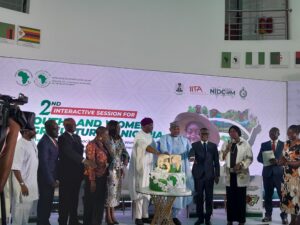
The Speaker of the House of Representatives, Rep. Tajudeen Abbas, says Nigeria can empower youth and women in Agriculture with the development and implementation of bankable business proposals.
Abbas said this at the Second Interactive Session and Workshop on Developing Bankable Business Proposals/Business Plans for Youths and women in Agriculture on Monday in Abuja.
The Speaker, who was represented by his Deputy, Rep.
Benjamin Kalu, said youth and women are the most vital demographics in the society.The event was organised by the African Development Bank (AfDB) Group.
While acknowledging the bank and its partners for their contribution and interventions in the sector, Abbas said the need to diversify Nigeria’s economy could not be over emphasised.
According to him, our over-reliance on oil as primary resource has become neither sustainable nor profitable as the global community shifts towards greener, more sustainable energy sources.
“This reality makes it not just necessary, but urgent for us to explore and invest in alternative sectors.
“By focusing on developing and implementation of bankable business proposals, we can empower our youth and our women, to become key players in these sectors.
“Their active participation is not only essential for economic diversification, but also for ensuring food security and sustainable development through agriculture and technological advancements through high safety,” he said.
Abbas recognised AfDB’s hi-5 priorities to empower, feed, industrialise, integrate and improve the quality of life for the people of Africa.
He expressed the commitment of the legislators to support youth and women development through various projects and programmes.
He urged for more collaboration of the AfDB and other stakeholders to advance initiatives that could drive significant progress in the country and across the continent.
“Through this, we will certainly build a better, more resilient future for Nigeria and for the world,” he said.
Earlier, the Minister of Agriculture and Food Security, Sen. Abubakar Kyari, said any workable concept on youth and women in agriculture would contribute to sustainable agricultural development across the continent.
Kyari said the country was committed to work closely with bilateral and multilateral development partners, in advancing the engagement of youth and women in agriculture.
“Notably, agriculture remains the singular sector with the highest potential for mass job creation.
Youth participation will further bridge the gap for aging farm population.
“It will take development back to the rural communities, cause a significant improvement in production and overall productivity and offer a veritable platform to accentuate the poverty reduction drive of government,” he said.
Kyari said President Bola Tinubu’s Renewed Hope Agenda for Food Security was poised to change the narrative of agriculture of a way of life.
“And agriculture as a wealth creating sector with sustainable, marketable, and bankable business prospects for youth and women engagement.’’
Similarly, the Minister of Youth Development, Dr Jamila Ibrahim, said it was crucial to build capacity of youth and women to see agricultural beyond subsistent but as an enterprise.
Ibrahim expressed the commitment of the ministry to work with stakeholders to co-create initiatives to support women and youth.
“We are open to working with partners to strengthen what we are doing. By doing so, we will build a brighter future for Nigeria,” she said.
For the Minister of Communications, innovation and Digital Economy, Dr Bosun Tijani, innovation is key to solve most challenges we face in Nigeria and the continent.
Tijani said that this innovation could not be done without including the young people including women, thus the need to invest in them.
Also speaking the Director-General, West Africa Region of AfDB, Mr Lamin Barrow, said the event was part of activities to celebrate the bank’s 60 years anniversary.
According to the director-general, Africa’s progress will be driven by young dynamic workforce, thus the importance to boost investment in them.(NAN)

The Securities and Exchange Commission (SEC) has approved the commencement of the N351 billion rights issue capital raising programme of Access Holdings Plc.
A statement made available by the Holdings to newsmen on Sunday in Lagos confirmed this.
The group said that the approval marked a significant milestone in its previously announced capital raising programme, which aimed to generate up to $1.
5 billion.It also said that the rights issue was strategically structured to boost Access Holdings’ financial position and support ongoing working capital needs.
According to the holdings, the programme will also provide funding for organic growth across its banking and non-banking subsidiaries.
“The approved rights issue offers 17,772,612,811 ordinary shares of N0.50 each at a price of N19.75 per share.
“The offer will be issued on the basis of one new ordinary share for every two existing ordinary shares held as of June 7, 2024,” it said.
The lead issuing house for Access Holdings’ rights issue is Chapel Hill Denham Advisory Ltd., while Atlas Registrars Ltd. will serve as the Registrars to the offer.
The offer will open on July 8 and close on Aug. 14.
It noted that the rights circular would be distributed to shareholders by Atlas Registrars Ltd., and application forms would also be available on its various websites.
The holding company advised its shareholders to contact their stockbrokers for more details about the offer.
Access Holdings said that it remained committed to its strategic vision of expanding its footprint and delivering exceptional value to all its stakeholders.
It noted that the successful execution of the rights Issue would further solidify the group’s position as a leading financial services provider in Africa and beyond.(NAN)
Tinubu Approves Management Unit for Health Sector Renewal Investment Initiative
SharePresident Bola Tinubu has approved the establishment of the Sector-wide Coordinating Office-Programme Management Unit (SCO-PMU) domiciled in the Office of...

FG Denies Slash in Students’ Allowances
Share The Federal Government says it has no plan to slash scholarship students’ allowances as recently projected in the media.The...

Planned Protests: CAN calls for calm and patience
ShareBy Laide Akinboade, Abuja The Christian Association of Nigeria, CAN, on Friday, has urged Nigerians to calm and patient with...


Senate Consultant Scores Benue LG Bureau High on Projects Execution
ShareThe Consultant for Senate Standing Committee on States and Local Government Administration, Engineer Kayode Adegbayo has described the quality of...


Doctor Mark Ogbodo: A Man Destined for Success
ShareBy Paul Ugah Henry Miller once said, “Every man has his own destiny, the only imperative is to follow it,...


Ignore Anti -government Protests, Wike Begs Abuja Residents
ShareBy Laide Akinboade, Abuja Minister of the Federal Capital Territory, Barr. Ezenwo Nyesom Wike has called on residents of the...
Reps Commit to Ensure Legislations for Better Skills Acquisition, Management
ShareBy Ubong Ukpong, Abuja The House of Representatives on Thursday pledged its continuous commitment to ensure legislations that would align...


Economic Sabotage: Senate Summons Petroleum Minister, NNPCl, CBN, NPA, Others for Interrogation
ShareBy Eze Okechukwu, Abuja The Senate is blowing hot over alleged economic sabotage by stakeholders within the petroleum sector, thus...
Dialogue with Organisers of August 1 Protest, AANI Urges FG
ShareBy Johnson Eyiangho, Abuja The Alumni Association of the National Institute (AANI) has advised the Federal Government to dialogue with...


Stigmatization: CSO Urges Kogi Gov to Assent Bill Protecting HIV Patients
ShareFrom Joseph Amedu, Lokoja Civil Society Organisation, Initiative for Grassroot Advancement in Nigeria (INGRA), has called on the Kogi State...