
Science & Tech
NEMSA to get 6 meter testing centres soon – MD/CEO


The Nigerian Electricity Management Services Agency (NEMSA) says it will soon increase the number of meter testing centres in the country from four to six.
NEMSA Managing Director/Chief Executive Officer, Peter Ewesor, an Engineer, said this on Tuesday in an interview with the Newsmen in Abuja.
He said the project was to support the industrial revolution efforts of the present administration.
According to him, it is also in line with the administration’s quest to supply meters to every electricity consumer through the mass metering programme under the Nigeria Electricity Supply Industry.
He said: “NEMSA has functional meter testing centers in Oshodi, Lagos, Port Harcourt town and Kaduna.
“We have just completed and officially inaugurated the one in the Enugu East. We now have two ongoing in Kano and Benin.”
Ewesor, who is the Chief Electrical Engineering Inspector of the Federation, said that only meters, which type tests were completed by NEMSA, were authorised to be used in the country.
He further said the agency also carried out routine tests on some of the already installed meters to ascertain their effectiveness and resistance to power challenges.
Ewesor also said that the agency was supporting local production of electricity meters, adding: “Whether they are local or imported, the type test is mandatory in the country.
“When the type test is done then the meter can be deployed.
“We do not do offshore testing but when anyone wants to import meters, we want to test that meter here to be sure it would work in our environment.’’
The NEMSA boss said it was through routine test that the agency discovered that some fraudulent contractors tried to by-pass the neutral lines for the `earth’ in order to cheat.
He said that in some places, contractors forged certifications for projects and got their installations connected to the national grid.
He said it was an offence for persons not certified by the agency to carry out electrical installations of any kind in the country.
“In this country today, by law, NEMSA is the sole agency and authority to certify competent electrical installation contractors and workmen.
“If you do not have NEMFA’s certificate you are not authorised under the law to execute any electrical installation and if you do, it is illegal.
“You are practicing quackery and it actually attracts sanctions,’’ Ewesor said.
He further said that the NEMSA Act of 2015 mandates the agency to enforce standards and regulations, technical inspection, testing and certification of all categories of electrical installations, electricity meters and instruments.
He said this was to ensure the efficient production of electricity power supply, sustainable and reliable electricity delivery to Nigerians.
He said the essence of the enforcement is to also assure the safety of lives and property.
NEMSA, he said, would continue to execute the mandate for safety “because electricity, as we know it, is a very good servant but very bad master.’’
He frowned against the trend where some people erect residential buildings under the high tension lines in different parts of the country .
He described the practice as a direct invitation to fire and other disasters leading to fatalities.
He warned those involved to desist from it or be prepared to face the wrath of the agency.
“As of today, we have disconnected well over 2,000 houses under the high tension lines to serve as deterrent to others planning to do similar thing,” Ewesor said.
He further warned that anyone, who chose to reside in such houses, using other power alternatives would be arrested and handed over to security personnel for prosecution. (NAN)


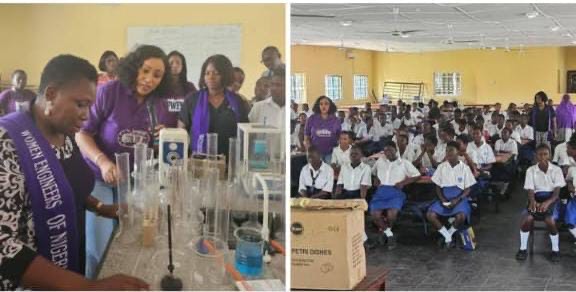
From Mike Tayese, Yenagoa
The Association of Professional Women Engineers of Nigeria (APWEN) Bayelsa Chapter led by their Chairman, Engr. Dr. Amalate Ann-Jonathan Obuebite FNSE, visited St. Judes Girls Secondary School, Yenagoa in commemoration of the 2026 International Day of Women and Girls in Science, donates laboratory equipment.
The donation, which includes pH meters, weighing scales, measuring cylinders, viscometers, volumetric and conical flasks, beakers, and pipettes is meant to support and encourage the study of Science, Technology, Engineering, and Mathematics (STEM) courses.
Presenting the items to the principal, Mrs. Josephine Imbiakpa, Dr. Obuebite emphasized APWEN’s commitment to promoting STEM education among girls.
Mrs. Imbiakpa expressed immense gratitude to APWEN BAYELSA for the donation, stating that it would motivate students to pursue STEM careers.
The event aimed to inspire girls to explore STEM fields and bridge the gender gap in these areas in line with the theme for this year.
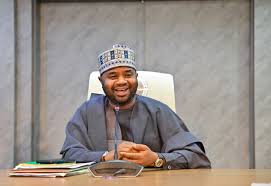
NRS chair, Adedej
The Executive Chairman of the Nigerian Revenue Service (NRS), Zacch Adedeji, has described technology as a crucial factor in the implementation of the new tax laws in the country.
Adedeji stated this on Wednesday while delivering the maiden convocation lecture of the Federal Polytechnic, Ayede, Ogo-Oluwa Local Government Area of Oyo State.
In a statement by his Technical Assistant on Print Media, Sikiru Akinola, Adedeji listed some of the most fundamental challenges confronting taxation to include infrastructure, skills, trust and resistance.
In the lecture entitled ‘The Role of Technology in Implementing Nigeria’s New Tax Laws: Challenges, Prospects, and Implications for National Development,’ the NRS chairman said each of these challenges would be addressed with the imminent upgrading of the country’s tax system for a digital environment.
“Nigeria has recently enacted a new set of tax laws, representing the most significant restructuring of our nation’s fiscal legislation in 50 years. While public conversation often frames these changes as legal reforms, and that is true, it is also an incomplete picture.
“These laws are not merely changing rates, definitions, or administrative powers. They are quietly redefining how authority operates within the tax system. This is a complete structural overhaul, signaling the end of tax collection as a manual task and the beginning of tax intelligence.
“If you read the new laws carefully, you will notice a subtle but profound assumption woven throughout their fabric. They presuppose the existence of reliable taxpayer identification, integrated data across institutions, traceable transactions, automated processes, and scalable enforcement.
“In other words, these laws are built for a digital environment. They cannot function properly in a manual, fragmented, paper-based system. The implication is clear: without technology, the laws remain aspirational. With technology, they become operational.
“This transition is central to the mandate of the Nigeria Revenue Service as we implement this new legal framework. Historically, tax administration relied heavily on human discretion over who is registered, who is assessed, who is audited, and who is penalized.
“While discretion is not inherently evil, excessive discretion creates inconsistency, which in turn breeds mistrust and drives non-compliance,” Adedeji said.
Speaking further, he noted that when infrastructure improves, capacity grows, trust is protected, and resistance is managed just as technology begins to do what policy alone cannot.
“One of the most important prospects of a technology-driven tax administration is the ability to expand the tax base without increasing tax rates. This matters deeply in a society where citizens already feel overburdened.
“By improving visibility and bringing previously unseen economic activity into view, technology levels the playing field. When compliance broadens, the pressure on the existing base reduces,
fairness improves, and legitimacy grows. This is how modern tax systems grow revenue sustainably,’ he added.
In his remark, the Speaker of the House of Representatives, Tajudeen Abass, encouraged the graduating students to be good ambassadors of the institution.
Represented by AbdulFatai Buhari, senator representing Oyo North, Abass charged them not to relent in their bid to acquire more knowledge.
He also commended the tax boss for leading the change in tax administration in the country.
The institution’s governing council chair, Yakubu Datti commended Adedeji for leading the re-engineering of Nigeria’s tax architecture.
The Rector of the institution, Dr. Taofeek Adekunle Abdul-Hameed, charged the graduating students to emulate Adedeji who, he said, began his journey from a polytechnic.

The Ministry of Communications, Innovation and Digital Economy has partnered with Meta to launch the Llama Impact Accelerator, promoting impactful AI development in Nigeria.
The Minister, Dr Bosun Tijani, confirmed this in a statement released on Tuesday by Ms Sade Dada, Head of Public Policy for Anglophone West Africa at Meta.
Tijani described the partnership as a significant step in Nigeria’s mission to nurture a thriving AI ecosystem and drive national development through innovation.
He said the government views AI as a key tool for addressing national challenges.
The programme will equip innovators with vital tools and expert guidance.“This initiative forms part of Meta’s broader effort to democratise responsible AI and foster local innovation across Nigeria’s growing technology landscape,” the minister noted.
Tijani added that collaboration with government, academia and civil society will help cultivate a more inclusive, forward-looking AI community in the country.
Dada stated that Meta also partnered with the National Centre for Artificial Intelligence and Robotics (NCAIR) and the National Information Technology Development Agency (NITDA).
She explained that the eight-month programme targets early-stage startups using open-source Llama models to tackle national and regional challenges in four key areas.
The priority sectors include agriculture, security and safety, healthcare, and a ‘wild card’ category for high-impact innovations in any other field.
“The wild card category encourages bold and creative AI applications that could bring substantial impact to underserved sectors,” Dada said.
She added that the programme starts with a six-week incubation phase, offering technical training and mentorship from industry leaders and AI professionals.
This is followed by six months of extended support, including access to further technical resources and relevant opportunities for growth and scaling.
Dada said Meta was thrilled to collaborate with FMCIDE on this initiative, recognising Nigeria’s strong innovation ecosystem and growing pool of AI talent.
She added that Meta aims to empower communities through open-source AI, tailored to address Nigeria’s unique development challenges.
“The accelerator offers local talent the infrastructure, tools and mentorship needed to build responsible solutions using open-source models like Meta’s Llama,” she said. (NAN)



Nigeria’s Oil Reforms will Unlock $50bn Deep Offshore Investments – Tinubu
SharePresident Bola Tinubu said recent reforms in Nigeria’s oil and gas sector are designed to unlock up to 50 billion...
Ododo Condoles Families of NAF Personnel, Armed Forces Over Ondo Crash
ShareFrom Joseph Amedu, Lokoja Kogi State Governor, Ahmed Ododo has commiserated with the families of the Nigerian Air Force personnel...
WUEDA Tasks Journalists on Verification, Development Reporting
ShareFrom Francis Sadhere, Delta The Warri, Uvwie and Environs Special Area Development Agency (WUEDA) has urged journalists to strengthen investigative...
Dauda Joins FG’s Delegation for Nigeria- Ethiopia Leadership Exchange, Learning Visit
ShareFrom Ifeanyichukwu Nwannah, Gusau President Bola Tinubu has approved a high-level Nigerian delegation to Addis Ababa for a leadership exchange...
Civic Education Vital for Future Leaders – Ekiti Commissioner
ShareThe Ekiti State Government said on Tuesday that exposing students to civic education played a vital role in preparing them...
DSIRS Threatens Prosecution of Fake Tax Collectors, Warns Taxpayers
ShareFrom Francis Sadhere, Delta The Delta State Internal Revenue Service (DSIRS) has warned individuals and groups issuing fake tax demand...
Alabere Urges Corps Members to Preserve Yoruba Culture, Uphold Good Character
ShareFrom Ayinde Akintade, Osogbo A revered traditional ruler in Osun State, the Alabere of Abereland, Oba Obafemi Adelakin Mutalib Abiade...
Nigeria Since 1999: When will the Years Begin to Count?
ShareBy Dakuku Peterside Think of a Nigerian born in 1999, the year civilian rule came back. That person is twenty-seven...


Tinubu’s Return: An Update
ShareBy Reuben Abati Exactly a week ago, President Bola Ahmed Tinubu, now jokingly renamed a citizen of Kano with a...


NDLEA Seizes over 10 Tonnes of Illicit Drugs, Recover Firearms in Kogi
ShareBy Elijah Oguche, Abuja The National Drug Law Enforcement Agency (NDLEA) in Kogi said it has seized more than 10...