
Metro
Ngige Flays Disparity in Foreign, Local Workers Payment in Nigeria

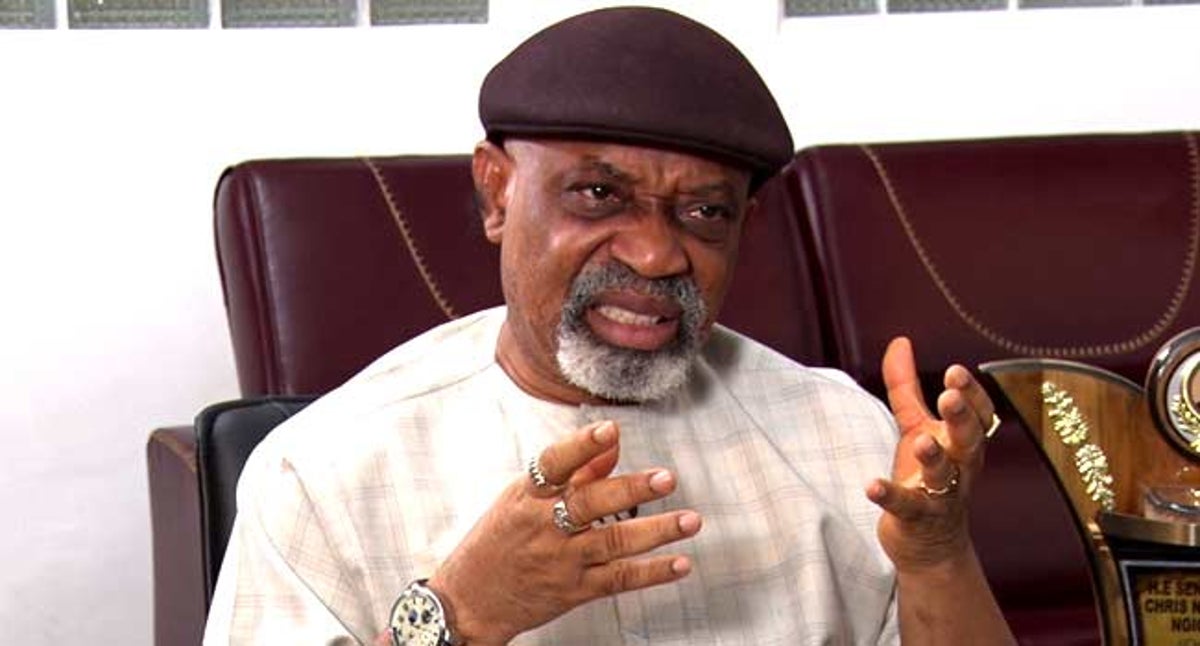
The Minister of Labour and Employment, Dr Chris Ngige, has frowned at the disparity in payments of foreign and local workers in parts of the country.
He criticised states in Nigeria that employed and paid foreigners five times higher than their Nigerian counterparts.
Ngige said this when he received the Chairman, Federal Character Commission (FCC), Dr Muheeba Dankaka, and other Federal Commissioners during a courtesy visit on Thursday in Abuja.
He regretted that such preferential treatment given to foreigners by some states ahead of their Nigerian counterparts does not encourage national unity and loyalty.
He therefore urged the FCC to use its constitutional mandate to promote national unity and loyalty, rather than concentrate their efforts only on the public sector, especially in job recruitment.
He appealed to the commission to ensure equitable distribution of amenities, infrastructure and social services in the country.
According to the minister, the constitution did not say that you do only cases in the public sector.
“There are areas we need you to look into especially where the constitution is silent.
“We have cases where doctors are employed from Egypt, Cuba and Pakistan and they are paid five times what the Nigerian doctor will get if you convert the foreign exchange they use to pay them.
“But in this country, I was here when some of my teachers left from South East to go and teach in the North East at a time.
“They left because we had enough down there to export to our brothers.
”They were paid with our local currency and given some other incentives, which at the end of the day make the economy of those states to be alright.
“Whether you like it or not, if some people are poor in Nigeria in the poverty index rating, when the Nigerian poverty index is being taken, it will be an aggregate, including those places.
”If it is health, when the health parameters are being taken, it is for the whole. So, FCC can go into that area,” he said.
The minister therefore urged the FCC to persuade the affected state governments to open up and advertise those jobs, so that Nigerians can come whether from South-East, South South or North Central to come and fill the gap.
Ngige also advised the commission to be revolutionary and do new things, using its broad mandate, established by Section 14 (3) of the 1999 Nigerian Constitution (as amended).
“Our constitution is the Supreme law of the land. And any law made by anybody, whether national and state assembly that is in conflict with constitution is void.
“So, you people have a strong mandate from the supreme law of the land.
”I think you should help us build a new country, where we will not be talking about hatred because it is some of these perceptions that cannot even be separated from reality that breeds all the discontent and hate speeches we see.
“We must strive to unite our country. All these North and South, East and West, they are artificial geographical demarcations.
“One body that can unite our country is FCC. As you are here now, you are no longer politicians.
“We count on your chairman that wherever she goes to fly the umbrella of justice, freedom and fair play, we need it for Nigerian workers.
“We need it for Nigerian people. If we distribute schools well, people will go to school in the areas where there are no schools now.
“The almajiris will get western education. When we educate people, we have liberated them from poverty and ignorance which breeds all these security issues all over,” he said.
Ngige noted that the economic situation has eaten into individual pockets for worsening labour dispute issues in the country.
He added that labour unions are now remembering agreements they signed with the previous adminstartions, some dating back to 2009 and even 2002.
“The President said we are alive to our responsibilities and we do not owe any worker salaries.
“The President is strong on that and that is why we have not retrenched anybody. He is also strong on the fact that government is a continuum.
“If they now remember that the previous administration owed them 2009, we will not say no, we will say yes. But we will pay you base on our capacity to pay and ability to pay.
”Those allowances can be stretched and we pay you in tranches. That is what we have been doing with Academic Staff Union of Universities (ASUU), Non Academic Staff of Universities (NASU) and Joint Health Staff Union (JOHESU).”
He noted that the resident doctors who were not paid were those illegally recruited by Chief Medical Directors (CMDs) without necessary approval.
“You people know the mandate for recruitment. The Federal Ministry involved will give approval.
“The office of the Head of Service of the Federation and Budget office will give approval.
”These three approvals come to you in Federal Character Commission for final approval and issuing of compliance letter.
“But in the case of these resident doctors, their letters were issued without any of these approvals.
“The CMDs who did that said they thought they could pay them through GFMIS platform, an ad hoc platform used for sundry expenses. Personnel costs have been removed from GFMIS. That is the problem.
”Every payment for personnel costs is done under IPPIS. But now, a waiver has been given. It will come to you in the FCC to give compliance certificate.
”We explained to them that it is not a one bus stop thing. It cannot be done in one day. They said no, we are going on strike.
“You go on strike to force government to regularise an irregularity. It is not done,” Ngige explained.
He also said that the request for compliance letter would be sent to the FCC by the Federal Ministry of Health before the end of the week and urged the commission to give the request expeditious attention.
Earlier, the FCC chairman noted that the commission was established to promote the unity of the country and ensure strong and indivisible nation, fostering sense of belonging, fairness, equality and justice.
Dankaka said they have the mandate to ensure the fair distribution of infrastructure, amenities and social sservice.
She assured that the commission would discharge its mandate in a manner to eschew the feeling of marginalisation from any quarters of the country. (NAN)




The National Identity Management Commission (NIMC) has reiterated its commitment to strengthening Nigerians’ digital identity, cybersecurity and privacy safeguards under the 2026 NIMC Act.
The commission also pledged to expand access to essential services across Nigeria through an improved digital identity system.
NIMC Director of Operations, NIMC, Uche Chigbo, said this on Thursday in Abuja on the sidelines of the Digital Nigeria Conference organised by the National Information Technology Development Agency (NITDA).
Recall that President Bola Tinubu signed the NIMC Act (2026) into law on June 26, 2026.
Chigbo explained that the repealed NIMC Act No. 23 of 2007 had become obsolete over the past 19 years before its replacement by the new law.
She said the new legislation would reposition NIMC and strengthen its role in Nigeria’s digital identity ecosystem.
According to her, the commission had shifted its focus beyond enrolment figures to maximising the value of digital identity.
She said that NIMC was working towards achieving universal identity coverage while ensuring that the National Identification Number (NIN) unlocked economic and social opportunities.
Chigbo said the new Act would expand the commission’s mandate to strengthen its technology architecture, particularly cybersecurity, and position it as the certification authority for public key infrastructure.
She added that the legislation would empower NIMC to play a leading role in developing Nigeria’s Digital Public Infrastructure.
She said that the Act introduced stricter sanctions for identity-related violations, particularly through collaboration with the Nigerian Data Protection Commission (NDPC).
The director said that the commission was developing identity-proofing mechanisms for people without conventional identity documents.
According to her, community chiefs or relatives could identify such individuals to facilitate their identity registration.
Chigbo added that the Act would also address challenges faced by Nigerians without permanent residential addresses to prevent their exclusion from identity registration.
Head of Legal, Enforcement and Regulations at the NDPC, Babatunde Bamigboye, said that it was imperative to protect personal information under the new Act.
Bamigboye said NIMC’s expanded mandate did not override individuals’ privacy rights, stressing that the law recognised the need to protect personal data.
He said possession of citizens’ identity and personal data did not give NIMC or any government agency unrestricted access to the database without a lawful basis.
According to him, access to personal information must be supported by lawful grounds, including consent, public interest and other provisions recognised under the Nigeria Data Protection Act.
He added that individuals had the right to access their personal data, correct inaccurate information and object to unauthorised access.
Bamigboye also stressed the need to protect individuals from decisions made solely through automated systems, particularly as artificial intelligence becomes increasingly integrated into public services.
He urged digital stakeholders to adopt proactive measures to ensure compliance with privacy, accountability and data protection standards.
“We want to see that such an operation is proactive. We don’t have to wait until things happen before we react,” he said. (NAN)

Nollywood actress and filmmaker, Bimbo Ademoye, has rejected an apology from a man who filed a copyright claim against her YouTube movie, My 30th Wedding, insisting that she remains angry over the incident.
The actress had earlier offered a ₦1m reward for information about the individual, identified as Mazi Enemuo, after a copyright claim temporarily affected the monetisation of the movie, which has reportedly garnered about 29 million views.
The film was released on October 1, 2026, on her YouTube channel.
On Monday, Ademoye took to Instagram to express her frustration, alleging that Enemuo had uploaded a song from the movie and used it to claim earnings from the project.
She said the soundtrack, titled “We Can Take It (My 30th Wedding)”, was specially produced for the film by musician Progress and that she owned the rights to it.
Ademoye also urged her followers to report the individual across social media platforms and called on YouTube and YouTube Africa to intervene.
She later announced that monetisation on the movie had been restored, thanking her team for their intervention.
However, she maintained that her ₦1m bounty on Enemuo remained in place.
Enemuo subsequently apologised, saying he had uploaded the song to help promote the movie’s soundtrack and reach a wider audience, rather than infringe on Ademoye’s rights.
In a public apology, he said, “Unfortunately, the distribution platform has laid a YouTube Content ID claim on the content. I take full responsibility for the situation and have since taken down the song from all streaming platforms.”
He added that the song would be removed from all platforms within 24 to 48 hours and that he would contact the distributor to ensure that no residual claim remained.
But responding to the apology on Instagram on Tuesday, Ademoye described it as insincere and questioned his explanation that he had intended to help her reach a wider audience.
“Mr Enemuo, while I see your apology, I call it complete bullshit! I took multiple breaths and I’ve counted 1-10 multiple times to ensure I calm down and not say anything out of pocket but guess what, I’m still very angry!
“You claimed you wanted to help me reach a wider audience, I’m not sure you thought that statement through, you wanted to use your 250 subscribes to help me reach a wider audience with my almost 2 million subscribers?” she asked.
Questioning why Enemuo uploaded the particular soundtrack rather than another song from the movie, she said, “You specifically took the song I didn’t properly copyright of all the songs in the movie. Why didn’t you take hammerboi’s song? If anything, that’s the viral one I’d have loved to go even more viral song.”
She also questioned why he attempted to claim earnings from the movie after allegedly uploading the song to promote it.
“After you ‘helped me reach a wider audience’ why did you try to claim my earnings? Why did you monetise it and have me demonitised?” she asked.
The actress further warned that she would pursue the matter, writing, “But I’d make an example out of you. Don’t ever take my silence for weakness, believe me when I tell you I AM NOT THAT NICE AT ALL! ESPECIALLY WHEN IT COMES TO MY WORK.”
In a postscript to her response, Ademoye also dismissed suggestions that she was using the controversy for publicity or had failed to protect her work through copyright registration.
She shared screenshots of messages from people who, according to her, had contacted her after their channels were taken down following copyright enforcement on her projects.

By David Torough, Abuja
Troops of the Nigerian Army’s 18 Brigade have rescued 21 kidnapped victims following a fierce gun battle with terrorists in Mariga Local Government Area of Niger State.
The rescue operation was conducted on November 9, 2026, after troops acted on credible intelligence about the activities of terrorists in Abaha and Sabon Wuri villages.
According to a statement issued on Tuesday by the Acting Assistant Director of Army Public Relations, 18 Brigade, Captain Adebayo Samuel Adewumi, the troops swiftly deployed a fighting patrol to the affected communities to intercept the criminal elements.
The statement said a fierce firefight broke out when the troops made contact with the terrorists, who were eventually overpowered and forced to flee into nearby bushes with suspected gunshot wounds.
All 21 kidnapped victims were rescued unhurt. They were subsequently given first aid treatment and subjected to preliminary profiling before being handed over to the appropriate authorities for reunification with their families.
The Army said troops had intensified operations, including aggressive patrols and ambushes, to track down and apprehend the fleeing terrorists.
It also urged residents of Mariga and neighbouring local government areas to report anyone suspected of having gunshot wounds, as well as suspicious movements of criminal elements, to the nearest security agency.
The Commander of 18 Brigade commended the troops for their gallantry, resilience and professionalism during the operation, urging them to sustain the momentum and maintain an aggressive operational posture.
He reaffirmed the Brigade’s commitment to eliminating criminal activities within its Area of Responsibility and ensuring the safety of law-abiding residents.
The operation comes amid the Nigerian Army’s recent expansion, which the military says has strengthened its operational capacity in the fight against terrorism and kidnapping.




Will new entrant, ESDIAC, ease Nigerians’ international call worries?
ShareBy David Torough After decades of frustration in accessing telephone services, Nigerians were relieved when in 2001, the then President...


AHF Launches Comic Book on Menstrual Health Education in Abuja
ShareFrom Attah Ede, Makurdi The Aids Healthcare Foundation (AHF) Nigeria, has revealed that nearly 2 billion people menstruate, with 500...


BBNaija’s Dorathy Begins Breast Reduction Journey
ShareFormer Big Brother Naija housemate, Dorathy Bachor, has taken the first step towards breast reduction surgery, three years after first...


They Planted Juju in my Jacket at Davido’s House – Peruzzi
ShareSinger Peruzzi has narrated how a charm was planted in his jacket during his stay at Davido’s house. Peruzzi was...


Withdraw all Charges within Two Weeks, Speed Darlington Appeals to Burna Boy, Apologises
ShareControversial Nigerian singer Speed Darlington has appealed to Grammy-winning artiste Burna Boy to withdraw all charges against him within two...
AFSNET Business Conference Kicks off in Calabar
ShareFrom Ene Asuquo, Calabar The 6th African sub – sovereign Governments Network Investment Conference has started in Calabar the cross...
NAFOWA Empowers 18 Widows, Donates Tricycles in Bayelsa
ShareFrom Mike Tayese, Yenagoa The Nigerian Air Force Officers’ Wives Association (NAFOWA), Mobility Command, Yenagoa, has empowered 18 widows of...


RMAFC Advocates Fair Share of 13 Per Cent Revenue Derivation Among Oil Producing States
ShareBy Tony Obiechina, Abuja The Revenue Mobilisation Allocation and Fiscal Commission (RMAFC) has advocated a fair distribution of the 13...


Customs CG Tasks Officers on Discipline, Integrity
ShareBy Tambaya Julius, Abuja The Comptroller-General of the Nigeria Customs Service (NCS), Bashir Adewale Adeniyi, has called on officers and...


2027: ADC Asks EFCC, INEC to Probe Alleged APC Cash Distribution
ShareBy Mvendaga Orjime, Abuja The African Democratic Congress (ADC) has called on the Economic and Financial Crimes Commission (EFCC) and...