
OPINION
Nigeria’s Democracy, 20 Years After: Where lies the Hope of the Poor?


By Menyanga Abu
Democracy according to Yusuf Bangura ,is a system of government in which leaders periodically renew their mandates through free, fear and competitive elections. It is a system that acknowledges the right of expression, organization and collective actions of the populace.
These rights grant the citizens the powers to exercise political choice and
to hold leaders accountable for their actions, inactions, decisions and indecisions as the case may be.
Democracy is considered as a powerful tool for meeting people’s aspirations as well as making them partners in decisions that affect their well-being. Functional and sincere democracy will alleviate poverty but where democracy becomes a charade – a capitalist tool or feudal instrument or an authoritarian institution, – it will end providing lip services.
That is a situation where overriding forces manning a sort of pseudo-democratic formations benefit themselves by exploiting the poor. No doubt, democracy in Nigeria has been elevated in public policy. I think we are yet to understand the type of politics and institutions that will make democracy to achieve growth and human wellbeing. Although our democratic process is participatory in outlook, it tends to be limited to few elected people without the involvement of such people like the informal workers, the artisans or the famers whose livelihood are directly affected by many of the development policies.
For democracy to add values to the lives of the poor masses and economic growth, every democratic practice should put economic liberty and transparency on a par with every other democratic value such as regular elections, rule of law, human rights, freedom of association and speech. For the poor to feel the positive impacts and benefit from democracy, I appeal to the present administration and its agencies not to use superfluities and rhetoric of democracy as a façade while behind the scenes engaging in rent-seeking practices that can lead to systemic entrenchment of corruption as done by the past administrations.
The corrupt system will easily provide avenues for politicians to use political powers for economic gains and the economic gains could be used for buying political influence. In such a situation democratic dividends hardly reach the general populace.
This usually results in persistent poverty among a large percentage of the population coupled with poor social services in struggling and developing democracy like ours. The situation above can lead to declining in supports for democracy by the populace at large and may signify real threat to democracy because impoverished poor masses may not have the necessary tools to fight back and in most cases they are not familiar with/use to demanding government’s accountability and responses.
Democracy can never be sustained without persistent efforts to eliminate poverty and vice versa. Strengthening democratic governance is an indispensable component of the efforts to alleviate poverty.
Poverty is a big threat to democracy as it tends to deprive people of their political voices, preventing them from holding their government accountable and responsive thus eroding public trust in democratic institutions. Democracy can deliver outcomes that will be beneficial to the poor only if,
(1) the rights of the people are institutionalized that will allow the poor to exercise political choice, build alliance with others and hold leaders to account
(2) groups with strong ties to the poor develop capacity for independent organization and mobilization as well as reconciling horizontal decisions and establishing structural links with the policy makers – social pacts – and
(3) lastly if there is high likelihood that the sitting government may likely lose office which can serve as incentives for redistribution. It is believed in some circles that electoral competitiveness can produce redistributive outcomes but competitiveness without effective organization and contestation may
produce weak redistributive outcomes.
Reducing poverty needs power relations at the nucleus of development, as such any strategy put in place to reduce poverty and inequality must consider tipping the balance of power. Eradicating poverty requires an expansion of the bargaining power of the poor masses and those who might represent them.
1999 marked the foundation of the longest continuous democratic governance in the history of Nigeria after her independence in 1960.
Democracy, as expected and believed by many Nigerians supposes to provide the citizens with that opportunity to participate in governance which in turn promotes development. But the said democratic government seems to be working against the aspirations and interests of the poor masses because of the way the democratic system is being operated coupled with corruption in this part of the world.
Take a survey of our National Assembly for example, the Assembly is a major democratic institution in any functional democratic setting, but today
our representatives are not reflecting our views, take less of reflecting our modest lifestyle who they claimed they are representing. Many of them own about four to seven exotic cars, each costing not less than twenty five to two hundred and fifty million naira in a country where about 130 million people out of the estimated 180 million are living in abject poverty and misery.
The irony of the whole thing is that, back in their villages, their closest neighbours and relatives are struggling to get some pieces of tiny tilapia fish (ibobo) of barely one hundred naira (N100) per a set of three or four just to give taste to their soups and not enough to eat. Yet these are the honourable members representing our interest that most cases pay us money to vote them to serve us. Nobody is asking why they should pay us for them to offer us services.
These show that these political elites have different motives that contradict the interests and aspirations of the general populace especially the poor masses. What I have observed in Nigeria today is that, that principle of value we cherished in the past no longer matter to our political elites as they can always use their ill-gotten money to get to public offices by buying the conscience of the poor masses. The highest bidders have takes on whatever is on the table.
The biggest enemy of democracy is poverty because when people are poor, they are in most cases reduced to destitute and a little money can change their minds. In such a situation that freedom of choice which is one of the beauties of democracy could be taken away from the poor masses by those who control the resources. Nigeria has no business with poverty because God has so blessed this nation with abundant resources.
We thought that with the advent of democracy in 1999, the gateway to development has been opened and bye to poverty sand misery. Little did we know that democracy as practiced in Nigeria is a gateway to corruption, individual enrichment resulting in abject poverty and misery instead of general development.
Democracy which is government of the people by the people for the people has tuned to government of the selected rich by the rich for the selected rich. Democracy to our political elites has come to mean government of the rich, making the rich richer and making the poor poorer. The permanent features of our democracy as experienced today are abject poverty and misery.
The first sixteen years of democratic governance in Nigeria was a complete
wastage though with some pockets of achievement that is nothing to write home about. Those years were marked with unprecedented corruption and wanton stealing of our common wealth by those entrusted with power. What we are experiencing today are no doubt the cumulative effects resulting from those years of mismanagement.
For example, sixteen billion dollars was said to have been spent on electricity provision, but where and what is the situation of power in Nigeria today and how was this huge amount spent, may be the details, as we are told are in a book written by one of our leaders. According to Brooking institute – 2018 world poverty clock – about 643 million people across the world are living in extreme poverty, which is below 1.9 dollars, about 540 naira per day. Out of this number, two third – about 428.7 million – of this population is from Africa.
On 26th June 2018, CNN reported that Nigeria is the new poverty capital of the world after overtaking India with an estimated number of 87 million
Nigerians extremely poor. We all know that the divine forces that drive democratic government to deliver anti-poverty outcomes are complex, but that does not mean that a functional democratic government cannot dismantle these complexities to provide the dividends of democracy to the poor masses that are always at the receiving end.
But then this takes time. Let us support the present administration in the fight against corruption and other of its programmes to bring about even development. I want to point out here that our problem as a country is most times the illusionary belief that we could change Nigeria over night by simply voting a different president into power believing that our problems start and stop with the president.
We tend to think that if we could just have the right person in power, then all of a sudden our numerous problems and Nigeria will be transformed forgetting that the person we are bringing as a new president comes from within Nigerian society and not from the moon or another angelic world or outer-space.
Nigeria’s problem is not just only the man in power but all Nigerians, our shared values and mentalities. Systemic rot and Nigerians are Nigeria’s problems and any day we realize this, we will no doubt get closer to finding solution to our complex problems.
The increasing level of poverty witnessed in Nigeria today results from many-sided problems that are traceable to our political elites/past leaders as well as us the followers because a country cannot good better leaders until it has better people.
Democratization in this country is often contested by the rich who sees it as a process or an avenue for making/stealing money and not for general development. To them democracy is viewed as a battle not of parties but of class and struggle between property and mere numbers.
This phenomenon is making democratization to lose its links between the political parties and broad social movements that define the interest of the poor. Poverty is on the rise as a result of failure of developmentalism; development in democratic setting according to Yusuf Bangura requires high level of continuous mobilization by political elites with development project who are ready to embrace open-led strategies of industrialization.
Any democracy without concerns for the welfare/wellbeing of the poor masses can never be said to be quasi-democracy no matter the colouration of the electoral processes and procedures.
Poverty alleviation in a democratic setting requires expansion of the bargaining power of the poor and those that represent them.
Menyanga Abu, is an Abuja-based Health System and Development Consultant.







By Uji Wilfred
Right from the foundations of the Independence struggle that led to self-rule, political party formations in Nigeria were crafted majorly for the capture of political power through periodic elections.
Political Parties never had ideological foundations that defined the boundaries of political recruitment and participation.
Political parties in their formation, leadership structure and ownership, belonged more to the ruling oligarchs than the people or the masses.In the First Republic, political parties had little ideological bent, framed along regional and ethnic sentiments, but little of rallying the entire nation along in a unified polity.
In the general elections of 1954 – 1956, each of the ruling political party, the Northern People’s Congress, the Action Group and the National Council of Nigerian Citizens emerged as regional parties in terms of the demographic voting pattern as well as the control of political seats.The First Republic suffered from a contradiction of centripetal and centrifugal forces within the framework of the tripartite system which eventually led to the collapse of that republic.
Political parties as well as the leadership recruitment reflected a regional and ethnic bias more than the need for the national integration of Nigeria.
Decamping across political lines, irrespective of ideological leanings, were the basic norms of the First Republic with political parties splitting out from the major political party. Formation of new political parties to fragment the dominant hold of ruling political parties were common political vices of the political class at that time. For example, Chief Akintola, despite the ideological soundness of the Action Group, splitted up the party with the formation of a new political party.
Chief Akintola’s desire was fired more by ambition than the issues of ideology and national interest.
In Northern Nigeria, the ruling Northern People’s Congress waged a war of suppression and dominance against other minority political parties with strong ideological bent that inspired minority ethnic nationalism.
The NPC through its slogan of One North, One Destiny, suppressed minority political parties such as the United Middle Belt Congress led by Joseph Tarkaa.
The point is that Nigeria from her foundations inherited a political culture where political parties have weak ideological roots as well as party and leadership recruitment.
Since 1999, Nigeria has witnessed the recycling of bourgeoisie Political Party Formation and leadership recruitment through a process of metamorphosis that defiles ideological lines and national interest.
Political participation and leadership recruitment has been centered on the urgent need to capture power at the center using political parties owned by a few powerful oligarchs.
The People’s Democratic Party in its formation and foundation was a fraternity of past and serving military generals and their civilian equivalent.
The PDP since its inception has been led by past military officers like David Mark and Atiku Abubakar, the civilian equivalent of the military.
The dream of the PDP led by these retired military generals under the leadership of former President Olusegun Obasanjo was the enthronement of Africa’s biggest political party that was to last for a century.
As good as the dream of the party was, the PDP, like the experience of the First and Second Republics lacked deep ideological roots that defined the boundaries of political recruitment and participation.
The triumph of the People’s Democratic Party forced the rival All People’s Party and the Action Congress of Nigeria into a state of collapse and submission leading up to the bourgeoisie metamorphosis that resulted to the formation of the All Progressive Congress on the eve of 2015 with the sole objective to unseat President Good luck Jonathan.
The APC was a metamorphosis and amalgamation of opposition parties including some dissenting faction of the PDP to reclaim the so called birth right of the far right North in Nigeria to produce the President of Nigeria.
Political recruitment and leadership struggle in Nigeria has never been defined by ideological needs to salvage or emancipate Nigeria as a nation. Political struggle has always been a recycling of that section of the bourgeoisie, through a process of metamorphosis, whose objective is to capture political power at the center.
The present protest and political struggle by the African Democratic Congress, the faction led by David Mark and Atiku Abubakar, is a recycling of bourgeoisie metamorphosis not too different from the experience of 2015.
At best, the David Mark and Atiku Abubakar led protest represents that desperate struggle entrenched in the thinking of the Far Right of Far Northern Nigeria, that political leadership resides in the ancestral birth right of the aristocratic ruling political class of the North.
David Mark and Atiku Abubakar perhaps are suffering from a dementia that has made them forget that they were the agents that destroyed the foundations of democracy in Nigeria through the sacking of former President Good luck Jonathan of the People’s Democratic Party.
These men formed the All Progressive Congress and wrestled power from a democratic government exploiting the dynamics of national security and developmental challenges.
In 2015, Nigerians believed their opinions and through the ballot removed Good luck Jonathan.
However, since then, has Nigeria fared better under the APC that was enthroned by oligarchs leading in the present protest under the auspices of the ADC.
Perhaps, David Mark and Atiku Abubakar may assume that Nigeria suffers from a collective dementia that has forgotten the past so soon.
There is an adage that says, he who comes to justice and equity must come with clean hands. The same forces that enthroned bad governance in Nigeria factored in the APC, through a metamorphosis, want to rebirth another Nigeria through the ADC.
In ideological terms, this does not make sense, the ADC Protest is the same old thing of old wine in a new wine bottle.
If Nigeria must experience a change, let it come through some revolutionary medium that will not exploit the people’s trust and betray them once in power.
Over the past decades, the betrayal of public trust, exploiting the innocence of the people, perhaps the naivety of the people, is what we have seen and experienced through the circles of bourgeoisie metamorphosis and political leadership recruitment.
By Raphael Atuu
Benue State, fondly referred to as the “Food Basket of the Nation,” was created on February 3, 1976, by the military administration, carved out of the old Plateau State. From its inception, the state was administered by a succession of military administrators, followed by civilian governors in Nigeria’s evolving political landscape.
Over the decades, leadership passed through several hands each leaving varying degrees of impact on the state’s trajectory.
In its early years, Benue was widely regarded as a peaceful and united society. Communities coexisted in harmony, bound by shared values, cultural pride, and a strong sense of collective identity.
The economy was largely driven by agriculture, with fertile lands producing yams, rice, cassava, and other staple crops. Institutions like the Benue Cement Company also contributed to economic activity and employment.In those days, the government was distant from the daily struggle of the average citizen. Few people concerned themselves with the affairs of Government House. Wealth and dignity were derived from hard work, farming, trading, and craftsmanship not political patronage.
The people spoke with one voice, celebrated their traditions with pride, and upheld communal respect as a guiding principle.
However, the return of democracy in 1999 marked a significant turning point, one that would reshape the state’s social and political fabric in ways few anticipated.
With democratic governance came new opportunities, but also new challenges. Politics gradually became the most attractive path to wealth and influence.
For many, Government House transformed from a symbol of public service into a gateway to personal enrichment.
The perception of politics shifted from service to self-interest.
As political competition intensified, unity began to erode. Divisions along ethnic, local government, and party lines deepened. The once cohesive voice of the Benue people became fragmented, often drowned in partisan conflicts and power struggles.
Perhaps more troubling was the subtle transformation in societal values.
The Benue man, once admired for courage, resilience, and industry, began though not universally to exhibit tendencies toward dependency and political loyalty over merit.
Sycophancy started to replace integrity, and the dignity of labor was gradually overshadowed by the allure of quick gains through political connections.
Elected officials rose to positions of authority and influence, becoming key decision-makers in society.
Yet, for many citizens, the dividends of democracy remained elusive. Infrastructure development lagged, agricultural potential remained underutilized, and poverty persisted despite abundant natural resources.
The irony is striking: a state so richly endowed, yet struggling to translate its potential into tangible progress.
Beyond economics, insecurity and communal clashes in recent years have further strained the social fabric.
The peace that once defined Benue has been challenged, forcing many communities to confront displacement and uncertainty.
While these issues are complex and multifaceted, the role of political leadership in addressing or failing to address them cannot be ignored.
So, where did the politicians get it wrong?
They lost sight of the essence of leadership service to the people. Governance became more about control than development, more about personal gain than collective good.
Long term planning gave way to short term political calculations. Investments in agriculture, which should have remained the backbone of the state’s economy, were neglected in favor of less sustainable ventures.
Moreover, the failure to foster unity and inclusive governance widened the gap between leaders and the led. Politics became a tool for division rather than a platform for progress.
Yet, all hope is not lost.
Benue still possesses immense potential, fertile land, vibrant culture, and resilient people, what is needed is a return to the values that once defined the state: hard work, unity, integrity, and community driven development.
Leadership must be reimagined, not as an avenue for wealth, but as a responsibility to uplift the people.
The story of Benue State is not just one of decline it is also one of possibility.
With the right vision, commitment, and collective will, the state can reclaim its place as a model of peace, productivity, and progress.
The question remains: will its leaders and its people rise to the occasion?
If you want, I can.

By Tanimu Yakubu
Nigeria is not collapsing; it is confronting long-avoided economic realities. The current hardship, though undeniable, reflects a deliberate process of correcting structural imbalances that have persisted for years. Distress is evident, but it must not be mistaken for systemic failure.
Countries in true economic collapse do not unify exchange rates, rebuild external reserves, regain access to international capital markets, or improve fiscal performance.
Nigeria, despite significant pressures, is making measurable progress across these indicators.Ending a Distorted Economic Order
For years, Nigeria operated under an economic framework that projected stability while masking deep inefficiencies.
Artificially suppressed fuel prices, multiple exchange rate windows, and expansionary fiscal practices incentivized arbitrage over productivity.These distortions disproportionately benefited a narrow segment of the population while imposing hidden costs on the broader economy.
Their removal has revealed the true cost structure of the system. While this transition has triggered inflationary pressures, it has also restored policy transparency and enhanced the credibility of economic management.
Strengthening the Fiscal Base
Recent fiscal data indicates a strengthening foundation. Distributable revenues to the Federation Account have risen by over 40 percent following subsidy removal, reflecting improved remittance discipline and reduced leakages.
Nigeria’s public debt remains below 30 percent of GDP, a relatively moderate level compared to peer emerging markets, according to the International Monetary Fund. Meanwhile, external reserves have surpassed $40 billion, based on figures from the Central Bank of Nigeria.
At the subnational level, increased fiscal inflows are enabling more consistent salary payments, with some states introducing inflation adjustments, an indication of gradually expanding fiscal space.
Inflation: A Transitional Challenge
Inflation remains the most immediate and visible consequence of ongoing reforms. It is being driven by exchange rate adjustments, energy price corrections, and longstanding supply-side constraints.
Global experience suggests that such inflationary spikes are often temporary when reforms are sustained. The greater risk lies not in reform itself, but in policy inconsistency or reversal.
Interpreting the Present Moment
Public frustration is both expected and understandable. Nigerians are justified in demanding tangible improvements in living standards. However, it is important to distinguish between short-term hardship and systemic collapse.
Nigeria’s institutional framework remains intact, fiscal capacity is improving, and macroeconomic reforms are actively progressing. This phase represents adjustment, not disintegration.
From Stabilisation to Impact
The next phase of reform must translate macroeconomic gains into measurable improvements in citizens’ welfare.
Strategic investments in healthcare, education, and targeted social protection will be essential to sustaining public confidence.
Ultimately, the credibility of these reforms will be judged not by policy intent, but by their impact on everyday life.
Conclusion: The Imperative of Consistency
Nigeria has long recognised its economic challenges; what has often been lacking is sustained policy execution. The greatest threat at this juncture is not reform fatigue, but reform reversal.
Abandoning the current course would erode credibility, deter investment, and reintroduce the very distortions that hindered growth.
This moment demands patience, discipline, and resolve. Nigeria is not collapsing, it is undertaking a necessary correction and laying the foundation for a more resilient economic future.
Tanimu Yakubu is DG, Budget Office of the Federation.


INC Elections: CITRE defends suspension of polls, insists on constitutional order
Share From Mike Tayese, Yenagoa The Council of Ijaw Traditional Rulers and Elders (CITRE) has defended its action suspending the election...

UN Secretary General Visits Benue Condemns Incessant Attacks On Communities, Killings.
ShareFrom Attah Ede Makurdi United Nations Deputy Secretary-General Dr. Amina Mohammed, on Friday condemned the incessant conflicts killings in Nigeria,...

President Tinubu commissions 60 megawatts gas turbine, other projects in bayelsa
ShareFrom Mike Tayese, Yenagoa The much awaited 60 megawatts Gas Turbine embarked upon by the administration of Governor Douye Diri...
Ijaw Traditional Rulers, elders suspend INC elections
Share The National Conference of Ijaw Traditional Rulers and Elders (N-CITRE-INC) has suspended the Ijaw National Congress (INC) elections till...

Experts Advocate Digital Economy, Governance Reforms as Pathway to Inclusive Growth
ShareBy David Torough, Abuja Stakeholders at the 2026 Academic Staff Union of Polytechnics (ASUP) International Conference in Bida have called...

Digital Economy, Good Governance Key to Unlocking Inclusive Growth in Developing Nations — Expert
ShareBy David Torough, Abuja At the 2026 Academic Staff Union of Polytechnics (ASUP) National Conference held at the Federal Polytechnic...
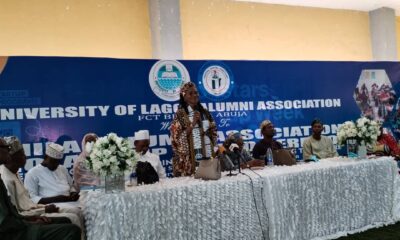

UNILAG Alumni awards scholarship to 28 indigent students
ShareBy Laide Akinboade, Abuja The University of Lagos Alumni Association, Federal Capital Territory (FCT), chapter on Thursday, awarded scholarship to...


JAMB Releases 2026 UTME Examination Slips for Candidates
ShareThe Joint Admissions and Matriculation Board (JAMB) has announced that candidates who registered for the 2026 Unified Tertiary Matriculation Examination (UTME) can now print...
Lobi Stars Target Promotion to NPFL in 2026/2027 Season
ShareThe Chairman of Lobi Stars Football Club of Makurdi, Simon Ikya, said the club’s sole target is to gain promotion...

Gambia Appoints British Barrister to Prosecute Gruesome Jammeh-era Crimes
ShareBritish barrister Martin Hackett has been appointed as The Gambia’s first special prosecutor to try those responsible for human rights abuses carried out...
1 Comment