
BUSINESS
No Plan to Withdraw Naira Notes from Circulation – CBN


The Central Bank of Nigeria (CBN) at the weekend debunked reports that it planned to replace the conventional Naira notes in circulation with digital currency, otherwise known as the eNaira, in due course.
This is as the African Development Bank (AfDB) Group’s Board has approved a $1.
5 billion facility to support African countries deal with the impact of the Russian-Ukraine war impacting food prices and availability.CBN’s Director of Corporate Communications Department, Mr. Osita Nwanisobi, said the misleading statement purportedly made at a stakeholders’ engagement on eNaira adoption in Asaba, Delta State, was misconstrued and therefore, urged the public to completely disregard it.
Nwanisobi further explained that the digital version of the Naira is meant to complement the existing currency notes and therefore, would circulate simultaneously with the conventional Naira notes as means of exchange and store of value.
He said the adoption of the digital legal tender, aside from its safety and speedy features, would also ensure greater access to financial services by the underbanked and unbanked populace thereby enhancing financial inclusion.
He urged the public and business owners to embrace digital currency as it offers more possibilities.
The eNaira was formally launched into circulation by President Muhammadu Buhari in October last year.
The apex bank’s governor, Mr. Godwin Emefiele had recently expressed optimism that the bank would achieve the 85 per cent financial inclusion target which is currently at about 70 per cent.
Addressing a delegation of Executive Directors from the Bank of Uganda, who was on an experience sharing tour of the CBN’s Central Bank Digital Currency (CBDC) project, Emefiele said the apex bank remained committed to accelerating the rate at which those who were financially excluded could come into the formal banking sector.
He also expressed satisfaction that the eNaira had recorded some level of success judging by the rate of integration and security features.
The central bank governor said the CBDC would enhance the relationship between mobile banking and e-business and speed up the rate of financial inclusion.
He pointed out that the interest that the eNaira continued to attract from other countries and multinational bodies, including the International Monetary Fund (IMF) and the World Bank, underscored the level and quality of work the CBN had put into the project.
Emefiele said Nigeria is currently a case study to other climes, being the first country in Africa to launch its CBDC, adding that the country was treading cautiously to ensure it sustains the successes recorded so far.
He also told the visiting team that the country had deepened its payment system infrastructure, which is ranked among the best in the world.
Emefiele had said with growing interest in CBDC around the world, the CBN had commenced extensive study, consultations, identification of use cases, and the testing of the CBDC concept in a Sandbox environment as far back as 2017.
He said the objective of the research was to establish a compelling case for the adoption of a digital currency in the country to enable a more prosperous and inclusive economy for all Nigerians.
He added that following the completion of the preliminary work, the researchers and experts at the CBN were able to clearly establish that a digital currency will drive a more cashless, inclusive, and digital economy as well as complement the gains of previous policy measures and our fast-growing payments platforms.










Analysts have warned of significant crude oil price hikes which would further erode global economic prospects.
Top grade Brent crude could surge to $200 a barrel if the Iran conflict drags on through the end of June and the Strait of Hormuz remains largely closed to shipping traffic, Macquarie strategists warned in a note.
These fears were echoed by Egyptian President Abdel Fattah al-Sisi, who warned at an energy conference in Cairo that supply disruptions and rising prices could push oil above $200 per barrel, calling such projections realistic rather than exaggerated.
Egypt, which maintains close ties with the U.
S. and Gulf states, has condemned Iran’s attacks on Gulf Arab nations and is actively supporting diplomatic efforts to prevent a broader regional conflict.Macquarie laid out two scenarios for the oil market. In the more likely case, assigned a 60 per cent probability, the war winds down soon, prices fall relatively quickly from current levels near $108 a barrel, and the economic damage remains contained.
But in the second scenario, which Macquarie puts at a 40 per cent chance, the disruption proves far more durable, with consequences the strategists describe as historically unprecedented.
“With the global economy much less oil-intensive than 50 years ago, we would not be surprised if that would require historically high real prices ($200) for a time,” strategists led by Peter Taylor said in the note.
The scale of the supply disruption is already striking. With the Strait of Hormuz mostly closed, Macquarie estimates around 13% of global oil production will be shut in by end of March, a hit already larger than the peak seen in either of the 1970s oil shocks or the first two Gulf Wars. In 2025, the world consumed almost 105 million barrels per day of oil and products.
Emergency stockpiles held by IEA members over 1.2 billion barrels would provide some buffer, but the strategists note these can only be released slowly. Some countries in Asia are already facing physical shortages of diesel and jet fuel.
“If the Strait were to stay closed for an extended period, prices would need to move high enough to destroy an historically large amount of global oil demand,” the strategists wrote.
Should prices reach $200, the team projects that talk would quickly turn to global recession, with growth slowing by around one percentage point relative to 2025. Central banks would face a stagflationary environment with weak growth alongside elevated inflation with echoes of the 1970s.
In the U.S., the Fed would be confronted with near-zero or negative employment growth alongside rising prices, according to Macquarie.
That said, the strategists suspect a full global recession could be narrowly avoided, partly because governments would likely step in to subsidize energy costs, as several already have. Japan and Italy have already moved in that direction.
Overall, Macquarie’s base case remains a relatively swift resolution. With around 15% of global oil supply at risk of being held back indefinitely, the economic incentive to reach a deal is enormous.
“It is that reality that underpins our view that a deal must eventually be made,” the strategists said.

The Kwara Government has partnered Olam Agri to curb post-harvest losses and boost farmers’ profitability across the state.
The development is contained in a statement issued on Sunday in Ilorin by Ashaolu Omotola, Press Secretary, Ministry of Agriculture.
The agreement was signed by Agriculture Commissioner, Dr Afees Alabi, and Olam Agri’s Vice President for Procurement, Noel Ferrao.
Alabi described post-harvest losses as a major constraint on farmers’ incomes and overall agricultural efficiency in the state.
He stressed the need for improved storage systems, describing them as practical tools to preserve produce and reduce avoidable waste.
The commissioner said activating storage facilities would improve preservation, support aggregation, and help farmers secure better market opportunities through flexible selling timelines.
Alabi reaffirmed the government’s commitment to strengthening agricultural support across the 16 local government areas, noting the initiative would directly benefit thousands of farmers.
“The engagement reflects the government’s focus on strengthening infrastructure, deepening private sector collaboration, and improving efficiency for long-term food security and rural development,” he said.
Ferrao said Olam Agri aimed to collaborate with the Federal Ministry of Agriculture, Kwara government, development agencies, and financial institutions.
He noted the partnership would deliver sustainable maize and soyabean outgrower programmes, providing inputs, training on best practices, and timely market access.
According to him, Olam Agri already operates a similar soyabean partnership and plans to expand with another programme this farming season.
Unstable electricity supply and rising fuel prices are placing significant strain on frozen food businesses in Lagos, as traders struggle to cope with higher operating costs and reduced customer patronage.
The traders, who spoke with in separate interviews on Wednesday, said the combined effect of unstable power supply and expensive fuel had increased their operating costs and reduced profit margins.
Frozen food businesses rely heavily on constant electricity to preserve items such as chicken, turkey, fish, and other perishable products.
However, irregular power supply has forced traders to depend on generators, which run on fuel, thereby increasing operational expenses.
There has been a nationwide drop in power generation due to insufficient gas supply.
Consequently, the country’s power sector, largely dependent on gas-fired plants, has been hit by disruptions in gas supply worsened by pipeline maintenance challenges and liquidity constraints.
Chika Oluehi, owner of Chika Frozen Foods at Ijora-Olopa, said he now factors electricity and fuel costs into his pricing to remain in business.
“Before now, a carton of turkey sold for about N85,000, but it now goes for between N105,000 and N110,000.
“A carton of chicken that used to sell for about N39,000 to N41,000, now sells for N46,000. We have to calculate our margins carefully to avoid losses,” he said.
Oluehi added that storage capacity determines how traders cope with electricity challenges.
“Suspending my frozen food business is not an option for me because of my storage facilities.
“When there is no electricity, we use fuel to power generators, but the generator does not fully carry the freezer. It only chills it and does not completely prevent spoilage,” he said.
Oluehi added that he had resorted to alternative energy sources to reduce losses.
“Where I live, I sometimes have light, and I also use a solar freezer. It helps, but it still depends on electricity, so it is not a complete solution,” he said.
According to him, the rising cost of fuel also affects the transportation of frozen foods from suppliers to markets.
“When fuel prices go up and there is no power, we spend more transporting these frozen foods.
“Once fuel increases, prices automatically rise, and customers cannot buy as much as they used to.
“Imagine having 10 customers and five stop buying, while the remaining five reduce the quantity they purchase. The business will eventually suffer,” he said.
Another trader, Mojisola Kazeem of MJ Frozen Foods in Surulere, said she had temporarily halted selling frozen items due to the cost of fuel and electricity.
“I had to pause it. I cannot cope with the electricity situation and the cost of fuel.
“Hopefully, when things return to normal, I can pick up from where I stopped,” she said.
Similarly, a fish seller in Mushin, Bose Adeyemi, said she now reduces the quantity she stocks to avoid spoilage.
“Without steady electricity, keeping large quantities is risky. If light goes off and fuel is expensive, you may lose everything.
“I now buy in small quantities even though it reduces profit,” she said.
A cold-room operator in Agege, Sulaiman Adebayo, said many traders now share storage space to cut electricity costs.
“Some traders cannot afford to run generators alone, so they rent space in cold rooms. But even cold-room owners are increasing prices because of fuel,” he said.
Adebayo noted that the situation had reduced customer patronage.
“Customers complain that frozen foods are too expensive. Many now buy smaller portions, and some switch to alternatives,” he said.
Yetunde Afolabi, a soft drink seller at Yaba Market, said poor electricity supply had affected her sales because customers prefer chilled drinks.
“People will not buy soft drinks when they are hot. Once there is no light, the drinks lose their chill, and customers walk away.
“Some of them even open the cooler, check the bottle, and drop it back when it is not cold enough.
“I spend money on fuel to run my generator, but I cannot keep it on all day because fuel is expensive. When I switch it off, the drinks become warm, and I lose sales,” she said.



When Will the Bloodlettings in Nigeria Stop?
ShareBy Tochukwu Jimo Obi The latest wave of violence in Nigeria has once again exposed the fragility of the nation’s security framework....
Analysts Warn Brent Crude Price Could Surge To $200 A Barrel
ShareAnalysts have warned of significant crude oil price hikes which would further erode global economic prospects. Top grade Brent crude could surge to $200 a barrel if the Iran conflict drags on through the...


CBN Sets Three-week Deadline for Banks’ Cybersecurity Self-assessment
Share The Central Bank of Nigeria has directed banks to complete a mandatory cybersecurity self-assessment within three weeks, as part...


Jos Killings: Tinubu Meets Security Chiefs, Summons Mutfwang
ShareBy David Torough, Abuja President Bola Tinubu has summoned Plateau State Governor Caleb Mutfwang to Abuja for high-level consultations following...


Again, Senate Approves Tinubu $6bn Loan as Budget Spending Surges
ShareBy Eze Okechukwu, Abuja In a series of far-reaching fiscal decisions on Tuesday, the Senate approved a $6 billion external...


AFN Reports Major Gains against Terrorists, Rescues Over 800 Victims in Q1 2026
ShareBy David Torough, Abuja The Armed Forces of Nigeria (AFN) has announced significant operational successes across multiple conflict zones in...


Palm Sunday Killings in Jos: Nigeria Cannot Keep Bleeding Like This, CAN, insist
ShareBy Laide Akinboade, Abuja The Christian Association of Nigeria (CAN),condemned, in the strongest possible terms, the horrific attack that took...
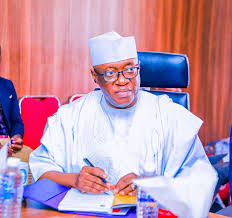

Nasarawa Accountant General Resigns Declares for 2027 Governorship
ShareFrom Abel Zwanke, Lafia The Nasarawa state Accountant General Rt. Hon. Musa Ahmed Mohammed, has resigned his position and declared his intention to contest the 2027 governorship election....

CAF Considers Africa Cup of Nations Expansion to 28 Teams
ShareConfederation of African Football (CAF) President Patrice Motsepe has said that the Africa Cup of Nations could be expanded from 24 to 28 teams. Motsepe made the...


Russian Oil Tanker Reaches Cuba after Trump Appears to Loosen Blockade
ShareA Russian tanker carrying oil to Cuba has entered the waters off the Communist-run Island, Russia’s Interfax. The oil shipment – the first to reach Cuba since January – comes hours after US...