
POLITICS
Official Engagements of Buhari, Osinbajo

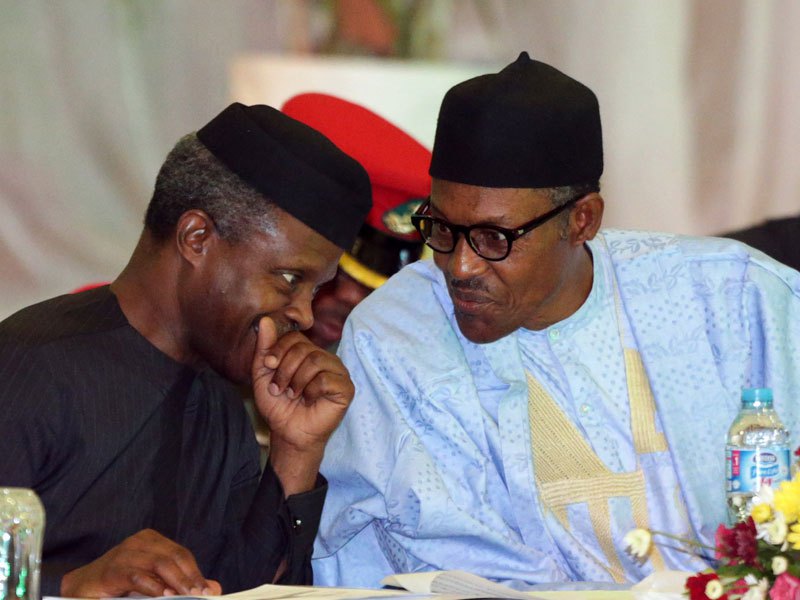
President Muhammadu Buhari started the week on March 2 with a briefing from a delegation he sent to Zamfara to sympathise with the people and government of the state on the kidnapped Jangebe schoolgirls.
The delegation was headed by the Minister of Aviation, Sen.
Hadi Sirika, with the Minister of Police Affairs, Alhaji Maigari Dingyadi; Minister of Humanitarian Affairs and Disaster Management, Hajiya Sa’adiya Umar-Faruk and Minister of Women Affairs, Mrs Pauline Tallen as members.Barely 24 hours after receiving feedback from the delegation, the president on March 3, expressed joy over the reported release of the abducted schoolgirls.
The president expressed his delight in a statement by his Senior Special Assistant on Media and Publicity, Malam Garba Shehu.
Buhari said: “I join families and people of Zamfara State in welcoming and celebrating the release of these traumatized female students.”
Few hours after the release of the schoolgirls, the president summoned a meeting of the National Security Council.
The March 2 meeting of the council reviewed the renewed onslaught on insurgency, banditry and other violent crimes by the Federal Government to achieve desired goals.
In attendance at the meeting were Osinbajo; Secretary to the Government of the Federation, Boss Mustapha; Chief of Staff to the President, Prof. Ibrahim Gambari and the Minister of Defence, retired Maj.-Gen. Bashir Magashi.
Others were Ministers of Police Affairs, Maigari Dingyadi; Interior, Rauf Aregbesola; the Chief of Defence Staff, Maj.-Gen. Lucky Irabor, other Service Chiefs and the Inspector-General of Police, Mohammed Adamu.
At the end of the meeting, the Federal Government declared Zamfara a no-fly zone and banned all forms of mining activities in the state.
On March 3, Buhari presided over the 36th virtual meeting of the Federal Executive Council at the Council Chamber of the State House.
In attendance at the meeting were Osinbajo, Mustapha, Gambari and 10 ministers.
The ministers include Information and Culture, Alhaji Lai Mohammed, Finance, Zainab Ahmed, Justice, Abubakar Malami, Agriculture Sabo Nanono and Environment, Mahmood Mohammed.
Others were the Ministers of Humanitarian Affairs, Sadiya Umar, Foreign Affairs, Geoffrey Onyeama, Works and Housing, Babatunde Fashola, Power, Sale Mamman, and Interior, Rauf Aregbesola.
The council meeting approved total reconstruction of the Abuja-Kaduna-Kano highway at a cost of N797.2 billion.
The figure shows an increase of N642.2 billion over the N155 billion the council previously approved for the rehabilitation of the same highway.
The council also approved N10. 4 billion for the procurement of fire-fighting vehicles and equipment for the Federal Fire Service and N6.04 billion for the provision of potable water in the four local government areas in Ogoniland in Rivers.
On March 4, Buhari inaugurated the Nigeria Immigration Service (NIS) Technology Building in Abuja, where he directed the NIS to improve surveillance and control around the nation’s borders, to check the activities of criminal elements in the country.
Buhari also met behind closed doors with Gov. Yahaya Bello of Kogi, where he enjoined all Nigerians to go about their lawful businesses as “the country’s unity is not negotiable”.
Also on March 4, Osinbajo delivered a keynote address at the 16th Biennial Delegates Conference of the Pentecostal Fellowship of Nigeria, held at Michael Okpara Square in Enugu.
Speaking on the theme: “The Unquenchable Light”, Osinbajo said: “We must bear this gospel of Jesus Christ, knowing that it is the beacon of hope and succour for our nation.
”As bearers of the gospel we are the reconcilers-in-chief.”
Buhari and Osinbajo concluded their engagements for the week on March 6, when they received vaccinations for the coronavirus.
The president’s chief physician, Dr Suhayb Rafidadi, administered the vaccine on Buhari at about 11.52 a.m., while the vice-president was vaccinated by his personal physician immediately after the president had received his dose.
Buhari, who is the ECOWAS Champion on the Fight against COVID-19 and Osinbajo also got COVID-19 vaccination cards.
The Nigerian leader used the opportunity to appeal to eligible Nigerians to take the coronavirus vaccination “so that we can be protected from the virus.”
Nigeria received 3.92 million doses of the Oxford/AstraZeneca vaccine on March 2, delivered under the international Covax scheme. (NAN)





By David Torough, Abuja
The crisis rocking the African Democratic Congress (ADC) has intensified following the Federal High Court judgment nullifying the David Mark-led leadership of the party, as National Secretary, Rauf Aregbesola, has appealed the ruling, while Minister of Aviation and Aerospace Development, Festus Keyamo, insists that the party will participate in the 2027 general elections, although candidates produced by the affected faction, including former Vice-President Atiku Abubakar, may be excluded from the ballot.
The unfolding political and legal developments have heightened uncertainty over the ADC’s leadership, the validity of its 2027 presidential nomination and its readiness for the forthcoming general elections, with the opposition party also raising concerns over alleged political violence, intimidation and the neutrality of electoral and security institutions.
Keyamo, in a statement posted on his verified X handle on Sunday, dismissed claims that the judgment had effectively barred the ADC from participating in the 2027 elections, arguing that the court’s decision concerned the legitimacy of the Mark-led leadership and not the continued existence or electoral eligibility of the party.
He, however, warned that the candidacies of individuals who emerged through the Mark-led faction, including Atiku Abubakar, could be affected by the outcome of the pending judicial proceedings.
“For the education of the public, those raising false alarm that the court judgment on ADC means the party will not be on the ballot are spreading misinformation.
“The ADC will be on the ballot. It is the David Mark faction of candidates, including Atiku Abubakar, that may not be on the ballot, depending on the final judgment of the Supreme Court,” Keyamo stated.
The minister also questioned the protests surrounding the judgment, arguing that Nigerians who participated in primaries conducted under the party’s original leadership structure should not be treated as less entitled to political participation than candidates produced by the Mark-led faction.
The controversy followed Thursday’s judgment by the Federal High Court in Abuja, presided over by Justice Peter Lifu, which nullified the Mark-led leadership and invalidated decisions taken by the faction, including the presidential primary that produced Atiku as the ADC’s candidate for the 2027 election.
The judgment arose from suit No. FHC/ABJ/CS/1819/2025, instituted by former ADC Deputy National Chairman (North-East), Nafiu Gombe, who challenged the process through which Mark and other members of the caretaker committee assumed control of the party.
Gombe argued that following the resignation of former National Chairman, Ralph Nwosu, he was constitutionally entitled to take over the party’s leadership, insisting that the emergence of the Mark-led leadership violated the ADC constitution and relevant electoral provisions.
The ruling has since generated fresh legal and political battles, with the affected leadership rejecting the decision and promising to challenge it.
In the latest development, Aregbesola has filed an appeal at the Court of Appeal, seeking to overturn the judgment on grounds that the Federal High Court lacked jurisdiction to determine the issues surrounding his emergence as national secretary and the validity of the resolutions of the party’s 99th National Executive Committee meeting.
In the notice of appeal filed on Friday through his counsel, Mohammed Sheriff, SAN, Aregbesola named Gombe, the ADC, Senator David Mark, the Independent National Electoral Commission (INEC) and former National Chairman, Ralph Nwosu, as respondents.
He asked the appellate court to set aside the judgment, strike out the claims against him and invalidate the findings affecting his emergence as national secretary.
Alternatively, he urged the court to dismiss the claims or order a retrial before another judge if it upholds the jurisdiction of the lower court.
Aregbesola’s legal team argued that the trial judge failed to distinguish between an election to fill a vacant party position and an interim appointment authorised by the ADC constitution.
Specifically, the counsel maintained that Article 23(4) of the party’s constitution empowered the appropriate executive organ to appoint an eligible replacement pending an election at the next convention or congress.
He further argued that the trial court wrongly applied Section 82(3) of the Electoral Act 2022 and Section 223(1)(a) of the 1999 Constitution without first determining whether his emergence was an interim appointment rather than an election.
The ADC national secretary has also filed a separate motion at the Federal High Court seeking a stay of execution of the November 5 judgment pending the determination of his appeal.
He argued that the appeal raised substantial legal and factual questions, particularly concerning the jurisdiction of the trial court and the interpretation of the party’s constitution and applicable electoral laws.
Meanwhile, INEC has maintained that it would not take a position on the ADC leadership dispute until it obtains and studies the certified true copy of the judgment.
The commission’s position has added another layer of uncertainty to the party’s preparations, particularly as the legal battle could determine which faction is recognised to conduct valid party activities and nominate candidates for the 2027 elections.
Beyond the leadership dispute, the ADC Presidential Campaign Council (ADC-PCC) has accused the Federal Government and its alleged political allies of creating an atmosphere of intimidation and insecurity capable of undermining the 2027 electoral process.
The council declared that no amount of intimidation, violence or alleged manipulation of democratic institutions would prevent Nigerians from deciding the country’s political future, insisting that President Bola Ahmed Tinubu would lose the 2027 presidential election.
The Director of Media and Publicity of the ADC-PCC, Kola Ologbondiyan, made the position known on Sunday in Abuja, where he raised concerns over alleged attacks on opposition members and supporters in different parts of the country.
Ologbondiyan cited reports of the killing of several members of the Nigeria Democratic Congress (NDC) in Delta State, allegedly following an attack on the party’s campaign venue by suspected political thugs.
He also alleged that opposition parties, particularly the ADC, NDC and Allied Peoples Movement, had faced attacks and intimidation in Kaduna, Kogi, Katsina, Kebbi and Sokoto states.
The council described the incidents as a threat to democratic freedoms, warning that political violence should not be normalised or allowed to become part of the country’s electoral culture.
It also questioned the neutrality and preparedness of INEC, alleging that the commission’s voter register database had been compromised and that individuals sympathetic to the ruling All Progressives Congress had been placed in sensitive positions within the electoral body.
The ADC-PCC further accused security agencies of being deployed to harass, arrest and intimidate opposition members, raising particular concern over the alleged involvement of a serving director of a security agency in the APC Presidential Campaign Council as a co-director of National Security and Intelligence.
Ologbondiyan described the alleged development as a violation of the law establishing the agency, insisting that public institutions must remain politically neutral.
The council warned that alleged manipulation of judicial processes and electoral institutions would not guarantee President Tinubu’s re-election, adding that Nigerians would resist any attempt to impose a president through compromised judicial decisions or electoral fraud.
It consequently called on security agencies to remain loyal to the Constitution and the Nigerian people rather than any political party or individual.
The ADC-PCC also appealed to civil society organisations, the international community, religious leaders and traditional institutions to pay closer attention to the country’s political and security environment ahead of the 2027 elections.
The developments have placed the ADC at a critical crossroads, with the party’s participation in the next general elections appearing distinct from the question of which faction has the legal authority to nominate its candidates.
While Keyamo maintains that the ADC will be on the ballot, the fate of the Mark-led faction and its candidates remains subject to judicial determination.
With Aregbesola’s appeal, the Mark-led faction’s planned legal challenge and the pending determination of the leadership dispute, the Court of Appeal and ultimately the Supreme Court could prove decisive in determining the political future of the opposition party.
For Atiku and other candidates who emerged through the Mark-led structure, the stakes are particularly high, as the final outcome could determine whether their nominations survive the legal contest or are rendered invalid.
As the 2027 general elections approach, the ADC’s internal crisis, allegations of political violence and concerns over the credibility of electoral institutions are shaping an increasingly contentious political atmosphere, with the courts expected to play a defining role in determining the party’s direction.
By David Torough, Abuja
Nigeria’s annual fish supply deficit has exceeded 2.2 million tonnes, forcing the country to spend close to $1bn annually on imports, as the Federal Government moves to ramp up domestic production with a $200m World Bank-backed intervention.
The Minister of Marine and Blue Economy, Dr Adegboyega Oyetola, disclosed this in a statement issued on Sunday by his Special Adviser, Dr Bolaji Akinola, announcing plans to strengthen fisheries and aquaculture development across the country.
According to the minister, Nigeria requires approximately 3.
6 million tonnes of fish annually but produces only 1.4 million tonnes, leaving a substantial gap that local producers are unable to bridge.The figures show that domestic production currently accounts for only about 39 per cent of national demand, while the remaining 61 per cent is largely met through imports, placing additional pressure on the country’s foreign exchange reserves.
Speaking through the Senior Special Assistant to the President on Marine and Blue Economy, Prof. Busayo Fakinlede, at an aquaculture investment training programme in Abuja, Oyetola stressed the need for Nigeria to reduce its dependence on imported fish.
He described fish production as critical to food security, household nutrition and rural livelihoods, insisting that the country must strengthen its capacity to meet domestic consumption needs.
“Fish is a pillar of food security, household nutrition and rural livelihoods. No nation can call itself food secure while it imports most of the fish it eats. Our ambition is to produce more, import less and, in time, become a net exporter. That ambition can be achieved only when every state plays its part,” he said.
Oyetola disclosed that the World Bank Group had committed $200m to support the development of fisheries and aquaculture, with the funding expected to be channelled to state governments through concessional loans.
The intervention is designed to expand production capacity, stimulate private-sector investment, create employment opportunities and improve the country’s food security outlook.
Under the proposed arrangement, participating states are expected to identify priority fisheries value chains, assess investment opportunities and develop bankable projects backed by measurable production targets.
The minister emphasised that closing the fish supply gap would require coordinated efforts involving federal and state governments, private investors and development partners.
He spoke at the Executive Training on Aquaculture Investment Guide, organised by the Ministry of Marine and Blue Economy in collaboration with the World Bank Group.
The programme attracted commissioners from Rivers, Bayelsa, Delta and Cross River states, alongside permanent secretaries and fisheries officials from across the federation.
Participants were trained in investment planning, risk management, environmental safeguards and public-private partnership frameworks to equip states with the capacity to attract and manage investments in the sector.
Oyetola also announced plans to convene a post-training stakeholders’ roundtable to strengthen implementation, improve coordination and secure commitments from state governments.
Highlighting developments in the sector, the minister said national fish production had risen from 1.1 million tonnes to 1.4 million tonnes, representing an increase of approximately 27.3 per cent.
He attributed the improvement to government interventions, including the inauguration of the Technical Committee on Accelerating Fish Production in August 2026 and the digitisation of fish import licensing.
Other initiatives, according to him, include Nigeria’s attainment of United States shrimp-export certification following compliance with Turtle Excluder Device requirements, as well as the development of the Fish City and Fish Terminal investment portfolio.
The government is expected to leverage these initiatives alongside the World Bank-backed financing to strengthen the country’s fisheries value chain and position aquaculture as a major contributor to economic growth.
Oyetola expressed optimism that sustained collaboration and investment would help close the production gap, improve livelihoods and reduce the country’s dependence on imported fish.
“Through strategic collaboration, contributive support and shared commitment, we will close the fish deficit, create jobs, raise household incomes and secure Nigeria’s place as a fish-sufficient nation,” he added.
By Tony Obiechina, Abuja
The Federal Government generated N33tn in revenue between January and October 2026, while about 90 per cent of Nigeria’s data is hosted abroad, highlighting the country’s growing revenue capacity and dependence on foreign digital infrastructure.
The Minister of Finance and Coordinating Minister of the Economy, Taiwo Oyedele, disclosed the figures while delivering the convocation lecture at the University of Uyo, Akwa Ibom State.
In a statement issued on Thursday by his Senior Special Assistant on Communications and Press Secretary, Maryann Duke, Oyedele attributed the record revenue performance partly to improvements in digital tax administration and the introduction of electronic invoicing.
He said the increased use of digital systems had strengthened revenue collection, improved tax compliance and enhanced efficiency across government institutions.
Oyedele, however, raised concerns over Nigeria’s dependence on foreign digital infrastructure, citing estimates from the Nigeria Data Protection Commission that as much as 90 per cent of the country’s data is hosted outside its borders.
He also disclosed, citing Nigerian Communications Commission figures, that Nigeria had recorded more than 157 million active internet subscriptions as of May 2026.
According to him, these connections generate enormous volumes of data through financial transactions, healthcare, education and taxation, creating significant economic opportunities for the country.
He warned that hosting most of this data abroad has implications for foreign exchange expenditure, job creation, technological skills development and Nigeria’s control over information generated by its citizens.
The minister compared the situation to Nigeria’s historical dependence on imported refined petroleum products, cautioning against allowing the country’s data to be processed abroad while digital services are subsequently sold back to Nigerians.
He called for increased investment in local data infrastructure, cybersecurity, technical expertise and predictable regulations to enable Nigerian businesses to capture greater value from the digital economy.
Oyedele stressed that digital sovereignty should not mean technological isolation but should position Nigeria to compete more effectively in international markets.
Addressing graduating students, he urged young Nigerians to move beyond consuming foreign technological products and become developers of solutions that address local and global challenges.
He described artificial intelligence as both a disruptive force and an opportunity for innovation, advising graduates to combine digital skills with critical thinking, creativity, sound judgement and integrity.
The minister also warned that irresponsible online conduct could affect employment opportunities, business relationships and professional credibility, as digital footprints increasingly shape public perception.
He urged universities to strengthen partnerships with government and industry to develop practical solutions in agriculture, energy, healthcare, environmental sustainability and digital services.
According to him, the performance of higher institutions should be measured not only by graduation figures and academic publications but also by businesses established, innovations developed and economic problems solved.
Oyedele outlined five priorities for graduates: continuous learning, value creation, integrity, responsible digital citizenship and active participation in national development.
“Your degree is evidence of what you have learned. Your competence will demonstrate what you can do. Your character will reveal who you truly are,” he told the graduating students.
He urged the graduates to combine innovation with ethical conduct and contribute to building an economy driven by local expertise, productive enterprises and technological advancement.




West Africa: How WAHO Successfully Harmonized Procedure Manuals for Health Disciplines and Professions
ShareBy David Torough After three days of serious brain-storming sessions in Abuja, the West African Health Organization (WAHO), has successfully...


2027: CAN Seeks Return of Sacked Traditional Rulers in Kaduna
ShareFrom Shabanyan Kantiok, Kaduna The Christian Association of Nigeria in Chikun Local Government Area of Kaduna State has urged Christian...


OPay Opens New Kano Office, Strengthens Commitment to Nigeria’s Financial Inclusion
ShareOPay, Nigeria’s leading digital bank, has opened a new office in Kano State, strengthening its presence in Nigeria and bringing...

Rigging Years Before Elections: Why Tinubu, Parliament Favours Staggered Balloting
Share Silhouette of Donald Andoor e‐mail; doandoor@gmail.com There is a growing need for Nigerians to look beyond the ballot box and...

Akpabio Congratulates Nigeria’s Golden Girls, Flamingos
ShareThe President of the Senate, Godswill Akpabio has sent a hearty congratulations to the Nigerian Under-17 Women’s National Team on...

Customs Generates N1.4tn Revenue in Two Months
ShareBy Julius Tambaya, Abuja The Nigeria Customs Service (NCS) generated a total of N1.419 trillion in revenue between September and...

ADC Crisis: Court Battle Threatens Opposition’s 2027 Game Plan
ShareBy David Torough, Abuja The crisis rocking the African Democratic Congress (ADC) has intensified following the Federal High Court judgment...


FG Secures $200m World Bank Support to Boost Aquaculture
ShareBy David Torough, Abuja Nigeria’s annual fish supply deficit has exceeded 2.2 million tonnes, forcing the country to spend close...

CBN Introduces New Regulatory Framework for Non-Security VASPs, others
ShareBy Tony Obiechina, Abuja The Central Bank of Nigeria (CBN) has introduced a comprehensive regulatory framework for non-security virtual assets...

Group tasks Women Journalists on Reporting Impact of Coal Mining in Enugu
ShareFrom Sylvia Udegbunam, Enugu A non-governmental organisation, Renevlyn Development Initiatives, has called on women journalists in Enugu State to intensify...