
security
OPWS Troops raid illegal arms factory in Nasarawa, recover six guns

From Attah Ede, Makurdi
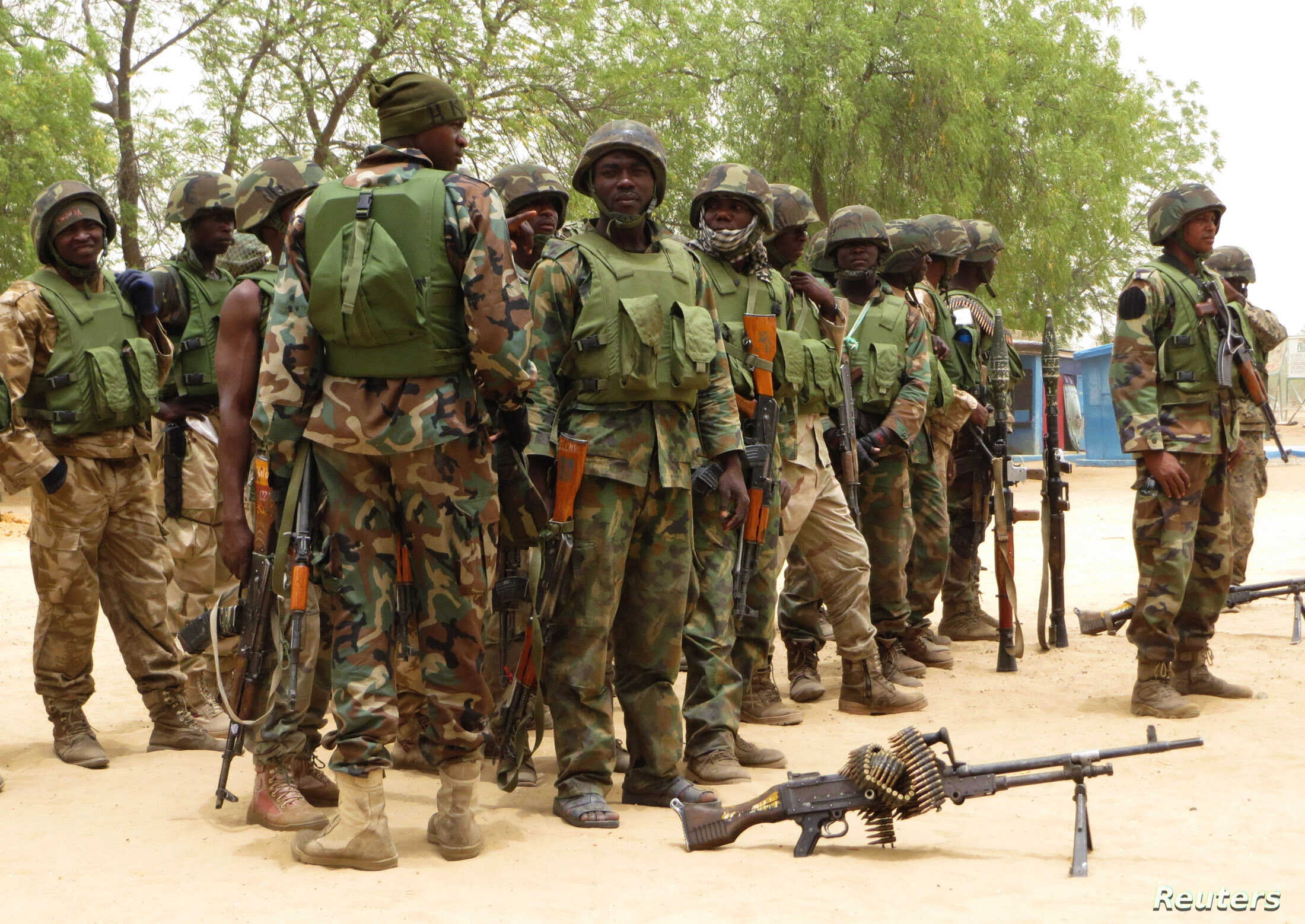
Troops of Sector 2, Joint Task Force codenamed Operation Whirl Stroke (OPWS), on Monday uncovered an illegal arms manufacturing factory in Agwatashi, Doma Local Government Area of Nasarawa State, recovering at least six arms.
Acting Media Information Officer, Headquarters JTF OPWS, Lt.
Ahmad Zubairu, confirmed this significant fit in a statement he issued and made available to newsmen on Monday in Makurdi.In the statement, Zubairu explained that troops deployed to Forward Operating Base (FOB) Idadu during routine patrols uncovered a concealed location suspected to be used for the illegal manufacturing of locally fabricated weapons.
“Some persons fled the area upon seeing the troops approaching the site.
“However, one suspect, Baba Ogar, a 26-year-old from Arusu Village in Kokona Local Government Area who hid on top of a tree to evade arrest, was apprehended.
“A thorough search of the site led to the recovery of six locally fabricated pistols, assorted tools and instruments believed to be used in the production of illegal weapons, the sum of ₦40,500, and a mobile phone, which was found on the suspect.
“Preliminary investigations indicate that the location served as an illegal arms manufacturing site supplying criminal elements with firearms within and beyond the area.
“The arrested suspect is currently in custody, while investigations have been intensified to track down and apprehend other fleeing accomplices connected to the criminal activity.
“The Force Commander, OPWS, Maj.- Gen. Moses Gara, has commended the troops for their professionalism, vigilance and sustained operational pressure, which culminated in the discovery of the illegal arms production facility”, Zubairu stated.
“Major General Gara charged the officers to continue maintain momentum and continuing to rely on intelligence-driven operations to dismantle criminal networks within the Joint Operations Area”, the statement concluded.

By David Torough, Abuja
Security concerns across Northern Nigeria took centre stage on Sunday as political leaders, civic groups and religious bodies raised alarm over escalating banditry and abductions, while urging coordinated action to restore peace and protect vulnerable communities.
In Kano State, the Deputy President of the Senate, Senator Barau Jibrin, visited security operatives deployed to Kano North Senatorial District following recent bandit attacks in Gwarzo, Shanono and Tsanyawa local government areas.
Addressing troops drawn from the Nigerian Army, Police and the Nigeria Security and Civil Defence Corps, Senator Barau urged them to sustain their offensive and “flush out” criminals threatening peace in the area and beyond.The deployment, approved by President Bola Ahmed Tinubu, followed reports of bandits crossing into Kano from neighbouring states. Senator Barau, who arrived early on Sunday, inspected troops at Lakwaya ward in Gwarzo LGA, accompanied by the Garrison Commander of the Nigerian Army’s 3 Brigade, Lt. Col. I. Ekoh, and other senior officers. He later visited security camps in Shanono and Tsanyawa LGAs.
Commending the operatives for their sacrifices, the Deputy Senate President said their presence had reassured affected communities. He thanked President Tinubu for what he described as swift and decisive intervention, noting that it followed consultations with top security chiefs, including the Chief of Defence Staff and the Inspector-General of Police. He also appealed to residents to support security agencies with timely intelligence.
During meetings with community leaders in Shanono LGA, residents welcomed the deployment and praised ongoing federal interventions. Senator Barau assured them of continued government support and announced plans to construct a dam in response to local requests.
Meanwhile, the Northern Reconciliation Group (NRG) expressed deep concern over rising attacks, kidnappings and banditry across the region, warning that the situation now constitutes a regional and national security emergency. In a statement issued in Kaduna, the group called for urgent, coordinated and intelligence-driven responses to dismantle criminal networks and secure the release of abducted persons.
The NRG stressed that insecurity should no longer be seen as isolated incidents and urged enhanced early warning systems, justice, accountability and community-driven approaches to rebuild trust between citizens and the state. It emphasised that human security must transcend ethnic, religious and political divisions.
In Kaduna State, the Christian Association of Nigeria (CAN) in Kajuru Local Government Area held a special prayer session for the release of 177 worshippers abducted from churches in Kurmin Wali community a week earlier. The victims were seized during Sunday services when armed men invaded the area, forcing congregants into nearby forests.
At the prayer session in Maraban Kajuru, CAN leaders combined calls for divine intervention with appeals for heightened vigilance. The Chairman of CAN in the 19 Northern States and the FCT, Rev. Joseph Hayab, urged churches to strengthen internal security and situational awareness around worship centres, warning that unrestricted access exposes congregations to danger.
Local CAN chairman, Rev. Enoch Kaura, described the Kajuru security situation as long-standing and troubling, citing repeated attacks, killings of clergy and mass abductions over the years. While acknowledging relative calm under the current state administration, he said persistent insecurity continued to disrupt farming and daily life, and called for intensified security operations to secure the release of all abductees.
Together, the developments underscore growing pressure on authorities and communities alike to confront Northern Nigeria’s security challenges through decisive action, unity and sustained collaboration.

By Laide Akinboade, Abuja
The Christian Association of Nigeria (CAN) has criticised security agencies over their response to the recent abduction of worshippers in Kurmin Wali community, Kajuru Local Government Area of Kaduna State.
The association expressed concern over what it described as poor public communication by the security agencies.
In a statement issued on Wednesday in Abuja and signed by its President, Archbishop Daniel Okoh, CAN expressed concern over what it described as poor public communication by the security agencies.
The association said the early response lacked sensitivity and thoroughness, noting that dismissing reports of the incident before proper verification caused confusion and further eroded public confidence in the authorities.
CAN’s reaction followed hours after the Nigeria Police Force (NPF) officially acknowledged the kidnapping.
Reports of the abduction in Kurmin Wali community, Kajuru Local Government Area of Kaduna State, first surfaced on Sunday, with claims that more than 100 worshippers were taken during the attack.
Both the Kaduna State Government and security agencies initially dismissed the reports, insisting that no such incident had occurred.
However, days later, the Force Public Relations Officer, Benjamin Hundeyin, confirmed that the abduction did take place.
In a statement issued late on Tuesday, Hundeyin said intelligence and operational findings had verified the incident.
He explained that the earlier position of the Kaduna State Police Command was aimed at preventing panic while investigations were ongoing and facts were being established.
Reacting to the police confirmation, CAN acknowledged the challenges security agencies often face in verifying incidents, particularly in hard-to-reach communities.
However, the association stressed that such challenges do not justify shortcomings in the handling of sensitive information.
CAN said it was disturbed by the early dismissal of reports about the abduction before a comprehensive verification was carried out, describing the approach as inappropriate given the gravity of the incident.
“The initial public dismissal of reports about this incident, before thorough verification, was deeply troubling. “It generated confusion, heightened fear, and unfairly questioned the credibility of nearly 170 worshippers, their families, clergy, and eyewitnesses who raised the alarm,” the statement said.
It added that, “In situations of this gravity, public communication must not appear dismissive of the suffering or fears of affected citizens.
“While the need to prevent panic is understandable, caution must not be communicated in ways that suggest denial or indifference.”
The association emphasized that statements from senior security officials carry immense weight and must be delivered with care, accuracy, empathy, and a clear understanding of their effects on public trust and social stability, particularly in situations involving threats to human life.
CAN acknowledged the subsequent confirmation of the abduction and commended the Inspector-General of Police for deploying operational and intelligence resources to the affected area, describing the action as both necessary and welcome.
However, the association stressed that such measures should be accompanied by a more disciplined and people-focused approach to crisis communication in the future.
It urged all security agencies and relevant authorities to strengthen coordination, improve verification procedures, and ensure that credible community reports are treated with the seriousness they deserve.
“Victims must be protected, genuine distress calls respected, and misinformation, whether dismissive or sensational, must be avoided,” CAN stated.
The association also called on governments at all levels to tackle the persistent insecurity across the country with renewed urgency, warning that recurring attacks continue to threaten lives, disrupt worship, and undermine public confidence.
CAN appealed for the immediate and unconditional release of all those abducted, praying for their safe and unharmed return.
It urged security agencies to intensify every possible effort, operational, intelligence, and diplomatic, to ensure a swift rescue, stressing that the protection of innocent lives must remain the highest priority.

| Torough David | Wed, Jan 21, 9:20 PM (9 hours ago) | ||
to me | |||
From Jude Dangwam, Jos
Gunmen on Sunday night abducted 28 travellers, including men, women and children, in Zak community, Bashar district of Wase Local Government Area of Plateau State, amid growing national concern over kidnapping and rural insecurity.
A youth leader in Wase, Sapi’i Sambo, confirmed the incident, saying the victims were travelling from Zak village to Sabon Layi community to attend a Maulud celebration when they were ambushed around 8 p.
m. on the outskirts of the community.According to Sambo, the attackers stopped the vehicle, abducted all the occupants including children and abandoned the car by the roadside.
He said two princes and a religious leader who were leading the journey were among those taken.“It was only on Monday morning that other road users discovered the abandoned vehicle, which belongs to the Zak community leader,” Sambo explained. “After investigations, the community realised it was the same vehicle conveying the abducted travellers.”
Another resident, Ibrahim Musa, said the whereabouts of the victims remain unknown, despite efforts by the community to trace them. Security agencies have since been alerted.
When contacted, the Plateau State Police Command spokesperson, Alabo Alfred, confirmed that the police were investigating the reported abduction.
The incident added to a pattern of kidnapping, banditry and cattle rustling that has plagued Wase and surrounding areas, with residents repeatedly calling on authorities to flush out criminal groups operating in forests and remote settlements.
The abduction came as the Federal Government announced a tougher national stance on insecurity, officially designating kidnappers, bandits and violent armed groups as terrorists.
Speaking at an end-of-year press briefing in Abuja on Monday, the Minister of Information, Mohammed Idris, said the move marks a shift from treating mass abductions and rural attacks as ordinary crimes to confronting them under full counterterrorism measures.
“Henceforth, any armed group or individual that kidnaps our children, attacks our farmers, and terrorises our communities is officially classified and will be dealt with as a terrorist,” Idris declared. “The era of ambiguous nomenclature is over.”
He said the designation would enhance intelligence sharing and operational coordination among security agencies, enabling faster and more decisive action against criminal networks.
As part of new measures to secure vulnerable areas, the minister announced the deployment of trained forest guards to combine surveillance, local intelligence and rapid-response capabilities in forests and remote locations often used as hideouts by kidnappers and bandits.
Idris noted that improved inter-agency cooperation has already yielded results, citing the recent arrest of some of Africa’s most wanted terrorists, including a senior ISWAP leader previously carrying a substantial international bounty.
By classifying kidnappers as terrorists and expanding security operations, the government says it is signalling zero tolerance for abductions and rural violence—an assurance communities like Zak hope will translate into the safe return of the abducted travellers and lasting security on their roads.



OPWS Troops raid illegal arms factory in Nasarawa, recover six guns
ShareFrom Attah Ede, Makurdi Troops of Sector 2, Joint Task Force codenamed Operation Whirl Stroke (OPWS), on Monday uncovered an illegal arms manufacturing factory in...


FG’s Technical C’ttee Releases New Housing Data, Pegs Deficit at 15m Units
ShareBy Raphael Atuu, Abuja The National Housing Data Technical Committee, inaugurated by the Federal Ministry of Housing and Urban Development, has released new housing sector data...


Minister of Livestock Development, Alhaji Mukhtar Idi Maiha, DAILY ASSET MINISTER OF THE YEAR (PEACE AND LIVESTOCK SECTOR TRANSFORMATION )
ShareThe Minister of Livestock Development, Dr. Idi Mukhtar Maiha perhaps one of the greatest patriots serving in the administration of...


Dr. Mustapha Salihu- National Vice Chairman, North East Politician of the Year
ShareNational Vice Chairman (North East), All Progressives Congress is a politician with a difference. His rise to the very top...


Ganduje Hands Yusuf Automatic 2027 Ticket as Governor Formally Joins APC
ShareBy Mike Odiakose, Abuja Kano State Governor, Abba Kabir Yusuf has formally defected from the New Nigeria Peoples Party (NNPP)...


After Denials, DHQ Confirms Coup Plot, Orders Military Trial for Indicted Officers
ShareBy David Torough, Abuja The Defence Headquarters (DHQ) has confirmed that investigations into alleged misconduct by some military officers’ uncovered...


When will Trump Auction the Statue of Liberty?
ShareBy Chidi Amuta Under Donald Trump, the United States is fast approaching the dead end of a curious transactional presidency. Even...


FCT AMAC Election: Tiv Community Roots for SDP Candidate
ShareBy Mike Odiakose, Abuja The candidate of the Social Democratic Party (SDP) for the Abuja Municipal Area Council (AMAC) in...


Ganduje’s Ex-Aide, Okpala, Slams Buba Galadima Over Attack on Buhari
ShareBy Mike Odiakose, Abuja The Senior Special Assistant on public Enlightenment to former National Chairman of APC, Chief Oliver Okpala,...


Bridging Urban-Rural Water Gap in Nasarawa – Muhammed Muluku
ShareAgainst this backdrop, the Nasarawa State Ministry of Water Resources and Rural Development has, in recent months, embarked on a...