
Foreign News
Over 20 Ethiopian Migrants Kill in ‘Horrific’ Road Crash


At least 22 migrants have been killed and 65 others injured after a lorry they were travelling in overturned in Ethiopia’s north-eastern Afar region, authorities said.
About 85 Ethiopian migrants were travelling along the eastern migration route when the lorry overturned in the town of Semera on Tuesday morning, a senior Afar official Mohammed Ali Biedo said in a statement.
Their final destination was unclear but the route typically runs from Ethiopia through Djibouti, across the Red Sea to Yemen, and onward to Saudi Arabia and other Middle Eastern countries.
Yemen is a major pathway for migrants from the Horn of Africa travelling to Gulf States in search of work.
Biedo said that 30 of the injured are in a critical condition.
“The accident occurred when a lorry transporting migrants, misled by illegal brokers and unaware of the dangers of their journey, overturned,” Biedo said in the statement.
The Afar regional government said it was “doing all the necessary life saving operations” on the injured migrants following the “horrific” accident.
It cautioned Ethiopians, particularly the youth, against the dangers of human trafficking driven by false promises.
“We will ensure that the law enforcement work will continue with the concerned authorities to prevent such tragic events from repeating,” the regional government added.
The International Organization for Migration (IOM) describes the journey from the Horn of Africa – composed of Somalia, Djibouti, Ethiopia and Eritrea – to Yemen as “one of the busiest and most perilous mixed migration routes”.
Despite the risks, more than 60,000 migrants arrived in Yemen in 2024 alone, many ultimately bound for Saudi Arabia, according to IOM.
A fire at a nursing home in Chile has killed 16 people, authorities said Saturday.
The blaze began on Friday night at the nursing home in the Araucania region, 640 kilometers (400 miles) south of the capital Santiago, and was extinguished in the early hours of Saturday.
Images shared on social media showed massive flames rising above the building in the darkness.
“We express our sorrow and dismay at the deaths of 16 elderly people in this tragedy,” authorities in the municipality of Pitrufquen said in a statement.
A total of 26 elderly residents were in the nursing home.
Ten of them survived and were taken to the local hospital, the statement said.Local mayor Jacqueline Romero said that municipal health and public safety teams, firefighters and police were deployed in response to the blaze.
“It is a situation that fills our souls with great sorrow and pain. We have been… providing support to the families,” she said.
The cause of the fire remained unclear.
“We are currently carrying out investigative procedures, including examining the scene and conducting inquiries, to determine the origin and cause of the fire, as well as to rule out third-party involvement,” Jorge Granada, the prosecutor assigned to the case, told local media.
Oil prices rose past $100 (£74) a barrel on Wednesday after further strikes in the conflict between the US and Iran and continuing Houthi attacks in Saudi Arabia.
In back and forth attacks, the US hit five Iranian tankers in reprisal strikes after Tehran targeted one of its warships.
Brent crude – which is the global benchmark for prices – has not been as expensive since the end of July, when a ceasefire between Iran and the US collapsed.
Yemen’s Iran-backed Houthi movement also attacked oil facilities in Saudi Arabia on Tuesday and have been targeting tankers in the Red Sea.
Brent crude did dip back down to $99.90 a barrel, but any fresh flare-ups in the Middle East could see it pushed higher again.
Tit-for-tat strikes between Iran and the US have escalated in the past week, more than six months after conflict broke out when the US and Israel launched attacks on Iran on 28 February.
Oil prices have fluctuated wildly since the war began, and pressure on the industry has been exacerbated by wider regional instability.
Before the conflict Brent crude had been priced at about $70 (£52) a barrel.
But the war has seen the effective closure of the Strait of Hormuz, which carries 20% of the world’s oil and liquefied natural gas (LNG).
The rising costs have sparked huge price leaps in petrol around the world for motorists at the pumps.
The US strikes on the five Iranian tankers saw four in the Gulf of Oman linked to Iran’s Revolutionary Guards Corps (IRGC) hit as well as another near Kharg Island.
Tehran responded by launching missiles at a US base in Jordan – most of which were shot down – and said it attacked two US vessels and eight oil tankers in the Strait of Hormuz.
The Houthis and Saudi Arabia have also been exchanging strikes since July after their own informal ceasefire unravelled.
On Monday the Houthis accused Saudi Arabia of bombing a prison in al-Hazm and killing 11 people.
Then on Tuesday the Saudi authorities said Houthis had struck civilian and economic sites in the cities of Abha, Khamis Mushait, Jazan and Najran.
The latest round of escalation comes after Iran targeted a US warship with ballistic missiles, which Centcom said were “successfully evaded”. It added that no American troops were harmed during the attacks.
In response, the US said that the five Iranian oil tankers it targeted were “part of a multi-billion-dollar shadow network that funds the IRGC and its regional proxies”.
One of the ships it had struck, the M/T Riesco, sunk in the Gulf of Oman, Centcom later said, posting a video on X of the damaged vessel.
Kharg Island – where one Iranian tanker was attacked in the latest round of US strikes – hosts Iran’s main terminal for exporting oil.
Some 90% of the country’s crude oil passes through the island in the Gulf, transported through pipes from the mainland.
Also on Tuesday, Yemen’s Iran-backed Houthi movement attacked energy facilities and civilian infrastructure in Saudi Arabia, injuring 73 people, according to Saudi authorities.
The drone and missile attack caused fires at oil facilities and installations that led to a temporary halt in operations, Saudi Arabia’s military and energy ministry said.
When asked by reporters about the latest tit-for-tat strikes between the US and Iran, US Secretary of State Marco Rubio on Tuesday said the situation was “pretty straightforward”.
“Iran continues to try to hit US naval ships. And, for every time they do that or try to do that, they’re going to lose tankers. And I think you’ll see that again today,” Rubio told reporters during a trip in Colombia.
The US strikes on Tuesday came hours after Iran’s Navy claimed it had seized an uncrewed US submarine in the Strait of Hormuz.
US Navy Capt Tim Hawkins, a spokesperson for Centcom, said that the “underwater drone operated by US forces malfunctioned more than a day ago” and was used to survey regional waters “in support of ongoing operations”.
The defective drone was “an older model that neither collected sensitive data nor carried any classified sonar or radar equipment”, he said, adding that US operations in regional waters were ongoing.

The United States must do its part in the fight against drug trafficking, Mexican President Claudia Sheinbaum said, following recent revelations of corruption at the U.S. Drug Enforcement Administration.
“We insist that they have a very important part to play over there and they shouldn’t just keep pointing the finger at Mexico,” Sheinbaum said at a press conference in the National Palace.
She said Mexico has succeeded in slashing the flow of fentanyl into the United States by more than 70 per cent, a figure acknowledged by U.
S. authorities.She added that the United States is also where the distribution of drugs and money laundering take place on a massive scale due to the high rate of drug consumption.
Sheinbaum also noted that Sara Carter, director of the U.S. Office of National Drug Control Policy, has acknowledged that drug abuse in the United States is a public health issue.
In May, Carter’s office released a document in which the U.S. federal government acknowledges the need for a national public health policy to address drug addiction.
Earlier this year, Carter visited Mexico and expressed interest in the Mexican government’s initiatives aiming to tackle the root causes of violence and prevent drug use.




Minister Warns Envoys against Unguarded Comments Ahead 2027 Elections
ShareThe Minister of Foreign Affairs, Ambassador Bianca Odumegwu-Ojukwu, has warned foreign diplomatic missions against making unguarded comments, disparaging remarks or...
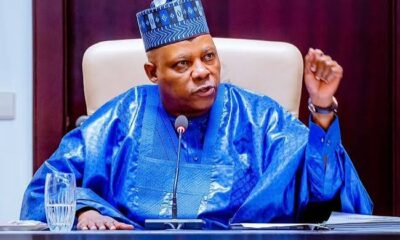

Shettima Holds Northern Governors in High Regard, Aide Clarifies
ShareSenior Special Assistant to the President on Media and Communications, Stanley Nkwocha, said Vice President Kashim Shettima holds northern governors...


World Bank Mobilises $112bn Private Capital in FY26
ShareThe World Bank Group said it mobilised a record 112 billion dollars in private capital in fiscal year (FY) 2026,...


Oluremi Welcomes FOPSHAN’s Endorsement of Tinubu for Second Term
ShareThe First Lady, Sen. Oluremi Tinubu on Thursday in Abuja, welcomed the endorsement of the President for a second term...


Why APC Govs Oppose Wike — Tinubu’s Ex-spokesman
ShareA former South-East spokesman to President Bola Tinubu, Denge Onoh, has attributed the growing face-off between the Minister of the...
Nigeria, State Capture and the Implications on 2027 Elections
ShareBy Uche Igwe An interesting trend is going on in Nigeria in the name of democracy. Many observers have noticed...


Wike, His Rainbow Coalition and the Politically Lazy Governors
ShareBy Hajia Hadiza Mohammed Nyesome Wike, the current Minister of the Federal Capital Territory (FCT) will go down in Nigeria...


2027: INEC Appeals for Peaceful Conduct, Promises Neutrality
ShareThe Independent National Electoral Commission (INEC) has appealed to political parties, candidates and voters to ensure peaceful conduct before, during...


DAILY ASSET Loses Political Editor, Mike Odiakose at 63
ShareBy David Torough, Abuja The management and staff of DAILY ASSET have announced the death of the newspaper’s Political Editor,...


Nigeria Nears 66: Why is Leadership Failing a Generation That Refuses to Give Up?
ShareBy Daniel Nduka Okonkwo Walk through any Nigerian city before sunrise and you will meet the youth of this country...