
OPINION
Peculiarity and Dangers of Nigeria’s Politics of Fear

By Richard Ikiebe
Some politicians depend on massive turnout to win, while others thrive when citizens are too afraid to leave their homes to vote. The recent stream of videos from Benin City, of attacks on politicians and the vandalism of a party state secretariat, reprises a familiar script in Nigeria’s fear-based politics.
They are harrowing reminders that this second logic is still an active strategy.In political theory, “politics of fear” refers to the deliberate production and amplification of fear to secure power, shape opinion and justify the measures. In a landscape already saturated by insecurity and weak institutions, violence against segments of the electorate and opposition figures is a cheap and effective way to intimidate, exhaust and demobilise the opposition.
The goal is not to win the argument before the people. It scares enough people off the path to the polling booth so that a small group of loyalists remains. Those forced to abdicate their civic role reconsider and say, “Politics no concern me.” Thus, indifference becomes the first layer.
The next layer is cautious observation. This involves citizens who still watch, talk, and complain. They “sidon look,” attentive but disengaged. They have not entirely abandoned the system they no longer believe in; fear hardens their posture into resignation.
Stories of past electoral violence, thuggery at polling units, ballot snatching, and clashes with security forces add to the mix. Stay away begins to appear quite reasonable and justifiable: nothing will change, they will rig it anyway, and you might get hurt trying. At that point, “sidon look” turns fear and private cynicism into self-preservation and public silence.
Political fear is largely manufactured, crafted and transmitted through headlines, rumour and threats. Around every election, gruesome violence stories multiply about “unknown gunmen,” and neighbourhoods that had been “taught a lesson.” The discreet advice: today is not the day to move around.
With thugs and “area boys” at polling centres, masked security officers with uncertain loyalties, every citizen walking towards the polling unit is forced to ask themselves: is my single vote worth this risk? And the absence of credible protection reinforces the feeling. For many, even the determined, the answer is no. The result is low, skewed turnout, a quiet victory for the architects of fear.
In Nigeria’s patron-client landscape, fear largely travels through intermediaries. Traditional rulers, market leaders, transport union bosses and community gatekeepers sit between political elites and ordinary citizens, wielding mostly economic authority. In a healthy democracy, they would mobilise people to participate freely and defend their rights.
In our reality, these intermediaries “advise” citizens on which candidates must win to “deliver” results, and which parties must not gain a foothold in the community. The pressure for them ranges from loss of access to removal from office, or worse – physical harm. Under such conditions, their instructions become menacing signals not to come out at all. Bloc voting and mass apathy are the unlikely twins, the result of organised fear.
Fear-based politics has a simple electoral logic. High turnout creates uncertainty and genuine possibilities for change; low, selective turnout protects those already in control. When urban youth, minorities, or disillusioned swing voters decide it is safer to stay home, the electorate is filtered.
Those who remain are loyalists, dependants in patronage networks, or people mobilised by local intermediaries who can guarantee safety in return for forced obedience. In that narrower Nigeria, a winner need not be broadly popular. Fear has already structured the electorate in their favour.
As the Independent National Electoral Commission (INEC) releases the timetable for next year’s elections, fear-based politics risks hardening into the system’s default setting. Voters betrayed or endangered in 2015 and 2023 are already inclined to withdraw. Every election cycle that rewards intimidation and demobilisation tells politicians, this works, do more of it.
If this continues, elections will rest on the consent of a shrinking, skewed slice of the population, and state legitimacy will continue to erode steadily. Over time, a culture of learned helplessness takes root; the people assume that “they” will always rig elections, and the alternative begins to feel impossible. And democracy is devoid of popular choice.
Breaking this cycle requires justified outrage and a deliberate effort to change both the emotional climate of elections and the structures that make fear politically profitable. First, physical risks must be visibly reduced. Election security cannot be an afterthought or a mere show of force; it must credibly guarantee that voters can come and go unharmed, and that perpetrators and sponsors of violence face real consequences.
Second, intermediaries must be protected. Traditional rulers, religious leaders, and market associations will stay influential, while law and public scrutiny must limit how their authority is coerced or weaponised.
Third, fear narrative must shift through counterstrokes of courage, solidarity and efficacy. Civic and political education must speak directly to fear and “sidon look,” helping citizens recognise demobilisation tactics and see abstention as a costly choice, and not neutral self-protection.
If fear remains a most reliable political instrument, each election will become another expression of a paper-thin democracy that evaporates at the polling unit. The challenge is to move from rule by fear to rule by consent, from a politics defined by who stays away to one genuinely shaped by who dares to show up.
Dr Richard Ikiebe is a Media and Management Consultant and Teacher.
As Nigeria gradually enters the political season ahead of the 2027 general elections, there is a growing temptation among politicians to return to the familiar playbook: aggressive campaigns, endless promises, political propaganda, ethnic calculations, religious sentiments and the mobilisation of money and machinery.
But if the political class is paying attention, the recent Osun election should offer a sobering lesson.
Elections are no longer simply contests between political parties or exercises in political arithmetic. They are increasingly becoming referendums on performance, credibility, organisation and the relationship between politicians and the people.The Osun experience should therefore be more than another election victory or defeat to be celebrated by one camp and rationalised by another. It should be a warning to every politician preparing for 2027.
The first lesson is that the people are watching.
For too long, Nigerian politicians have behaved as though voters can be permanently manipulated with slogans, inducements and election-day theatrics. But voters are becoming more discerning. They may still respond to material incentives, but they also remember who governed well, who failed, who showed up and who disappeared after collecting their votes.
The second lesson is that political structures cannot replace public trust.
A party may possess powerful godfathers, influential leaders, vast resources and impressive campaign machinery, but these cannot indefinitely compensate for a credibility deficit. Political structures are important, but they work best when they are reinforced by genuine voter confidence.
The third lesson is that incumbency is not an automatic guarantee of victory.
Those who occupy political offices must understand that public office comes with a political bill that eventually falls due. Roads, schools, healthcare, jobs, security, salaries, infrastructure and the general welfare of citizens are not merely governance issues; they increasingly shape electoral decisions.
The politician who assumes that occupying government gives him an irreversible advantage may discover, rather painfully, that voters have the final word.
There is also a lesson for opposition parties. Winning elections requires more than criticising the government. Nigerians are increasingly interested in alternatives. Opposition parties must articulate credible programmes, build strong grassroots structures and demonstrate that they have the competence and discipline required to govern.
Perhaps the most important lesson is that 2027 cannot be approached as politics as usual.
Nigeria is facing an electorate that is younger, more digitally connected and increasingly vocal. Social media has changed political communication. Citizens can challenge official narratives in real time. Political mistakes can become national conversations within minutes. Candidates can no longer depend entirely on traditional campaign rallies and carefully managed media appearances.
The political class must also recognise that Nigerians are tired of being treated as statistics during elections and forgotten citizens afterwards.
The road to 2027 will undoubtedly produce the usual alliances, defections, endorsements and political realignments. There will be new coalitions and old rivalries. There will be attempts to weaponise identity, manipulate emotions and redefine political narratives.
But the real question is whether politicians will learn from Osun.
Will they understand that voters deserve respect? Will they realise that performance matters? Will political parties begin to prioritise competence over loyalty? Will candidates campaign on ideas rather than insults? Will politicians understand that democracy is not simply about winning elections but earning the legitimacy to govern?
These are the questions the Osun election should force the political class to confront.
The 2027 election is approaching. The campaign season may only be beginning, but the lessons have already arrived.
The politicians who choose to ignore them may do so at their own peril.
Nigeria’s voters are watching. And this time, they may be keeping a much longer memory.
Kokome, a communications strategist and public affairs analyst, writes from Lagos via kokomejohn@yahoo.com
By John Chibuzo Emmanuel
The realm of Nigerian politics today is a chessboard where our bones and dripping blood are recklessly tossed from one end to another. This is why one of the most quoted phrases in the history of our nation is “politics is a dirty game.
” Well, from the days of Azikiwe right to the days of Asiwaju, from Balewa to Buhari, from Gowon to Goodluck, from Obafemi to Obasanjo, corruption scandals have never ceased to dominate our headlines.Achebe summed it all up when he lamented: “The trouble with Nigeria is simply and squarely a failure of leadership.
There is nothing basically wrong with the Nigerian character. There is nothing wrong with the Nigerian land or climate or water or air or anything else. The Nigerian problem is the unwillingness or inability of its leaders to rise to the responsibility, to the challenge of personal example which are the hallmarks of true leadership” (Achebe 1).And in these trying times of ours, when the blood of our children flow in the thick green forest, when the cries of our raped mothers do nothing but chase away the watching birds that perch on the tall trees, when the screams of our brave soldiers that echo in the forests serve as their untimely and only goodbye; we must remember General Murtala Muhammad. In this era when inhumanity has replaced our sense of religion and empathy, we must not forget a man who truly loved, lived and died for Nigeria. We must not forget the bravest and most fearless leader to have walked the brown earth of this barren land endowed with the greatest mineral deposits. Do not laugh at this paralyzing but profound and truthful paradox.
It is indeed a national tragedy that the most distinguished and excellent individuals in our short history have either been relegated to the background of oblivion, persecuted by the majority, or slaughtered on the altar of envy. It is a national tragedy that our school children know nothing of their history or heroes. It is even a greater tragedy that they are being robbed of noticeable examples of distinguished leadership from our history. The painful consequence of this is that we have come to accept stupidity and ideological bankruptcy in politics as our national guiding principles.
Mothers in the marketplace, children in malpractice-ridden schools, students in dilapidated institutions, brave soldiers dying in the thick enclaves of Sambisa, intellectuals tired from years of doing battle with the federal and state governments, do not forget General Murtala Muhammad. Do not forget General Murtala for he is a reminder of all we can achieve if we eradicate the different manifestations of corruption unique to our lives.
General Murtala was born on November 8, 1938, and became one of the youngest generals throughout the history of Nigeria. At the age of thirty-six he took over the reins of government from General Yakubu Gowon on July 29, 1975, through a bloodless coup d’etat, and ruled the country for just two hundred days before he was assassinated by Lieutenant Colonel Bukar Suka Dimka on February 13, 1976.
However, in his two hundred days of power, he implemented some of the most impactful and iconoclastic social and economic reforms ever seen in the history of this country. In his two hundred days of power, he sacked more than ten thousand corrupt and incompetent civil servants. In his two hundred days of power, he conceived and began implementing a vision of a central capital city other than Lagos. This city is now known as the city of Abuja.
In his two hundred days in power, he championed African Liberation Movements throughout Africa as well as opposed apartheid and neo-colonialism virulently. In his two hundred days of power he did what even democratically elected leaders have always hesitated to attempt: decentralization of the national executive. He decentralized his executive powers into a military triumvirate consisting of himself, Olusegun Obasanjo and Theophilus Danjuma.
In his two hundred days in power, the University of Jos—my alma matter—became a degree awarding institution. In his two hundred days of power he set Nigeria on the path of democracy before his tragic and untimely end. In his two hundred days in power he taught Nigerians the definition of true leadership.
No wonder Achebe once popularly wrote: “On the morning after Murtala Muhammed seized power in July 1975, public servants in Lagos were found “on seat” at seven thirty in the morning. Even the “go-slow” traffic that had defeated every solution and defied every regime vanished overnight from the streets.” How can one man wield such a positive influence in our national culture?
General Murtala Muhammed never allowed his ideas to rot in the bureaucratic files of government “experts”. For this, his signature phrase “with immediate effect” has become one of the most used and sadly, abused phrases by Nigerian politicians.
Do you know that the expression “fellow Nigerians” which has been bastardized by Nigerian leaders today was a term he coined and used to address ordinary Nigerians on the street whom he truly cared for? Do you know that upon his ascension to power he cut down the heavy security and military convoys that have come to characterize modern Nigerian politics? Do you know that in his two hundred days of power corrupt military officers and even military governors faced the wrath of the law just like every other Nigerian citizen on the streets? Do you know that all this was achieved by a man of just thirty-seven years?
If we forget Murtala Muhammad, we forget the dream of the poor hawker on the street, the prayer of the sun bathed keke driver, the hope of the unemployed graduate on the verge of suicide, or the resilience of the Northern girl child in her quest for education. If we forget Murtala Muhammad, we forget the Nigerian dream. The dream of living a peaceful and happy life.
On this historic day, we must remember General Murtala Muhammed and all he stood for so that we can eternally realize and regret the depth of our profound ignorance if we make a mistake on the 2027 ballot box. We cannot afford to make a mistake in the ballot box unless we want to eternalize the pain and tragedy of our lives. Vote for the future; our future, next year. Thank you for listening.
John Chibuzo is a Nigerian writer, literary critic, educator and multi-instrumentalist based in Jos city. His poetry and essays have been published in The National Scholar, Lolwe, Beyond the Pages, Nestle on the Rock and the anthology: Letters to the Union We Hope to Become. He co-founded The Excellent Magazine in 2024 and served as it’s first editor-in-chief. He studied English and Literature at the University of Jos.
By Tochukwu Jimo Obi
The rate at which public infrastructure is being vandalised and stolen across Nigeria, particularly in the Federal Capital Territory, Abuja, has reached an alarming level that can no longer be ignored.
What was once regarded as isolated acts of petty criminality has gradually become a serious threat to public safety, government investment and the effective functioning of cities. Across Abuja, the brazen removal of public infrastructure has become so widespread that urgent and coordinated action is now required.One of the most disturbing examples is the widespread theft of manhole covers.
In several parts of Abuja, open manholes have become a common sight following the removal of their metal covers by vandals. This poses a serious danger to pedestrians, motorists and other road users, particularly at night. Beyond the immediate safety risks, the theft of these covers demonstrates the extent to which public property is being systematically stripped for the purpose of making quick money.The problem, however, goes far beyond manhole covers. Bridge rails, railway tracks, underground cables, solar street lights, electrical installations and other public facilities have also become targets. Infrastructure installed with taxpayers’ money is being dismantled and carted away, often with little or no resistance. The consequence is that facilities designed to improve public safety, transportation, security and the quality of life of citizens are being destroyed by individuals motivated by short term financial gains.
A major destination for these stolen materials is the network of makeshift scrap markets popularly referred to as “pantaker markets” in Abuja and its environs. These markets provide an avenue through which stolen public infrastructure can allegedly be disposed of with relative ease. The existence and continued operation of such markets should therefore be treated not merely as a commercial issue, but as a security and public infrastructure concern requiring the attention of relevant authorities.
Even more troubling is the role of those who purchase these materials. It is difficult to accept that buyers of manhole covers, cables, bridge components, railway materials and other government infrastructure would always be unaware of their origins. Where such materials are offered for sale under suspicious circumstances, buyers should be expected to exercise due diligence. Anyone who knowingly purchases stolen public property is not merely engaging in commerce; such a person is helping to sustain the criminal network responsible for the theft.
It is therefore worrying that successive administrations in Abuja have not appeared to give this problem the level of attention it deserves. Government agencies responsible for infrastructure, environmental enforcement and public safety must work closely with the police, civil defence authorities and other relevant security agencies to identify and raid locations where stolen public infrastructure is being traded. Such operations should not be limited to the arrest of street level vandals. Dealers, middlemen and buyers who knowingly participate in the illegal trade must also face investigation and prosecution.
The economic cost of this criminality is enormous. Every manhole cover, street light, cable, bridge rail or railway component stolen from public infrastructure must eventually be replaced. Money that could have been used to construct new roads, improve healthcare, provide schools, expand public transportation or address other pressing social needs is instead spent repeatedly replacing facilities that have already been provided. This creates a vicious cycle in which the government invests in infrastructure, criminals destroy it, and taxpayers are forced to finance its replacement.
There is also a broader question of public responsibility. Citizens should not remain passive when they witness the destruction or suspicious sale of public property. Communities have an important role to play in reporting vandals and suspicious dealers to the appropriate authorities. Government, on its part, must create effective reporting mechanisms and ensure that information supplied by citizens is acted upon. Enforcement will be difficult if citizens look the other way while stolen public property is openly traded in their communities.
The Federal Government, states and the FCT Administration and security agencies must therefore treat public infrastructure theft as a serious national security and economic issue. There should be a sustained crackdown on vandalism, proper regulation of scrap markets, effective monitoring of critical infrastructure and swift prosecution of those found culpable. Most importantly, enforcement must be consistent rather than occasional, because criminal networks quickly return whenever they discover that government attention has waned. Nigeria cannot afford to continue losing scarce public resources to vandals while millions of citizens struggle with inadequate infrastructure. The time to act decisively is now.
Tochukwu Jimo Obi, a concerned Nigerian writes from Obosi Anambra state.




JAMB Breaks New Ground, Allows Home Upload of O’Level Results
ShareCandidates seeking admission into Nigerian tertiary institutions can now upload and verify their O’Level results from the comfort of their...
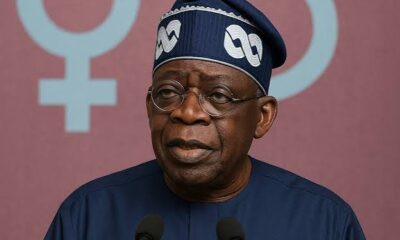

Tinubu Mourns Ogogo, Extols His Creative Legacy
SharePresident Bola Tinubu has condoled with the family, friends and colleagues of veteran Nollywood actor, filmmaker and screenwriter Taiwo Hassan,...


Nigeria Upgrading its Digital, Intelligence-led Border Management System — NIS
ShareNigeria is strengthening its border management architecture through digital technology, biometric identity systems, intelligence sharing and stronger collaboration with border...
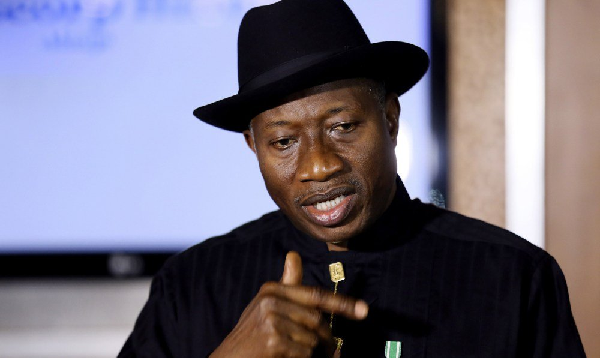
ShareGoodluck Jonathan Advises Leaders to Invest in Youths, Industry Former President of Nigeria, Dr. Goodluck Jonathan, has called on leaders...


First Quarter Pension Contributors Rise by 143,248 – PenCom
ShareThe National Pension Commission (PenCom) said cumulative Retirement Savings Account (RSA) registrations under the Contributory Pension Scheme (CPS) rose by...

Police Honour 10 Fallen Officers, Disu Vows to Crush Banditry
ShareBy Elijah Oguche, Abuja The Nigeria Police Force (NPF) on Monday honoured 10 officers of the Special Intervention Squad (SIS)...


Petrol Imports Rise as Local Supply Plunges 21 Per Cent
ShareBy Tony Obiechina, Obiechina Nigeria’s reliance on imported petrol increased in July as domestic refinery supplies fell sharply, reversing some...
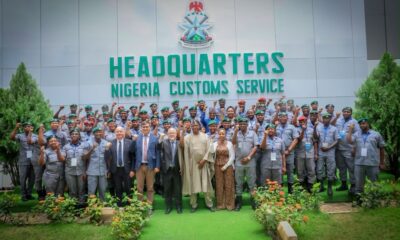

NCS, WCO, UK Intensify Anti-Corruption Drive, Strengthen Customs Integrity
Share By Tambaya Julius, Abuja The Nigeria Customs Service (NCS), in collaboration with the World Customs Organisation (WCO) and the...
Bayelsa Receives Twon-Brass Draft Constitution
ShareFrom Mike Tayese, Yenagoa The Bayelsa State Government has received the final draft copy of the constitution of Twon-Brass Kingdom...
Nigeria’s Reforms Must Now Deliver Jobs, Higher Incomes – CPPE
ShareCentre for the Promotion of Private Enterprise (CPPE) has urged the Federal Government to shift its economic reform focus from...