
Environment
Sabotage by Oil Thieves, Cause of Enviromental Pollution in the South – South — Survey

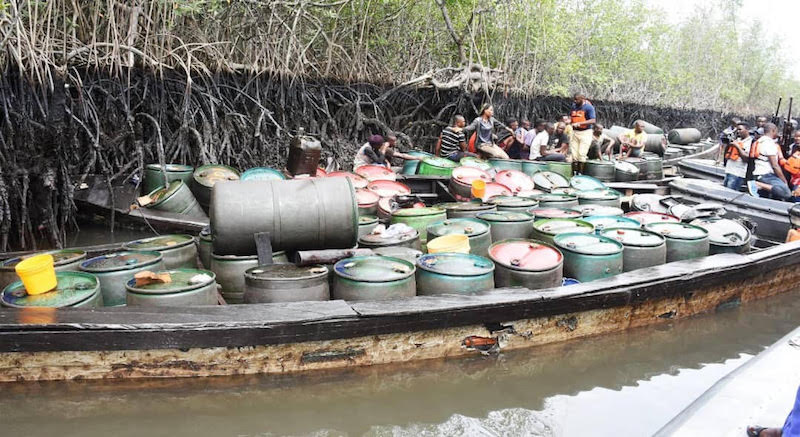
Data from the National Oil Spill Detection and Response Agency (NOSDRA) indicate that oil spills and pollution occur due to sabotage by oil thieves, pipeline vandals, equipment failure and operational accidents.
The data further showed that some 1,000 incidents of spillage were reported on a monthly basis from oil facilities across Bayelsa State alone.
According to Mrs.
Ayibakuro Warder, a woman leader in Ikarama, an oil producing community in Yenagoa Local Government of Bayelsa, oil exploration has brought only pains to residents whom she claims suffer losses due to spills which destroy farm products.Warder also expressed deep concern that oil related pollution and gas flares cause damage to public health as the people of Ikarama record high incidence of respiratory diseases.
She recalled an oil spill incident about six years ago that ravaged a part of the community.
“Women are the worst affected by gas flare, and oil spills which we contend with almost on a daily basis. We notice dwindling fish catch due to spills that pollute the rivers, streams, ponds and swamps.
“As for our farms, when it is time to plant cassava, the yield is frustrating as a result of oil spills, there is a specie of cocoyam we used to have but research showed that it got extinct due to gas flare,” Warder said.
Speaking on a recent oil spill incident from an offshore facility in Bayelsa where several operators denied responsibility, Mr. Idris Musa, Director-General of NOSDRA decried the high rate of spills in the state.
According to Musa, the effect on the environment and ecology could sometimes take decades to remediate.
He said that the agency had consistently sensitised the oil communities on the inherent dangers.
“The rate of oil spills in Bayelsa is a cause of worry and we should ask ourselves if this type of things happens in other countries that produce crude.
“The oil fields in the entire Southern Ijaw swamps are very notorious for pipeline vandalism by oil thieves who steal crude for local refining and in the process pollute the environment.
“It is a very big challenge to our resources as regulators and each incident has to be investigated as majority of the spills are caused by vandals,’’ Musa said.
Also, NOSDRA and some environmentalists expressed concern over alleged environmental impact of Conoil Producing Limited’s operations in Bayelsa.
The concern was raised over the firm’s alleged insensitivity to the sustenance of the environment where it operated.
It was also raised over its alleged continued failure to appropriately respond to an undersea leak in its oil field pipeline in the state, since Sept. 3 , 2020.
NAN recalled that NOSDRA’ Director General, Musa, who confirmed the incident on Dec. 2, 2020 alleged that the company had operated in breach of regulatory guidelines.
Musa had alleged that the oil firm had the habit of causing avoidable spills and had previously been sanctioned for degrading the environment.
“This oil company has been spilling oil for a period of time now, from our findings, it is from an underwater pipeline under pressure creating bubbles on the water surface.
“All the directives given to it to contain the oil spill, shut down, and replace the leaking pipeline, near the shore in Sangana, Bayelsa, fell on deaf ears.
“The agency sanctioned the company for this untoward act, but nothing has changed. The leakage continues and the oil company behaves irresponsibly even though it is a Nigerian oil firm,” he alleged.
The leak emanated from Conoils’s facility known as ‘Aunty Julie platform’ within Oil Mining Lease 59, at Otuo Oil field, NAN learnt.
In Rivers, the State Ministry of Environment has urged the Federal Government to increase efforts in protecting crude oil pipeline’ right of way to check activities of vandals and also curb oil spillage in the state.
Mr Charles George, Head of Department, Inspectorate and Enforcement in the Ministry, told NAN in Port Harcourt that the call was necessary since the oil and gas sector is exclusively regulated by the Federal Government.
Accordingly to George, all the 23 local governments areas in River are either oil producing or hosts to oil facilities which makes all of them experience some level of oil spillage.
He however, noted that the level and extent of oil spillage related pollution is more in the coastal and riverine communities.
The environment expert also attributed oil spillage to equipment failure, operational error and sabotage, or third party interference.
“The impact of oil spillage is more in the aquatic environment because the river sediment has the bio-accumulation and bio-availability capacities.
“These make them remain polluted for several years as there are usually no remedial measures for cleanup of affected pollution sites,’’ he said.
George also revealed that all flow stations in the state still flare gas on daily basis.
He however, added that the ministry had been enlightening the public on the negative impacts of pollution to humans, animals and the environment.
“We are also enlightening the public on the need to shun crude oil theft and also the need to protect pipeline’ right of way.
“The fact is that the oil industry is the major contributor to the Nigerian economy and the Federal Government is somehow lukewarm towards effective enforcement of standards for oil companies,” George alleged.
He said the state government had laws in place against environmental pollution by vehicles plying the roads.
“Part IV, Section 18, subsections 1a-d, section 20 subsections 2d, 3 and 4 of the state ‘Green Book’ are laws on vehicle pollution,” George said.
Similarly, Mr Fegalo Nsuke, President, Movement for the Survival of Ogoni People (MOSOP), also confirmed that gas flaring had remained a major cause of air pollution in the Niger Delta region.
Mr Tammy Nkoti, a sewage waste manager said that there were effective laws by the state against the menace of open defecation and urinating.
Nkoti noted that the level of compliance to these laws was considerably high in Rivers State. (NAN)








In a bid to tackle environmental degradation impacting negatively on communities in Kaduna state, Bridge That Gap Hope for Africa Initiative (BTG), in partnership with the Network of Civil Society in Environment (NCSE) has launched a transformative project aimed at empowering women and advancing sustainable climate governance.
Executive Director Bridge that Gap Hope for Africa Initiative (BTG), Gloria Kasang Bulus, who dropped the hint in Kaduna during the week, regretted that environmental disasters and shocks have deepened poverty and eco-anxiety among women who remain grossly under-represented in decision-making.
The project is tagged “Women Empowerment and Climate Resilience Initiative”While revealing that the project would focus on three Local Government Areas of Zaria, Chikun, and Zango Kataf, Ms Bulus stated that reports from these three local councils were troubling because “they show high levels of environmental degradation, food insecurity and limited female representation in governance structures”
“Kaduna state faces a troubling mix of environmental, social, and economic challenges.
From extensive deforestation and desertification to resource shortages and ecosystem breakdowns, the impacts of climate change have become severe. A report by Global Forest Watch shows that in 2023 alone, the state lost over 5,400 hectares of natural forest, leading to 1.94 million metric tons of CO₂ emissions.These environmental shocks have worsened poverty and eco-anxiety, especially among women who are disproportionately affected but remain underrepresented in decision-making. Although women play important roles in agriculture, small businesses, and household sustainability, they often lack access to platforms and resources that could help them influence climate policies and local development strategies.
The project focuses on LGAs with some of the worst environmental records:
- Zaria LGA suffers from massive vegetation loss due to fuelwood consumption, which accounts for nearly 40% of its deforestation. According to satellite data from 1973 to 2014, over 80% of vegetation in the area has been degraded, highlighting the urgent need for clean energy alternatives and community-led environmental restoration (Global Forest Watch).
- Zango Kataf LGA faces challenges from erratic rainfall, rising temperatures, and soil degradation. Women and internally displaced persons are especially vulnerable to water shortages and land conflicts, worsened by deforestation caused by agricultural practices.
- Chikun LGA, especially communities like Kakau Daji, is experiencing rapid environmental decline due to firewood collection and industrial pollution from nearby petrochemical plants. The ecosystem has suffered from biodiversity loss, soil erosion, and toxic emissions.
With women at the forefront
focusing on gender inclusion and environmental sustainability, the project aims to strengthen women-led coalitions by improving their policy advocacy skills, providing them with energy-efficient cookstoves, and developing a climate action plan that considers gender and Persons with Disabilities (PWD) in line with the Kaduna State Climate Change Policy.
“Women are central to community life. They manage natural resources, care for households, and make significant contributions to the economy.
“However, they still face marginalization in important decisions about the environment and development. By providing women with advocacy tools and encouraging cooperation among policymakers, civil society, and the private sector, the project aims to change this situation”, Bulus volunteered.
According to her, the goals of the initiative is built around four core objectives:
*Enhancing Policy Advocacy Capacity – Training women’s groups to participate in governance structures and advocate for inclusive climate strategies.
*Developing Inclusive Climate Action Plans – Ensuring that gender and PWD perspectives are prioritized in environmental policies.
*Promoting Climate Adaptation – Implementing grassroots solutions like reforestation, clean energy use, and climate-smart agriculture.
*Strengthening Multi-Stakeholder Collaboration – Fostering collaboration among women’s coalitions, government agencies, and environmental stakeholders.
She assured that her organization remains determined to build sustainable communities by removing barriers to basic rights of vulnerable populations.
The organization has also concluded preparations to plant 15,000 trees in the state. To date, over three thousand (3000) economic and forest trees have been planted in Chikun LGA and its environs.
She further disclosed:
“Journalists in Kaduna will also receive training to enhance their skills in effective writing and reporting on climate change-related issues.
“The Partnership for Agile Governance and Climate Engagement (PACE) Project supports coalitions that influence governments to address climate and governance issues affecting the poorest and most vulnerable communities. It aims to boost state government revenue from internal sources, integrate climate actions into state policy, planning, and budgets, and enhance election delivery and credibility.
The program, she stated, is being carried out in Kaduna, Kano, and Jigawa in northwestern Nigeria, with focused strategic engagement at both federal and regional levels.

The First Lady, Sen. Oluremi Tinubu has called for a lasting solution to eradicate environmental pollution caused by plastic wastes.
In her message to mark the year 2025 World Environment Day, with the theme ‘Ending Plastic Pollution’, in Abuja on Thursday, the first lady also advised people to curtail the way they consume food and drinks packaged in plastics.
“I join millions of Nigerians and the world in calling for urgent and united action to safeguard our environment.
Plastic pollution has become one of the most pressing environmental challenges of our time, affecting our health, our environment, and our future.“In Nigeria, we must rise to this challenge by changing how we consume packaged food items and how we dispose of plastic containers and bags.
“I particularly want to speak to our youths, the leaders of tomorrow, be it in schools or within our neighborhoods, each of you has a role to play in creating a cleaner, healthier and greener Nigeria,” she said.
Mrs Tinubu had recently promised to introduce environmental solutions clubs to schools through her NGO, Renewed Hope Initiative (RHI).
“I want to use this opportunity to introduce our students to two programmes that the RHI will be launching soon.
“First is the Environment Club for Secondary School Students and the Environment Society for Students in Tertiary institutions nationwide to help us clean up our environment and grow more trees.
“Second is the “Flow with Confidence” for our girls in rural communities.
“This programme is to provide one year’s supply of disposable sanitary pads to our adolescent girls to support them to remain in school during their menstrual cycle,” She said.
NAN further reports that some of the functions of RHI environmental clubs in schools would include raising environmental awareness; fostering social and life skills; empowering students to take action and promoting sustainable behaviours.
The clubs can also enhance critical thinking and creativity, encourage healthy lifestyles, and strengthen communities.
The club would encourage students to participate in various environmental projects, like tree planting, recycling, and garden projects, gaining practical experience and deeper understanding.(NAN))

Abia Government says it will offset the hospital bills of the Aba Billboard accident victims.
Mrs Victoria Onwubiko, Managing Director, Abia State Signage and Advertising Agency (ABSAA) made this known on Thursday in Aba at the Salad Market entrance, the site of the accident.
A big billboard fell on some passengers in five tricycles in Aba on Wednesday, following a boisterous wind, killing one person and injuring seven others.
Onwubiko said the governor had given the necessary approval for procedures regarding the victims’ treatment without hindrances.
“So, we are glad there are not going to be any more deaths; from what we have seen, the victims in the hospital are recovering and doing well.
“We understand that about eight persons were involved in the accident; five are at the Abia University Teaching Hospital, two have been discharged and one is died,” she said.
Onwubiko added that the governor had sent his Chief of Staff to the hospital for the proper management of the victims at ABSUTH, Aba.
According to her, there is no hoping that any one of them will go to the court as the state government is doing everything to take care of them.
He said ABSAA would ensure such accidents did not reoccur noting that henceforth the agency would inspect every advertising site in the state.
“We are going to ask the owners of sites like this to give us the technical drawings with which they built their sites.
“If we don’t see them, the bill board will come down for them to redo it to ensure safety,” she said.
The ABSAA MD said every site, whether high or low, which is not sound, will go down.
Mr Chinedu Nwibo, an eye-witness and a vulcaniser for tricycle operators, said there were seven persons at the entrance of the Salad Market on that Wednesday when the accident occurred.
“We were inside a little makeshift shop I had set up for my work when the rain started on Wednesday.
“The wind was very boisterous and some of the tricycle operators went into their tricycles to stay for the rain to stop.
“No sooner had they ran into their tricycles than a big iron pipe used to hoist a billboard fell on them.
“One Destiny Uguru, 27, from Izzi in Ebonyi state died from the accident while seven persons sustained injury,” he said.
Nwibo called on the government to come to the aid of the victims especially by replacing their tricycles.
“The man that lost his life has an expectant wife and two children,” he said. (NAN)



Plateau PDP Cautions Members Against Obtaining Nomination Forms From Pro-Wike Faction
ShareBy Mike Odiakose, Abuja As Nigerians await the verdict of the Supreme Court on the leadership crisis rocking the Peoples...


Soludo’s 16.4km Road Project Ends Years of Suffering, Opens Up Anambra Communities
ShareBy Laide Akinboade Abuja Vice President of Boardwalk Group and Abuja-based real estate developer Chief Obiageli Okwubanego, on Wednesday, commended...


Ekiti Church Attack: CAN Demands Action Over Killing, Abduction of Worshippers
ShareBy Laide Akinboade, Abuja The Christian Association of Nigeria (CAN) on Wednesday, condemnedthe attack on a church gathering in Eda...


Journalist Petitions DSS Over Alleged Criminal Activities Of Company, River-Bend Agent
ShareBy Julius Tambaya, Abuja Following alleged criminal conducts of River-Bend Nigerian Limited and one Mr. Thomas Terzulum Nongo, a renowned...


Stakeholders Urge FG, Benue Govt to Partner NGOs to End Violence, Discrimination Against Girls
ShareBy Julius, Tambaya Abuja Stakeholders have called on the Federal and the Benue State Governments to strengthen collaboration with non-governmental...


Bago Orders Immediate Repairs of Wind-Damaged Buildings at NYSC Camp
Share From Dan Amasingha, Minna Niger State Governor, Mohammed Umaru Bago, has directed the immediate rehabilitation of buildings damaged by a windstorm at the National Youth Service Corps...
2028 Olympic Games Qualifier: Super Falcons to Discover Opponents Today
ShareNigeria’s Super Falcons will find out their opponents for the 2028 Los Angeles Olympic Games women’s football qualifiers this week. The Confederation of African Football (CAF) announced on Tuesday that the draw for the African qualifying...

Ghana Military Convoy Attack Kills Three Civilians, Seven Assailants
ShareFor Somalia’s malnourished children, already suffering the twin catastrophes of looming famine and radical cuts in foreign aid, the U.S.-Israeli...


Imo Deputy Governor Resigns
ShareFrom Marcel Duru Owerri The Commissioner for Information and Strategy Chief Declan Emelumba has said that Imo State Deputy Governor, Ekemaru has resigned. Speaking...


NAF Airstrikes Destroy Terrorists’ Structures in Mandara Mountains
ShareThe Nigerian Air Force (NAF) has sustained its counter-terrorism offensive with precision airstrikes that destroyed terrorists’ structures and logistic hubs in the Mandara Mountains area of Borno....