
BUSINESS
Senate Passes Finance 2021 Bill

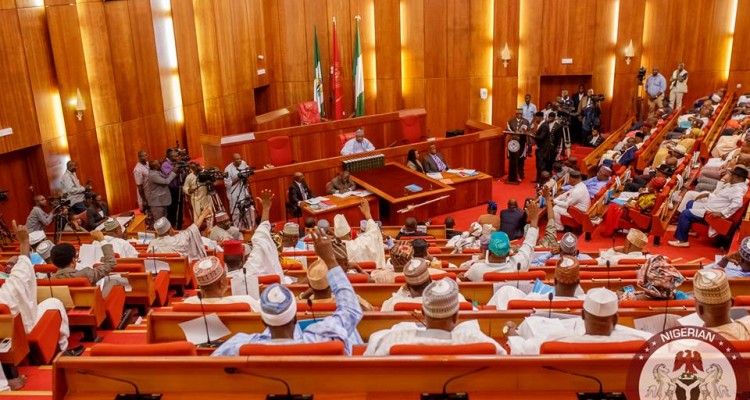
Senate yesterday passed the Finance Bill 2021, transmitted to the National Assembly by President Muhammadu Buhari, on December 7.
The passage of the bill followed consideration of a report by the Joint Committee on Finance; Customs, Excise and Tariff; Trade and Investment.
Presenting the report, the Chairman of the Joint Committee, Sen.
Solomon Adeola (APC-Lagos), said the bill seeks to support implementation of the 2022 Federal Budget of Economic Growth and Sustainability by proposing key specific taxation, customs, excise, fiscal and other relevant laws.According to him, a total of 12 Acts were amended under the finance bill which contains 39 clauses.
He said the bill seeks to promote fiscal equity, align domestic tax laws with global best practices, introduce tax incentives for infrastructure and capital markets, support small businesses and promote increase government revenue.
“The Finance Act 2020 was predicated essentially on having no new taxes and no new incentives due to the COVID-19’s impact on the economy as such it was structured across four broad thematic areas.
“Enacting counter cyclical measures and crisis intervention initiatives; Tax, fiscal responsibility, and public procurement reforms; Reforming fiscal incentives policies for job creation; Ensuring closer coordination of monetary, trade and fiscal policies; and Enhancing tax administration,” Adeola said.
According to the report, approved by the Senate, the Joint Committee, based on its observations, recommended that 5 per cent Capital Gains Tax to be imposed on shares’ disposal transactions where gains exceed N250 million in 12 calendar months.
It recommended that gaming and lottery companies, as well as oil and gas companies to be taxed.
It underscored the need for midstream and downstream oil and gas companies to be made liable to corporate tax without the benefit of tax exemptions for firms exporting goods to earn foreign exchange.
The Committee observed that doing so would prevent double-dipping by gas utilization companies such that they cannot claim both (1) 3-year Tax Holidays; as well as (2) Petroleum Profit Tax Act Incentives or (3) Pioneer tax Holidays under IDITRA.
It advocated for qualifying Capital Expenditure rules for small and pioneer companies, to prevent double dipping by mandating that companies cannot deduct qualifying capital expenditure.
This, it said, is to reduce their taxable profits where the relevant qualifying Capital Expenditure is used to generate tax – exempt income.
It sought more powers for the Federal Inland Revenue Service (FIRS) to collect NPTF levies on Nigerian Companies on behalf of the fund and to streamline tax levy collection from Nigerian Companies in line with President Buhari administration’s ease of doing business reforms.
The committee also emphasised the need for the Federal Government to ensure that FIRS deploys both proprietary and third-party technical applications to collect information from taxpayers, enhance confidentiality and non-disclosure and to enable them investigate tax evasion and other crimes and sanction non-compliant tax payers.
It further called for the FIRS to be empowered to assess Non-Resident Firms to tax on fair and reasonable turnover basis on Turnover earned from digital services to Nigerian customers, with a further mandate to appoint persons for the purpose of collection and remittance of non-resident taxes.
It demanded necessary reforms on securities lending transactions, minimum tax for insurance companies and companies in general, taxation of unit trust income, real estate investment trust, and insurance companies capitalization by NAICOM in line with tax equity.
It urged the government to mandate FIRS as Principal Tax Revenue Collection Agency to collaborate with other law enforcement MDAs in streamlining tax collections by enhancing Public Financial Management reforms.
According to the report, doing so would reduce revenue leakages and better track actual expenditure to revenue performance in line with the provision of the Constitution of the Federal Republic of Nigeria 1999 (as Amended), Fiscal Rules and other Extant Money Acts.
It also called for the diversification of Nigeria’s revenue from Oil sector to other sectors to fund critical expenditures.
It demanded an increase of 0.5 per cent in educational tax, pushed for close monitoring of unfolding development and policies on VAT, tax incentives, projected increase tariff on tobacco, alcohol and carbonated drinks to fund vital expenditure on health, education and security, with a possibility of introduction of new taxes, tariffs and levies as the economy recovers.
Meanwhile, the Senate also passed a bill to amend the 2021 Appropriations Act.
The bill, sponsored by Senate Leader, Yahaya Abdullahi (APC-Kebbi), scaled through second and third readings after it was considered during plenary.
The 2021 Appropriations Act (Amendment) bill seeks to extend implementation of the Capital aspect of the Appropriation Act 2021 from December 31, 2021, to March 31, 2022. (NAN)






By Tambaya Julius, Abuja
Nigerian businesses are divided over whether high borrowing costs or limited access to credit remains the biggest barrier to growth, as the country’s tight monetary policy continues to push lending rates to levels many entrepreneurs consider unsustainable.
While some business owners believe reducing interest rates should be the priority, others argue that the availability of credit is more important, even if it comes with a high cost.
The debate comes amid the Central Bank of Nigeria’s (CBN) continued tight monetary policy aimed at curbing inflation, with the Monetary Policy Rate (MPR) at 26.
5 per cent.The policy has increased funding costs across the banking sector, forcing lending rates for many small and medium-sized enterprises (SMEs) to exceed 28 per cent.
Although commercial banks have expanded their loan portfolios in recent years, many business owners say access to affordable credit remains a major challenge due to stringent collateral requirements, high interest rates and additional financing charges.
A Lagos-based entrepreneur, Blessing Isizuwa, said while obtaining loans may have become easier, the cost of borrowing has made financing difficult for many businesses.
“It is easier to access loans these days, but at what cost? If you ask someone to borrow at 35 per cent, they must do a business that will return at least 40 per cent to 45 per cent at the end of the financial year,” she said.
She noted that rising interest expenses, processing fees and other charges have significantly increased the cost of capital, making business expansion difficult for entrepreneurs.
Data from the CBN on lending rates show differences among commercial banks. Guaranty Trust Bank recorded the lowest prime lending rate at 21.0 per cent, with a maximum lending rate of 32.0 per cent.
Zenith Bank’s prime lending rate stands at 23.62 per cent, while its maximum lending rate is 32.0 per cent. Access Bank has a prime lending rate of 25.5 per cent and a maximum rate of 32.0 per cent.
First Bank of Nigeria’s prime lending rate is 26.0 per cent, with a maximum rate of 38.0 per cent, while Ecobank’s prime lending rate stands at 26.75 per cent and its maximum lending rate is 48.0 per cent. United Bank for Africa (UBA) maintains a prime lending rate of 28.5 per cent and a maximum rate of 32.0 per cent.
Chief Executive Officer of Rice Afrika, Ibrahim Maigari Ahmadu, said commercial lenders continue to favour established corporate organisations while imposing strict collateral requirements on SMEs, particularly those operating in agriculture and other sectors considered high risk.
“The collateral threshold and pricing structure effectively exclude many viable businesses from formal finance,” he said.
The 2025 World Bank Enterprise Survey highlighted the financing gap facing Nigerian MSMEs, showing that while 94.8 per cent of businesses have bank accounts, only 20.2 per cent have access to bank loans.
The report further showed that more than 42 per cent of businesses remain partially credit-constrained, while only 1.5 per cent of investments are financed through banks. Most firms rely on retained earnings, personal savings and informal funding sources to sustain operations.
Analysts said the financing challenge is rooted in structural weaknesses within Nigeria’s financial system. Although fintech lenders have expanded digital access to credit, their interest rates remain comparable to those of commercial banks, limiting their ability to provide affordable working capital.
Development finance institutions such as the Bank of Industry (BOI) continue to provide subsidised loans, but limited capital has restricted their ability to meet growing demand from businesses.
Entrepreneur Nikcy Onyeso said the financial system also suffers from a mismatch between available credit periods and the long-term financing needs of businesses.
“SMEs require long-term capital to invest in productive assets, but most bank facilities are short-term, making cash-flow management difficult,” he said.
However, an Abuja-based businessman, Dipo Oluwanjobi, said access to credit is more important than the cost of borrowing. “I will pay once the money is available. I will ensure the return exceeds the cost of loans,” he said.
The Chief Executive Officer of the Centre for the Promotion of Private Enterprise (CPPE), Muda Yusuf, said financing challenges vary depending on business size.
According to him, micro and small businesses struggle mainly with access to credit because they lack acceptable collateral, while medium-sized companies can obtain loans but are weighed down by high borrowing costs that reduce profitability and discourage investment.
Economists warned that unless lending rates moderate and access to affordable credit improves, financing constraints could continue to weaken private sector investment, slow MSME expansion and reduce the sector’s contribution to employment creation, productivity and non-oil economic growth.
The Federal Government and Access Bank Plc have emphasised the strategic role of Artificial Intelligence and digital financial infrastructure in expanding small business operations, maintaining that Nigeria’s target of attaining a $1tn economy remains tied to the rapid digitisation of Micro, Small, and Medium Enterprises.
The consensus was reached at the Access Bank MSME Digital Growth Conference, themed “AI for SMEs: Scaling through Digital Tools,” which coincided with the official launch of the Access SME Application on Friday at the bank’s head office in Victoria Island, Lagos.
Delivering the keynote address, the Senior Special Assistant to the President on Entrepreneurship Development in Communications, Innovation and Digital Economy, Chalya Shagaya, stated that the Federal Government considers small enterprise operators critical catalysts in actualising its macroeconomic objectives under the Renewed Hope Agenda.
Shagaya urged business owners to adopt emerging digital tools, noting that modern enterprise operations are heavily reliant on technological integration to scale from local markets to global markets.
She said, “Everyone wants to be an entrepreneur today. You are the ones who will drive the $1tn economy that Mr President has charged us with achieving under this administration of Renewed Hope. We are your partners, and you are ours.”
Addressing operational bottlenecks confronting small enterprise owners, the presidential aide highlighted that AI applications act as critical operational equalisers, enabling small firms to automate inventory tracking, customer insights and supply chain logistics without incurring massive overhead costs.
She added that digital technology serves as a platform for social inclusion, giving neurodivergent entrepreneurs the tools to build structured, independent commercial enterprises.
“AI is not coming in the future; it is here today. The sooner we embrace these tools, the faster we can scale our businesses and build a stronger economy,” Shagaya noted, revealing that President Bola Tinubu recently signed an AI Policy mandating the Ministry of Communications, Innovation, and Digital Economy to set up capacity-building hubs across the country to upskill young business operators.
In his goodwill message, the Executive Director of the University of Lagos Business School, Prof Sunday Adebisi, presented data underlining the vital contributions of small businesses to national output and employment.
Citing recent research figures, Adebisi stated that Nigeria currently has between 39 million and 42 million registered MSMEs, which generate 84 per cent of total employment and contribute 48 per cent to the Gross Domestic Product.
Adebisi said, “All the big companies you think about, including Access Bank, Dangote, Shell, Chevron, and others, account for only 16 per cent of jobs combined. You are responsible for the remaining 84 per cent.
“Beyond that, 96 per cent of all businesses in Nigeria are SMEs, while mega-corporates make up only four per cent.”
The don, however, raised concerns over commercial mortality rates, disclosing that 50 per cent of small businesses in Nigeria fail within their first year of operation. He advised operators to deploy AI as a digital co-pilot to optimise workflows, leverage predictive market analytics and cater to digital-first consumers.
The conference featured two high-level panel sessions. The first panel, titled “Digital Transformation: Beyond the Buzzwords,” examined actionable strategies for small business managers to move beyond industry hype into practical digital workflows, stressing cloud integration, operational efficiency and scalable financial management.
The session featured the Executive Director of IT and Digitisation at Access Holdings Plc, Mr Lanre Bamisebi; the Country Manager for West Africa at Mastercard, Dr. Folasade Femi-Lawal; and the Country Manager for Financial Services Industry at Huawei Nigeria, Glarie Gao.
The second panel session, themed “Navigating the Business Ecosystem: Tools, Trends, and Tactics,” explored practical frameworks for surviving economic pressures and expanding trade networks.
Panellists included the Vice President of World Trade Center Lagos, David Opeyemi Oke; the Principal Consultant at Scientia Partners Innovation Hub, Dr. Helen Emore; and the Creative Director and Co-Founder of Trax Apparel, Mark Odiete.
Access Bank reaffirmed its commitment to deepening non-financial advisory support, expanding credit access and providing specialised digital solutions tailored to improve small business sustainability across the country.
By Tambaya Julius, Abuja
The Nigeria Customs Service (NCS) has dismissed a purported recruitment update circulating on social media, describing it as false and not originating from the Service.
The Service, in a statement, urged members of the public to disregard the misleading information and refrain from sharing unverified content capable of misleading prospective applicants and the general public.
The NCS advised Nigerians to rely solely on information published through its official communication channels for accurate updates on recruitment exercises and other activities of the Service.
It reiterated that its verified social media platforms remain the authentic sources of information and urged the public to always verify recruitment-related announcements before acting on them or sharing them with others.


FG begins 2026 National Laureate Programme
ShareThe Tertiary Institutions National Laureate Committee has announced the commencement of the 2026 National Laureate Programme. The National Laureate Programme...
Still On Abubakar Malami, His Battles and Landmark Achievements
ShareBy Hajia Hadiza Mohammed As I stated in my previous article, some of my colleagues have queried my interest in...


Why Nigeria’s Births should not Worry Elon Musk
ShareBy Chinedu Moghalu Elon Musk has a gift for reducing significant anxiety to a sentence. “Nigeria alone had 4 million...


Neutralizing South Africa’s Xenophobic Excesses
ShareBy Chidi Amuta Nelson Mandela must be churning in his resting place. An exemplary life lived and a myth created...
Enugu Joint Security Operatives Rescue Abduction Victim
ShareFrom Sylvia Udegbunam, Enugu A joint security team comprising Police operatives, Forest Guards, and members of the Neighbourhood Watch Group...


Police Uncovers Two Illegal Arms Factories in Benue
ShareFrom Attah Ede, Makurdi Police in Benue State uncovered and destroyed two illegal firearm manufacturing factories, recovered three AK-47 rifles...


Troops Foil Bandits’ Attack, Rescue Nine Kidnap Victims in Zamfara
ShareFrom Ifeanyichukwu Nwannah, Gusau Troops of Sector 2, Operation FANSAN YAMMA, deployed at the Forward Operating Base (FOB) in Kasuwan...
The Fake DG Saga Holds a Mirror to All of Us
ShareBy Akin Fadeyi A man got tired of his wife’s alleged belligerent behaviour. She was never “available” and whenever she...


OPay is Okay: Trust Is Not Claimed – It Is Earned
ShareFor tens of millions of people across Nigeria, digital finance has changed everyday life. Paying bills, sending money, saving, and...


Wike Directs Immediate Demolition of Suspected Criminal Hideout in Abuja
ShareBy Laide Akinboade Abuja Minister of the Federal Capital Territory (FCT), Nyesom Wike has directed the immediate demolition of an...