
POLITICS
Senate Pushes for Nigerian Medical Graduands from Ukraine, Sudan to Sit for July, Nov MDCN Exams


By Eze Okechukwu, Abuja
The senate has called out the Medical and Dental Council of Nigeria (MDCN) to allow Nigerian medical graduates from Ukraine and Sudan to sit for the MDCN exams in July and Nov without any discrimination, particularly those that the wars in both countries did not affect their academic activities.
The upper chamber also urged MDCN to in no distant time, work toward the conduct of the MDCN exams in each geo-political zone of the country like the Law Schools, to reduce the cost on the students and their parents.
The senate resolutions followed the adoption of a motion at plenary yesterday which was sponsored by Senator Oyewumi Olaler from Osun state titled: “Discrimination Against Medical Graduands from Ukraine by the Nigeria Medical and Dental Council.
In his lead debate, senator Olalere said that the issue of medical graduates from Ukraine universities has drawn attention of National Assembly since 2022, pointing out that in 2023, the House of Representatives and the Ministry of Health concluded with the Medical and Dental Council to allow the students that graduated from medical schools in Ukraine to participate in the qualifying exams like other students, or at best, organise a makeup programme for them before the exam.
The senator noted that MDCN has slated a referral programme for the 2022 graduates alone at Federal Medical Centre Gwagwalada at the cost of N1.5 million per student to be paid in one and half weeks.
He said the concerned parents of the affected students had visited the National Assembly complex to lodge their complaint during the vacation of the Senate for extension of the deadline for payment to one month from one and half week.
Olalere, who is the Senate Deputy Minority leader, said the war in Ukraine affected the eastern part of Ukraine and Kyiv, the capital, adding that the entire western Ukraine was not affected.
According to him, the students were on campus doing their programme unhindered as confirmed by the Ukrainian Ambassador to Nigeria.
He explained that since the war in Ukraine did not affect all the universities, especially, students in Western parts of Ukraine, students who graduated from those universities in 2023 should be allowed to sit for MDCN exams henceforth without any hindrance.
Other senators who supported the motion included Senators; Adamu Aliero, from Kebbi state Abdul Ningi from Bauchi state among others.
In a related development, the senate also urged the Committee of Nigerian Vice Chancellors to allow Nigerian students arriving from war torn countries to be admitted into Nigerian universities to complete their studies.
President of Senate Godswill Akpiabio in his remarks thanked the sponsor of the motion, saying that it was a popular motion and elicited comments from the lawmakers.
He expressed belief that the resolutions of the senate would be adhered to by MDCN and the Vice Chancellors to ameliorate the sufferings of concerned Nigerian medical graduates from the war affected nations.




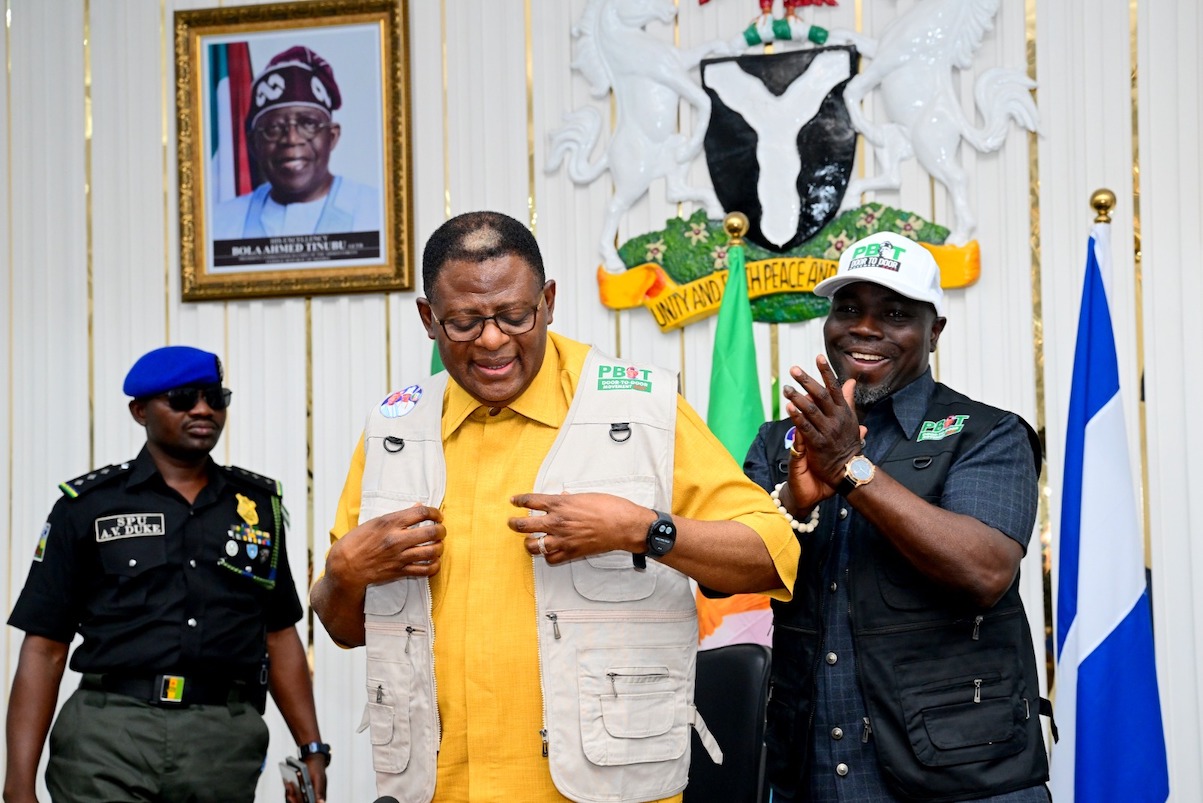
Grand Patron of the PBAT Door-to-Door Movement, High Chief Oweizidei Government Ekpemupolo, has donated 50 vehicles for President Bola Tinubu’s reelection campaign in Enugu and Cross River states.
The vehicles were donated at separate campaign rallies in the two states, on Monday, during the inauguration of the state chapters of the Movement and distribution of campaign materials to the state coordinators.
The two states got 25 vehicles each.In Cross River State, the government pledged that it will mobilise voters in the state to deliver no less than 1.5 million votes for President Bola Tinubu’s reelection in 2027.
According to latest data from the Independent National Electoral Commission (INEC), Cross River state has 1,928,978 registered voters.
Governor Bassey Otu who was represented the deputy governor, Peter Odey, said the entire Cross River state was for Tinubu as a mark of appreciation for the developments he had brought to the state, including the Lagos-Calabar Super Highway, increased federal allocation which had ensured prompt salary payment and infrastructure development, among others.
He said it was also important to reelect the president so that the state can regain its status as an oil producing state and the actualisation of the Bakassi Deep Sea Port which the president will commission on November 13, 2026.
“If we don’t support Tinubu to be reelected, we will miss a lot so, a support for Tinubu is a support for ourselves.
“If we were to give the president 1 million votes, the PBAT Door-to-Door Movement has made it 1.5 million because of the logistics support which will enable us go deep into the corners of the state to campaign at every door,” the governor stated.
In Enugu, the State Governor, Peter Mbah, represented by his deputy, Ifeanyi Ossai, commended the Movement for its investment in grassroots mobilisation, particularly its recruitment of members across electoral wards and provision of platforms to communicate the party’s message.
He said the Tinubu administration is working to address the challenges facing Nigerians, adding that the achievements recorded in the last three and a half years provided a basis for continuity.
Earlier, leader of the Movement, Government Ekpemupolo, also known as Tompolo, called on the people of Cross River to come out enmasse and vote for Tinubu and all other APC candidates in the 2027 election.
Tompolo, who was represented by Kestin Pondi, Managing director of Tantita Security Services, likened ongoing reforms to plant and harvest season and human gestation, saying it takes time but is sure to yield positive results provided the right steps are taken.
“Today, we no longer have fuel queues. We like to compare Nigeria with Asian countries that are doing well, like Malaysia and Indonesia, but one thing we forget to remember is that in those countries, reforms took over 25 or 35 years in some cases.
“Given the same conditions as we have in Nigeria, under which President Tinubu is operating, they may not have achieved what he has achieved in four years.
“If you want reforms like NELFUND which is guaranteeing tertiary education for your children, more federal allocation to your state for projects and so on, you must reelect Tinubu to continue,” he said.
Continuing, Tompolo added: “We cannot start development and truncate it. We want you to vote APC candidates in all elections,” he added.
Tompolo, who emphasised that the vehicles donation was to support the state in its campaign, said: “we’ll stand by you in this campaign. If the plan was to deliver 80%, this should help you take it to 99%.”
He described President Tinubu as a courageous leader who has taken difficult decisions from the beginning of his administration to reposition the Nigerian economy, expressing confidence that the ongoing reforms would deliver a brighter future for the country.
Tompolo said the campaign will cover wards, polling units, churches, mosques, markets and other public places, ensuring that the achievements and policies of the present administration are properly communicated to people across the country.
He also commended Governor Mbah for projects and initiatives in the state, including road infrastructure
By David Torough, Abuja
The crisis rocking the African Democratic Congress (ADC) has intensified following the Federal High Court judgment nullifying the David Mark-led leadership of the party, as National Secretary, Rauf Aregbesola, has appealed the ruling, while Minister of Aviation and Aerospace Development, Festus Keyamo, insists that the party will participate in the 2027 general elections, although candidates produced by the affected faction, including former Vice-President Atiku Abubakar, may be excluded from the ballot.
The unfolding political and legal developments have heightened uncertainty over the ADC’s leadership, the validity of its 2027 presidential nomination and its readiness for the forthcoming general elections, with the opposition party also raising concerns over alleged political violence, intimidation and the neutrality of electoral and security institutions.
Keyamo, in a statement posted on his verified X handle on Sunday, dismissed claims that the judgment had effectively barred the ADC from participating in the 2027 elections, arguing that the court’s decision concerned the legitimacy of the Mark-led leadership and not the continued existence or electoral eligibility of the party.
He, however, warned that the candidacies of individuals who emerged through the Mark-led faction, including Atiku Abubakar, could be affected by the outcome of the pending judicial proceedings.
“For the education of the public, those raising false alarm that the court judgment on ADC means the party will not be on the ballot are spreading misinformation.
“The ADC will be on the ballot. It is the David Mark faction of candidates, including Atiku Abubakar, that may not be on the ballot, depending on the final judgment of the Supreme Court,” Keyamo stated.
The minister also questioned the protests surrounding the judgment, arguing that Nigerians who participated in primaries conducted under the party’s original leadership structure should not be treated as less entitled to political participation than candidates produced by the Mark-led faction.
The controversy followed Thursday’s judgment by the Federal High Court in Abuja, presided over by Justice Peter Lifu, which nullified the Mark-led leadership and invalidated decisions taken by the faction, including the presidential primary that produced Atiku as the ADC’s candidate for the 2027 election.
The judgment arose from suit No. FHC/ABJ/CS/1819/2025, instituted by former ADC Deputy National Chairman (North-East), Nafiu Gombe, who challenged the process through which Mark and other members of the caretaker committee assumed control of the party.
Gombe argued that following the resignation of former National Chairman, Ralph Nwosu, he was constitutionally entitled to take over the party’s leadership, insisting that the emergence of the Mark-led leadership violated the ADC constitution and relevant electoral provisions.
The ruling has since generated fresh legal and political battles, with the affected leadership rejecting the decision and promising to challenge it.
In the latest development, Aregbesola has filed an appeal at the Court of Appeal, seeking to overturn the judgment on grounds that the Federal High Court lacked jurisdiction to determine the issues surrounding his emergence as national secretary and the validity of the resolutions of the party’s 99th National Executive Committee meeting.
In the notice of appeal filed on Friday through his counsel, Mohammed Sheriff, SAN, Aregbesola named Gombe, the ADC, Senator David Mark, the Independent National Electoral Commission (INEC) and former National Chairman, Ralph Nwosu, as respondents.
He asked the appellate court to set aside the judgment, strike out the claims against him and invalidate the findings affecting his emergence as national secretary.
Alternatively, he urged the court to dismiss the claims or order a retrial before another judge if it upholds the jurisdiction of the lower court.
Aregbesola’s legal team argued that the trial judge failed to distinguish between an election to fill a vacant party position and an interim appointment authorised by the ADC constitution.
Specifically, the counsel maintained that Article 23(4) of the party’s constitution empowered the appropriate executive organ to appoint an eligible replacement pending an election at the next convention or congress.
He further argued that the trial court wrongly applied Section 82(3) of the Electoral Act 2022 and Section 223(1)(a) of the 1999 Constitution without first determining whether his emergence was an interim appointment rather than an election.
The ADC national secretary has also filed a separate motion at the Federal High Court seeking a stay of execution of the November 5 judgment pending the determination of his appeal.
He argued that the appeal raised substantial legal and factual questions, particularly concerning the jurisdiction of the trial court and the interpretation of the party’s constitution and applicable electoral laws.
Meanwhile, INEC has maintained that it would not take a position on the ADC leadership dispute until it obtains and studies the certified true copy of the judgment.
The commission’s position has added another layer of uncertainty to the party’s preparations, particularly as the legal battle could determine which faction is recognised to conduct valid party activities and nominate candidates for the 2027 elections.
Beyond the leadership dispute, the ADC Presidential Campaign Council (ADC-PCC) has accused the Federal Government and its alleged political allies of creating an atmosphere of intimidation and insecurity capable of undermining the 2027 electoral process.
The council declared that no amount of intimidation, violence or alleged manipulation of democratic institutions would prevent Nigerians from deciding the country’s political future, insisting that President Bola Ahmed Tinubu would lose the 2027 presidential election.
The Director of Media and Publicity of the ADC-PCC, Kola Ologbondiyan, made the position known on Sunday in Abuja, where he raised concerns over alleged attacks on opposition members and supporters in different parts of the country.
Ologbondiyan cited reports of the killing of several members of the Nigeria Democratic Congress (NDC) in Delta State, allegedly following an attack on the party’s campaign venue by suspected political thugs.
He also alleged that opposition parties, particularly the ADC, NDC and Allied Peoples Movement, had faced attacks and intimidation in Kaduna, Kogi, Katsina, Kebbi and Sokoto states.
The council described the incidents as a threat to democratic freedoms, warning that political violence should not be normalised or allowed to become part of the country’s electoral culture.
It also questioned the neutrality and preparedness of INEC, alleging that the commission’s voter register database had been compromised and that individuals sympathetic to the ruling All Progressives Congress had been placed in sensitive positions within the electoral body.
The ADC-PCC further accused security agencies of being deployed to harass, arrest and intimidate opposition members, raising particular concern over the alleged involvement of a serving director of a security agency in the APC Presidential Campaign Council as a co-director of National Security and Intelligence.
Ologbondiyan described the alleged development as a violation of the law establishing the agency, insisting that public institutions must remain politically neutral.
The council warned that alleged manipulation of judicial processes and electoral institutions would not guarantee President Tinubu’s re-election, adding that Nigerians would resist any attempt to impose a president through compromised judicial decisions or electoral fraud.
It consequently called on security agencies to remain loyal to the Constitution and the Nigerian people rather than any political party or individual.
The ADC-PCC also appealed to civil society organisations, the international community, religious leaders and traditional institutions to pay closer attention to the country’s political and security environment ahead of the 2027 elections.
The developments have placed the ADC at a critical crossroads, with the party’s participation in the next general elections appearing distinct from the question of which faction has the legal authority to nominate its candidates.
While Keyamo maintains that the ADC will be on the ballot, the fate of the Mark-led faction and its candidates remains subject to judicial determination.
With Aregbesola’s appeal, the Mark-led faction’s planned legal challenge and the pending determination of the leadership dispute, the Court of Appeal and ultimately the Supreme Court could prove decisive in determining the political future of the opposition party.
For Atiku and other candidates who emerged through the Mark-led structure, the stakes are particularly high, as the final outcome could determine whether their nominations survive the legal contest or are rendered invalid.
As the 2027 general elections approach, the ADC’s internal crisis, allegations of political violence and concerns over the credibility of electoral institutions are shaping an increasingly contentious political atmosphere, with the courts expected to play a defining role in determining the party’s direction.
By David Torough, Abuja
Nigeria’s annual fish supply deficit has exceeded 2.2 million tonnes, forcing the country to spend close to $1bn annually on imports, as the Federal Government moves to ramp up domestic production with a $200m World Bank-backed intervention.
The Minister of Marine and Blue Economy, Dr Adegboyega Oyetola, disclosed this in a statement issued on Sunday by his Special Adviser, Dr Bolaji Akinola, announcing plans to strengthen fisheries and aquaculture development across the country.
According to the minister, Nigeria requires approximately 3.
6 million tonnes of fish annually but produces only 1.4 million tonnes, leaving a substantial gap that local producers are unable to bridge.The figures show that domestic production currently accounts for only about 39 per cent of national demand, while the remaining 61 per cent is largely met through imports, placing additional pressure on the country’s foreign exchange reserves.
Speaking through the Senior Special Assistant to the President on Marine and Blue Economy, Prof. Busayo Fakinlede, at an aquaculture investment training programme in Abuja, Oyetola stressed the need for Nigeria to reduce its dependence on imported fish.
He described fish production as critical to food security, household nutrition and rural livelihoods, insisting that the country must strengthen its capacity to meet domestic consumption needs.
“Fish is a pillar of food security, household nutrition and rural livelihoods. No nation can call itself food secure while it imports most of the fish it eats. Our ambition is to produce more, import less and, in time, become a net exporter. That ambition can be achieved only when every state plays its part,” he said.
Oyetola disclosed that the World Bank Group had committed $200m to support the development of fisheries and aquaculture, with the funding expected to be channelled to state governments through concessional loans.
The intervention is designed to expand production capacity, stimulate private-sector investment, create employment opportunities and improve the country’s food security outlook.
Under the proposed arrangement, participating states are expected to identify priority fisheries value chains, assess investment opportunities and develop bankable projects backed by measurable production targets.
The minister emphasised that closing the fish supply gap would require coordinated efforts involving federal and state governments, private investors and development partners.
He spoke at the Executive Training on Aquaculture Investment Guide, organised by the Ministry of Marine and Blue Economy in collaboration with the World Bank Group.
The programme attracted commissioners from Rivers, Bayelsa, Delta and Cross River states, alongside permanent secretaries and fisheries officials from across the federation.
Participants were trained in investment planning, risk management, environmental safeguards and public-private partnership frameworks to equip states with the capacity to attract and manage investments in the sector.
Oyetola also announced plans to convene a post-training stakeholders’ roundtable to strengthen implementation, improve coordination and secure commitments from state governments.
Highlighting developments in the sector, the minister said national fish production had risen from 1.1 million tonnes to 1.4 million tonnes, representing an increase of approximately 27.3 per cent.
He attributed the improvement to government interventions, including the inauguration of the Technical Committee on Accelerating Fish Production in August 2026 and the digitisation of fish import licensing.
Other initiatives, according to him, include Nigeria’s attainment of United States shrimp-export certification following compliance with Turtle Excluder Device requirements, as well as the development of the Fish City and Fish Terminal investment portfolio.
The government is expected to leverage these initiatives alongside the World Bank-backed financing to strengthen the country’s fisheries value chain and position aquaculture as a major contributor to economic growth.
Oyetola expressed optimism that sustained collaboration and investment would help close the production gap, improve livelihoods and reduce the country’s dependence on imported fish.
“Through strategic collaboration, contributive support and shared commitment, we will close the fish deficit, create jobs, raise household incomes and secure Nigeria’s place as a fish-sufficient nation,” he added.



2027: Tompolo Deploys 50 Vehicles in Enugu, Cross River for Tinubu’s Re-election
ShareGrand Patron of the PBAT Door-to-Door Movement, High Chief Oweizidei Government Ekpemupolo, has donated 50 vehicles for President Bola Tinubu’s...

Customs Generates N1.4tn Revenue in Two Months
ShareBy Julius Tambaya, Abuja The Nigeria Customs Service (NCS) generated a total of N1.419 trillion in revenue between September and...

Tegbe Assures Nigerians of Swift Restoration of Power Supply
ShareThe Minister of Power, Joseph Tegbe, has assured Nigerians experiencing reduced electricity supply in parts of the country of a...

WAHO Leads Drive to Harmonise Subspecialty Training Across ECOWAS
ShareBy David Torough, Abuja Accredited health professional colleges, training institutions and regulatory bodies across the Economic Community of West African...


Bishop Oyedepo Re-affirms strong support for Pastor Ibiyeomie, Pastor Komaiya’s Ministry
ShareBy David Torough, Abuja The Founder and Presiding Bishop of Living Faith Church Worldwide, Bishop David Oyedepo, has reaffirm strong...


West Africa: How WAHO Successfully Harmonized Procedure Manuals for Health Disciplines and Professions
ShareBy David Torough After three days of serious brain-storming sessions in Abuja, the West African Health Organization (WAHO), has successfully...


2027: CAN Seeks Return of Sacked Traditional Rulers in Kaduna
ShareFrom Shabanyan Kantiok, Kaduna The Christian Association of Nigeria in Chikun Local Government Area of Kaduna State has urged Christian...

OPay Opens New Kano Office, Strengthens Commitment to Nigeria’s Financial Inclusion
ShareOPay, Nigeria’s leading digital bank, has opened a new office in Kano State, strengthening its presence in Nigeria and bringing...

Rigging Years Before Elections: Why Tinubu, Parliament Favours Staggered Balloting
Share Silhouette of Donald Andoor e‐mail; doandoor@gmail.com There is a growing need for Nigerians to look beyond the ballot box and...

Akpabio Congratulates Nigeria’s Golden Girls, Flamingos
ShareThe President of the Senate, Godswill Akpabio has sent a hearty congratulations to the Nigerian Under-17 Women’s National Team on...