
OPINION
The Muslim-Muslim Ticket

By Femi Fani-Kayode
A high-ranking and respected official of the Christian Association of Nigeria (CAN) came to see me yesterday and expressed concern about my disposition towards a Muslim/Muslim ticket.
He informed me about CAN’s vehement opposition to such a ticket and said that the leadership of the organisation watched my interview on Channels Television where it appeared that I was not on all fours with them.
They felt this was very unlike me because they know how much I rever my faith and how much I respect CAN and its leadership and how I am usually in agreement with them on all issues.
It was a mark of honour to me that they thought me worthy of sending someone to get an explanation and after thanking him for that we spoke for no less than two hours.
At the end of it all I believe the person understood my position better and promised to convey it to the leadership of CAN.
Permit me to share some of the points I made to him here for the record.
The first point is as follows: It is perceived by many in the All Progressives Congress (APC) that a Muslim/Muslim ticket may be the winning formula in the coming election. They believe that it would be politically expedient to take advantage of that and present such a ticket.
It is perceived by others in the APC that a Muslim/Muslim ticket will be a direct challenge to the Christian community in Nigeria and it may jeopardise the chances of our party in the coming election.
I hold the latter view but I have said that if our candidate, Asiwaju Bola Tinubu, insists on a Muslim/Muslim ticket, I and many others shall stand by him and attempt to defend it as long as his running mate is not an extremist who will undermine the interests of the Christian community.
In this matter, we must not allow ourselves to be guided by emotion but rather by our obligation to support our candidate and party, the quest and desire to win the coming presidential election at all costs, political expediency and by what the British call ‘real politik’.
And neither is it in any way a betrayal of our values or our Christian faith to take this position because Muslim/Muslim ticket or no Muslim/Muslim ticket we will not sit by idly and allow anyone or any government to undermine our faith or our people.
If Asiwaju decides on a Muslim/Muslim ticket we shall either swim with him or sink with him and, whichever way, given the experience of Atiku Abubakar and the certainty that the PDP will give its vice presidential ticket to a Christian, it will be a hard fight.
I say this because there are over 100 million Christians in this country who feel passionately about their faith and who believe that they must be protected and represented at the highest level.
Those that wish them away, dismiss their concerns and say they do not care about how they feel do so at their own peril.
No matter what the candidate decides, he must allay their fears and carry them along because the fear and concerns about Islamisation, rightly or wrongly, are very real.
The second point is as follows.
The success or lack of it of a Muslim/Muslim ticket will depend largely on who the Muslim vice presidential candidate will be.
If it is a Muslim that has a track record of killing, persecuting, denigrating, hating, undermining, marginalising or working against Christians in any shape or form, I and millions of Christians all over this country will oppose it decisively and aggressively regardless of the consequences because we will not allow anyone to destroy the church, intimidate or persecute our people or mess with our faith.
However if it is a Muslim that has shown love and displayed sensitivity to the Christian community over the years and who we believe we can trust, I and millions of other Christians will support it.
It is left to those of us that are Christians to let the faithful know who is who and who they can trust amongst the Muslims in the knowledge that not all Muslims are bad and not all Christians are good.
There are indeed good and bad people on both sides of the religious divide.
The truth is that in an ideal world religion and faith should not determine who our candidates and their running mates ought to be and when it comes to matters of governance I agree with those that say that in this day and age we should not bring religion into it.
Yet, sadly, this is not an ideal world and in the Nigerian context we must recognise the fact that given our history and our bitter experiences over the last few years, religion is a factor that cannot be ignored or wished away and this is more so today than at any other time in our history.
In all that we do we must factor in the fears of both Muslims and Christians when it comes to presidential tickets and elections and we must allay those fears.
For example if you insist on a Christian/Christian ticket for whatever reason at least give me Christians that will protect the Muslims and if you insist on a Muslim/Muslim ticket at least give me Muslims that will protect Christians.
Apart from that you must also commit to giving the leadership of the senate and the House of Representatives and the position of the Secretary to the Government of the Federation (SGF) to members of the faith that does not enjoy representation at the presidential or vice presidential level.
These are just some of the things that can allay our fears.
And interestingly that is what is practiced in Lebanon and what is known as the “Lebanese model”. They rotate the positions of power and leadership on the basis of religious faith and between Christians and Muslims and this has led to a certain degree of peace and harmony since the end of their civil war which lasted from 1975 till 1990.
Whichever way we must tread with caution and care about the issue of religion and we must not act as if it is no big deal because it will play a decisive role in the outcome of the election and in the running of the campaign.
We must also endeavour to put Nigeria first and not toy with anything that will divide us on religious or ethnic grounds.
If the APC comes up with Muslim/Muslim ticket, as long as it is a Muslim that has a track record of religious tolerance, kindness and sensitivity towards the Christian community and one that places our nation and the Nigerian people, regardless of their religious affiliation, before his faith, I will gladly support such a candidate and such a ticket.
However if the Muslim/Muslim ticket produces a Muslim running mate that secretly despises Christians or that has a track record of treating Christians with contempt in his state or constituency or of endangering and wasting Christian lives, I will oppose that ticket, that candidate and indeed that party.
We know who is who. We know who the liberals and moderates amongst them are and we know who the extremists and hardliners are.
We know those who allow Christians to be slaughtered with impunity under their watch and in their backyards and we know those who built churches for Christians where churches were never built before.
We know those who publicly mocked our faith, committed blasphemy and made references to our Lord and Saviour Jesus Christ in denigrating and disrespectful tones and we know those that have always treated His precious name with love, decency and respect.
We know those who have publicly likened the Virgin Mary to a street prostitute and we know those who respect our God, revere our faith and treat us as equals.
We know those that are malevolent and that see Christians as inferior beings and mortal enemies and we know those that are benign and that see us as equals and as brothers and compatriots.
I agree that we must do whatever it takes to win but we must also be wary of our choices. You bring the wrong Muslim who is hostile to Christians as your running mate and that will not only be the end of your ambition but will also polarise our country in a very significant and dramatic way.
You bring the right one and we may just be able to push it through and overcome the challenge that our collective detractors and adversaries will pose.
The truth is that it is not ones faith that matters but what is in one’s heart.
Whether Christian or Muslim, if we have a heart filled with light, compassion, kindness, love and the fear of God we give nothing but goodness and love but if we have a heart filled with darkness, prejudice, hate, bitterness, evil and contempt and disdain for God we have nothing to give but evil and hate.
More important than anything else is the condition of the heart: whether Christian or Muslim that is what counts.
Again, we must always remember that whether Christian or Muslim or southerner or northerner, we are first and foremost Nigerians and that we are one!
Asiwaju Bola Ahmed Tinubu’s choice of running mate will make or mar our parties chances at the election.
May God lead and guide him to make the right one.
May the Lord grant him the spirit if discernment to do the right thing and may He grant him the courage to stand firm in this great and epic struggle to move our nation forward.
Femi Fani-Kayode is a former Minister of Aviation


By Hakeem Jamiu
In his seminal work, Political Order in Changing Societies (1968), Professor Samuel P Huntington argues that political order is essential for societal development. He emphasises that strong, adaptable political institutions are necessary to manage conflicts and meet growing societal demands during periods of rapid change.
Huntington warns that failure to adapt swiftly to societal shifts often results in political decline and instability.
These insights offer a valuable perspective for analysing the recent palace coup in Guinea-Bissau, a country on the verge of greater unrest.Between 24 and 26 September, I was in Guinea-Bissau for the Economic Community of West African States (ECOWAS) pre-summit as the lead facilitator nominated by the Amandla Institute for Policy and Leadership Advancement (AIPLA).
During this time, I predicted that political upheaval was imminent. It was no surprise, therefore, when, on 26 November, a palace coup took place, leading to the forced evacuation of former President Goodluck Jonathan, head of the West African Elders Forum Election Observation Mission.
He described it as a “ceremonial coup,” an unusual act in which President Umaro Embaló himself announced the coup, despite claiming to be under arrest. This move was clearly staged to prevent the announcement of election results, ultimately undermining democracy in the country.
Embalo’s strategy to consolidate power began long before the coup. He had previously excluded his main challenger, PAIGC’s Domingos Simões Pereira from the electoral process, through judicial manipulation by the Supreme Court, which barred Pereira from contesting the election.
Pereira, a former prime minister, had supported the independent candidacy of lawyer Fernando Dias. Despite his official term ending on 27 February, Embaló remained in office, citing a different inauguration date.
His controversial decision to seek re-election, despite initial promises not to, prompted public protests, which were suppressed by force, with activists arrested and opposition movements restricted.
The road to Bissau, however, was not just fraught with political instability but also physical danger. As I journeyed from Zinguinchor to Bissau, a typically two-hour trip extended to eight hours due to the dilapidated roads, squeezed between rising rivers. The road was perilous, especially when we learnt of the armed insurgents operating along the route.
The driver, having initially misled us about the condition of the road, almost abandoned us at the Senegalese border. Fortunately, immigration officials ensured that we continued. Later, it was revealed that the road’s poor condition has been intentionally kept so as to prevent insurgents from reaching the capital easily.
The coup, led by General Horta Inta-A, just a day before the announcement of presidential election results, claimed that it was necessary in order to prevent “narcotics traffickers” from manipulating the election.
Both President Embaló and opposition candidate Fernando Dias claimed victory, with Dias seeking asylum in the Nigerian embassy, due to credible threats to his life. The people’s resolve for change had been underestimated by Embaló, who believed he could easily eliminate the opposition.
Despite the country’s dire economic situation, with deteriorated infrastructure and widespread poverty, the people of Bissau maintained a remarkable sense of joy.
Young men and women danced in the streets at 3 a.m., while others gathered at the hotel we stayed in, socialising late into the night. These youthful social gatherings reflect a society aware of global trends, including political unrest, despite being influenced by their leader’s poverty politics.
The summit, held at the Royal Hotel in Bissau from 24 to 26 September, focused on the future of ECOWAS, in its 50th anniversary. The theme, “Political Stability, Peace, and Security in West Africa,” seemed ironically prescient.
The dialogue, involving the civil society, youths, and security experts, examined the challenges facing ECOWAS, particularly Unconstitutional Changes of Government (UCG).
My prediction that Guinea-Bissau would soon face political turmoil was echoed by ECOWAS’ General Ojabo, who remarked that his troops were primarily tasked with “guard duties at the homes of politicians,” reflecting the mistrust between Guinea-Bissau’s political class and its military. “The minute ECOWAS pulls out of GB, there will be chaos,” he warned, a grim foreshadowing of what was to come.
The coup, led by General Horta Inta-A, just a day before the announcement of presidential election results, claimed that it was necessary in order to prevent “narcotics traffickers” from manipulating the election. Both President Embaló and opposition candidate Fernando Dias claimed victory, with Dias seeking asylum in the Nigerian embassy, due to credible threats to his life. The people’s resolve for change had been underestimated by Embaló, who believed he could easily eliminate the opposition.
This turned out to be a grave miscalculation, and the coup was a direct result of the president’s failure to meet the people’s expectations. As Huntington’s theory suggests, political instability often arises when rising societal expectations are unmet, leading to frustration and disorder.
The African Union (AU) has also suspended Guinea-Bissau from its activities, calling for respect for the electoral process. The United Nations has urged restraint and respect for the rule of law. The coup in Guinea-Bissau presents another challenge to ECOWAS’s credibility, especially as the region has seen an alarming rise in military takeovers. The coup belt, stretching across West Africa, is increasingly a source of concern.
ECOWAS, having strongly condemned the coup, has suspended Guinea-Bissau from its decision-making bodies and is advocating for the restoration of constitutional order in the country. Meanwhile, the African Union (AU) has also suspended Guinea-Bissau from its activities, calling for respect for the electoral process.
The United Nations has urged restraint and respect for the rule of law. The coup in Guinea-Bissau presents another challenge to ECOWAS’s credibility, especially as the region has seen an alarming rise in military takeovers. The coup belt, stretching across West Africa, is increasingly a source of concern.
Guinea-Bissau, with its fragile political and economic situation, faces considerable instability. With a population of only two million and a per capita GDP of $670, the country ranks among the poorest in the world. Around 70 per cent of the people live below the poverty line, with limited access to essential services such as healthcare, roads, education, and sanitation. As the political crisis deepens, there are concerns that drug trafficking could intensify, further destabilising the region.
For ECOWAS, the challenge is clear: it must persist in applying diplomatic pressure on the coup leaders to restore constitutional order. Military force alone is insufficient; what is needed is a sustained diplomatic strategy supported by respected statesmen.
ECOWAS needs to rediscover its role as a facilitator of West African peace, rather than as an end in itself. The organisation must act consistently and enhance its operational capabilities to tackle the root causes of instability. Unconstitutional changes of government are not merely political anomalies but symptoms of systemic governance failures that must be addressed to prevent further crises across the region. The time for action is now.
Hakeem Jamiu, an ECOWAS facilitator, writes from Ado-Ekiti.
By Folasade Akpan
For Mrs Schola Effiong, a 58-year-old confidential secretary in Calabar, managing diabetes in today’s economy feels like “climbing a hill that only gets steeper”.
Diagnosed in 2009, she said her monthly expenditure on insulin, tablets, laboratory tests and monitoring supplies now exceeds ₦150,000.
“You cannot stop taking the drugs, yet the cost keeps going up.
“Sometimes I do not have the money to buy some of them at the same time,” she said.
Her struggle mirrors the experiences of thousands of Nigerians at a time when experts warn that diabetes is becoming a major public health concern.
According to a 2018 national meta-analysis by Uloko et al.
, titled “Prevalence and Risk Factors for Diabetes Mellitus in Nigeria: A Systematic Review and Meta-Analysis”, Nigeria’s diabetes prevalence stands at 5.7 per cent, representing 11.2 million adults.The authors defined diabetes mellitus as a metabolic disorder of chronic hyperglycaemia caused by absolute or relative insulin deficiency and associated with disturbances in carbohydrate, protein and fat metabolism.
The study, which pooled data from numerous research works across the country, revealed wide regional disparities.
The prevalence rate was 3.0 per cent in the North-West, 5.9 per cent in the North-East, and 3.8 per cent in the North-Central, respectively.
The rates were higher in the southern part of the country: 5.5 per cent in the South-West, 4.6 per cent in the South-East, and 9.8 per cent in the South-South.
Experts say these patterns reflect changing lifestyles, rapid urbanisation and limited access to routine screening.
However, for many patients, statistics tell only a fraction of the real story.
Mr Offum Akung, a 57-year-old teacher in Cross River, said he had to ration his drugs because prices kept rising faster than his salary.
“I spend over ₦40,000 a month and still cannot buy everything on my prescription.
“I rely mostly on Glucophage now; when money allows, I add Neurovite Forte; diabetes management has become more difficult than the disease itself,” he said.
He appealed for government intervention, saying many patients were already “giving up”.
The Second Vice-President of the Diabetes Association of Nigeria, Mr Bernard Enyia, said the economic situation had pushed many Nigerians with diabetes into dangerous coping methods.
He said that he once managed his condition with about ₦70,000 monthly, but currently spends more than ₦180,000.
“Insulin has become something you pray for, while some people are sharing doses or skipping injections.
“Once you break treatment, the complications come quickly.”
Enyia, who lost his job as a health worker in 2017 due to frequent hospital visits, described the emotional toll as immense.
“It affects your finances, your social life, your marriage — everything. Many Nigerians with diabetes are quietly drowning,” he said.
Globally, concerns are also rising.
The World Health Organisation (WHO) estimates that more than 24 million adults in Africa are living with diabetes, a figure projected to rise to 60 million by 2050.
Marking World Diabetes Day 2025, WHO Regional Director for Africa, Prof. Mohamed Janabi, warned that rising obesity, lifestyle changes and weak health systems were fueling an “unprecedented wave of diabetes” across the continent.
He urged governments to prioritise access to affordable insulin, diagnostics and long-term care.
More so, pharmacists say they are witnessing the crisis firsthand.
The Senior Vice-President, Advantage Health Africa, Mr Adewale Oladigbolu, said many patients were no longer able to maintain regular medication schedules.
“People buy drugs today and skip them tomorrow because they do not have money.
“With non-adherence, they never reach therapeutic goals.”
Oladigbolu, a Fellow of the Pharmaceutical Society of Nigeria, said that locally manufactured metformin remained in high demand due to affordability, but insulin-dependent patients faced the harshest burden.
He stressed that diabetes care extended far beyond drugs.
“You need glucometers, strips, blood pressure monitors and regular tests.
“In countries where insurance work, patients do not think about the cost; in Nigeria, they pay for everything out of pocket,” he said.
He called for diabetes care to be covered under health insurance to reduce the financial burden on patients.
President of the Diabetes Association of Nigeria, Prof. Ejiofor Ugwu, described the rising cost of treatment as “a national crisis hiding in plain sight.
He said insulin, which sold for about ₦3,500 four years ago, presently costs ₦18,000 to ₦22,000 per vial.
“Test strips that were ₦2,000 now sell for ₦14,000, while glucometers have risen from ₦5,000 to over ₦25,000.
“On average, a patient now needs between ₦100,000 and ₦120,000 every month. Imagine earning ₦50,000 and being asked to spend twice that on one illness.”
He warned that between half and two-thirds of Nigerians with diabetes remain undiagnosed.
“We are seeing more kidney failure, more limb amputations, more blindness.
“These are late presentations caused by delayed or inconsistent treatment.”
Ugwu urged the Federal Government to urgently subsidise essential anti-diabetic medications and remove taxes on their importation.
“Most of these drugs are produced outside the country.
“Once you add import duties and other charges, prices become unbearable; subsidies and tax waivers could drop costs by at least 30 per cent,” he said.
He also called for expansion of the National Health Insurance Authority (NHIA) to cover a wider range of anti-diabetic medicines, glucose meters and strips — none of which are currently covered.
For many Nigerians, however, the struggle continues daily.
Across households, clinics and pharmacies, the message is the same: as Nigeria’s diabetes prevalence rises and treatment costs soar, more patients are slipping through the cracks — some silently, others painfully — while waiting for meaningful intervention.
In all, stakeholders say diabetes is a national emergency; people are dying quietly because they cannot afford medicine; hence the urgent need for relevant authorities to make anti-diabetic medications accessible and affordable.(NAN)
 | ReplyReply allForwardAdd reaction |

By Dorcas Jonah
In the Nigerian culture, extended families and communities play a crucial role in care-giving, instilling values, and supporting the development of children.
This cultural heritage of community parenting emphasises shared responsibility in raising children.
But in contemporary Nigeria, this age-long practice is facing enormous challenges due to modernisation.
In scrutinising this trend, some parents are of the view that community parenting helps in instilling morals and curbing social vices among children and youths, while others believe it is outdated.
Some parents are of the belief that their children are their responsibility; so they do not tolerate others correcting their children.
By contrast, others say that community parenting, when done with good intentions, can help raise a better society.
Mr Peterson Bangyi, a community leader in Dutse Makaranta, said that community parenting was the bedrock of raising a child.
He said the adage: “it takes a village to raise a child”, remained a powerful principle in contemporary society.
According to him, by Nigeria’s cultural norms and values, a child is owned by everyone; therefore, the grandparents, aunts, uncles, and neighbours actively contribute to raising children.
“This approach fosters a sense of belonging and ensures children grow up with diverse role models.”
Bangyi said that the extended families practiced by more communities were the backbone of parenting.
“But modernisation has taken away this practice as most families do not want people to come close to their children,’’ he said.
Mrs Monica Umeh, a mother of two, emphasising on the importance of community parenting, said that it played significant role in shaping her upbringing as a child and young adult.
Umeh advised that when correcting other people’s children, it is essential to do so with love and good intentions, without any form of bitterness.
“I am a strong advocate of community parenting as long as it is done with love and good intentions.
“I believe no parent can single-handedly raise a child without the support of others,’’ he said.
Mr Temitope Awoyemi, a lecturer, said that community parenting was crucial and could not be over-emphasised.
He said that community parenting helped society in inculcating strong moral values in children and youths, adding that modern life could be isolating for parents.
Awoyemi said that strong community support networks had been shown to lower parental stress levels and promote a more optimistic approach to raising children.
“It also ensures that a child receives guidance and correction from various adults, providing a broader, more consistent moral and social baseline that might be missed by parents who are busy with work.
“Community parenting encourages collaborative, interdisciplinary support from various community members and agencies in addressing a child’s developmental needs comprehensively.
“It focuses on prevention of long-term problems and celebrating individual strengths,’’ he said.
Awoyemi said that as the society continued to evolve, community parenting could adapt to ensure children benefitted from both cultural roots and contemporary innovations.
Mr Fortune Ubong, a cultural enthusiast, attributed the increasing crime rate in Nigeria to lack of community parenting that had extended to schools, and government institutions.
According to him, community parenting remains the foundation of every child’s moral upbringing.
“Most parents are now focused on earning a living and improving their lifestyle, in the process abandoning their primary duty of molding and guiding their children; this is where community parenting plays a greater role,” he said.
However, Mrs Joy Okezia, a businesswoman, said that given the recent developments in the country, correcting a child should be the sole responsibility of their parents.
Okezia said that she preferred to correct her children herself as she knew them better than anyone else.
She also noted that with the rising insecurity in the country, intervening to correct a child could pose a significant risk to the person.
Mrs Ijeoma Osita, a civil servant, also shared Okezia’s view, saying that a child’s behaviour was shaped by their family upbringing.
She said that if a child was not taught to love and respect others at home, an outsider would have little impact in correcting such a child.
Osita emphasised that parents should in still in their children the values of love and respect regardless of their status or background.
According to her, a child brought up with good values is less likely to misbehave well.
She cited the Holy Bible, saying, that says: “Train up a child in the way they should go, and when they are old, they will not depart from it’’.
Osita said that community parenting remained a vital aspect of Nigerian culture, promoting shared responsibility and resilience among families.
He opined that while modernisation posed challenges, blending traditional practices with modern strategies offered a promising path forward.
Observers say robust community connections are linked to better social-emotional development, academic achievement, and overall well-being for children.
They say that in modern society, amidst the digital world, economic instability, and busy work schedules, parents face pressures, making community support systems fundamental.
All in all, stakeholders are of the view that combining traditional community parenting with modern childcare – integrating technology, play-based learning, and skill acquisition – will produce well-rounded children.(NAN)



NCDMB set to Attain 100% Local Content in Africa
ShareBy Eddy Ochigbo The Nigerian Content Development Management Board (NCDMB) has reaffirmed its determination to increase the current from 56%...

The Man Rotimi Makinde: A True Progressive by All Standards
ShareBy Kolapo Ogundare It is impressive to note that many well-meaning Nigerians are now coming out, recounting several good deeds...
FG, NBS Launch Nationwide MICS7 Survey
ShareFrom Francis Sadhere, Delta The Federal Government of Nigeria, through the National Bureau of Statistics (NBS), has officially launched the...
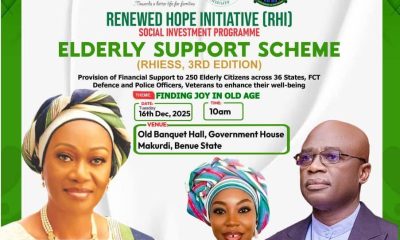

Finding Joy in Old Age: The Renewed Hope Intervention
ShareBy Bridget Tikyaa Getting to the life journey of a senior citizen should ordinarily be a source of pride, a...


CBN Revokes Licenses of Aso Savings, Union Homes Savings, Loans
ShareBy Tony Obiechina, Abuja The Central Bank of Nigeria (CBN) has revoked the operational licences of Aso Savings and Loans...


Dangote Petitions ICPC, Accuses NMDPRA Boss of Corruption, Abuses
ShareBy David Torough, Abuja President of the Dangote Group, Alhaji Aliko Dangote, has petitioned the Independent Corrupt Practices and Other Related Offences Commission...

NDIC Liquidates Aso Savings, Union Homes, Pays N2m Deposits
ShareBy Tony Obiechina, Abuja The Nigerian Deposit Insurance Corporation (NDIC) exercised its appointment as the liquidator of Aso Savings and...


Reps Launch Nationwide Probe into Drug Abuse, Trafficking Crisis
ShareBy Ubong Ukpong, Abuja The House of Representatives has commenced a nationwide investigation into Nigeria’s worsening drug abuse and trafficking...

Clement Koko Assumes Office as CIPPON President
ShareBy David Torough, Abuja Clement Koko has been inaugurated as the President and Chairman-in-Council of the Chartered Institute of Professional...

Thousands of Drivers Wrongly Fined for Speeding Since 2021
ShareThousands of drivers could have speeding fines cancelled after a fault saw some cameras falsely triggered on English A roads...