
Health
Tuberculosis: 57,000 Children are Infected Annually

By Laide Akinboade, Abuja
Experts have revealed that over 57,000 children in Nigeria are infected with Tuberculosis annually.
Dr. Odume Bethrand, the Executive Director of KNCV, stated this while briefing newsmen on the 2020 Pre- World TB, day organized by National Tuberculosis and Leprosy Control Programme, NTBLCP, and Stop TB partnership Nigeria, in Abuja,
He said the emergence of drug resistant TB posed a major health threat and could put at risk the gains made in efforts to end TB.
He decried the fact that out of $278 million needed in control of TB in Nigeria in 2019, only $52.
8 million, 40%, was made available which affected the control of TB in 2019.The theme for this year’s celebration is ‘Check that cough, Time no dey’, the theme will ensure the world is reminded of the commitments made and timely need for action to scale up, research, funding, human rights and accountability.
He noted that, “Nigeria is among the 30 high burden countries for TB, TB/HIV and MDR-TB, ranked 6th among the 30 high TB burden countries and 1st in Africa. Nigeria accounts for 12 % of the global TB incidence and notified cases, out of 429,000 estimated new TB cases in Nigeria in 2019 only 120, 266 were notified to the NTBLCP with 28% treatment coverage.
“An estimated 21,000 DR-TB cases recorded in 2018, only 2,384, 11%, were diagnosed and 83% of them enrolled on second day line treatment. Only 8% of all forms of notified TB cases are children less than 15 years.
DOES CLINIC is only available in 30% of health facilities in Nigeria, and only 8% of them have TB diagnostic services. Of the $278 million needed for TB control in Nigeria in year 2019, only 40% was available to all the implementers of TB control activities in Nigeria, 8% domestic and 32% donor full dstv, with 60% funding gap”.
TB is an infectious disease caused by bacteria known as mycobacteria tuberculosis. It is passed from person to person through air.
Anyone can have TB disease , but people experience who have weakened immune system are at higher risk of getting sick like elderly people, children, persons with diabetes Mellitus, HIV, cancer etc. TB most commonly affects the lungs but affect any other parts of the body.
Symptoms include, continuous cough lasting for two weeks or more, fever lasting for 2 weeks or more, sweating at night even when the weather is cold, weight loss, difficulty in breathing, chest pain and blood stain sputum.
Diagnosis and treatment is free in all government owned health facilities.
Among experts who were present at the briefing, Ayodele Awero, from World Health Organization, WHO, Dr. Temitayo Odusote, United States Agency for International Development, USAID, Odume Bethrand, CEO of KNCV, Ronke Agbaje, Institute of Human Virology Nigeria, etc.






By David Torough, Abuja
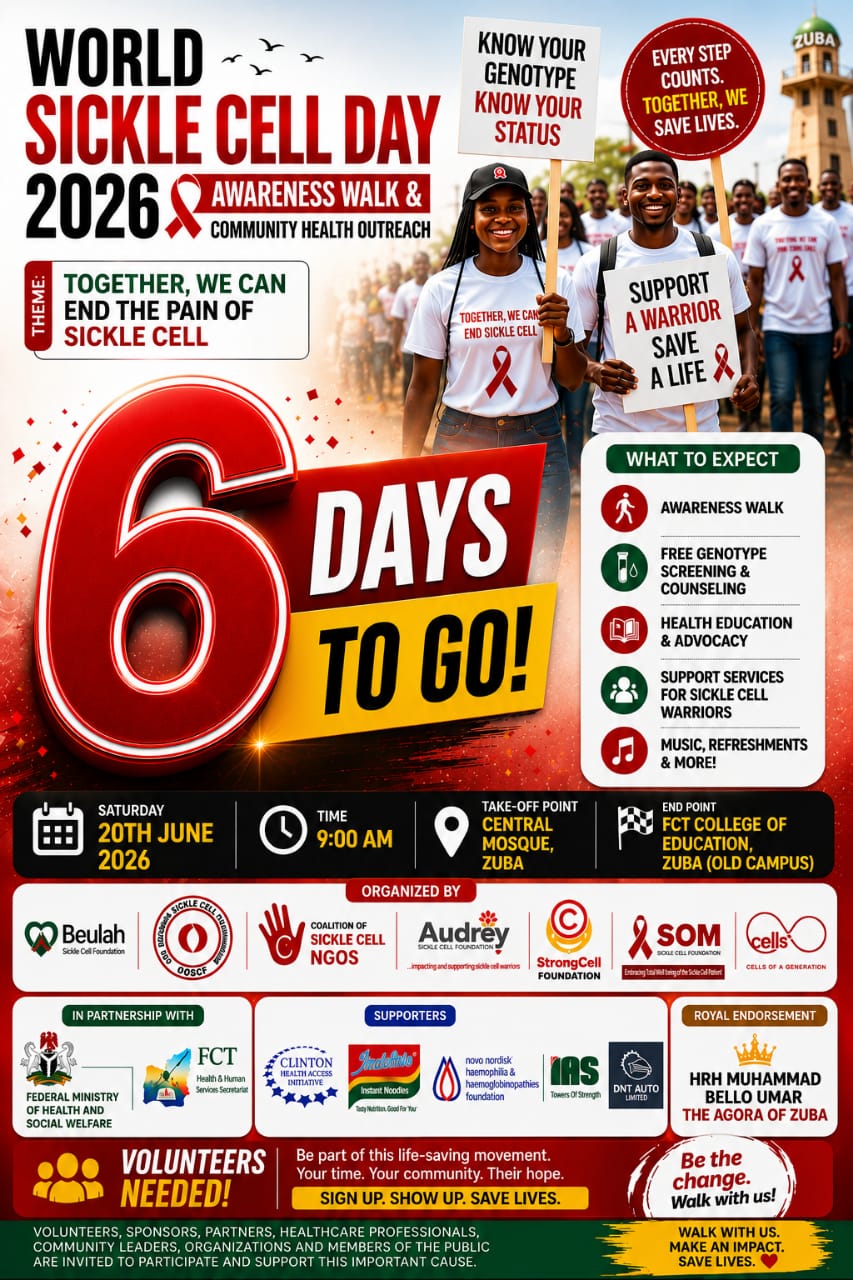
Preparations have reached an advanced stage for the World Sickle Cell Day 2026 Awareness Walk and Community Health Outreach, scheduled to take place in Zuba, Abuja, on June 20, as organizers intensify efforts to mobilize public participation ahead of the event.
The initiative, themed “Together, We Can End the Pain of Sickle Cell,” is being organized by a coalition of sickle cell advocacy groups, including the Beulah Sickle Cell Foundation, Obi Ogbonnia Sickle Cell Foundation (OOSCF), Coalition of Sickle Cell NGOs, Audrey Sickle Cell Foundation, StrongCell Foundation, SOM Sickle Cell Foundation, and Cells of a Generation Initiative.
Organizers say the event is expected to be one of the largest community-driven sickle cell awareness campaigns in the Federal Capital Territory this year, bringing together healthcare professionals, volunteers, corporate organizations, schools, faith-based groups, community leaders, development partners, and members of the public.
The outreach aims to increase awareness about sickle cell disorder, encourage genotype testing and counseling, support individuals and families affected by the condition, and strengthen community engagement in prevention and care efforts.
Activities scheduled for the day include an awareness walk from the Central Mosque, Zuba, to the FCT College of Education, Zuba (Old Campus), alongside free genotype screening and counseling services, health education sessions, advocacy engagements, and support programmes for people living with sickle cell disorder.
The programme is being implemented in partnership with the Federal Ministry of Health and Social Welfare and the FCT Health and Human Services Secretariat.
It is also receiving support from organizations such as the Clinton Health Access Initiative (CHAI), Novo Nordisk Haemophilia & Haemoglobinopathies Foundation (NNHF), IHS Towers, Indomie Noodles, DNT Auto Limited, and other corporate and development partners.
The event has also received the endorsement of His Royal Highness Muhammad Bello Umar, the Agora of Zuba, whose support has contributed to community mobilization efforts.
Speaking ahead of the outreach, Founder and President of the Obi Ogbonnia Sickle Cell Foundation, Obi Light Ogbonnia, described the collaboration as a significant milestone in sickle cell advocacy in Nigeria.
“This is more than an awareness walk. It is a demonstration of what can be achieved when patient organizations, government institutions, development partners, corporate organizations, and traditional institutions unite around a common cause,” he said.
He called on Nigerians to participate in the event, stressing the importance of collective action in raising awareness, supporting individuals living with sickle cell disorder, and advocating for improved healthcare outcomes.
Nigeria remains one of the countries with the highest burden of sickle cell disease globally, making awareness campaigns, early diagnosis, genotype education, and access to quality healthcare essential components of efforts to reduce the impact of the condition.
As the event draws closer, organizers have renewed calls for volunteers and sponsors, emphasizing that contributions through funding, materials, expertise, and participation will help ensure the success and impact of the outreach.

From Attah Ede, Makurdi
The United Nations Children’s Fund (UNICEF), has revealed that one out of every four Benue State is stunted and experiencing nutritional deficiencies.
The International organisation further intimated that findings from the 2024 Nigeria Demographic and Health Survey showed that 25.
5 percent of children under five years in the state are stunted, an indication of chronic malnutrition.The UNICEF Nutrition Specialist with UNICEF’s Enugu Field Office, Mrs. Ngozi Onuora, disclosed this during a High-Level Engagement and Planning Meeting for Policymakers, Local Government Councils and Stakeholders on the United States Government-funded initiative, “Preventing Malnutrition in the First 1,000 Days of Life” held in Makurdi, the State capital.
Mrs. Onuora further revealed that only 6.4 percent of children in the state consume the minimum acceptable diet, a figure she described as evidence of poor dietary diversity and inadequate feeding practices.
She appealed to the Benue State Government to make adequate investments in nutrition programmes and release counterpart funding for the Child Nutrition Fund, stressing that malnutrition continues to threaten the health and development of thousands of children in the state.
Mrs. Onuora, explained that the programme was designed to address malnutrition during the critical period from conception to a child’s second birthday, regarded globally as the most important window for physical growth and brain development.
According to her, the initiative is being implemented with funding support from the United States Government and aligns with Nigeria’s Multisectoral Plan of Action for Nutrition.
“Benue and Enugu were among seven states selected nationwide to benefit from the programme, with 12 local government areas chosen in Benue for implementation.
“Nutrition is a foundation of human capital development and investments made during the first 1,000 days of life determine a child’s future health, educational attainment and economic productivity.
“The first 1,000 days of life, from conception to a child’s second birthday, provide a unique opportunity to influence growth, brain development and future productivity. It is during this period that the foundation for a healthy and prosperous society is laid.
“Despite Benue’s reputation as Nigeria’s food basket, the state continues to record worrying nutrition indicators. Findings from the 2024 Nigeria Demographic and Health Survey indicated that 25.5 percent of children under five years in the state are stunted, an indication of chronic malnutrition.
“One out of every four children in Benue is stunted. This means these children are not attaining the expected height for their age because of prolonged nutritional deficiencies,” the Specialist said.
She noted that poverty, displacement caused by insecurity and limited access to nutrition services have compounded the challenge.
According to her, UNICEF recently conducted nutrition screenings in one of the affected local government areas and discovered alarming levels of acute malnutrition among children.
“We screened 127 children and found that only 26 percent were normal. About 46 percent were suffering from Severe Acute Malnutrition, while many others had moderate acute malnutrition. These are figures that require urgent intervention,” she said.
The UNICEF official also highlighted the prevalence of anemia in the state, disclosing that 56 percent of pregnant women and 61 percent of children under five suffer from the condition.
To address the challenge, she said the programme would support the procurement and distribution of nutritional commodities including Small Quantity Lipid-Based Nutrient Supplements (SQLNS), Ready-to-Use Therapeutic Foods (RUTF) and Multiple Micronutrient Supplements (MMS).
She explained that the supplements help prevent malnutrition, reduce anemia and improve the nutritional status of pregnant women and young children.
Mrs. Onuora, however, stressed that the success of the programme would depend largely on the willingness of the Benue State Government to take ownership of it.
“Our request is simple. The state government must own this programme. Development partners can provide technical assistance and support, but sustainability can only come when government invests resources and drives implementation,” she stated.
She also called for nutrition-focused budgets across key ministries and agencies, including Health, Agriculture, Education and Women Affairs, to ensure effective implementation of the state’s nutrition action plan.
Speaking with journalists on the sidelines of the meeting, the Benue State Commissioner for Health and Human Services, Dr. Paul Ogwuche, assured UNICEF and other stakeholders that Governor Hyacinth Alia’s administration remained committed to improving healthcare and nutrition outcomes in the state.
He described the US Government-supported initiative as a welcome intervention and pledged the state’s cooperation.
“We are grateful to the United States Government and UNICEF for this initiative. The Benue State Government is committed to working with partners to ensure that our children are protected from malnutrition and that the programme succeeds,” he said.
Dr. Ogwuche maintained that the present administration had introduced reforms across various sectors and would provide the necessary support for nutrition interventions.
“The Governor has consistently demonstrated commitment to the wellbeing of the people. I can assure you that this programme will receive the needed attention and support from government,” he added.
Also speaking, the Director-General of the Benue State Budget and Economic Planning Commission, Prof. Jerome Andohol, said the fight against malnutrition requires coordinated action across several sectors.
He identified health, education, agriculture, social protection and water, sanitation and hygiene as critical sectors that must work together to improve nutrition outcomes.
Prof. Andohol disclosed that the state was considering budget realignments to create dedicated nutrition funding lines and strengthen monitoring mechanisms to track implementation.
“We want to ensure that nutrition is adequately captured in the budgets of relevant sectors. We also intend to engage local governments so they can contribute to the Child Nutrition Fund alongside the state government,” he said.
The Commissioner for Education and Knowledge Management, Dr. Margaret Adamu, emphasized the link between nutrition and learning, noting that malnourished children often struggle academically.
“A child who is not properly nourished cannot effectively learn. Nutrition is therefore not only a health issue but also an education and development issue,” she said.
She advocated greater public awareness on healthy feeding practices and the use of locally available food products to improve children’s diets.
The meeting attracted commissioners, local government chairmen, development partners and other stakeholders who deliberated on strategies for reducing malnutrition and improving maternal and child nutrition across Benue State.
Stakeholders agreed that stronger government commitment, increased funding and sustained multi-sectoral collaboration would be essential to achieving lasting improvements in nutrition and securing a healthier future for children in the state.
The Hajiya Gambo Sawaba General Hospital (HGSGH) Fistula Centre, Zaria, has successfully repaired over 2,000 obstetric fistula cases since its establishment in 1999.
Chief Surgeon of the centre, Dr. Mohammed-Ado Zakari, disclosed this on Saturday during the 2026 commemoration of the International Day to End Fistula held at the hospital in Zaria.
According to Zakari, the centre currently performs an average of 150 repairs annually, with a success rate of over 70 percent.
The chief surgeon said five doctors and several nurses had also been trained at the centre under the mentorship of Dutch Fistula Surgeon, Dr.
Kees Waaldijk.He said the centre was established through collaborative efforts of the Kaduna State Government, Rotary International, and Waaldijk to address the growing burden of obstetric fistula in northern Nigeria.
Zakari described obstetric fistula as an abnormal opening between the vagina and the bladder or rectum, caused mainly by prolonged obstructed labour, resulting in continuous leakage of urine or stool.
He said the condition remains a major public health and social problem, particularly among rural women with poor access to quality maternal healthcare.
The surgeon revealed that globally, more than two million women “are living with untreated obstetric fistula, while between 50,000 and 100,000 new cases occur annually.”
He added that Nigeria alone may have between 100,000 and one million women living with untreated fistula.
Zakari identified early marriage, home delivery, shortage of skilled birth attendants, poverty, and prolonged obstructed labour as major causes of the condition.
He also raised concerns over increasing cases linked to medical quackery and poor surgical practices.
According to him, over 60 percent of private clinics in Zaria do not have qualified medical personnel to handle maternal healthcare needs.
“We currently have patients who are victims of such unqualified medical personnel undergoing fistula repairs at the centre.
“I am retired and own a private hospital, but I know that the priority of some private clinics is money, not patient-centred services,” he said.
The surgeon, however, commended the Federal Government for interventions through the Basic Health Care Provision Fund (BHCPF) and the Comprehensive Emergency Obstetric and Newborn Care (CEmONC) initiatives.
The 2026 theme for the International Day to End Fistula is: “Her Health is a Right: Invest in Ending Fistula and Childbirth Injury”.
The centre used the occasion to hold a special session for traditional and religious leaders.
The session urged participants to leverage the state health insurance scheme and other federal government’s interventions to improve access to quality, subsidized medical care.
Medical Director of the hospital, Dr. Hassan Adamu, reiterated the hospital’s commitment to providing robust health services to VVF patients.
He called for increased investment by governments, development partners, and philanthropists to strengthen maternal healthcare services and eliminate fistula and childbirth injuries.
In his remarks, Alhaji Sambo Shehu-Idris, District Head of Zaria and Kewaye, commended the centre for the event.
Idris, represented by Alhaji Ibrahim Sarki, Ward Head of Madarkaci, lamented that traditional leaders were closest to the communities and often reported the presence of quack centres.
He, however, said the lack of action by relevant authorities had made them targets of illegal operators.




Customs, American Business Council Deepen Trade Collaboration
ShareBy Tambaya Julius, Abuja The Nigeria Customs Service (NCS) and the American Business Council (ABC) have reaffirmed their commitment to...

NCS, UAE Customs Foil Tramadol Smuggling Attempt
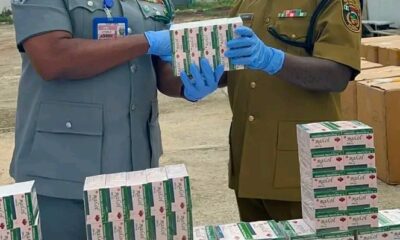
ShareBy Tambaya Julius, Abuja In collaboration with international partners, the Nigeria Customs Service (NCS) has foiled an attempt to smuggle...


Police Detain Actor Ugezu Ugezu for Defamatory Facebook Post against Prince Daniel Kanu
ShareBy David Torough, Abuja Actor and social commentator Ugezu J. Ugezu, was detained by the Nigeria Police Force following an...

Tinubu Visits Benue, Commissions Projects Tomorrow
ShareFrom Attah Ede, Makurdi Benue State is set to host the First Lady of the Federal Republic of Nigeria and National...

Fifa to Pay Somali Referee Artan Full World Cup fee
ShareSomali referee Omar Artan, who was denied entry to the United States to officiate at the World Cup, will still receive his full...
Delegates in China Denounce Xenophobic Attacks
ShareAfrican delegates attending seminars in China have condemned reported xenophobic attacks against foreign African nationals in South Africa and called for greater unity across the continent. The delegates made the...


Kogi Targets 240,000 Children for Schistosomiasis Mass Drug Administration
ShareFrom Joseph Amedu, Lokoja The Kogi State Government said it will reach over 240,000 children aged 5–14 years in 39 wards across 15 Local...


Anambra Urges Residents to Provide Information on Fake Pastors, Others
ShareFrom Sylvia Udegbunam, Enugu The Anambra State Government, under the leadership of Prof. Chukwuma Charles Soludo, has extended the “War Against Fake Native Doctors”...


Boat Mishap Kills 11 in Benue River
ShareFrom Attah Ede, Makurdi No fewer than 11 persons were Saturday night feared dead when a boat said to be conveying them...


Terrorism: After Gen Rabe’s Death, Buratai Warns of Darker Days Ahead
ShareBy David Torough, Abuja Nigeria’s deepening insecurity crisis has triggered fresh alarm across military, political and religious circles following the...