
NEWS
Was the World Cup 2026 a Success?

By Reuben Abati
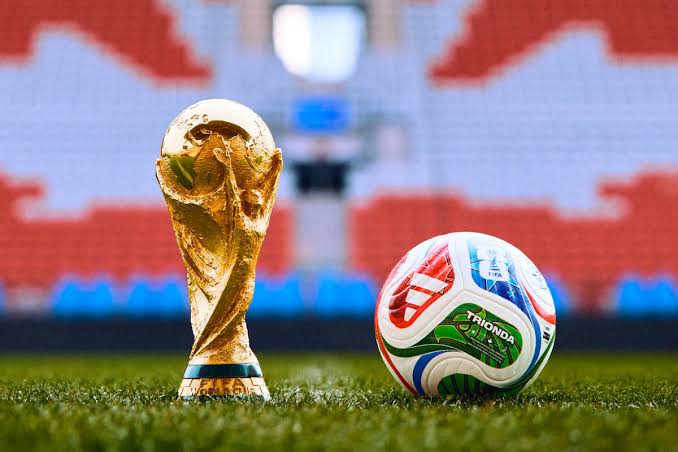
The straight-forward, honest and correct answer to the question raised above is: Yes. Spain won at the end of the day on Sunday, 19 July, 1-0 against Argentina, defending champions since Qatar 2022, and that was the climax of a tournament that lasted for 39 days during which 104 matches were played, by 48 teams from six Federations, participating (for the first time in the World Cup finals), in three countries – Canada, Mexico and the United States in 16 host cities – 11 in the United States (Atlanta, Boston Dalla, Houston, Kansas City, Los Angeles, Miami, New York City/New Jersey, Philadelphia, San Francisco Bay Area and Seattle; three cities in Mexico – Guadalajara, Mexico City and Monterrey, and two cities in Canada – Toronto and Vancouver.
This was the longest, most expansive, indeed the most expensive tournament ever in the history of the World Cup, with tickets selling as high as $2,000 and over $10,000 on the day of the final match. Spain’s victory was very well deserved. Supporters of Argentina and, particularly, the team’s talisman, Lionel Messi, had hoped that Argentina would win the World Cup back-to-back, but that did not happen.
Argentina actually failed to get one shot on target. Instead, Spain dominated the game from start to finish, with 20 shots and 12 on target, until Ferrand Torres scored the winning goal in the 106th minute.
The tally could even have been higher were it not for Argentine goalkeeper, Emiliano Martinez, who was busy throughout until he got a shot that made the difference from Torres. It was a sad goal, but it was also perfectly made. It was a historic moment.
Spain is the first nation ever to hold both the men’s and women’s FIFA World Cup titles at the same time. It is also the first country to be the reigning men’s Champion of the World Championship, the European Championship and the Olympics Championship simultaneously.
In addition, Spain won the Golden Ball in the final (Rodri), best young player (Pan Cubarsi) and the Best Goalkeeper with Golden Gloves (Unai Simon).
The Spanish team conceded only one goal and scored 14 goals throughout the tournament. To be fair, Argentina could have been beaten by more than one goal. The best team won. Spain played throughout as a complete team, with possession and positional football to win their Second World Cup title.
Argentina relied heavily on their goalkeeper, Emiliano Martinez, and Lionel Messi, easily the best player in the world who was reduced to tears at the end of what may well be, at 39, his last World Cup appearance. He will always be remembered as a legend of the tournament with 21 World Cup goals and clearly a first rank artist of the game at club, national and international levels, a genius and a master builder.
But despite the hype that heralded the final match, it was not even the most exciting match of the tournament. In that category would be the match between Netherlands and Japan in Group F, which ended 2-2, Algeria vs Austria, 3- 3, and Belgium vs Senegal in the Round of 32 at 3-2. The Teranga Lions of Senegal almost defeated Belgium! Argentina vs Cabo Verde which ended 3-2. Cabo Verde, a country of 529,000 people, the smallest country at the World Cup, which does not even have a properly organised national team had a fairy tale run, with its 40-year-old goalkeeper, Vozinha, who put up a memorable, remarkable performance.
That was a match! Cabo Verdeans nearly disgraced Argentina. In the Round of 16, Norway knocked out Brazil 2-1 to get to the quarter finals for the first time. Almighty Brazil was thrown out. England defeated Mexico in the Round of 16, but the same England was so disappointing in the semi-final match against Argentina playing a needless defensive game after going ahead with a goal in the first half.
They would later redeem their brand in the third-place play-off in which they defeated France. This was England’s best outing at the World Cup since 1966 when they won
the trophy, and now a bronze medal that was considered not good enough, even if they won 6-4 against one of the best teams in the world in the 2026 tournament.
There was also Argentina against Egypt, which Messi’s team won 3-2 in the Round of 16. Egypt felt cheated, so heartbroken, and had to complain about the officiating. On the whole, the World Cup 2026, in its expanded format projected the beautiful game so well, there is even now a lobby for further expansion to 64 teams in future editions.
The continent of Africa got a record 10 slots, nine of the teams reached the knock-out stage, and African countries were no spectators as they gave a good account with the competent performances by Morocco and Egypt, which both made it to the Quarter finals, and the Round of 16, before being eliminated by France and Argentina respectively.
DR Congo, appearing in the World Cup finals for a second time since 1974, drew against Portugal 1-1, defeated Uzbekistan, 3-1 and almost gave England a scare in the Round of 32, eventually losing 2-1. Our neighbour, Ghana, didn’t do too badly either, especially in their 0-0 match against England, and their 1–0 defeat of Panama.
But the star team from Africa was Cabo Verde which recorded a draw against Spain, the eventual winners of the tournament, held Uruguay to a 2-2 draw, and again drew with Saudi Arabia and almost defeated Argentina! Cote D’Ivoire did well too.
I will rather not talk about South Africa – those xenophobes – whose country should be busy answering questions at the International Court of Justice (ICJ). Nigeria, which by the way did not qualify for the World Cup, was everywhere at the tournament but actually nowhere in particular.
While 10 other African countries were competing with the rest of the world on the field of play, Nigeria was busy in the cheerleading corner through its artistes.
Afro-beat artiste Odogwu Burna Boy sang and danced with waist-twisting Colombian sensation, Shakira at the opening in Mexico Stadium on 11 June, and at the interlude of the closing in MetLife Stadium in New Jersey on 19 July.
Other Nigerian artistes – Rema, Davido and Ayra Starr – provided entertainment at other forums, while football was being played by capable nations. Nigeria was also a provider of talented footballers for other countries; a total of 15 players of Nigerian descent represented other countries at the World Cup.
While this recognition of Nigerian talent and stardom is remarkable, Nigerians would rather have their country on the main stage at the World Cup but that was something we could not do. Having missed the last two World Cup finals (2022, 2018), Nigeria should work harder to make it to the next World Cup in 2030 and the time to start is now not yesterday. Other countries start the preparations for the next World Cup, the moment a particular one ends. Nigeria’s story is different. The Nigeria Football Federation (NFA) usually waits till the last minute for the qualifying games to begin before running helter-skelter to get a coach, a team and oftentimes, the players are demoralised by the usual lack of organisation and a sense of direction. The problem is that nobody ever learns from past mistakes in Nigeria’s House of Football.
Meanwhile, there are very clear lessons to be learnt from the just concluded FIFA World Cup 2026 about the excitement that football attracts, the co-ordination and organisation by the world football body, FIFA, the high standards of the facilities in all the venues, and the quality of play showing off modern football as an advanced art and science.
The weather was treacherous in many places: extreme, potentially dangerous weather with temperatures as high as 33C but in the end it was the world’s biggest sport that triumphed. The heat, humidity and poor air quality did not stop the fans from turning out in their numbers, an average of about 65,500 spectators per match and a record-breaking total of 6.81 million across the 104 matches. There were tender family moments that added colour to the
tournament, the Viking row with which Norway left an even bigger impression off the field of play, the display of natural beauty in the stands and at the fan centres, and the spectacle of mothers, and WAGs travelling all the way to the tournament to see their loved ones in action.
The mothers of Vozinha (Cabo Verde), Ismael Saibari (Morocco), Lamine Yamal (Spain) Nico Williams (Spain) celebrated special moments with their sons. Lamine Yamal was surrounded by family, especially his little brother, Keyne who was just as actively involved as his super star sibling.
It was heartwarming also seeing Marc Cucurella sharing his World Cup glory with his wife and three children! The diversity at the World cup was projected not just by the ethnic mix of some of the national teams, but also by the individuality of some of the players – Nico Williams with Ghanaian parents playing for Spain, and Lamine Yamal with a Moroccan father and a mother from Equatorial Guinea.
FIFA World Cup 2026 was played against the background of major geopolitical events: the 250th Independence anniversary of the United States, with President Donald Trump seeing it as part of his self-glorifying Freedom 250 personal project.
He was at the final match of the World Cup, and when Spain won, and took the trophy and the medals, Trump lingered around for the celebrations until he was politely nudged off the spotlight. It was also typical of him to have inserted himself into the process when he got FIFA to suspend a red card that had been issued to an American player, one of those Nigerian exports, Folarin Balogun.
There was also the on-going war in the Middle East between the United States/Israel and Iran. The Iran national team was treated as unwelcome guests in the United States. Immigration arrangements were marred by prejudice and discrimination.
FIFA-grade referee from Somalia, Omar Artan was barred from entering the United States, despite having a valid travel visa. He would have been the first Somali to officiate at a World Cup. The national team of Senegal was subjected to humiliating security checks at the tarmac as they arrived.
But by far the most embarrassing moment of the World Cup was the racism on display, especially the xenophobic abuse of Kylian Mbappe by Paraguayan Senator, Celeste Amarilla, who was incensed by France’s victory over Paraguay during the knock-out stage, and referred to Mbappe, the eventual Golden Boots winner and world record holder for the most goals at the World Cup, as a “colonized Cameroonian, who sucked on coconuts as a child and the most educated creatures he ever listened to were chimpanzees.” Mbappe responded by calling her a “a despicable woman, unworthy of her position.” The government of Paraguay distanced itself from Amarilla’s comments.
The French Football Federation lodged a complaint. There was also the Argentina vs. England semi-final clash, which had all the undertones of a re-enactment of the unresolved tension of the 1982 Falklands war. After a tension-soaked adversarial match, which Argentina won 2-1, some of the Argentine players put up a banner, “Las Malvinas son Argentinas”, turning the encounter into a political conflict, against FIFA’s established rules.
FIFA is investigating. By a twist of irony, when Argentina lost the final match to Spain on Sunday, 19 July, only one song matched the occasion: “Don’t Cry For me, Argentina”, complete with pathos.
All things considered, this was a successful World Cup, and the biggest beneficiaries are all the players and teams that made history, no surprise that the four teams that got to the finals are the FIFA-ranked top four men’s teams in the world – Spain, Argentina, France and England.
Gianni Infantino, who has now been endorsed by 200 of FIFA’s 211 member associations to be elected for a fourth term as FIFA president, despite his bootlicking, subservience, cozying up to US President Trump and, of course, the
host nations – Canada, Mexico and the United States – who had brilliant days in the sun. Football is also mythical and one myth has again been confirmed – that the reigning Ballon d’Or winner never wins the World Cup, and so it has been this year as it was in the examples of France’s Ousmane Dembele (2026), Italy’s Gianni Rivera (1970), Netherland’s Johan Cruyff (1974) and Marco van Basten (1988, 1992), France’s Michel Platini (1986), Italy’s Roberto Baggio (1994), and Brazil’s Ronaldo (R9), (1998).
FIFA World Cup 2026 was also a commercial success with a record-breaking total prize pot of $871 million, with the champions Spain, taking home $51 million, with gold rings for every member of the team, and the runners-up, Argentina – $34 million, and England in third place, $30 million. Every team also got something extra ($12.5 million).
My oh my. That was a profitable enterprise. The money train now moves to Morocco, Spain and Portugal in 2030 as host countries, with a further expanded 64-team format, to mark the centenary of the World Cup. It will be a shame if Nigeria again fails to show up, not necessarily for the money, in 2030, but national pride, now so badly wounded.
Reuben Abati, a former presidential spokesperson, writes from Lagos.

Candidates seeking admission into Nigerian tertiary institutions can now upload and verify their O’Level results from the comfort of their homes, following a new initiative by the Joint Admissions and Matriculation Board (JAMB).
Under the new arrangement, candidates will no longer need to visit Computer-Based Test (CBT) centres solely to upload their Senior Secondary School Certificate Examination (SSCE) results, as JAMB will verify the results directly with the examination bodies, beginning with the West African Examinations Council (WAEC).
In a statement on Monday in Abuja, JAMB’s Acting Director, Public Affairs and Protocol, Dr.
Fabian Benjamin, said the Board would continue to deploy technology and collaborate with examination and government agencies to simplify its services and make them more accessible to candidates.According to him, the initiative was part of its renewed commitment to making its services “easier, faster, safer and more convenient” for candidates.
He said the integration of its e-Facility platform with examination bodies would enable candidates’ results to be verified against the records of the issuing bodies before being downloaded into their profiles.
The new system is also expected to address problems associated with manual O’Level result uploads, including misplaced or mixed-up paper results, presentation of fraudulent or unverified certificates and errors in the manual entry of subjects and grades.
The examination body said the initiative would particularly ease pressure on CBT centres during periods of high patronage and help reduce the effect of network challenges and long queues.
The statement reads: “Consequently, candidates can now upload their O’Level results from the comfort of their homes, while the Board undertakes the verification of such results directly with the issuing examination bodies.
“The initiative is part of the Board’s renewed commitment to making services easier, faster, safer and more convenient for candidates. By using technology to reduce unnecessary visits to CBT centres, queues and manual processes, JAMB is putting candidate ease of service delivery at the centre of its operations.
“The new arrangement also addresses challenges associated with manual O’Level result uploads, including misplaced or mixed-up paper results, presentation of unverified or fraudulent results, and errors in the manual entry of subjects and grades. Through the integration of JAMB’s eFacility platform with examination bodies, results can now be verified directly against the examination body’s records before being downloaded into the candidate’s profile.”
To use the new service, candidates are required to visit its website, enter their National Identification Number (NIN) and select the number of examination sittings and relevant examination body or bodies.
After providing their email address and GSM number, candidates are required to pay for the verification using a debit card or bank transfer before entering their examination number, examination series and examination year.
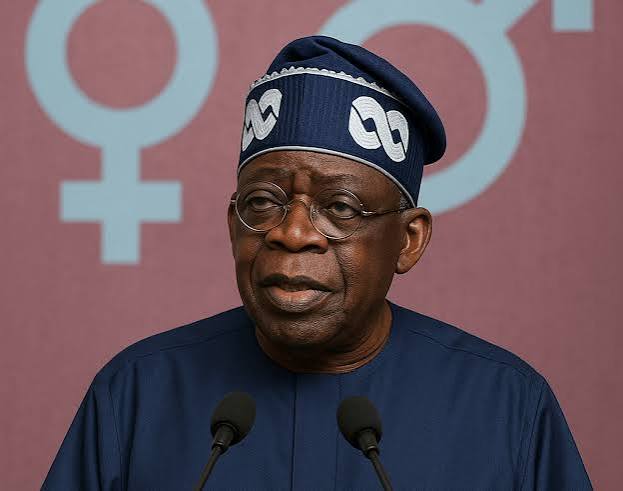
President Bola Tinubu has condoled with the family, friends and colleagues of veteran Nollywood actor, filmmaker and screenwriter Taiwo Hassan, popularly known as Ogogo, who died after decades in acting.
Tinubu described the late actor as a distinguished artiste whose decades-long career contributed significantly to the growth of Yoruba-language theatre and Nigerian cinema, particularly through memorable performances.
The President’s condolence message is contained in a statement issued by his Presidential Spokesperson, Bayo Onanuga, on Monday in Abuja.
Tinubu said Ogogo’s body of work would remain an important part of Nigeria’s cultural history, while his mentorship of younger artistes further strengthened his enduring legacy in Nollywood.
He said that through his distinctive acting style, powerful screen presence and dedication to his craft, Ogogo entertained generations while promoting Yoruba culture and Nigeria’s diverse cultural heritage.
“Alhaji Taiwo Hassan was a gifted artiste who used his talent to tell Nigerian stories, preserve our cultural heritage and entertain audiences at home and abroad.
“His passing is a great loss to his family, the Yoruba film industry, Nollywood and the entire Nigerian creative community.
“On behalf of the Federal Government, I extend my heartfelt condolences to his family, colleagues, friends and millions of admirers,” Tinubu said.
The President urged members of the creative industry and Nigerians to honour Ogogo’s memory by preserving and building on the cultural values and artistic traditions to which he devoted himself.
Tinubu also prayed for the peaceful repose of the late actor’s soul and strength for his family and loved ones, describing his death as an irreparable loss to those closest to him.
“I pray that Almighty Allah will grant him eternal rest and give his loved ones the strength to bear this irreparable loss,” Tinubu said.
Ogogo worked as a mechanic with the Ogun State Water Corporation for about 13 years before gaining prominence in acting and becoming a notable figure in Yoruba cinema.
He began acting in 1981 while combining the profession with his mechanic job, eventually leaving the employment in 1994 to pursue acting as a full-time career.

Nigeria is strengthening its border management architecture through digital technology, biometric identity systems, intelligence sharing and stronger collaboration with border communities.
The Comptroller-General of the Nigeria Immigration Service (NIS), Kemi Nandap, made this known at the African Borderlands Research Network (ABORNE) 2026 conference on Monday in Lagos.
She said the transformation was necessary as changing migration patterns, regional integration, cross-border economic activities and emerging security threats continue to reshape Africa’s borderlands.
The conference, with theme: “The Connected Borderlands: Socio-Cultural Integration and the Centrality of Policy, Research, and Security,” brought together scholars, policymakers, practitioners and development partners.
The stakeholders examined the changing nature of border management across Africa.
According to Nandap, borders should no longer be viewed merely as geographical lines separating sovereign states, but as dynamic spaces where families, communities and cultures interact and where legitimate trade and movement take place.
She said the challenge for governments was to keep these spaces secure while facilitating lawful mobility, strengthening regional cooperation and preserving the socio-cultural and economic relationships that sustain border communities.
She noted that the nature of border security had also evolved, with threats such as human trafficking, migrant smuggling, identity fraud, organised crime, terrorism and cyber-enabled crimes increasingly operating across national boundaries.
The NIS boss said that the service was therefore combining the experience and professional judgment of its officers with technology, intelligence and stronger institutional cooperation to respond to emerging threats.
She outlined Nigeria’s progression in modern border management, recalling that the country became the first African nation to introduce the electronic passport in 2007.
She said Nigeria had subsequently introduced an enhanced e-Passport with stronger security and biometric features, while automating passport applications, payment systems, processing and identity verification.
According to her, the centralisation of passport personalisation has also improved the integrity and efficiency of passport production.
She further said Nigeria’s participation in the International Civil Aviation Organization’s Public Key Directory (ICAO PKD) was strengthening international confidence in the authentication of Nigerian electronic passports.
She noted that contactless biometric passport services were making passport processes more accessible to Nigerians living abroad while maintaining required security standards.
The comptroller-general also highlighted the deployment of automated border control systems, including e-gates, at Nigeria’s international airports.
He said the systems were transforming passenger processing by combining biometric identity verification with faster, more efficient and secure border procedures.
These measures, she said, are being complemented by investments in surveillance systems, command and control capabilities, communications infrastructure, and integrated border and data platforms covering Nigeria’s air, land and maritime borders.
She stressed, however, that the investments were not about technology for its own sake.
The NIS boss also emphasised the continued importance of the human element in border management, saying technology could not replace professionalism, experience, judgment and integrity.
She called for greater involvement of border communities, describing them as strategic partners whose local knowledge could contribute significantly to effective border management.
The Chairman of ABORNE, Prof. Paul Nugent said emerging health threats such as Ebola, COVID-19 and regional insurgencies routinely placed borders at the center of political and security interventions.
He said that these often lead to prolonged closures.
Nugent said that bridging academia and policy, ABORNE aimed to move beyond isolated academic debate by actively engaging border enforcement agencies, policymakers, and field practitioners.
He said that in reframing African borderlands, rather than viewing borders purely through the lens of instability or poor reputation, ABORNE scholars emphasise borderlands as vibrant hubs of trade, urban innovation, and cultural creativity.
Prof. Anthony Asiwaju, a former Director of the Centre for African Regional Integration and Border Studies, commended the ABORNE conference.




JAMB Breaks New Ground, Allows Home Upload of O’Level Results
ShareCandidates seeking admission into Nigerian tertiary institutions can now upload and verify their O’Level results from the comfort of their...

Tinubu Mourns Ogogo, Extols His Creative Legacy
SharePresident Bola Tinubu has condoled with the family, friends and colleagues of veteran Nollywood actor, filmmaker and screenwriter Taiwo Hassan,...


Nigeria Upgrading its Digital, Intelligence-led Border Management System — NIS
ShareNigeria is strengthening its border management architecture through digital technology, biometric identity systems, intelligence sharing and stronger collaboration with border...
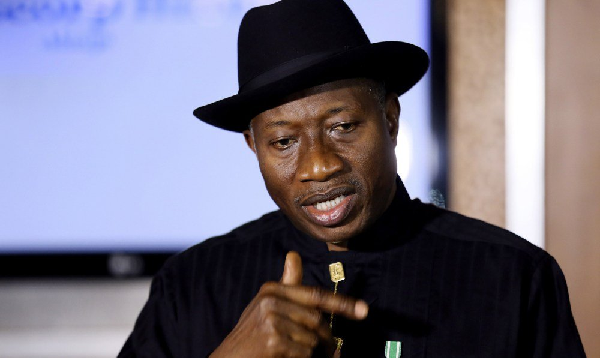
ShareGoodluck Jonathan Advises Leaders to Invest in Youths, Industry Former President of Nigeria, Dr. Goodluck Jonathan, has called on leaders...


First Quarter Pension Contributors Rise by 143,248 – PenCom
ShareThe National Pension Commission (PenCom) said cumulative Retirement Savings Account (RSA) registrations under the Contributory Pension Scheme (CPS) rose by...

Police Honour 10 Fallen Officers, Disu Vows to Crush Banditry
ShareBy Elijah Oguche, Abuja The Nigeria Police Force (NPF) on Monday honoured 10 officers of the Special Intervention Squad (SIS)...


Petrol Imports Rise as Local Supply Plunges 21 Per Cent
ShareBy Tony Obiechina, Obiechina Nigeria’s reliance on imported petrol increased in July as domestic refinery supplies fell sharply, reversing some...
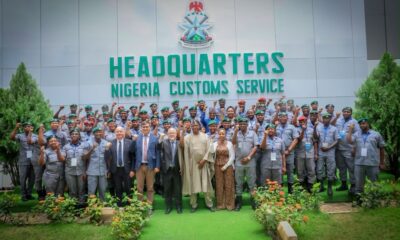

NCS, WCO, UK Intensify Anti-Corruption Drive, Strengthen Customs Integrity
Share By Tambaya Julius, Abuja The Nigeria Customs Service (NCS), in collaboration with the World Customs Organisation (WCO) and the...
Bayelsa Receives Twon-Brass Draft Constitution
ShareFrom Mike Tayese, Yenagoa The Bayelsa State Government has received the final draft copy of the constitution of Twon-Brass Kingdom...
Nigeria’s Reforms Must Now Deliver Jobs, Higher Incomes – CPPE
ShareCentre for the Promotion of Private Enterprise (CPPE) has urged the Federal Government to shift its economic reform focus from...