
Health
World Heart Day: FG unveils cardiac emergency response devices

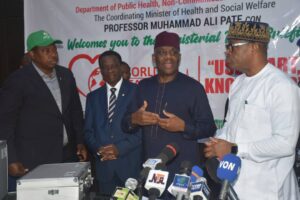
The Federal Government on Friday unveiled the Cardiac Emergency Response Box otherwise known as Automated External Defibrillators (AEDs) to respond to heart emergencies such as cardiac arrest.
The Coordinating Minister of Health and Social Welfare, Prof.
Ali Pate, inaugurated the three devices in Abuja in commemoration of the 2023 World Heart Day.The theme for the celebration is “Use Heart, Know Heart”.
The News Agency of Nigeria (NAN) reports that the day is set aside by the Cardiovascular Health Community all over the world to raise awareness about the importance of the heart and promote preventive measures to reduce the global impact and burden of heart diseases.
Pate who was represented by the Minister of State, Dr Tunji Alausa, said that the boxes which were donated by the Nigerian Heart Foundation (NHF) would be deployed at appropriate designated high population areas such as airports.
According to him, AEDs are portable, life-saving medical devices used to revive sudden heart arrest.
Pate said that the heart is one of the vital organs of the body and the engine room responsible for pumping life-sustaining blood to all parts of the body.
He added that the heart needs to be protected against diseases and conditions that would cause it to malfunction.
“Statistics from the World Health Organisation (WHO), shows that Cardiovascular Diseases (CVDs) are the leading Non-Communicable Diseases (NCDs) and are the foremost cause of death globally, taking an estimated 17.9 million lives each year.
“Of these cardiovascular deaths, 85 per cent are due to heart attack and stroke, and over three-quarters occur in low- and middle-income countries.
“The 2018 WHO NCDs Country Profiles show that NCDs accounted for 29 per cent of all deaths in Nigeria with CVDs responsible for 11 per cent of all the NCD deaths.
“The country profile also shows that the risk of dying prematurely from NCDs in Nigeria is 22 per cent.
“Premature mortality in this instance is defined as death occurring between ages 30 and 70 years from any of the common NCDs”, he said.
The minister said that although the FMOH is currently in the field conducting National Steps Survey of NCDs, several pockets of studies in Nigeria report various incidence and prevalence of CVDs such as hypertension at prevalence greater than 30 per cent.
He put stroke incidences at 25.9 per 100,000 persons per year between 2000 and 2015; coronary heart disease prevalence at 0.7 per cent and rheumatic heart disease, which is a disease of the socio-economically disadvantaged at 27 per 1,000 children.
Pate also noted that the morbidity and mortality due to CVDs in Nigeria is underestimated because of inadequate awareness and health seeking behaviours as well as limited screening, diagnostic and therapeutic services including poor data repository.
“Given the silent and chronic nature of majority of the CVDs, it is important to institute long-lasting measures to prevent, detect and manage them early in order to avert complications such as heart attack, heart failure, stroke and even death.
“Luckily, the risk factors for heart diseases are well known and largely preventable.
“For example, hypertension, diabetes mellitus, sickle cell disease, lipid abnormalities, overweight and obesity, tobacco use, alcohol intake and insufficient physical activity are significant modifiable and preventable risk factors for heart disease and other NCDs.”
He, however, said that in response to the burden of CVDs, the federal government over the years instituted several strategic interventions at the Tertiary, Secondary and Primary Health Care (PHC) levels.
They include the development of the National NCDs Policy and Multi-Sectoral Action Plan, an offshoot to the Policy and Multi-Sectoral Action Plan 2019-2025.
Also, the National Tobacco Control Act 2015 and Regulations 2019 which are being implemented to reduce tobacco consumption and exposure to second-hand smoke in Nigeria.
“In collaboration with NAFDAC, the Fats and Oil Regulations has been reviewed and gazetted to incorporate Trans-Fatty Acid (TFA). This regulation prescribes TFA at less than two grams (g) per 100g of oil or fat as a start of our transition to a total elimination of TFA by 2030.
“In recognition of the key role of Primary Health Care in the prevention and early detection of diseases, the ministry in collaboration with the National Primary Health Care Development Agency (NPHCDA), WHO Country Office, and Resolve to Save Lives (RTSL), inaugurated the National Hypertension Control Initiative (NHCI) in August 2019.
“This was with focus on strengthening the PHC Centers to prevent and manage simple and uncomplicated hypertension using a simple standard treatment protocol. The protocol was first deployed to PHC Centers in November 2020.”
Pate added that through the NHCI, the simplified hypertension treatment protocol is currently used in a total of 104 PHC centers across Kano and Ogun States.
Similarly, the Protocol is also implemented at 60 PHC Centers in the FCT by the University of Abuja Cardiovascular Research Group, while an additional 360 PHC Centers across 18 States are using the same protocol under the Healthy Heart Africa Programme in collaboration with the NPHCDA, Population Services International (PSI) and AstraZeneca.
He, however, advised Nigerians to adopt a healthy lifestyle always to make their heart age longer and healthier.
These activities include engagement in physical activity for a minimum of 30 minutes daily, avoidance of tobacco use and exposure to second-hand smoke and avoidance of harmful intake of alcohol.
He also enjoined Nigerians to eat a healthy diet containing a minimum of three to five servings of a variety of fresh fruits and vegetables spread over each day.
“In addition, eat a variety of whole grains, lean meat, fish, peas, beans, and lentils.
“Limit processed foods, limit salt intake to less than five grams daily, reduce dietary cholesterol, and avoid industrially produced trans-fats.
“Know your numbers by regularly checking your blood pressure, cholesterol, and glucose levels”, he added.
The Executive Director, NHF, Dr Kingsley Akinroye, while speaking about the AEDs, said that they are sophisticated, lightweight, portable, yet easy -to-use medical devices that can analyse the heart’s rhythm and send electric pulses to a person’s heart.
Also it helps to restore a normal heartbeat and could be used at hospitals, homes, schools and in public places.
“AEDs are the only way to restore a normal heartbeat when someone is experiencing a cardiac arrest.
“To help someone who is in cardiac arrest survive, a defibrillator needs to be found as quickly as possible.
“Subsequently, NHF will promote the message, advocate for the inclusion of these boxes as an essential package for prevention of deaths resulting from sudden cardiac arrest in public institutions and privately owned organisations such as airports, banks, offices, malls, sports centers, gyms and schools.”








By Eze Okechukwu, Abuja
The Senate yesterday ordered mandatory health screening for every international passenger arriving Nigeria airports, seaports, land borders as Ebola resurfaces in the Democratic Republic of Congo with a scare case reported in the FCT.
The resolution followed an urgent motion by Senator Francis Fadahunsi, who warned that with Lassa fever already ravaging states, Nigeria cannot afford another outbreak.
“Protecting our entry points is far cheaper than managing Ebola,” Fadahunsi told the chamber.
Lawmakers insisted screening must be total and indiscriminate — no exemptions based on nationality or departure country because infected travellers can transit through safe-listed nations.
Senator Diket Plang raised the stakes further, demanding immediate funding for NCDC and Port Health Services, including release of withheld funds and emergency budget.
Senate President Godswill Akpabio said the Federal Government has started releasing Ebola response funds but ordered relevant committees to track every kobo.
“Ascertain whether the funds were released and judiciously utilised. Any outstanding debt must be released by the Finance Ministry without delay,” Akpabio directed.

By Laide Akinboade, Abuja
The Federal Government (FG), on yesterday confirmed one case of Ebola disease in the Federal Capital Territory (FCT), following laboratory confirmation.
Minister of Health and Social Welfare, Prof.
Muhammad Ali Pate, stated this while briefing journalists in Abuja.He said the patient, a woman, who was from Uganda, was admitted in Abuja and the diagnosis has been confirmed.
The statement reads, “The patient, a woman who recently arrived in Nigeria on an international flight from Uganda, was admitted to a private hospital in the FCT, where she received care for several days before the diagnosis was confirmed.
She is currently in isolation and receiving medical care.“The Federal Minister of Health and Social Welfare and NCDC are working closely with the FCT Health Services Secretariat and other relevant authorities to contain the infection and prevent further spread..
“Contact tracing has commenced with 44 close contacts identified presently, with public health teams identifying and monitoring people who may have been exposed, including healthcare workers, patients, caregivers and travel contacts. Surveillance has been intensified, and the hospital is receiving immediate support to strengthen infection prevention and control measures.
“The FG calls on all public and private healthcare facilities nationwide to be on high alert. Healthcare workers must maintain a high index of suspicion, promptly identify and isolate suspected cases, observe strict infection prevention and control measures, and immediately report suspected cases to public health authorities.
“What Nigerians Should Know and Do
Ebola spreads through direct contact with the blood or body fluids of someone who is sick with the disease or has died from it, or through contact with contaminated materials. A person with Ebola cannot spread the disease before symptoms begin”.
The Federal Government therefore advised residents to remain calm but vigilant.
“Remain calm but vigilant. There is no need for panic. Practise regular hand hygiene and avoid contact with the body fluids of anyone suspected to have Ebola.
Watch for symptoms, including fever, severe weakness, headache, vomiting and diarrhoea, particularly following possible exposure.
“Report any possible exposure immediately, even if you feel well. If you develop symptoms, avoid close contact with others and call public health authorities for guidance before visiting a healthcare facility.
” Cooperate with public health teams. Anyone contacted during contact tracing, including relevant airline passengers, should provide the necessary information and follow public health advice.
“Avoid rumours and stigma. Share only verified information from official health authorities” .
The Minister recalled, “Our Assurance to Nigerians. Nigeria successfully contained Ebola in 2014, and we have the experience and public health systems to respond to this case. However, containing Ebola requires everyone to play their part.
“The Federal Government, FCT authorities and other partners are working together to protect healthcare workers, patients and the wider public. Investigations are ongoing, and we will continue to provide accurate and timely information.
” We urge Nigerians to remain calm, stay vigilant and cooperate with public health authorities. Early detection, prompt reporting and everyone’s cooperation are critical to preventing further spread.
“The Government of Nigeria through the Presidential Taskforce on EVD and NCDC will continue to provide updates.
NCDC free call centre is available 24 hours a day, seven days a week. For information or to report a suspected case, please call NCDC toll-free number 6232″.

By Laide Akinboade, Abuja
The Benue State House of Assembly has passed into law a landmark legislation aimed at eliminating tuberculosis (TB) and protecting persons affected by the disease from discrimination and human-rights violations.
The legislation, known as the Tuberculosis Elimination, Human Rights Protection and Anti-Discrimination Law of Benue State, 2026, was passed into Law during Thursday plenary presided over by Speaker, Rt.
Hon.Berger Alfred Emberga, MNIQS, RQS, following consideration of the report of the House Standing Committee on Health and Human Services.The committee, chaired by Hon. Matthew Damkor, Ph.D., said the legislation was necessary to provide a comprehensive legal framework for tuberculosis prevention, diagnosis, treatment, care and control across the state.
The law also seeks to safeguard the rights of persons affected by Tuberculosis (TB), including their rights to dignity, healthcare, privacy, information, employment, education and social protection.
In its report, the committee identified several areas of the original Bill that required amendment, particularly provisions relating to federal laws and institutions, implementation responsibilities, screening and isolation, enforcement mechanisms, offences and penalties.
The committee recommended the removal of provisions purporting to amend federal legislation, particularly the Employees’ Compensation Act, 2010, noting that such amendments were inappropriate for state legislation.
It also recommended that references to federal institutions as implementing authorities be replaced with relevant Benue State institutions, while allowing for lawful collaboration with federal authorities.
The committee further recommended that the Commissioner for Health and Human Services, through the Ministry of Health and relevant state agencies, be clearly designated to coordinate the implementation of the law.
On the protection of fundamental rights, the House called for clearer safeguards in provisions dealing with TB screening, isolation and restriction of movement, including informed consent, confidentiality, medical necessity, proportionality and the use of the least restrictive measures.
It also recommended the establishment of an accessible mechanism for receiving complaints, addressing discrimination and providing remedies to persons whose rights may have been violated under the law.
The House further urged relevant agencies to ensure that offences and penalties under the legislation are clearly defined, proportionate and enforceable.
After considering and adopting the committee’s recommendations clause-by-clause, the bill was read for the third time and subsequently passed into law by the Speaker, Rt. Hon. Emberga following a unanimous consideration and adoption by members.
The Tuberculosis Law which was sponsored by Hon. Dr. Simon Gabo of Mata State Constituency and others, is expected to strengthen Benue State’s response to tuberculosis and provide a stronger legal framework for protecting persons affected by the disease from stigmatization, discrimination and other rights violations.
Meanwhile, Civil Society Organisations, Lawyers Alert and Media Health and Rights Initiative of Nigeria, MHR, have commended the Benue State House of Assembly for taking steps to strengthen the state’s response to tuberculosis, and protect the rights of persons affected by the disease.
In a joint statement, the President of Lawyers Alert, Rommy Mom and the Executive of MHR, Alu Azege said the Bill brings health and human rights dimensions of TB into legislative conversation in the state.




2027: Don’t Call Benue People Shenanigans, Alia not answerable to you- Ex- Amb, Tarzoor Tells Ortom, Wike.
ShareFrom Attah Ede, Makurdi Ex -Nigeria’s Ambassador to Namibia, Terhemen Tarzoor, has warned the immediate past Governor of Benue State...


DBN Signs $61m Credit Deal With AfDB, Unveils Support Initiative Report
ShareBy Tony Obiechina, Abuja The Development Bank of Nigeria Plc (DBN) has launched DAWN: DBN Action for Women in Nigeria,...


NLC Threatens Nationwide Action as Talks With FG Collapse
ShareBy Tambaya Julius, Abuja The Nigeria Labour Congress (NLC) has threatened possible nationwide industrial action following the failure of talks...


Top10 Magazine Names Umaru Kwairanga as Man of the Year 2026
ShareAlh. (Dr) Umaru Kwairanga, Group Chairman, Nigerian Exchange Group (NGX Group), has been named as the Top10 Magazine’s Man of...


UK, Nigeria to Deepen Defence, Security Cooperation
ShareThe United Kingdom has reaffirmed its commitment to deepening defence and security cooperation with Nigeria, with emphasis on military training,...


2027: INEC Steps Up Preparations, Completes Nine Activities
ShareBy Tambaya Julius, Abuja The Independent National Electoral Commission (INEC) has completed nine of the 14 activities on its timetable...


2027: Tinubu Accords Benue Security Top Priority, Tompolo Tells Supporters
ShareLeader of the PBAT Door-to-Door Movement, Government Tompolo, has called on the people of Benue state to come out enmasse...


Senate Demands Compulsory Screening of Foreign Arrivals
ShareBy Eze Okechukwu, Abuja The Senate yesterday ordered mandatory health screening for every international passenger arriving Nigeria airports, seaports, land...

Reps Summon Telecom Operators over Poor Network Services
ShareBy Ubong Ukpong, Abuja The House of Representatives on Wednesday, summoned telecommunication operators in the country to appear before it...


Bill to Design, Manufacture, Commercialize Drones Passes Second Reading in Reps
ShareBy Ubong Ukpong, Abuja A bill for an Act to move the nation to developing the capacity to design, manufacture...