
NEWS
Zamfara APC Cautions Citizens Against Planned Nationwide Protest


The Zamfara State chapter of the All Progressives Congress (APC) has cautioned citizens in the state against participating in the planned nationwide protest over economic hardship in the country.
This is contained in a statement signed by the State APC Chairman, Alhaji Tukur Danfulani, issued in Gusau on Saturday.
According to him, the protest is likely to be hijacked by the hoodlums.
He said: “I was at the APC National Headquarters, I attended a meeting between state executives of the party from all the 36 states of the federation and Abuja held with the National Working Committee members.
”It was chaired by the National Chairman of the party, Dr Abdullahi Ganduje in Abuja over the impending protest.
“I find it very imperative to lend our party’s voice to make this call due to the insecurity situation bedeviling our dear state of Zamfara and the need for Nigeria’s stability as one united nation.
“There’s the likelihood of criminals who have continued to make life highly unbearable to the people taking over the protest and making the security situation worse.
“As good citizens, let’s think wisely to avoid wanton destruction of our country in the name of protest.”
Danfulani said that most of the countries that carried out such protests in the past, were now experiencing more difficulties than what caused the protest.
He added: “Like in Sudan, the people protested for the hike of bread price but now they are buying bread at five times the cost before the protest price.
”A lot of the citizens’ properties, government infrastructure, businesses and health facilities were all destroyed, with many people made homeless and turned into refugees within their country and its neighbours.
“The same thing in Libya, Syria, and most current one in Kenya so let’s resolve our grievances through negotiation and dialogue.
”This is because no country will progress through protest that will lead to anarchy if hijacked by hoodlums,” the APC Chairman explained.
According to Danfulani, although the protest is an expression of the citizens’ constitutional rights, all the channels of amicable resolution of the problem cannot be said to have been exhausted.
He said, “As Muslims, Islam abhors protests and for the fear that no one can tell the extent of damage such protests could cause, it is better to find other avenues of settlement.
“President Bola Tinubu is a listening leader who is doing his best to make Nigeria a better place for all.”
“He is the only president that took the Nigerian Governors to the Supreme Court in order to ensure that the government at the grassroots is fully functioning.
”I believe, with the local government areas having full autonomy, issues of unemployment, insecurity, hardship and other criminalities will become history in the country.
“So let’s support him in that direction through goodwill and prayers for the benefit of our future generations.”
Danfulani urged that Nigerians should not be instigated by some enemies of the country.
”They are abroad enjoying with their families and cannot even come near the protest venues but can only watch and comment on the social media,”he added.(NAN)
NEWS
A Birthday Tribute to His Excellency Senator Kashim Shettima, Vice President of The Federal Republic Of Nigeria
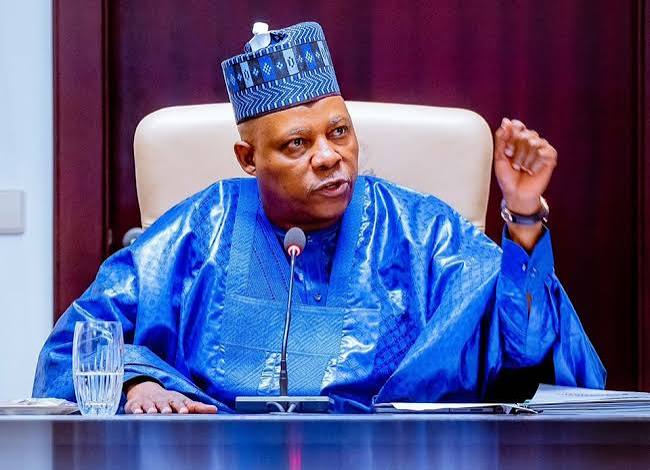
Your Excellency,
On behalf of the National Executive Council, National Executive Committee and the entire membership of the Alumni Association of the National Institute (AANI), I extend warm felicitations and heartfelt good wishes to Your Excellency on the occasion of your birthday.
We are mindful of Your Excellency’s expressed wish that this milestone be observed quietly, with public attention directed towards the more pressing task of nation building rather than personal celebration.
We fully respect your wishes. Nevertheless, as members of the family of the National Institute for Policy and Strategic Studies (NIPSS), Kuru, we cannot allow this special day to pass without acknowledging your remarkable journey of service and expressing our sincere appreciation for your friendship, support and commitment to our Alma Mater.Your Excellency’s distinguished journey from the banking profession through public service as Governor of Borno State and Senator of the Federal Republic of Nigeria to your present position as Vice President has been marked by courage, resilience, intellectual depth and a commitment to the Nigerian project.
For AANI, our appreciation goes beyond the office you occupy. We particularly acknowledge and commend Your Excellency’s warm disposition towards the Association, your accessibility and receptiveness to our engagements, and your recognition of the immense reservoir of knowledge, experience and strategic capacity within the NIPSS alumni community.
We are especially grateful for your consistent support for NIPSS Kuru, our Alma Mater, and your appreciation of its strategic importance to national development. Your commitment to strengthening the Institute as a centre of excellence for policy research, strategic thinking and leadership development is deeply appreciated by the entire NIPSS family.
Your Excellency’s recognition of the need to ensure that the wealth of knowledge and policy recommendations generated by NIPSS translate into tangible outcomes in governance is particularly commendable. It reflects your understanding that the Institute and its alumni constitute an important national asset whose intellectual resources can contribute significantly to addressing Nigeria’s complex developmental, security, economic and social challenges.
AANI equally appreciates your openness to engaging with the Association on issues of national importance. Your disposition towards our ideas and initiatives has reinforced our belief that the NIPSS family can and should remain a strategic partner in the collective effort to build a more secure, prosperous, united and resilient Nigeria.
As you attain another milestone in your life, we celebrate not merely the passage of another year, but a life dedicated to public service and the advancement of our dear country.
We pray that Almighty Allah will continue to grant Your Excellency wisdom, strength, sound health, courage and divine guidance as you discharge the enormous responsibilities entrusted to you by the President and the people of Nigeria.
May the years ahead bring you greater fulfilment and enable you to continue contributing meaningfully to the peace, stability, prosperity and development of our beloved nation.
Happy Birthday, Your Excellency.
May Almighty Allah continue to bless you and your family, and grant you many more years of purposeful service to Nigeria.
Ambassador Emmanuel Obi Okafor mni, President, Alumni Association of the National Institute AANI, Abuja
When the Government Owns The Newsroom, Who Owns The Truth?
By Isaac Asabor
There was a time when entering a newsroom meant entering a sanctuary of truth; a place where facts mattered more than friendships, accountability mattered more than political convenience, and the journalist’s loyalty was owed not to the man in the Government House but to the public. That ideal is increasingly under siege.
In too many state-owned media organizations, journalism has been reduced to an elaborate performance in which the script is written elsewhere, the characters are carefully selected, the villains are predetermined, and the journalist is expected to read his lines without asking inconvenient questions.
In fact, the newsroom, once a watchdog, is gradually becoming a kennel. And the tragedy is that the journalist holding the pen may have little control over what he is permitted to write.
State-owned media, in principle, should belong to the people. After all, governments do not own public broadcasting organizations in the same way individuals own private businesses. They are funded, directly or indirectly, by taxpayers. Their obligation, therefore, should be to inform citizens fairly, scrutinize the government responsibly and provide credible information on matters of public interest. But somewhere along the line, ownership has been confused with control.
The consequence is a dangerous mutation: public media becomes government media, government media becomes ruling-party media, and ruling-party media eventually becomes propaganda machinery. That is where the real danger begins.
As it is at the moment, loyalty has become the qualification to work in state-owned media outfits. One of the most damaging practices in state-owned media is the politicization of appointments.
Instead of entrusting media organizations to professionals with the experience, independence and editorial courage required to manage them, governments sometimes treat such institutions as extensions of the political reward system. The message to the newsroom becomes unmistakable: loyalty is more valuable than competence.
Once political loyalty becomes the currency for appointment, the newsroom’s editorial compass begins to malfunction. The editor who should be asking, “Is this story true?” starts asking a more dangerous question: “How will the governor react to this?” That single change in question can destroy an entire institution.
A reporter who knows that an uncomfortable story could offend a political appointee will think twice before filing it. An editor who fears losing his position will find reasons to kill it. A management team dependent on political goodwill will gradually learn the art of avoiding stories that embarrass those who control the purse.
Nobody needs to issue a written order. Fear becomes the editor. Silence becomes policy. Self-censorship becomes professional survival. And this is how journalism can be executed without anyone firing a bullet.
The most effective censorship is not necessarily the one imposed through a memo. Sometimes it is the censorship a journalist imposes on himself because he has learnt what happens to colleagues who cross invisible political boundaries.
Against the backdrop of the foregoing, the journalist undeniably becomes the victim. It is tempting to blame journalists when state-owned media fail in their responsibilities. That criticism is not entirely misplaced. Journalists are professionals and must be held to ethical standards irrespective of where they work. But it is intellectually dishonest to ignore the environment in which many of them operate.
Consider a journalist who works in an organization where management is politically appointed, editorial decisions are subject to political interference, salaries are irregular and investigative journalism receives little or no financial support. Then ask that journalist to behave like an entirely independent watchdog. That is easier said than done. A hungry journalist is still a human being.
A journalist with school fees to pay, rent to settle, children to feed and medical bills to confront is vulnerable to pressures that may not appear in any journalism ethics textbook. This is why the economic condition of journalists cannot be separated from the quality of journalism they produce.
When salaries are delayed for months and reporters are expected to chase stories without transportation, communication or investigative resources, the newsroom becomes fertile ground for ethical compromise. The infamous “brown envelope” culture does not emerge from nowhere. It thrives where institutional poverty meets personal desperation.
This does not excuse corruption. A journalist who accepts money to distort a story has violated the public trust. But institutions that deliberately or negligently keep journalists financially vulnerable should not pretend to be shocked when ethical standards begin to collapse. You cannot starve a watchdog and then complain that it has stopped barking.
Perhaps the most disturbing feature of the state-owned media ecosystem is the double standard, which in summary is the politics of selective accountability.
Private media organizations can face regulatory scrutiny, public condemnation and legal consequences when they breach professional standards. Yet state-owned media can sometimes behave as though government ownership provides a diplomatic passport against accountability. That is a dangerous assumption.
A public broadcaster should not become a political weapon simply because the government pays its bills. Its microphone belongs to the public. Its cameras belong to the public. Its journalists, ultimately, serve the public.
The moment a state-owned broadcaster becomes a platform for ridiculing political opponents, suppressing embarrassing information, amplifying government achievements while burying government failures, or manufacturing favourable narratives, it ceases to perform the public-service function for which it exists. It becomes propaganda. And propaganda is not journalism wearing a different shirt. It is the opposite of journalism.
Given the backdrop of the foregoing view, it is expedient at this juncture to opine that journalism asks questions. Propaganda supplies answers. Journalism investigates power. Propaganda protects power. Journalism gives citizens the information they need to make informed judgments. Propaganda tells citizens what judgment they should make. The difference could not be clearer.
In fact, the puppeteers may win the newsroom, but they lose the audience. This is as there is another problem politicians and their media managers often fail to understand. The problem emerges when credibility cannot be commanded.
A government can compel a state broadcaster to praise it from morning until night. It can instruct presenters to celebrate every project, describe every policy as historic and portray every critic as an enemy of progress. But it cannot compel citizens to believe it. In an age of social media, satellite television, online newspapers, podcasts and citizen journalism, audiences have more avenues than ever to compare narratives and perspectives.
When citizens repeatedly discover that a state broadcaster presents only one side of reality, they eventually stop regarding it as a credible source of independent information. There is, perhaps, no greater tragedy for a media organization than losing the trust of the very audience it is meant to serve. Indeed, the most devastating punishment a media organization can suffer is not criticism, but irrelevance, when people simply stop relying on it for news.
Once the audience concludes that a broadcaster merely says whatever those in power want said, the organization loses the most valuable asset any media house possesses: trust. And once trust disappears, no amount of government funding can purchase it back.
Surprisingly, particularly to those who seem not to understand the dynamics of journalism, government needs journalists it can disagree with. This is where political leaders must demonstrate maturity.
A strong government does not need a newsroom populated by people who agree with everything it does. In fact, a government should value journalists capable of asking difficult questions because uncomfortable journalism can serve as an early-warning system. A reporter who exposes a failed public project is not necessarily an enemy of the government.
An investigation into corruption is not automatically an attack on the governor. A critical editorial is not a declaration of war. Sometimes criticism is simply criticism. And governments that understand this can actually use journalism to improve governance. A serious administration should want its media organizations to expose potholes, abandoned projects, corruption allegations, failing hospitals, dysfunctional schools and the grievances of citizens.
Given the foregoing, it is compelling to ask, “Why?”. The answer is simple. It is because the government cannot see everything. The journalist can become the government’s eyes and ears among the people, but only if the journalist is permitted to report what he sees and hears. Unfortunately, the irony is that political leaders who suppress bad news often deprive themselves of the information required to correct their own mistakes. They surround themselves with praise singers until they can no longer hear reality.
At this juncture, it is expedient to opine that the newsroom must be rescued. The solution is not to abolish state-owned media. That would miss the point. The solution is to restore the meaning of public media.
Appointments must be based primarily on professional competence rather than political loyalty. Editorial independence must become more than a phrase buried in policy documents. Journalists must receive regular and decent salaries, while newsrooms must be adequately funded to conduct serious reporting. There must also be transparent editorial standards and mechanisms for protecting journalists from arbitrary political interference. Above all, public broadcasters must understand that their first responsibility is not to make the government look good. It is to tell the public what is happening. If the government performs well, journalism should report it. If the government fails, journalism should report that too. That is not sabotage. That is the job.
A public broadcaster should be able to interview a governor and ask uncomfortable questions without the journalist fearing that his career has just been placed on the chopping block.
It should be able to investigate government spending without management receiving a midnight telephone call demanding that the story disappear. It should be able to give opposition voices reasonable access without being accused of treason. Anything less is not public broadcasting. It is political broadcasting masquerading as public service.
This argument may sound deliberately provocative, particularly when governments that own media organizations are perceived to be the puppeteers of the press. But perhaps provocation is necessary because what is at stake is not merely the welfare of journalists. It is democracy itself. Democracy cannot survive on citizens receiving carefully manufactured information.
When public media become government megaphones, citizens lose access to the independent scrutiny required to judge those in power. When journalists become afraid to report inconvenient truths,
corruption becomes easier to conceal. When editors begin to measure stories by their political consequences rather than their public-interest value, journalism loses its soul.
And when journalism loses its soul, democracy loses one of its most important safeguards. The real tragedy is that the journalists themselves may become casualties of the system.
They enter the profession wanting to investigate, question and inform. They may eventually discover that the most dangerous story is not the one they published. It is the one they were ordered not to publish. That is how journalism is executed. Not necessarily through dismissal. Not necessarily through censorship.
Sometimes, it is executed one suppressed story at a time, one intimidated editor at a time, one hungry reporter at a time, until an entire newsroom forgets what it was created to do. The greatest danger, therefore, is not that governments own media organizations. It is that governments may forget why public media exist in the first place.
In fact, the newsroom is not a throne room. The journalist is not a courtier. And the microphone is not a political loudspeaker. It belongs to the public.
If state-owned media must survive as credible institutions, governments must stop treating them as instruments of political patronage and start treating them as what they ought to be: public institutions whose first loyalty is to truth, accountability and the citizens who ultimately pay for them.
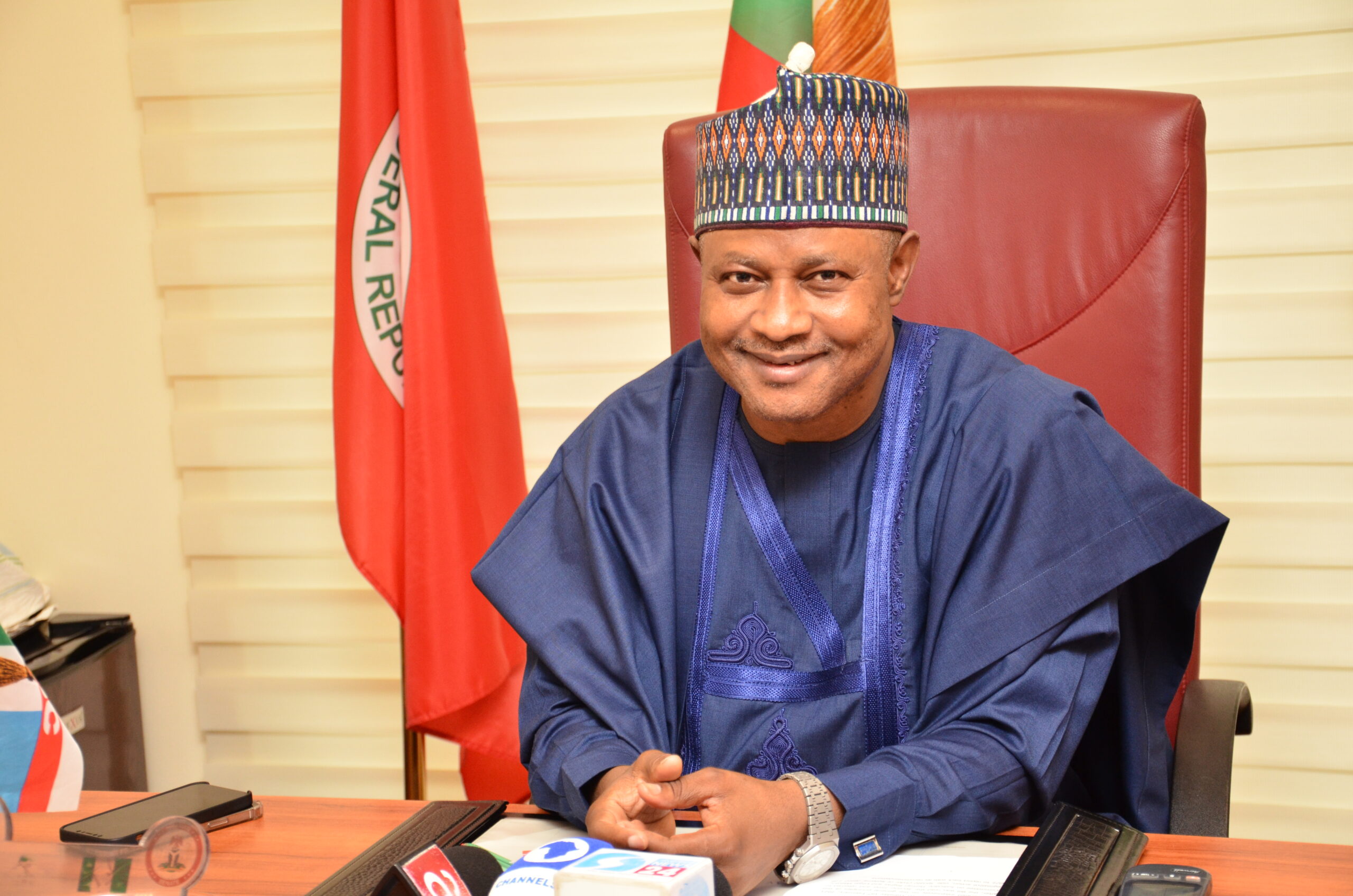
From Agbo Emmanuel, Kaduna
Kaduna State Governor, Uba Sani, has said recent tax reforms have significantly improved Nigeria’s revenue mobilisation, while also boosting the state’s internally generated revenue (IGR).
Sani disclosed this on Wednesday in Kaduna at the 160th meeting of the Joint Revenue Board, themed, “One Year of Tax Reform: Assessing Progress and Addressing Challenges.
”The governor said Nigeria’s revenue increased from about N10.1 trillion in 2023 to N21.6 trillion in 2024 and N36.8 trillion in 2025.
He added that revenue generated in the first half of 2026 stood at approximately N21.
6 trillion, representing a 49 per cent increase compared with the corresponding period of the previous year.Sani commended President Bola Tinubu for what he described as a bold and politically challenging decision to overhaul Nigeria’s tax system through landmark legislation, including the Act that transformed the former Joint Tax Board into the Joint Revenue Board.
According to him, the reform reflects the need for a modern, coherent and efficient revenue system capable of supporting economic growth without placing unnecessary constraints on businesses and investment.
He also praised the Chairman of the Nigeria Revenue Service, Zach Adedeji, for his leadership in advancing the tax reform agenda, describing his contribution as a combination of technical competence and a clear understanding of the need to make taxation simpler, fairer and more predictable for taxpayers.
The governor further commended the immediate past Executive Chairman of the Kaduna State Internal Revenue Service (KADIRS), Jerry Adams, and his team for increasing the state’s monthly IGR from barely N4 billion to N10 billion.
Sani said the improved revenue figures should not be viewed merely as fiscal statistics, but as evidence of Nigeria’s growing capacity to finance development through domestic resources.
He explained that the tax reforms were designed to simplify the country’s complex tax environment, reduce multiple and overlapping taxation, deploy technology and e-invoicing to curb leakages, strengthen revenue administration and rebuild trust between government and taxpayers.
The governor stressed that sustainable taxation must be based on fairness, transparency, predictability and trust rather than coercion.
He said taxpayers were more likely to comply when their obligations were clear, the system was easy to navigate and they had confidence that public funds were being responsibly utilised.
“ The objective, therefore, should not simply be to collect more revenue. It should be to build a tax system in which compliance becomes easier, enforcement becomes more intelligent and voluntary participation becomes the norm rather than the exception,” he said.
Sani said Kaduna State had adopted the same approach through investments in technology-driven revenue collection, professional training for revenue officials and stronger taxpayer education and engagement.
He added that the state’s goal was not only to increase revenue but also to create a broader, fairer, more efficient and sustainable revenue system.
“We seek to expand the tax base rather than continually place a heavier burden on the same compliant taxpayers. We seek to make compliance easier and enforcement more intelligent, targeted and transparent,” he said.
The governor maintained that the state ultimately sought to build a relationship with taxpayers based on clarity, fairness and mutual responsibility rather than fear, stressing that the institutional framework created by the new tax reforms would be critical to achieving that objective.
The African Democratic Congress (ADC) has inaugurated a national reconciliation and peace committee to strengthen unity, rebuild trust and resolve grievances ahead of 2027.
National Chairman of ADC, Sen. David Mark who performed the inauguration on Wednesday in Abuja named Sen.
Tunde Ogbeha as Chairman, Prof. Oserheimen Osunbor, South-South, Deputy chairman, Dr Ahmad Ajuji (North-East), member and Musa Elayo (North-Central), member among others.Mark described the reconciliation as essential, saying it is to ensure every ADC member felt valued and carried along.
He said the ADC was founded on democracy, inclusion, justice, consultation and its handshake philosophy, which encouraged members to build bridges across political differences.
“Our recently concluded primaries produced winners, but they also produced disappointments and grievances. These are realities we must acknowledge and address clearly today,” he said.
He said an election might determine the party’s flag bearers, but should never determine who belonged to the party or remained valuable members.
“Those who did not emerge victorious still remain valuable members of the ADC. Their experience, networks, structures and commitment remain important assets,” Mark added.
He urged successful aspirants to recognise that victory came with responsibility, stressing that it was not a licence to exclude, humiliate or marginalise other members.
Mark said the party’s major challenge was building a united political platform capable of winning Nigerians’ confidence, rather than fighting members who contested against others.
The committee’s terms of reference according to Mark included engaging aspirants, candidates, leaders and stakeholders in constructive dialogue to identify grievances, address legitimate concerns and rebuild trust fully.
“I expect the committee to discharge this responsibility with fairness, neutrality, maturity, sincerity and confidentiality. Everyone must support this reconciliation process wholeheartedly,” he said.
He appealed to all leaders, state chairmen, zonal coordinators, candidates, aspirants and elected representatives to become ambassadors of reconciliation and reject internal sabotage and revenge.
He said the 2027 general elections would require a disciplined, coordinated and united ADC, adding that the party could not approach the polls.
“The ADC is bigger than any individual, aspirant, candidate or office. Our Handshake Philosophy requires us to reach across differences and build bridges,” he said.
He called on aggrieved members to give reconciliation a chance, candidates to extend fellowship, unsuccessful aspirants to remain committed, and leaders to lead by example.
Mark charged committee members to build bridges, heal wounds, restore confidence and unite members, urging them to work together for the country and its people.
In his acceptance speech, Ogbeha said he recognised the enormous responsibility before the committee and would do everything humanly possible to achieve the objectives.
“Our members must sacrifice and put Nigeria first, then the party and personal interests, because the 2027 election offers another opportunity for collective success.
Ogbeha assured the party leadership that they would uphold the oath with honesty, transparency, diligence and fear of God while pursuing justice, reconciliation, peace and unity



A Birthday Tribute to His Excellency Senator Kashim Shettima, Vice President of The Federal Republic Of Nigeria
ShareYour Excellency, On behalf of the National Executive Council, National Executive Committee and the entire membership of the Alumni Association...

Tax Reforms: Kaduna IGR Hits N10bn Monthly — Uba Sani
ShareFrom Agbo Emmanuel, Kaduna Kaduna State Governor, Uba Sani, has said recent tax reforms have significantly improved Nigeria’s revenue mobilisation,...


ADC Inaugurates Reconciliation Committee, Seeks Unity Ahead 2027
ShareThe African Democratic Congress (ADC) has inaugurated a national reconciliation and peace committee to strengthen unity, rebuild trust and resolve...

Akpabio Celebrates Shettima at 60
SharePresident of the Senate, Godswill Akpabio has felicitated Vice President Kashim Shettima on the occasion of his 60th birthday. Akpabio...


2027 Election: CAN Warns Politicians, Supporters to Leave ‘Jesus’ out of Political Struggles
ShareBy Laide Akinboade, Abuja The Christian Association of Nigeria (CAN), on Wednesday, warned politicians, and their supporters against dragging the...


NSCDC Arrests Two Armed Suspects for Terrorizing Legitimate Miners in Cross River
Share From Ene Asuquo, Calabar The Nigeria Security and Civil Defence Corps (NSCDC), Cross River State has disclosed that the command...

2027: Wike Raises the Alarm Over APC Govs, Backs Tinubu
ShareBy Laide Akinboade, Abuja The Federal Capital Territory (FCT) Minister, Nyesom Wike, has accused some governors of the All Progressives...

PFIPC Scandal: Reps Trace 58 Accounts to ‘Fake Agency’
ShareBy David Torough, Abuja The House of Representatives ad hoc committee investigating the purported Presidential Foreign Investment Promotion Council (PFIPC)...


10 Years. N1.2bn. 40+ Tertiary Institutions by 2026. OPay Is Here to Stay
ShareFor a Nigerian student, a scholarship can mean more than money. It can mean staying in school when a family...


NCS Sets Physical Screening for 2024/2025 Recruitment, Warns Candidates Against Absence
ShareBy Tambaya Julius, Abuja The Nigeria Customs Service (NCS) has fixed physical screening and documentation for successful candidates shortlisted in...