
economy
Zulum Presents N234.8bn Budget for 2023


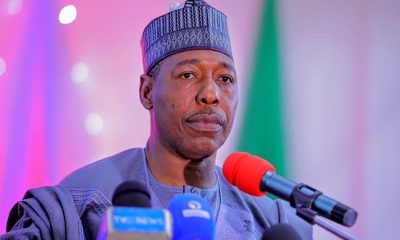
Gov. Babagana Zulum of Borno on Wednesday presented N234.8 billion budget for 2023 fiscal year to the State House of Assembly.
The budget tagged: “Budget of Continuity for Sustainabilty,” is N34 billion lower than N267.
9 billion for 2022.Presenting the budget, Zulum said it was made up of N144.
1 billion capital expenditure and N90. 6 recurrent expenditure.He said the budget would be financed through N137.8 billion Recurrent Revenue; N33.1 billion Internally Generated Revenue (IGR), Value Added Tax of N30.1 billion, other Federation Account sources of N6.
5 billion, and Capital Receipts of N95.6 billion comprising loans and grants.“The 2023 budget like the 2022 shall be based on the Federal Government Fiscal forecast for 2023 to 2025 Medium Term Expenditure Framework which is already domesticated for the first time in the state through your support recently.
“The 2023 budget shall, therefore, be facilitated by enhanced Internally Generated Revenue (IGR) as projected,” he said.
Major highlight of the budget showed that the Ministry of Finance got the lion share of N30.3 billion followed by education with N28 billionn and N25 billion for works.
More than N19.9 billion has been allocated to Ministry of Health and N19.6 billion for Ministry of Reconstruction, Rehabilitation and Resettlement.
The Speaker, Alhaji Abdulkarim Lawan described the budget as “all inclusive”, and captured all peculiar needs of the people of the state.
Lawan said the House would ensure speedy passage of the bill, and tasks Ministries, Departments and Agencies to accord maximum cooperation to its committees during their budget defences.
“The Honourable House will accord the processing and passage of the budget proposal bill the urgency it deserve to enable your administration to start implementing it in January,” he said. (NAN)(www.nannews.ng)






By Tony Obiechina, Abuja
A committee of the Revenue Mobilisation, Allocation and Fiscal Commission (RMAFC) has received Anambra State’s request for N70 billion from the Stabilization Fund. The money would pay for priority projects and other investments in key sectors of the state’s economy.
The Indices and Disbursement Committee heard the state’s presentation at a technical session at the Commission’s headquarters in Abuja on Tuesday, 20th October 2026.
The request covers security, environmental management, infrastructure, healthcare, education, agriculture, solid minerals and tourism.The committee chairman, who is also the Commissioner representing Lagos State, Prof. Olusegun Adekunle Wright, praised the Anambra government for bringing its financial challenges before the committee. He explained that the Stabilization Fund is meant to help states in genuine need, but only within set rules.
In a statement issued on Wednesday by the Head of the Commission’s Information and Public Relations Unit, Hajia Umar Maryam Yusuf, Prof. Wright said the Fund is “an important fiscal intervention mechanism intended to provide assistance in deserving circumstances, subject to established guidelines, availability of resources and the appropriate approval processes.”
He made it clear that the session does not mean the money has been approved. The technical review, he said, “did not constitute automatic approval.” The request remains open to further checks and possible recommendations to the full Commission, known as the plenary.
Wright said the Commission’s rules require any state seeking money from the Fund to first make a formal presentation. Only after that can officials visit the state to inspect the proposed projects on the ground. The committee will check whether the state’s financial records can be trusted, whether the projects are workable and their costs reasonable, what is needed to carry them out, and what benefits ordinary people in the state will get.
Representing Anambra, the Secretary to the State Government, Chiamaka Nnake, described the state’s economy, its income, its spending pressures and its development plans.
She said Anambra has 21 local government areas and 179 communities. It has an estimated 8.9 million people, a gross domestic product of about $12.7 billion and a projected 2026 budget of ₦766 billion.
Nnake said the state has raised its internally generated revenue from about ₦2.2 billion to about ₦7.2 billion. She said its economy is driven by the commercial and industrial centres of Awka, Onitsha and Nnewi, as well as its oil-producing areas.
She named insecurity, erosion, flooding, inflation and the rising cost of public services as the main pressures on the state’s finances. Sit-at-home orders and restrictions on movement, she said, have disrupted business, reduced government income and made investors less confident.
On the erosion ravaging the state, she said Anambra has more than 1,000 erosion sites, with 146 communities affected to varying degrees. She estimated that about ₦170 billion would be needed to fix the most serious sites. That is more than twice the ₦70 billion being requested. She listed work already going on, including erosion control, flood management, road repairs, land reclamation, clearing of waterways and tree planting. The state has also restricted sand mining near vulnerable areas. She asked for more resources to protect communities and key infrastructure.
On security, Nnake said the state has passed a Homeland Security Law, set up a state security outfit and works with a joint task force. She said extra funds would buy patrol vehicles, surveillance and communication equipment, and pay for staff training and better coordination. This, she said, would protect lives and property, bring back investor confidence and revive economic activity.
On health, she said the state’s free antenatal care and delivery programme has supported more than 206,000 deliveries, including 642 Caesarean sections, at no cost to the women involved. In education, she said the state has recruited 8,415 teachers and introduced free education from nursery to Senior Secondary School Three.
She said these programmes have raised the demand for doctors and nurses, equipment, medicines, classrooms and learning materials. The state must therefore keep spending to maintain quality and reach more people.
Nnake described agriculture as a major chance for the state to earn from more than one source. She said it has given out more than 2.3 million coconut and oil-palm seedlings. She called for investment in processing, storage, irrigation, cold-chain facilities and market access, so that farmers produce more, lose less after harvest and create jobs.
She also pointed to the state’s minerals, which include kaolin, bentonite, lignite, silica sand, gypsum and laterite, along with oil-related opportunities. To attract investors, she said, the state needs geological surveys, processing plants and supporting infrastructure.
On tourism, she cited Agulu Lake and other natural and heritage sites. Better access roads, visitor facilities and supporting infrastructure, she said, would make the state a more attractive destination and bring jobs, investment and income.
Concluding, she repeated the request for ₦70 billion. The money, she said, would add to what the government is already spending, keep essential services running, protect livelihoods, improve investor confidence and help build a stronger economy that does not depend on one source of income.
In his closing remarks, the Commissioner representing Anambra State, Dr. Enefe Ekene, thanked the committee chairman for presiding. He also thanked fellow commissioners for their patience and sharp observations, and the committee secretariat for its guidance.
He said the observations made at the session would help the Anambra delegation improve its presentation before the planned visit to the state. He said he was hopeful the engagement would produce good results.
The committee said its decision would depend on the financial documents supplied, the feasibility of the projects, their costs, what is needed to carry them out and the expected benefits. It added that any recommendation would still be subject to further checks and the proper procedures.
The Abuja Electricity Distribution Company (AEDC) says it is committed to settling all legitimate allowances owed staff.
The company’s Managing Director, Mr Chijioke Okwuokenye, said this in a statement in Abuja on Thursday following a threat from the workers to shutdown the operations of the establishment.
The threat notice was given by the two labour unions in electricity supply industry, the National Union of Electricity Employees (NUEE) and the Senior Staff Association of Electricity and Allied Companies (SSAEAC).
The unions had respectively resolved to resume their earlier suspended strike over non-implementation of agreements reached with the AEDC since Nov.
5 and Nov 7, 2024.The unions threatened to resume the suspended action over non-remittance of pension deductions for 16 months, non-implementation of the national minimum wage.
They also cited non-promotion and the continuous stagnation of members of staff for over 10 years, non-confirmation of staff on acting appointment, non-regularisation and proper placement of appointments amongst others.
Okwuokenye said that management had been engaging constructively with the union representatives regarding the notice of industrial action.
”We are committed to ensuring that all legitimate allowances owed to staff are settled promptly, subject to our financial processes and regulatory compliance.
”We have already initiated dialogue with the union leadership to address their concerns transparently and to seek a mutually agreeable resolution.
”We are confident that, through continued negotiation and open communication, we will find a way to avert any disruption to our operations and to uphold our commitment to the welfare of our employees, ”he said.
According to him, employees of AEDC are at the heart of all the company does, and their well-being and welfare are paramount to management.(NAN)
By Tony Obiechina Abuja
The Nigeria Sovereign Investment Authority (NSIA) yesterday disclosed that its net assets grew from N156bn in 2013 to N4.35 trillion in 2024.
Similarly, the Authority has remained profitable for 12 consecutive years, leading to cumulative retained earnings of N3.
74 trillion in 2024.Managing Director and Chief Executive Officer of NSIA, Aminu Umar- Sadiq made these disclosures at a media engagement in Abuja, highlighting its audited financial results for the 2024 fiscal year.
According to him, the results underscored the resilience of the authority’s investment strategy and the strength of its earnings, driven by a well-diversified revenue base and robust risk management practices, despite a challenging global macroeconomic and geopolitical environment.
Total operating profits, excluding share of profits from associates and Joint Venture (JV) entities, increased from N1.17 trillion in 2023 to N1.86 trillion in 2024, driven by the strong performance of
NSIA’s diversified investment portfolio, infrastructure assets, gains from foreign exchange movements, and derivative valuations.
In addition, Total Comprehensive Income (TCI), inclusive of share of profits from associates and JV entities, reached N1.89 trillion in 2024, reflecting a 59 per cent increase from N1.18 trillion in 2023.
Core TCI (excluding foreign exchange and derivative valuation gains) rose by 148 per cent to N407.9 billion in 2024 compared to N164.7 billion in 2023, supported by robust returns on financial assets measured at fair value through profit and loss, including collateralised securities, private equity, hedge funds, and Exchange-Traded Funds (ETFs).
Umar-Sadiq said the authority’s outstanding financial performance in 2024 reflected the “strength of our strategic vision, disciplined execution and unwavering commitment to sustainable socio-economic advancement.”
He said, “By leveraging innovation, strategic partnerships and sound risk management, we have not only delivered strong returns but also created value for our stakeholders
“As we move forward, we remain focused on driving economic transformation, expanding opportunities, scaling transformative impact and ensuring long-term prosperity for current and future generations of Nigerians.”
The CEO reaffirmed the authority’s commitment to managing the country’s SWF, and delivering the mandates enshrined in the NSIA Act.
He said NSIA remained poised to continually create long-term value for its stakeholders by delivering excellent risk-adjusted financial results, developing a healthy and well-diversified portfolio of assets and large-scale infrastructure projects, and enhancing the desired social outcomes.
He noted that NSIA was committed to its mandate of prudent management and investment of Nigeria’s sovereign wealth.
“In adherence to its Establishment Act, NSIA prioritises transparency, disclosure, and effective communication with all stakeholders and counterparties,” he said.
He pointed out that in the year under review, a new board, led by Olusegun Ogunsanya as Chairman, was appointed by President Bola Tinubu, in accordance with the provisions of the NSIA Act.
The new board will provide strategic direction and oversight, in addition to playing a pivotal role in critical decision making.
He remarked that under the guidance of the Board, the Authority will retain focus on its primary mandate of creating shared value for all stakeholders based on its continued adoption of corporate governance practices.
“NSIA prides itself an investment institution of the federation established to manage funds in excess of budgeted oil revenues and its mission is to play a pivotal role in driving sustained economic development for the benefit of all Nigerians through building a savings base for the Nigerian people, enhancing the development of the county’s infrastructure, and providing stabilisation support in times of economic misadventure,” he added.




Aba Commercial Smart City Celebrates COO, Mazen Kalassina at 39
ShareBy David Torough, Abuja Aba Commercial Smart City has celebrated its Chief Operating Officer (COO), Engr. Mazen Kalassina, on his...

Rebuilding Public Trust in Government Borrowing: The Case for Scaling Up Sukuk Financing in Nigeria
ShareBy Uche Joe Uwaleke The recent request by President Bola Tinubu to the National Assembly for approval to raise $20.52...

2027: Buba Yakub Mobilises Adamawa Support for Tinubu, APC
ShareFrom Yagana Ali, Yola The Director-General of the Nigerian Technical Aid Corps (NTAC), Rt. Hon. Yusuf Buba Yakub, has called...

2027: FOOG Women Coordinator Urges Nigerians to Support Tinubu’s Re-election Bid
ShareBy Francis Sadhere, Warri Chief (Mrs) Esther Orighomisan Okotie-Eboh, Coordinator of Felix Omagbemi Ogbe Group (FOOG) Women Support Group for...


Troops Neutralise 217 Terrorists, Rescue 349 Kidnap Victims, Arrest 333 Suspects in Oct
ShareBy David Torough, Abuja The Armed Forces of Nigeria (AFN) say troops neutralised 217 terrorists and other criminals, rescued 349...


2027: Tompolo Mobilises Support for Tinubu in Ogun, says Economy Stabilising
ShareThe Grand Patron of the PBAT Door-to-Door Movement, Government Ekpemupolo, has called on the people of Ogun State to massively...

Henry Okeke Commends Mbah for Clearing Pension Arrears in Enugu
ShareBy Raphael Atuu, Abuja Barrister Henry Nnanna Okeke, a member of the Governing Council of Enugu State Polytechnic, Iwollo, has...

2027: ADC Urges ECOWAS to Insist on Credible Elections in Nigeria
ShareThe National Chairman of the African Democratic Congress (ADC), Sen. David Mark, has urged the Economic Community of West African...
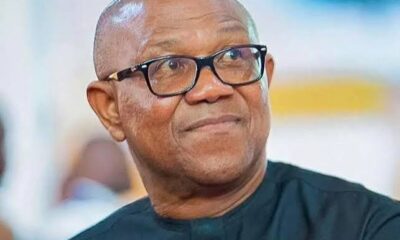

Obi Promises Emergency Measures on Security, Corruption, Poverty
SharePresidential candidate of the Nigeria Democratic Congress (NDC), Peter Obi, has promised emergency measures to tackle insecurity, corruption, hunger and...


Why I Chose Music over Football – Mr Eazi
ShareAfrobeats star Mr Eazi has claimed that English club Chelsea FC wanted to sign him before they signed former Super...