
NEWS
$1bn Arms Fund Went to Defence Ministry, Not Me —Buratai

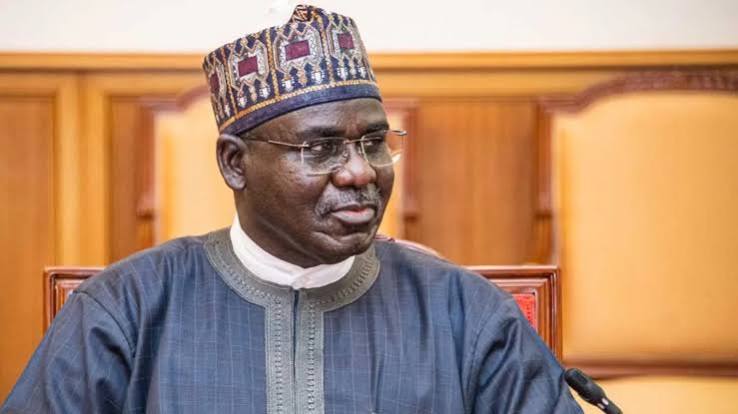
Former Chief of Army Staff, Lt. Gen. Tukur Buratai (retd.), has said the $1bn approved for defence procurement during his tenure as Army Chief was released to the Ministry of Defence.
He said the funds approved by the National Economic Council did not pass through his hands or the accounts of the Nigerian Army, Navy and Air Force.
Speaking at the Defence Correspondents Association of Nigeria conference in Abuja on Monday, Buratai described the allegations surrounding the funds as “political and malicious,” saying they first emerged during the 2019 election period when the opposition alleged that the money had been diverted for electoral purposes.
“The $1 billion was approved by the National Economic Council for defence procurement. Not a single dollar of that fund passed through my hands or through the accounts of the Nigerian Army, Navy, or Air Force. The funds were released to the Ministry of Defence, and the entire procurement process was handled by that ministry.
“The Army, Navy, and Air Force never had a single dollar from that fund to make procurement directives. I have described these allegations as political and malicious. They first surfaced during the 2019 election period, when the opposition alleged the funds had been diverted for electoral purposes-a claim the Federal Government publicly refuted. Yet the stain remained, attached to the Service Chiefs rather than the institution that managed the funds”, Buratai stated.
Buratai said the Federal Government publicly refuted the allegation at the time but lamented that the controversy continued to affect the reputation of service chiefs.
He faulted the ministry for publicly explaining how the funds were disbursed or how contracts were awarded.
“The ministry then, on its own, had not publicly explained how funds were disbursed or contracts awarded. Accountability must be properly located,” he said.
Buratai, however, called for greater transparency in military procurement, recommending the establishment of a defence procurement transparency portal to publish information on contracts awarded, contracting entities and delivery timelines, subject to national security considerations.
“The Ministry of Defence must own procurement records. The $1 billion arms procurement controversy festered because the institution that managed the funds, the Ministry of Defence, remained silent while Service Chiefs absorbed criticism.
“I recommend a Defence Procurement Transparency Portal that publishes, within national security limits, broad categories of contracts awarded, contracting entities, and delivery timelines. When the media asks where the money went, the answer should come from the ministry that spent it, not from military officers who never touched it,” he said.
He further proposed quarterly accountability bulletins summarising court-martial outcomes relating to human rights violations and operational conduct, provided the publications did not compromise the rights of accused personnel or ongoing military operations.
On allegations of human rights violations by members of the Nigerian security forces, Buratai said credible claims should be investigated and, where substantiated, prosecuted.
“I have always maintained that where credible allegations exist, they must be investigated and, where substantiated, prosecuted. The military is not above the law,” he said.
He acknowledged the need for the military to demonstrate that its disciplinary processes were credible, transparent and capable of addressing allegations at all levels.
The retired army chief said improved communication by the military and the Ministry of Defence would help address public concerns and ensure that media reports reflected the full context of security operations.
Speaking earlier, the Minister of Information and National Orientation, Mohammed Idris, said Nigeria’s security challenges cannot be addressed by military force alone, calling for improved intelligence, modern technology and stronger collaboration among security agencies and communities.
Idris, represented by the Director-General of the Voice of Nigeria, Jibrin Ndace, said military operations remained necessary but must be complemented by measures to address the conditions enabling criminal groups to recruit members and threaten the lives and livelihoods of citizens.
“This Conference’s theme is particularly relevant because today’s security threats cannot be addressed by force alone. Military operations remain necessary, but they must be supported by reliable intelligence, modern technology, effective coordination among security agencies and cooperation with communities,” he said.
The minister said President Bola Tinubu’s Renewed Hope Agenda placed national security at the centre of Nigeria’s development, adding that the administration was pursuing the modernisation of the Armed Forces, intelligence-led operations, improved surveillance and stronger coordination among security and intelligence agencies.
He disclosed that Tinubu, in August 2026, directed the preparation of a comprehensive National Threat Assessment and a rolling five-year Strategic Defence Operations Plan to improve coordination, establish priorities and guide the deployment of resources.
“This is an important step towards a more coherent national response to evolving threats,” Idris said.
He also said the President had approved salary increases of between 30 and 80 per cent for Armed Forces personnel, effective September 2026, describing the decision as recognition of the sacrifices made by security personnel.
According to him, security initiatives must translate into tangible improvements in the lives of Nigerians, including safer communities and roads, protection for farmers and businesses, and an environment where children can attend school without fear.
On the role of the media, Idris said accurate reporting and responsible verification were necessary to help citizens understand security developments and prevent rumours from creating panic or undermining military operations. He, however, warned against interpreting responsible reporting as shielding the government or security agencies from scrutiny.
“This does not mean shielding the government or the security agencies from scrutiny. Journalists must keep asking difficult questions and hold institutions accountable, while respecting legitimate operational sensitivities,” he said.
Deputy Medical Director, General Hospital, Apapa, Dr. Ridwan Kekere-Ekun, said high costs of dental materials, equipment and hospital operations limit Nigerians’ access to timely dental care.
Kekere-Ekun, Chief Dental Officer at the hospital, made this known in an interview with the News Agency of Nigeria on Monday.
Kekere-Ekun identified imported dental equipment and materials, whose prices were affected by the naira’s depreciation, as major factors driving up treatment costs.
He added that high energy costs, including petrol and diesel for generators, increased hospitals’ operational expenses, which were transferred to patients through higher bills.
The dentist also attributed the problem to inadequate government funding of hospitals and limited public trust in health insurance schemes.
He said poor insurance coverage forced many Nigerians to pay out-of-pocket for consultations, X-rays, prescriptions and dental treatments.
According to him, financial constraints often prevent patients from completing investigations and recommended procedures, forcing some to abandon treatment or select only one of several planned interventions.
Kekere-Ekun added that delayed treatment could necessitate referrals and specialist reviews, while increasing morbidity and mortality risks.
He said the problem was common among patients visiting his hospital, noting that feedback from patients regularly highlighted the financial difficulties they encountered.
The dentist said some patients moved between dental facilities in search of cheaper and more affordable treatment.
He urged the government to increase funding for dental units and reduce import duties on dental equipment to make services more affordable.
Kekere-Ekun also called for mandatory enrolment in health insurance schemes, supported by adequate public sensitisation, to reduce patients’ out-of-pocket expenditure.
He recommended greater investment in preventive dental care through public education, community outreach, free scaling and polishing, and public-private partnerships.
The dentist further urged the government to expand dental services and reduce hospitals’ energy costs through electricity and diesel subsidies, generator support and solar installations. (NAN)
Maryam Umar, a limb difference student, is set to graduate with a Bachelor of Science degree in Economics from the Gombe State University.
Umar, who successfully completed her Level 400 course work, examinations and project, achieved this feat after overcoming educational and financial challenges.
In an interview on Monday in Gombe, Umar said that the intervention by the Academic Staff Union of the University (ASUU) made her journey to attain university education a reality.
Umar recounted that she started primary education at the age of 11 at Hammadaji Primary School in Gombe metropolis, adding that she could not immediately proceed to secondary school due to challenges.
The foot-writer student later attended Government Day Secondary School, Nasarawo, Gombe, where she obtained a senior school certificate.
“Many people doubted my ability to attend university because of physical and financial challenges.
“Nevertheless; I sat for the Joint Admissions and Matriculation Board (JAMB), and National Examinations Council (NECO) examinations, and passed both, but could not proceed due to lack of sponsorship.
“Apparently, my predicament widely circulated in the national dailies attracted the attention of the ASUU,” she said.
She said that the union visited her family home, verified her educational credentials, and subsequently offered her scholarship.
Umar said that handwriting proved to be a major obstacle because she writes with her toes during lectures, tests and examinations.
“During my first test, I couldn’t finish within the allocated time and reported the matter to the union.
“The ASUU chairman subsequently wrote to my Head of Department, requesting an additional time for me during tests and examinations. The department granted the request and continued to support me throughout my studies,” she said.
Umar also commended her lecturers for their support and understanding.
She recalled that when a journalist visited the university, and inquired about her academic performances, the records rated her as being more punctual than most of the able-bodied students.
Umar also expressed joy over the successful completion of her degree programme without any academic failure.
“I am happy that I am about to graduate. I give God the glory because I have had no problem academically.
“Some students who I started schooling together had withdrawn or dropped out,” she said.
While urging people living with disabilities not to allow their conditions to distract them from pursuing their dreams, Umar enjoined them to shun street begging.
“You should not see begging as the only option. I once begged on the street, but now I am about to achieve my dream of becoming a graduate.” (NAN)
The Cross River State government on Saturday said it had closed down no fewer than 58 schools in Calabar South, Calabar Municipality, Odukpani and Yakurr local government areas of the state.
Commissioner for Education in the state, Professor Stephen Odey, disclosed this in Calabar, the state capital.
According to him, the ministry’s Department of Quality Assurance has intensified crackdown on schools operating without Approval To Operate (ATO) across the state.
He noted that the exercise was part of the state’s ongoing efforts to sanitise the education sector, enforce compliance with established regulations and ensure acceptable standards for teaching and learning.
The commissioner further explained that the exercise was aimed at protecting learners and ensuring that schools operated in safe, conducive and properly regulated environments.
Odey stressed that the government would not compromise the standards required for operating educational institutions in the state.
The commissioner explained that the exercise was not intended to witchhunt school proprietors, but rather, ensure that all schools met the prescribed minimal requirements for establishing and managing educational institutions.
He urged proprietors of unapproved schools to regularise their operations by obtaining the necessary approval, warning that any school sealed by the government and reopened without authorisation would face appropriate sanctions.
According to him, the enforcement exercise will continue across the state’s 18 local government areas, until the objectives of the sector’s ongoing cleanup are achieved.


High Cost of Dental Care Limits Access to Treatment in Nigeria — Dentist
ShareDeputy Medical Director, General Hospital, Apapa, Dr. Ridwan Kekere-Ekun, said high costs of dental materials, equipment and hospital operations limit...

$1bn Arms Fund Went to Defence Ministry, Not Me —Buratai
ShareFormer Chief of Army Staff, Lt. Gen. Tukur Buratai (retd.), has said the $1bn approved for defence procurement during his...


Oyo Police Arrest 11 Suspects over Alleged Cultism, Armed Robbery
ShareThe Police Command in Oyo State has arrested 11 suspects over alleged cultism, armed robbery and unlawful possession of firearms...

Lawyer Seeks Transfer of Wike’s son’s $2.1m Suit over Bias Concerns
ShareCounsel to Safwan Garba GY and GY Global Oil and Gas Nigeria Limited, Ibrahim Waru, has asked the Chief Judge...


TikTok Denies Restricting Access in Northern Nigeria
ShareSocial media platform, TikTok said it did not restrict access to its network in Northern parts of Nigeria. TikTok’s Head...
Abeokuta FMC Workers Begin 72-hour Warning Strike over Staff Assault
ShareWorkers union at the Federal Medical Centre (FMC), Idi-Aba, Abeokuta, on Monday began a 72-hour warning strike over an alleged...


PHED Explains Higher Electricity Bills after Feeder Upgrades
ShareThe Port Harcourt Distribution Company (PHED) has attributed rising electricity bills being borne by some customers to feeder upgrades designed...
CJN Warns Judges Against Romancing with Politicians in Dispute Resolution
ShareThe Chief Justice of Nigeria (CJN) Justice Kudirat Kekere-Ekun has warned judges against romancing with political parties in the resolution...
ASUU Sponsor My Education – Student
ShareMaryam Umar, a limb difference student, is set to graduate with a Bachelor of Science degree in Economics from the...
C’River Shuts 58 Unapproved Schools in Four LGs
ShareThe Cross River State government on Saturday said it had closed down no fewer than 58 schools in Calabar South,...