
NEWS
2026 International Democracy Day: Group Tasks NASS on Special Seat Bill


By Laide Akinboade, Abuja
League of Women Voters
of Nigeria (NILOWV) on Tuesday, tasks the National Assembly on the quick passage of Special Seat bill for women and people with disability.
The President of NILOWV, Hon.
Irene Awunah-Ikyegh, stated this while briefing the media in commemoration of 2026 International day of Democracy, in Abuja.She lamented that no nation can claim to leave a lasting democratic legacy without it’s commitment to inclusive democracy that include women and people with disabilities.
She there begged NASS not to waste the opportunity but to make history, the opportunity to tell the daughters of
Nigeria that Parliament sees them, the opportunity to tell young women that their political aspirations
are legitimate, the opportunity to strengthen our democracy.
She said, “The Special Seats Bill presents an opportunity to leave a lasting democratic legacy. The question is not
whether Nigerian women are asking for too much. The question is whether Nigeria can continue to
claim that it is committed to inclusive democracy while women remain so dramatically
underrepresented.
“You have the opportunity to make history, the opportunity to tell the daughters of
Nigeria that Parliament sees them, the opportunity to tell young women that their political aspirations
are legitimate, the opportunity to strengthen our democracy. Please, do not waste this opportunity”.
She noted that, “This day is not merely a day for speeches, ceremonies and declarations. It is a day for reflection. It is a day to ask difficult questions. It is a day to examine whether the democracy we practise truly reflects the aspirations of the people. It is a day to ask whether every citizen has a meaningful opportunity to participate. It is a day to ask whether our institutions are working. It is a day to ask whether our political
parties are truly democratic. And, most importantly for us at NILOWV, it is a day to ask whether Nigerian women who constitute approximately half of our population are being given a fair and meaningful opportunity to participate in political leadership and decision-making”.
She lamented, “The final list of National Assembly candidates provides us with a sobering picture. There are 4,408
candidates contesting for seats in the Senate and House of Representatives. Of this number: 3,965 are
men while only 443 are women. Women therefore constitute approximately 10 percent of the candidates, while men constitute approximately 90 percent. This means that, for roughly every one
woman appearing on the National Assembly ballot, there are about nine men.
“These figures are more than statistics they represent the continuing imbalance in access to political power. They tell us that although Nigerian women are participating in the political process, the pathway from participation to actual political power remains extremely difficult and this is where we must
distinguish between participation and representation.
“Women may constitute a large proportion of voters Women may attend political meetings. Women may
mobilise communities. Women may campaign tirelessly. Women may provide food, logistics and
grassroots structures during elections.
“Women may even constitute the majority of volunteers in some
political activities but when it comes to the point at which tickets are allocated, resources are distributed and candidates are selected for elective office, the numbers suddenly collapse.
“That is the problem Women are often visible in political mobilisation but invisible in political power that
is not equality that is not inclusion and that is not the democracy Nigeria should be proud of” .
She decries, “We must humanise these figures. Behind the 443 women on the ballot are hundreds of Nigerian women
who have decided that they are ready to serve but behind the thousands of women who are not on the
ballot are also stories. There is the woman who wanted to contest but could not afford the nomination
and expression-of-interest fees. There is the woman who had the qualifications but lacked the political
godfather.
“There is the woman whose party told her to wait. There is the woman who was encouraged to contest but later discovered that the ticket had already
been informally allocated. There is the woman who was told that she could serve better as a campaign
mobiliser than as a candidate. There is the woman who was warned that politics is too dangerous for
her.
“There is the woman who was threatened. There is the woman who was sexually harassed. There is
the woman who was subjected to online abuse.There is the woman who was told that she was too ambitious. There is the woman whose competence
was questioned simply because she is a woman and there are women who have watched all these
experiences and quietly concluded:
“Perhaps politics is not for people like me.”
She therefore concluded by urging every Nigerian not to give up on democracy, ‘Instead, demand a better democracy.
Democracy belongs to citizens. If we withdraw, others will’.
The Abia Government has elevated selected cultural and natural sites to state heritage and monuments as part of efforts to position them for recognition as UNESCO World Heritage Sites.
Commissioner for Information, Okey Kanu, said this while briefing newsmen on the outcome of the State Executive Council meeting on Monday in Umuahia.
Kanu said the State Executive Council had approved the declaration of selected heritage and natural sites as state heritage and monuments to strengthen their preservation and promotion.
He said the approved sites included the National War Museum, Ojukwu Bunker and Government College, all in Umuahia, as state monuments.
He also listed the Ibom Waterfall in Arochukwu and Ulochukwu Caves at Alayi Bende as state natural monuments.
According to him, the elevation of the sites would enhance their tourism potential and position them for possible recognition as UNESCO heritage sites.
Kanu also announced the designation of Aba as a Creative and Innovative City, saying the move was part of efforts to promote the state’s cultural, creative and tourism potential.
He further said that the retrofitting of the Ojukwu Bunker and National War Museum had reached about 80 per cent completion and was expected to be completed before the end of 2026.
The commissioner said that the projects, when completed, would enhance the preservation and historical value of the sites, improve visitor experience and increase their tourism potential.
Kanu said the Ministry of Arts, Culture and Creative Economy had commenced the development of the Ibom Waterfall Tourism Corridor in Arochukwu.
He said that initial development works, including the grading of access roads to the waterfall, had commenced, adding that the project was expected to be completed before the end of 2026.
According to him, the project is expected to unlock additional tourism and economic opportunities in the state.
He said that the ministry had also commenced the erection of monuments at strategic locations across the state to preserve Abia’s heritage and honour its heroes and heroines.
Kanu said one of the monuments would honour the heroines of the 1929 Aba Women’s Uprising, celebrating their courage, resilience, resistance and leadership.
The commissioner said that the initiatives reflected the state government’s broader efforts to preserve its historical and cultural assets while using them to drive tourism and economic development.
On tax rates in the state, Kanu said the rates being circulated were not new, adding that most dated back to 2020 and were introduced by the previous administration.
He said that the Abia Board of Internal Revenue could not increase tax rates without enabling laws and that no such increase had been introduced by the board.
Kanu also dismissed reports that an akara seller was paying N50, 000 in tax, describing the claim as false.
“Akara sellers don’t pay tax or levies, they pay daily tolls, and none can pay as high as N50, 000,” he said.
On gratuity payments, Kanu said that the state government had paid the batch covering 2001 to 2010, while preparations covering 2011 to 2025 were being processed.
He dismissed claims that the government was compelled by the opposition to commence gratuity payments, describing the narrative as misleading.
He explained that the government had incorporated gratuity provisions into its 2026 to 2030 Medium-Term Expenditure Framework to ensure that future arrears did not accumulate.
“This does not translate to the payments being terminated in 2031.
“So, as soon as the internal processes are done with, these payments will continue at pace and in batches,” Kanu said.(NAN)

The Transmission Company of Nigeria (TCN) has announced an annual preventive maintenance of its 330/132 Kilo Volt (kV) at Ajaokuta Transmission Substation.
It said that the maintenance was scheduled to take place on Tuesday from 9am to 4pm.
The management of the company announced this on its X handle in Abuja on Tuesday.
According to TCN, the exercise will enable its crew to carry out preventive maintenance on the 162 MegaVolt Ampree (MVA), 330/132kV power transformer, associated switchgear and ancillary equipment in the substation.
It said that the Abuja Electricity Distribution Company (AEDC) would be unable to off-take electricity to its customers in Ekirin, Omuo, Ibillo, Akoko, Ogala, Ikare, Magongo, Okene Town, Ayere, Kabba and environs during the period.
”Similarly, Benin Electricity Distribution Company (BEDC) will be unable to off-take electricity to its customers in Okpella Town, BUA Cement Company, West African Fertiliser Company, Dibeks Milling Company, and Edestein Company.
”Other areas to be affected include the Freedom Group Company, Ososo, Uluoke, Iyora, Apana, Okpekpe, Arigidi, Ikare Town, Lampese, Igara, Oka and environs,” it said.
The company said that power supply would be restored to the affected areas upon completion of the exercise.
It also apologised for the inconvenience the planned maintenance would cause affected electricity customers, and appreciated their understanding and cooperation.(NAN)
By Tom Chiahemen
Sometimes, a controversy that appears to be about one thing is really about something else.
Former Anambra State governor and 2027 presidential candidate of the Nigerian Democratic Congress (NDC), Peter Obi, may have set out for Benue last week with the relatively simple intention of commiserating with victims of the Yelwata massacre, where more than 200 people were reportedly killed.
Yet, before he could reach his destination, the aborted visit had produced two very different but equally important conversations.The first was about the alleged obstruction of his movement in Makurdi and the larger question of whether any Nigerian, much less a presidential candidate, should be prevented from entering a part of the country for legitimate political or humanitarian purposes.
The second—and the one that interests me more as a student and practitioner of journalism, media and public relations—was the unexpected debate over who speaks for a government.
More specifically: where does the responsibility of a Governor’s Chief Press Secretary end and that of a Commissioner for Information begin?
At first glance, this may appear to be an argument over nomenclature, protocol or bureaucratic hierarchy. It is, however, much more profound than that. It goes to the heart of government communication, reputation management, public trust and crisis communication.
The reported disagreement between Benue’s Commissioner for Information, Solomon Iorpev, and the Governor’s Chief Press Secretary, Tersoo Kula, over who had the right to comment on Peter Obi’s visit has therefore presented an unusual opportunity to examine a question that is often misunderstood in government: when two officials are responsible for communicating government, who actually speaks for the government?
My interest in the matter is not merely academic.
Although I have spent more than three decades in Journalism, Media and Public Relations, I have never served as Commissioner for Information or as a Chief Press Secretary. I have therefore resisted the temptation to pronounce myself an authority on a matter that is best illuminated by those who have actually occupied the offices.
I reached out to a number of eminent Benue sons who have served in those positions and also considered the views of other informed commentators.
The answers are revealing.
Chief John Omanchi, who served as Chief Press Secretary to the then Military Governor of Benue State, Lt. Col. Ishaya Bakut, at a time when Rev. Tor Ujah was Commissioner for Information, put the matter rather bluntly: there should be no clash of responsibilities between the two offices. In his view, where such friction exists, it could simply amount to a contest for power.
That observation takes us to the heart of the matter.
In public communication, power is rarely neutral.
Who gets to speak? Who gets the headline? Whose statement becomes the official position? Who enjoys the Governor’s confidence? And who is seen by the public as the authentic voice of the administration?
These may look like professional questions, but they can quickly become questions of ego and political influence.
Dr. Cletus Akwaya, who served both as Commissioner for Information and as Special Adviser/Governor’s Chief Spokesperson at different times over a period of 10 years, offers perhaps the most practical lesson.
According to him, when necessary, the two offices met, jointly drafted statements and determined who should speak first and who should follow up. In other words, the issue was never who was more important; it was who was better positioned to communicate a particular message at a particular time.
That is a profoundly important distinction.
Good government communication is not a competition for visibility. It is a coordinated effort to ensure that the public receives the right message from the right messenger at the right time.
Chief Tahav Agerzua, who served at various times as Chief Press Secretary, Special Adviser and Principal Special Assistant to the Governor, similarly recalled a structure in which the Commissioner for Information had statutory responsibility for the government’s information machinery, while the CPS managed the Governor’s reputation and the Government House press corps.
The distinction, as he remembered it, was clear: the Commissioner spoke for the government; the CPS spoke for or about the Governor.
That distinction is perhaps the most useful starting point in understanding the controversy.
The Commissioner for Information is a member of the State Executive Council and has responsibility for the Ministry of Information and the state’s information agencies. The CPS, on the other hand, is fundamentally an appointee of the Governor, serving the Governor’s office and managing the Governor’s media relations.
But there is an important caveat.
Government is not a collection of isolated voices.
Chief Press Secretaries, Commissioners, Special Advisers, Senior Special Assistants and other media officers may have different briefs, but they ultimately serve one administration. Consequently, the existence of different communication offices should not produce different versions of government.
Dr. Justine Amase, who served as Commissioner for Information and Orientation during the administration of Governor Gabriel Suswam, reinforces this point.
He explained that the CPS’s primary mandate was to speak directly for the Governor and the Governor’s office, while the Commissioner was responsible for the government’s official information and public communication machinery.
Yet the relationship between the two offices, he recalled, was maintained through a “dotted reporting line” that enabled them to discuss issues, align positions and reach agreement before going to the press.
That arrangement worked because neither office regarded coordination as a surrender of authority.
Indeed, Dr. Amase’s recollection of the successful hosting of the Radio Nigeria annual conference is instructive. When the Governor determined that the event should be handled by the Commissioner because it was a State Government event rather than an event of the Governor’s office, Dr. Akwaya willingly handed over the responsibility and supported the Commissioner.
There was no war over territory.
There was simply an understanding that the interest of the institution was greater than the ego of the individual.
That is precisely where the larger lesson lies.
Dr. Terver Akase, who served as Special Adviser on Media and Publicity, Chief Press Secretary and Senior Special Assistant on Media to Governor Samuel Ortom, also draws a distinction between the two offices. In his experience, the Commissioner is a member of the cabinet and has responsibility for government information, while the CPS is primarily concerned with the Governor’s media relations.
But he adds something even more important: the relationship must be symbiotic and cordial.
If the Commissioner is speaking on a matter of state policy, the CPS needs to know. If the CPS is communicating the Governor’s position, the Commissioner needs to understand the context. Otherwise, two officials can unintentionally begin speaking about the same matter from different positions.
And once that happens, the government has a problem.
Not merely a communication problem.
A credibility problem.
This is why Akase’s insistence that “the government needs to speak with one voice” deserves serious consideration.
Samuel Zenke, while agreeing that the Commissioner has broader responsibility for the state’s information policy and communication of government programmes, makes an equally important point: the CPS is not domiciled in the Ministry of Information and is not automatically subordinate to the Commissioner simply because both offices deal with information and the media.
This is where a mature understanding of institutional roles becomes indispensable.
Different does not necessarily mean superior.
The CPS and Commissioner may have different reporting lines, different mandates and different constituencies. That does not mean they should become rival centres of communication.
If anything, the more complex a government’s communication architecture becomes, the greater the need for coordination.
This brings me back to the Peter Obi controversy.
Dr. Amase makes an important distinction between the April 2025 episode involving Obi and the current September 2026 controversy.
In the earlier incident, he recalled, Governor Hyacinth Alia had taken a personal and public position on Obi’s visit and directed the CPS to communicate that position. The communication responsibility was therefore clearly located within the Governor’s office.
The current situation, however, is different, at least from the facts presented. There has not been sufficient evidence establishing that Governor Alia personally directed the alleged obstruction of Obi or that he directly participated in the actions of the thugs.
That distinction matters.
Where the Governor has taken a personal position, the CPS is naturally central to communicating that position. But where the matter concerns the actions or position of the State Government as an institution, the Commissioner for Information has a legitimate and broader responsibility.
The tragedy, therefore, is that what should have been a coordinated communication response appears to have become another story altogether: a story about the communicators themselves.
And that is dangerous.
In crisis communication, the moment the public begins discussing the disagreement among the people managing the crisis rather than the crisis itself, the communication machinery has already lost part of the battle.
Iorliam Shima perhaps captures this most appropriately in describing the Peter Obi episode as one of the most challenging public-relations moments since the beginning of the Alia administration.
At such a moment, he argues, the government’s communication machinery ought to have been focused, disciplined, coordinated and strategic—with every member of the media team concentrating on defending the government’s image, clarifying its position and managing the backlash.
That is the essence of professional public relations.
The first casualty of a divided communication team is often the reputation of the institution it is supposed to protect.
Government is entitled to defend itself. It is entitled to correct misinformation. It is entitled to explain its actions and challenge allegations against it.
But the effectiveness of that defence depends greatly on the credibility, consistency and coherence of the messenger.
A government that speaks through competing voices risks creating three versions of reality: what happened, what one official says happened and what another official says happened.
The public, naturally, begins to ask: Who should we believe?
And once that question takes root, rebuilding trust becomes considerably more difficult.
This is why the apparent controversy between Benue’s CPS and Commissioner for Information should not be dismissed as merely another quarrel among political appointees.
It offers Governor Hyacinth Alia and his administration an opportunity to revisit their communication architecture and clarify, once and for all, the responsibilities of the various offices involved in public communication.
There is nothing unusual about having several communication officers. Modern governments everywhere require specialists in strategic communication, media relations, public enlightenment, digital communication, crisis communication and reputation management.
What is unusual—and potentially destructive—is allowing those specialists to operate as competing voices.
The ultimate lesson from the experiences shared by these former Benue government officials is remarkably simple:
The CPS does not have to become the Commissioner, and the Commissioner does not have to become the CPS. What both must become is a coordinated communication team.
The Governor does not need multiple voices competing for ownership of his message. The government does not need multiple officials competing to demonstrate who is more powerful.
What it needs is something much less glamorous but far more valuable: clarity of roles, mutual respect, professional discipline and a shared understanding that public communication is ultimately about the institution—not the communicator.
After all, the microphone may belong to the individual at the podium.
But the voice belongs to the government.
And when that voice begins to sound divided, the public does not merely hear disagreement among officials.
It hears uncertainty at the heart of government.




2026 International Democracy Day: Group Tasks NASS on Special Seat Bill
ShareBy Laide Akinboade, Abuja League of Women Votersof Nigeria (NILOWV) on Tuesday, tasks the National Assembly on the quick passage...


Abia Targets UNESCO Recognition of Heritage Sites
ShareThe Abia Government has elevated selected cultural and natural sites to state heritage and monuments as part of efforts to...


TCN Announces Annual Maintenance at Ajaokuta Transmission Substation
ShareThe Transmission Company of Nigeria (TCN) has announced an annual preventive maintenance of its 330/132 Kilo Volt (kV) at Ajaokuta...
When Government has Too Many Voices: The Benue lesson in Power, PR and Public Trust
ShareBy Tom Chiahemen Sometimes, a controversy that appears to be about one thing is really about something else. Former Anambra...
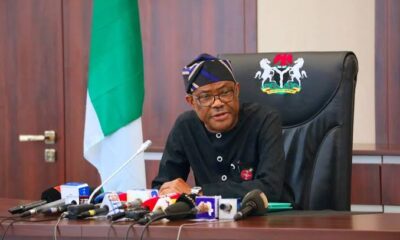

2027: My Support Only for Tinubu Re-election, not APC – Wike
ShareBy Laide Akinboade, Abuja The Federal Capital Territory (FCT) Minister, Nyesom Wike, has reiterated that his support for the reelection...

INEC, African Union Strengthen Electoral Partnership Ahead of 2027 General Elections
ShareBy David Torough, Abuja The Independent National Electoral Commission (INEC) has strengthened its engagement with the African Union (AU) ahead...


NEMA Begins Flood Simulation Exercise for Multi-Stakeholder Preparedness in Benue
ShareFrom Attah Ede, Makurdi In a bid to mitigate the impact of flooding, the National Emergency Management Agency (NEMA) in...

Release My Academic Records, Obi Tells UNN, Other Institutions
SharePresidential candidate of Nigeria Democratic Congress (NDC), Peter Obi, has authorised University of Nigeria, Nsukka (UNN) and other academic institutions...


Dangote IPO: A Caution for Short Term Investors amid the Hype
ShareBy Kenechukwu Aguolu With the Dangote Refinery Initial Public Offering (IPO) opening on Monday, September 14, the excitement among Nigerian...

Nigeria’s Inflation Rate Slides to 15.39 Per Cent in August – NBS
ShareBy Tony Obiechina, Abuja The National Bureau of Statistics (NBS) on Tuesday disclosed that headline inflation has eased to 15.39...