
Health
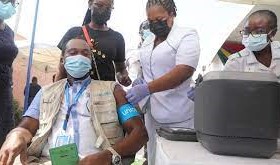
COVID-19: Nigeria Vaccinates 3% of Population

By Laide Akinboade
The National Primary Healthcare Development Agency (NPHCDA), said it has vaccinated 5,770,899 (3%), out of over 200 million eligible persons with the first dose of the COVID-19 vacscination while 3,146,885 have taken the second dose (fully vaccinated).
The Director, Planning Research and Statistics, NPHCDA, Abdullahi Garba, disclosed this in Abuja, at the Ministerial Press Briefing update on COVID-19 Response and Development in the Health Sector.
Mr Garuba added that these figures were achieved as at November 7, 2021, in the 36 states and the FCT.
He noted that there were over eight million doses of vaccines in the country at the moment, but the country was still expecting more doses.
He noted that to achieve herd immunity against the infection, Nigeria had set an ambitious goal of vaccinating 40 per cent of its over 200 million population before the end of 2021, and 70 per cent by the end of 2022.
“To achieve this, the vaccine roll-out was scheduled to be in four phases, starting with health workers, frontline workers, COVID-19 rapid response team, amongst others.
“The second phase has commenced and it’s capturing older adults, aged 50 years and above, and those aged between 18 and 49 years of age,” he explained.
Elsie Ilori, Director of Disease Surveillance Department, Nigeria Centre for Disease Control (NCDC), while giving an update on the Nigeria’s COVID-19 situation, said that while progress had been made in response to the ongoing pandemic with the fact-paced development of diagnostic, therapeutic, and vaccines globally, variants of concern with increased transmissibility pose a threat.
Mrs Ilori said that the pandemic continues to play out differently across countries worldwide.
Notably, Africa had seen fewer severe cases and deaths but despite limitations of testing has experienced similar transmission of the SARS-CoV-2 virus in its population.
According to her, “Regardless of the differing patterns of disease and deaths seen, the risk of the emergence of SARS-CoV-2 variants capable of evading human immune responses is a global concern”.
She added that Delta variant remains the dominant variant globally adding that, alongside existing safety measures, widespread vaccination was providing a means for the world to exit this pandemic.
While some countries are achieving set goals for population vaccination (South Korea), including using vaccine mandates, others are easing back on restrictions (Melbourne) and some are contemplating preserving existing restrictions for only the unvaccinated (Austria).
“Many countries in the global north have introduced vaccine booster doses, and have approved the use of COVID-19 vaccines for children aged 5 to 11 years,” she added.
The Director noted as much as it seems like Nigerians have moved on from COVID-19, it was still in existence, and people are still becoming infected and sadly, dying.
She noted that despite the differences in the disease pattern across countries, Nigerians have the same patterns of risk for the elderly, those with other diseases e.g., hypertension and diabetes, the immunosuppressed, etc as seen elsewhere.
It remains essential to ensure hand and respiratory hygiene, physical distancing, facemask wearing and receiving the full dose of COVID-19 vaccine available.
We have continued to respond to the pandemic and navigate these terrains by planning strategies on how to continue to live with COVID-19. A return to normalcy will be ensured by high levels of testing to ensure complete surveillance including tracking of variants of interest and concern and high levels of vaccination,” she explained.
She said that testing remains core to the response, with the rollout of rapid diagnostic testing continuing across the country.
“Community health workers are being trained on active contact tracing in states and focus is being placed on contacting silent states which do not submit reports on cases, deaths and more.
“With regards to infection, prevention, and control (IPC), health facilities are on the receiving end of training sessions on IPC,” she explained.
According to her, “The Emergency Operations Centre remains active, weekly coordinating the response in the Incident Coordination Centre with all pillars represented and partners contributing also travel restrictions.”
“On Oct. 25, revised travel restrictions were released and took effect. Key changes to the protocols include the removal of travelers from Brazil, Turkey, and South Africa from the list of restricted countries.
“In addition, key highlights are that: negative COVID-19 PCR test results should not be conducted more than 72 hours before boarding flights for travel.
“There is no longer self-isolation as a requirement for fully vaccinated inbound passengers, however, there must be a COVID-19 PCR test done on Day 2 of arrival.
Seven-day self-isolation is mandatory for unvaccinated and partially-vaccinated individuals in addition to COVID-19 PCR tests on days 2 and 7 after arrival.
“Additionally, people arriving on official/business trips seven days must be fully vaccinated, test negative 72 hours before boarding and conduct a PCR test within day 2 of arrival,” she explained.
She added that the ravel portal was undergoing revisions to improve it and it was hoped that the challenges of the past would become history on completion of the process.
Meanwhile, The Minister of Health, Osagie Ehanire, reiterated that it is imperative for Nigerians to take action to protect the vulnerable by practising the safety measures and ensuring they are vaccinated if they are eligible.
“It is strongly recommended you get vaccinated against COVID-19 to stop the spread of the virus. When you get vaccinated, you protect yourself, your family, friends, and community against the disease,” Ehanire urged.
The minister noted that all the brands of vaccines used in the country were safe and able to deliver protection against COVID-19 for any eligible person who was vaccinated.









The Hajiya Gambo Sawaba General Hospital (HGSGH) Fistula Centre, Zaria, has successfully repaired over 2,000 obstetric fistula cases since its establishment in 1999.
Chief Surgeon of the centre, Dr. Mohammed-Ado Zakari, disclosed this on Saturday during the 2026 commemoration of the International Day to End Fistula held at the hospital in Zaria.
According to Zakari, the centre currently performs an average of 150 repairs annually, with a success rate of over 70 percent.
The chief surgeon said five doctors and several nurses had also been trained at the centre under the mentorship of Dutch Fistula Surgeon, Dr.
Kees Waaldijk.He said the centre was established through collaborative efforts of the Kaduna State Government, Rotary International, and Waaldijk to address the growing burden of obstetric fistula in northern Nigeria.
Zakari described obstetric fistula as an abnormal opening between the vagina and the bladder or rectum, caused mainly by prolonged obstructed labour, resulting in continuous leakage of urine or stool.
He said the condition remains a major public health and social problem, particularly among rural women with poor access to quality maternal healthcare.
The surgeon revealed that globally, more than two million women “are living with untreated obstetric fistula, while between 50,000 and 100,000 new cases occur annually.”
He added that Nigeria alone may have between 100,000 and one million women living with untreated fistula.
Zakari identified early marriage, home delivery, shortage of skilled birth attendants, poverty, and prolonged obstructed labour as major causes of the condition.
He also raised concerns over increasing cases linked to medical quackery and poor surgical practices.
According to him, over 60 percent of private clinics in Zaria do not have qualified medical personnel to handle maternal healthcare needs.
“We currently have patients who are victims of such unqualified medical personnel undergoing fistula repairs at the centre.
“I am retired and own a private hospital, but I know that the priority of some private clinics is money, not patient-centred services,” he said.
The surgeon, however, commended the Federal Government for interventions through the Basic Health Care Provision Fund (BHCPF) and the Comprehensive Emergency Obstetric and Newborn Care (CEmONC) initiatives.
The 2026 theme for the International Day to End Fistula is: “Her Health is a Right: Invest in Ending Fistula and Childbirth Injury”.
The centre used the occasion to hold a special session for traditional and religious leaders.
The session urged participants to leverage the state health insurance scheme and other federal government’s interventions to improve access to quality, subsidized medical care.
Medical Director of the hospital, Dr. Hassan Adamu, reiterated the hospital’s commitment to providing robust health services to VVF patients.
He called for increased investment by governments, development partners, and philanthropists to strengthen maternal healthcare services and eliminate fistula and childbirth injuries.
In his remarks, Alhaji Sambo Shehu-Idris, District Head of Zaria and Kewaye, commended the centre for the event.
Idris, represented by Alhaji Ibrahim Sarki, Ward Head of Madarkaci, lamented that traditional leaders were closest to the communities and often reported the presence of quack centres.
He, however, said the lack of action by relevant authorities had made them targets of illegal operators.
The Kano State Contributory Healthcare Management Agency (KSCHMA) said it has enrolled vulnerable groups, including hypertensive and HIV patients and inmates in correctional centres, into the state’s healthcare insurance scheme.
The Executive Secretary of the agency, Dr.
Rahila Aliyu-Mukhtar, disclosed this in an interview on Friday in Kano.Aliyu-Mukhtar said the agency had enrolled more than 6,000 vulnerable hypertensive patients across the state to help them access medications and investigations they ordinarily could not afford.
According to her, the intervention has contributed to reducing complications arising from hypertension in the state.
“We received a nationally generated report indicating that Kano State has reduced complications arising from hypertension.
“This can be attributed to the hypertensive patients we enrolled under the scheme,” she said.
The executive secretary added that more than 6,000 people living with HIV have also been enrolled in the programme.
She explained that although antiretroviral drugs were provided through donor support, beneficiaries still require healthcare support for other illnesses such as malaria, typhoid, diabetes, and hypertension.
Aliyu-Mukhtar further disclosed that the agency had concluded plans to enroll 6,000 tuberculosis patients under its vulnerable group programme.
“We realised that TB patients also need support beyond their TB medications because secondary health conditions may arise,” she said.
She also said the agency had enrolled all inmates in correctional centres across the state, describing it as the first initiative of its kind in the country.
Aliyu-Mukhtar noted that the initiative earned the Kano State Government commendation from the Controller-General of Corrections.
According to her, other states have contacted the agency to understudy the implementation model adopted by Kano State.
She said the agency remained committed to reducing out-of-pocket healthcare spending and improving access to healthcare services for vulnerable residents.
The National Drug Law Enforcement Agency (NDLEA) said the dangers of drug use are often underestimated among young people, with many unaware of the long-term consequences of their actions.
NDLEA representative for the Kwara Command, Galleys Oyedepo said this at a seminar organised by the Federation of Muslim Women Association of Nigeria (FOMWAN) in Ilorin on Friday.
The seminar was organised in collaboration with NDLEA to sensitise secondary and tertiary school students against indulging in drug abuse.
Oyedepo expressed concern that drug and substance abuse is becoming prevalent among youth on campuses of tertiary institutions.
“Drug abuse is increasingly prevalent among young people, particularly on university campuses, where many students turn to substances in response to academic pressure, social expectations, and emotional challenges,” she said.
According to her, what begins as curiosity, peer influence, or a coping mechanism can quickly develop into dependency, trapping students in cycles of addiction.
Oyedepo identified commonly abused substances to include cannabis, codeine-based syrups, tramadol, and synthetic drugs.
She cited findings from the 2018 National Drug Use and Health Survey, which put Nigeria’s drug use prevalence at 14.4 per cent, nearly three times the global average.
The NDLEA representative noted that recent enforcement data further underscored the severity of the problem.
She further disclosed that more than 60 per cent of over 77,000 drug offenders arrested by the agency in the past five years were youths.
“Some are as young as 15, and most individuals currently undergoing treatment and counselling in NDLEA facilities are also young people.
“The trend is partly attributed to a culture that increasingly normalises drug use among youths, with many perceiving it as harmless or fashionable,” she said.
Oyedepo warned that the consequences of drug abuse include poor academic performance, mental health disorders, broken relationships, and increased exposure to crime and violence.
According to her, youth must understand that drug abuse comes with serious and lasting consequences, and that it is not a solution to stress or academic challenges.
FOMWAN Amirah, Hajia Biliqis Oladimeji, said the programme was organised under the Health Committee of the Association to educate young people on the dangers of drug abuse in the state.
Oladimeji lamented the rise in cases of drug abuse among youth in Kwara, saying the association would not fold its arms and watch the nation’s future destroyed by the menace.
She, therefore, appealed to parents and guardians to monitor their wards so that they do not fall victim to drug abuse.




2027 election: l Nwanyanwu emerges as ZLP Consensus Presidential Candidate
ShareBy Laide Akinboade, Abuja The Zenith Labour Party (ZLP) has endorsed its National Chairman, Chief Dan Nwanyanwu, as the party’s...


Three Years After: A Critical Evaluation of Tinubu’s Economic Reforms
ShareProf Uche Uwaleke As President Bola Ahmed Tinubu marked three years in office on May 29, 2026, Nigeria stands at a defining moment in...


Troops Neutralize Five Terrorists, Rescue 31 Kidnapped Victims in Katsina, Zamfara
ShareFrom Ifeanyichukwu Nwannah, Gusau Troops of Sector 2 Operation Fansan Yamma have rescued 31 kidnapped victims, neutralized five terrorists and dismantled several terrorists camps in a series of coordinated...

Arsenal Set Aside UCL Loss to PSG with Bus Parade Celebrating EPL Title
ShareTens of thousands of Arsenal fans put aside their pain at missing out on European glory as the club on Sunday celebrated...
Ghana’s Parliament Passes Anti-LGBTQ+ Bill
ShareThe parliament in Ghana has approved a new bill criminalising homosexuality and the promotion of LGBTQ+ activities. It proposes that identifying as lesbian, gay, bisexual, transgender or...
Kwara Community Clash Claims Two, Razes 10 Houses
ShareTwo people were killed, and about 10 houses were burnt in Ilesha Baruba, Baruten Local Government Area of Kwara State, on Saturday, after a violent clash involving an...


Declares No Faction in Nasarawa
ShareFrom Abel Zwanke, Lafia The Nasarawa State chapter of the Peoples Democratic Party (PDP) has declared that there is no faction within the party, insisting that...


Personal Loans Rise to N1.96trn in Jan 2026 – CBN
ShareBy Tony Obiechina, Abuja Personal loans granted by Nigerian banks rose to N1.96tn in January 2026, accounting for more than...


NNPC Records N481bn April Profit amid Strong Revenue Growth
ShareBy Tony Obiechina, Abuja The Nigerian National Petroleum Company Limited has recorded a significant month-on-month surge in performance, with revenue...


Oyo Abduction: Tinubu Orders Full-Scale Action After 16 Days of Agony
ShareBy David Torough, Abuja President Bola Tinubu has intensified efforts to secure the release of 46 abducted pupils and teachers...