
BUSINESS
Customs Intercepts N1.5bn Potent Tramadol Variant at Apapa

From Anthony Nwachukwu, Lagos
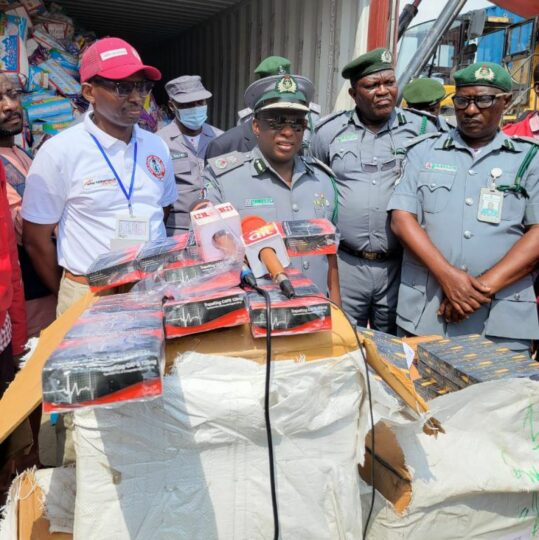
A 40-foot container laden with 20 cartons of tapentadol – a new and more potent brand of tramadol worth N1.56 billion has been intercepted by the Apapa Area Command of the Nigeria Customs Service (NCS).
The contraband, which arrived the Apapa Port from India on July 3, 2022 and declared as chocolates, has been under customs’ surveillance since arrival, Compt.
Yusuf Malanta said while showcasing the seizure at the Classic Bonded Terminal at Ago Palace Way in Lagos Thursday.On examination, however, the container was discovered to contain cartons of Ok POP sweets, which were used to carefully conceal the tapentadol 225mg and 120mg in 20 cartons inside the container, Malanta said.
“The importer cleverly concealed the drugs at the back of the container just to undermine our officers. We found out that he had 20 cartons of the drugs. Each of the 225mg had 838,500 tablets while the 120mg is 90,10,000 tablets.
“These drugs are deadlier than the normal tramadol. Imagine the havoc it would cause if it had escaped into the market! You will agree with me that most of the criminal actions taking place today in our society is as a result of the consumption of this type of drugs.
“Therefore, whoever is importing these drugs, we are telling him today that our collaboration is fully informed and we cannot relent.”
He explained that though the shipment arrived at the mother port since July 3, the importer had been buying time, probably to escape the customs’ watch, “but behold, we are really on top of our game and will continue being on top of our game.
“If he is not tired of importing, we will not be tired of making him lose his investment, and will ensure that he is trailed and brought to book.”
Malanta further commended the collaboration among the relevant agencies, stating that “the cooperation with the NDLEA and other agencies around here has yielded a fruitful result for the command.
“We will continue doing that to ensure that a serene environment is created for compliant traders, and for goods that are in tandem with Customs and Excise Management Act (CEMA). We thank God for giving us the wisdom to track and seize these kinds of drugs because it contravenes section 64, 46 and 47 CEMA Act.”
Though no arrest has yet been made, Malanta noted that ongoing investigations have already yielded substantial evidence on suspected importers, as the manifest in e-Customs modernisation, which begins from the port of loading to destination, will show the content of the cargo.
On his part, the NDLEA Apapa Commander, Ishiaku Kwajaffa, said “the 120mg written on the drugs is just a cover-up, the potency of the drugs is three times higher than the normal tramadol. This particular brand is new to us. This is the first time we are coming across the drugs.
“The 20 cartons are worth N1.560 billion. Each carton of tramadol is worth N78 million, but we have made it so scarce for them.”





Nigeria’s crude oil production fell by four per cent month-on-month in July, but the country still met its Organisation of Petroleum Exporting Countries quota for the third consecutive month, latest data from the Nigerian Upstream Petroleum Regulatory Commission has shown.
The commission’s latest production figures showed that Nigeria pumped an average of 1.
505 million barrels per day of crude oil in July, slightly above its OPEC quota of 1.5 million barrels per day.When condensate production of about 170,000 barrels per day is included, the country’s total crude and condensate output stood at 1.
67 million barrels per day during the month.The July performance, however, represented a decline from the 1.735 million barrels per day recorded in June, translating to a reduction of about 65,000 barrels per day, or 3.75 per cent.
The NUPRC disclosed the figures in a statement issued on Wednesday by its Head of Media and Corporate Communications, Eniola Akinkuotu.
The statement read, “Nigeria has for the third consecutive month met and exceeded its OPEC quota of 1.5mbpd. In the month of July 2026, Nigeria produced 1.505mbpd of crude oil and 0.17mbpd of condensate, bringing the combined daily production to 1.67mbpd.
“Although Nigeria met its OPEC quota in the month of July, the statistics show that on a month-on-month basis, production fell by 4 per cent.”
According to the commission, daily combined crude and condensate production fluctuated between a low of 1.57 million barrels per day and a peak of 1.78 million barrels per day in July.
“Daily average production was 1.67 million barrels per day, comprising both crude oil (1.505 million bopd) and condensate (0.17mbpd),” the commission said.
Despite the July decline, Nigeria has maintained crude production above its 1.5mbpd OPEC quota for three consecutive months.
The country’s combined crude and condensate production has increased since the beginning of the year, according to NUPRC’s month-on-month data.
Production stood at 1.459 million barrels per day in January, before rising to 1.483mbpd in February. It subsequently increased to 1.564mbpd in March, 1.663mbpd in April, 1.701mbpd in May and 1.735mbpd in June.
July therefore marked the first monthly decline after the steady increase recorded in the first half of the year.
Compared with January, however, July’s combined production of 1.67mbpd was about 211,000 barrels per day, or 14.5 per cent, higher.
The NUPRC attributed the July decline principally to operational challenges at the Erha and Akpo fields, which affected production during the month.
“These disruptions constrained production volumes and contributed significantly to the overall reduction in national crude oil output,” the commission said.
It added that production activities at other oil-producing assets remained relatively stable despite the disruptions.
“Despite the challenges encountered, production operations across other producing assets remained relatively stable, with operators implementing measures aimed at maintaining production efficiency and minimising the impact of operational constraints,” the regulator said.
It said routine production and crude evacuation activities were also largely sustained across the industry.
The commission added that operators and other stakeholders were working to resolve the affected production facilities and restore lost capacity.
“Industry stakeholders remain focused on addressing the identified operational issues, restoring affected production capacity and strengthening asset reliability to support improved performance in subsequent months,” it said.
The breakdown of production by terminals and streams showed that Forcados Terminal recorded an average output of 322.34kbpd in July, making it the largest producing stream listed by the commission.
It was followed by Bonny Terminal, which recorded 303.72kbpd.
Qua Iboe Terminal ranked third, with average production of 158.02kbpd of crude oil and condensates, while Escravos Oil Terminal recorded 131.41kbpd.
The Bonga stream ranked fifth among the leading producing terminals, with an average of 100.23kbpd of crude oil.
The Federal Government and NUPRC have identified increased crude oil production as important to government revenue, foreign exchange earnings and investment in the upstream sector.

The Managing Director of Chevron Nigeria Limited, Jim Swartz, has highlighted key areas that would sustain Nigeria’s energy transition growth pathway.
Swartz, is of the opinion that strong collaboration and partnership are key to sustain the country’s energy needs.
Speaking at the just-concluded 49th Nigerian Annual International Conference and Exhibition (NAICE) in Lagos, Swartz, said no one player can deliver the scale of projects required to achieve the goals set by the country alone.
He declared that Collaboration is essential because no single company, institution, or stakeholder can address the opportunities and challenges of the intersector alone.
And technology will remain a key driver of safer operations, stronger performance, and the future that we will deliver. For Nigeria, the opportunity is significant.The conference with the theme “Thriving in the Evolving Global Energy Landscape: Collaborative Growth and Resilience,” focused on how Nigeria can compete for capital and sustain production amid global volatility.
The managing director listed four pillars he believed are essential to define a resilient energy future.
These include continued investment, enabling long-term policies, competitive local capacity development, and strong partnerships.
He continued, “Building a resilient energy future requires continued investment, enabling policies that are resilient for the long-term, local capacity development that’s competitive and durable as well, and strong partnerships across governments, regulators, industry, and the technical community,”.
He said Chevron has invested in Nigeria for more than six decades, noting the company’s role in building the foundation of the industry and in developing technical capacity.
The firm therefore called for stronger collaboration across government, regulators and industry operators as the foundation for building a resilient oil and gas sector that can deliver growth, jobs and energy security for Nigeria.
The Federal Government, through the Rural Electrification Agency, is set to inject a cumulative 60.82 megawatts of renewable power into the national grid following the rollout of decentralised mini-grid projects across the country.
The milestone was reached on Wednesday with the groundbreaking of a 13.
92-megawatt-peak interconnected hybrid solar project in Yobe State. The latest project brings the total capacity of recent REA renewable energy projects launched across six states to 60.82MW.Before the Yobe project, the agency had commenced 46.9MW of power infrastructure across five states, including a 20MW mini-grid in Egume, Kogi State; an 11.
9MWp project in Ogu-Bolo, Rivers State; and a 10MW installation in Kofare, Adamawa State, a statement by the REA said.The earlier projects also include a 3.5MW mini-grid in Ambursa, Kebbi State, and a 1.5MW project in Pankshin, Plateau State.
The 13.92MWp Yobe project, supported by the World Bank, is equipped with 40 distribution transformers and is spread across major commercial and residential areas to improve electricity supply, stabilise power and stimulate local economic activities.
The capacity comprises a 3.20MWp installation in Nguru, another 3.20MWp plant at Yarimaram in Potiskum, a 2.98MWp system in Gashua, a 2.78MWp project at Rugan Fulani in Potiskum, and a 1.76MWp solar installation serving the Waziri Ibrahim Estate in Damaturu.
Speaking during the groundbreaking ceremony, Yobe State Governor, Mai Mala Buni, praised the REA’s commitment, noting that the project aligned with his administration’s vision for resilient infrastructure to boost local industrial capacity and agricultural productivity.
The REA Managing Director and Chief Executive Officer, Dr. Abba Abubakar Aliyu, explained that interconnected hybrid mini-grids were designed to integrate seamlessly with existing distribution networks.
“We are not merely connecting communities to electricity. We are connecting them to opportunity. We are creating an environment where businesses can grow, young people can innovate, farmers can process more of what they produce, healthcare facilities can provide better services, and local economies can flourish,” Dr. Aliyu said.
The REA boss disclosed that beyond the 60.82MW covered by the current nationwide groundbreakings, the agency had 14 additional pipeline projects underway in Yobe State alone.
He said the projects, which followed a strategic roundtable held in June 2025, would add another 15.3MWp of combined capacity when completed.
According to him, the planned projects are expected to provide electricity access to 23,870 new connections across communities, including Jawur Katamma, Federal Polytechnic Damaturu and Dibbwol.


Dangote Cement Ibese, FRSC Strengthen Strategic Partnership to Advance Road Safety in Ogun
ShareEfforts aimed at further enhancing road safety in Ogun State has received a boost following fresh collaborative engagement between the...


Sustained Military Pressure Drives 213 Per Cent Rise in Terrorist Surrenders in North-East
ShareBy David Torough, Abuja Troops of Operation Hadin Kai (OPHK) have recorded a 213 per cent increase in the number...
Nigeria’s Oil Production Drops 4 Per Cent in July – NUPRC
ShareNigeria’s crude oil production fell by four per cent month-on-month in July, but the country still met its Organisation of...


CBN Reverses OMO Restriction, Opens Market to Local Investors
ShareBy Tony Obiechina, Abuja The Central Bank of Nigeria (CBN), has reversed its seven-year restriction on local investors’ participation in...
Northern Senators Seek Enduring Solution to Flooding in Niger
ShareBy Dan Amasingha, Minna The Niger State Government and Northern Senators’ Forum have called for lasting measures to tackle the...

Osun Election Tension Deepens as Accord Petitions EU over Alleged Killings
ShareFrom Ayinde Akintade, Osogbo Tension has heightened in Osun State ahead of Saturday’s governorship election, with the Accord Party alleging...


Rethinking the CBN’s Mandate: Lessons from Malaysia for Nigeria
ShareBy Uche Uwaleke During a recent academic study tour of key financial institutions in Malaysia with some of my PhD...


Tinubu, Shettima not Elected by Muslims Alone, Northern Christian Chair Slams Cleric
ShareChairman of the Northern Christian Association, NCA, Rev. Joseph Hayab, has said President Bola Tinubu and Vice President Kashim Shettima...


Dangote Confident on Group’s Projected $100bn Revenue Target By 2030
ShareAliko Dangote, has expressed confidence in his company meeting estimated revenue growth in the next four years. He said detailed...


Chevron Says Competitive Local Capacity Devt to Define Nigeria’s Energy Future
ShareThe Managing Director of Chevron Nigeria Limited, Jim Swartz, has highlighted key areas that would sustain Nigeria’s energy transition growth...