
BUSINESS
Customs Sharpens Operational Edge as 50 Officers Graduate from NCCSC


Fifty officers of the Nigeria Customs Service (NCS) have completed the three-month Junior Course 25 at the Nigeria Customs Command and Staff College (NCCSC), Gwagwalada.
The Customs Spokesperson, Abdullahi Maiwada, made this known in a statement on Sunday in Lagos.
Speaking as the Special Guest of Honour, the Comptroller-General, Adewale Adeniyi, urged the graduates to uphold integrity, sound judgment and national interest above personal gain.
Adeniyi said modern Customs leadership required competence and accountability beyond revenue collection, urging officers to adapt to evolving trade, security and compliance challenges.
“Leadership is not defined solely by the rank that you wear, but is demonstrated through competence, fairness, courage and the responsibility you take,” Adeniyi said.
He charged the officers to apply their training to complex operational demands, improve service delivery and strengthen border security while facilitating legitimate trade.
The Commandant of the College, Assistant Comptroller General of Customs (ACG), Dow Gaura, commended the officers’ dedication and highlighted ongoing upgrades at the institution.
Gaura said the upgrades included digital learning tools and strategic training partnerships with the Nigerian Army to equip personnel with modern skills.
He said the investments would enhance decision-making and align Customs operations with international best practices for efficiency and transparency.
Maiwada said the ceremony featured certificate presentations to all 50 graduates, while the CGC presented special awards to three top-performing officers.
He said the awards recognised excellence in academics, leadership and discipline among the graduates.
Maiwada said activities began on Wednesday, Aug. 26, with a regimental dinner where Deputy Comptroller General of Customs, Suleiman Chiroma, represented the CGC.
He said Chiroma urged the cohort to demonstrate vigilance and decisive leadership in their new postings.

The African Export-Import Bank (Afreximbank) and its subsidiaries (the Group) recorded a 30 per cent increase in net income to 534.7 million dollars in the first half of 2026.
The bank disclosed this in a statement issued by Vincent Musumba, Communications and Events Manager, Afreximbank, on Wednesday, on its financial results for the six months ended June 30, 2026.
Musumba said the performance reflected the resilience of its business model and its continued support for trade and economic development across Africa and the Caribbean.
According to the statement, total assets and contingencies rose by 7.
8 per cent to 52.3 billion dollars from 48.5 billion dollars as of Dec.31, 2025.It said the growth was driven largely by increased lending, with net loans and advances rising by 5.7 per cent to 35.4 billion dollars, compared with 33.5 billion dollars at the end of 2025.
The statement said the bank’s asset quality remained sound, with its non-performing loan (NPL) ratio improving to 2.20 per cent at the first half of 2026, from 2.43 per cent at year-end 2025.
It said the bank also maintained a sound liquidity position, with liquid assets accounting for 13 per cent of total assets, within its strategic target range of between 10 per cent and 15 per cent.
The statement said shareholders’ funds increased to 8.5 billion dollars from 8.4 billion dollars at the end of 2025.
“The increase was supported by 534.7 million dollars in internally generated profits and 13.9 million dollars in new equity raised during the period.”
It said the Net interest income increased by 22 per cent to 1.0 billion dollars, compared with the 0.84 billion dollars in the corresponding period of 2025.
The statement said fee and commission income also increased by 15 per cent to 71.1 million dollars, from 61.9 million dollars in the first half of 2025.
It said the bank attributed the increase to higher fees earned from guarantees, letters of credit and advisory services.
“As a result net income reached 534.7 million dollars, representing a 30 per cent increase from 412.7 million recorded in the first half of 2025.”
The statement said Profitability indicators also improved, with return on average shareholders’ equity rising to 13 per cent from 11 per cent in the first half of 2025.
“Return on average assets increased to 2.54 per cent from 2.22 per cent over the same period.”
It said operational efficiency remained strong, with the cost-to-income ratio at 20 per cent, compared with 19 per cent in the first half of 2025, in spite of higher personnel expenses and persistent inflationary pressures.
According to the statement, Afreximbank further strengthened its funding profile after the reporting period by completing a 1.5 billion-dollar dual-tranche bond issuance.
It said the transaction, described as the largest international debt capital markets issuance in the bank’s history, comprised a 750 million-dollar 5.5-year tranche and a 750 million-dollar 10-year tranche.
“The offering was approximately two times oversubscribed, highlighting strong investor confidence and reinforcing the bank’s capacity to support its strategic growth objectives.
The statement quoted Denys Denya, Afreximbank’s Senior Executive Vice-President, as saying the financial performance reflected the continued resilience of the Group amid a complex global environment.
“Our healthy balance sheet gives us the capacity to respond when markets are disrupted, while continuing to finance the trade, industrialisation and investment that underpin longer-term economic resilience,” he said.
Denya said the expansion of lending, strength of asset quality and continued access to diversified funding enabled the bank to remain responsive to immediate challenges.
He added that these strengths would also support the structural transformation of African and Caribbean economies. (NAN)
Centre for the Promotion of Private Enterprise (CPPE) has urged the Federal Government to shift its economic reform focus from macroeconomic stabilisation to productivity, job creation and improved living standards.
The Chief Executive Officer of CPPE, Dr.
Muda Yusuf, made the call on Sunday in the centre’s assessment of the government’s economic reform scorecard released by the Minister of Finance.Yusuf said the reforms had delivered measurable gains, including stronger government revenues, improved foreign exchange stability, higher external reserves and increased investor confidence.
He said real Gross Domestic Product growth also strengthened to 3.89 per cent in the first quarter of 2026, from 3.13 per cent in the corresponding period of 2025.
“Macroeconomic stability is a means, not an end,” he said.
He said the real test of the reforms was their ability to deliver higher productivity, stronger investment, more jobs, lower poverty and improved living standards.
According to him, purchasing power remains under pressure, while businesses continue to face high energy, financing, logistics and regulatory costs.
Yusuf said the next phase of reforms should therefore prioritise productivity, competitiveness and household welfare.
He also urged state governments to translate increased statutory allocations and internally generated revenues into visible development outcomes.
He listed roads, healthcare, transportation, education, agricultural infrastructure, security, power and enterprise support as areas requiring greater investment.
“Higher revenues must produce a visible development and welfare dividend, rather than simply finance higher recurrent expenditure and prestige projects,” he said.
Yusuf identified electricity, logistics, insecurity, agricultural productivity, infrastructure, regulatory costs and high cost of capital as major structural constraints to economic growth.
He said the 15.3 per cent contraction in the electricity sector in the first quarter of 2026 underscored the urgency of addressing supply side constraints.
He said manufacturing and agriculture grew by 3.29 per cent and 3.15 per cent, respectively, during the period.
Yusuf called for trade policies that protected industries and agricultural producers with credible local capacity against unfair import competition.
He however, said producers should retain competitive access to critical inputs that were not adequately available locally.
He also advocated stronger fiscal and monetary coordination to enable a gradual reduction in financing costs as inflation moderates.
The CPPE chief executive cautioned against reversing the economic reforms, describing such a move as potentially damaging to investor confidence and fiscal stability.
He said policy makers should instead sustain the reform trajectory, while continuously refining its implementation based on evidence and its impact on businesses and households.
Yusuf said: ‘’Nigeria’s next reform phase must move from stabilisation to productivity; from higher government revenues to better development outcomes.
‘’Also, it must move from improving macroeconomic indicators to tangible gains in jobs, incomes and living standards.’’ (NAN)
The National Institute of Credit Administration (NICA) has called for the immediate capitalisation of the Nigerian Credit Guarantee Company (NCGC) with two trillion naira.
The Registrar and Chief Executive Officer of NICA, Prof.
Chris Onalo, made the call on Sunday in a statement on the state of Nigeria’s credit economy.Onalo said stronger banks from the recent recapitalisation would not translate into economic growth without deliberate measures to expand credit to productive sectors.
He said private sector credit stood at 28 per cent of the Gross Domestic Product as of June 2026, far below the 60 per cent to 80 per cent average recorded in emerging economies.
According to him, high lending rates of between 32 per cent and 35 per cent have priced key sectors out of formal credit.
He listed manufacturing, agriculture, housing and education among sectors struggling to access affordable financing.
He said banks had become increasingly risk averse in spite of improved liquidity following the recapitalisation exercise.
He attributed the situation to weak credit infrastructure, limited credit bureau coverage, weak collateral enforcement and slow judicial recovery.
Onalo warned that the credit gap was pushing millions of Nigerians toward informal lenders and digital loan platforms.
He said this could worsen household debt and weaken the capital base of small businesses.
The NICA boss described the situation as a “credit paradox”, where funds existed within the banking system, but were not sufficiently circulating in the productive economy.
He said the government must, therefore, create mechanisms to de-risk lending and encourage banks to finance businesses capable of creating jobs and expanding production.
Onalo urged the Federal Government to empower the NCGC with two trillion naira to provide broad-based guarantees for lending to micro, small and medium enterprises.
He said the guarantee scheme would serve as a bridge between stronger banks and increased financing for businesses.
“Given the recent robust bank recapitalisation, the Federal Government should immediately capitalise the Nigerian Credit Guarantee Company (NCGC) with N2 Trillion.
“This broad-based guarantee will de-risk lending, unlock bank balance sheets, and upscale credit to MSMEs nationwide. It is the bridge between strong banks and a strong economy,” he said.
Onalo also called for single-digit intervention funds for agriculture, manufacturing, housing and the creative economy through relevant government institutions.
He advised the government to establish an Office of the National Chief Credit Officer to coordinate federal credit policies, intervention funds and guarantee programmes.
Onalo also recommended mandatory credit reporting by fintechs, cooperatives and other lenders to strengthen Nigeria’s credit infrastructure.
He called for the full digitisation of the National Collateral Registry to reduce lending risks and improve access to credit.
He insisted on regulation of digital lenders to protect borrowers from predatory interest rates and unethical debt recovery practices.
Onalo also proposed reforms allowing pension and insurance funds to invest more in corporate bonds and infrastructure debt.
He urged all 36 states to establish Credit Access Departments to work with financial institutions and the NCGC to fund grassroots enterprises.
“Bank recapitalisation has given us stronger banks. What Nigeria needs now is coordinated, guaranteed and disciplined credit,” he said.
He added that such measures would enable credit to become a catalyst for enterprise, employment and sustainable economic growth.
Onalo said NICA was ready to provide policy support, technical guidance and executive training for implementing the proposed reforms. (NAN)


Customs Sharpens Operational Edge as 50 Officers Graduate from NCCSC
ShareFifty officers of the Nigeria Customs Service (NCS) have completed the three-month Junior Course 25 at the Nigeria Customs Command...


Lydia Memorial Hospital Takes Free Healthcare to Akpodo, Treats Over 250 Residents
ShareBy David Torough, Abuja Residents of Akpodo Community in Okpokwu Local Government Area of Benue State on Sunday, August 30,...
Nigeria’s Tertiary Healthcare; The Waterbed, the Blackout and the Long Road
ShareBy Prince Charles Dickson In February 2026, Ogonna Egwu took her gravely ill mother to the Accident and Emergency Ward...


2027: Tinubu, Atiku and Obi Step up New Strategies for Nigeria’s Presidency
ShareBy Raphael Atuu As the 2027 general elections draw closer, the political atmosphere in Nigeria is gradually heating up, with...


Tinubu Reports Xenophobic Attacks to AU
SharePresident Bola Tinubu has formally reported recurring xenophobic and Afrophobic attacks against Africans and other nationals in South Africa to...


Alia Changing Infrastructure Narrative in Benue South, Says Council Boss
ShareFrom Attah Ede, Makurdi The Chairman of Agatu Local Government Area of Benue State, Melvin Ejeh, has commended Governor Hyacinth...


NDDC Commences Reconstruction of Benin-Sapele Expressway
ShareFrom Francis Sadhere, Delta The Niger Delta Development Commission (NDDC) has commenced the reconstruction of a 15.4-kilometre failed section of...
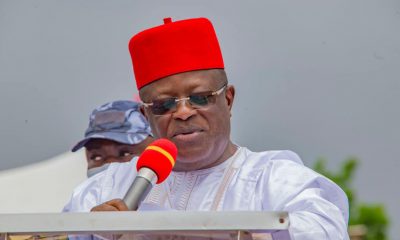

Trans-Sahara Highway to Boost Security, Commerce — Umahi
ShareMinister of Works, Chief David Umahi, says the Trans-Sahara Superhighway will significantly improve security, agriculture and commerce across its corridor....


Police Dismantle Bandits’ Hideouts in Kaduna
Share The Police Command in Kaduna State has dismantled two bandits’ hideouts during a clearance operation in Makarfi Local Government Area....


NABTEB Sets Deadline for 2026 Nov, Dec Certificate Exams Registration
ShareThe National Business and Technical Examinations Board (NABTEB) has set Sept. 10 as the deadline for its 2026 November/December certificate...