
Agriculture
FCTA Distributes Fishery Inputs to 60 Farmers to Boost Fish Production

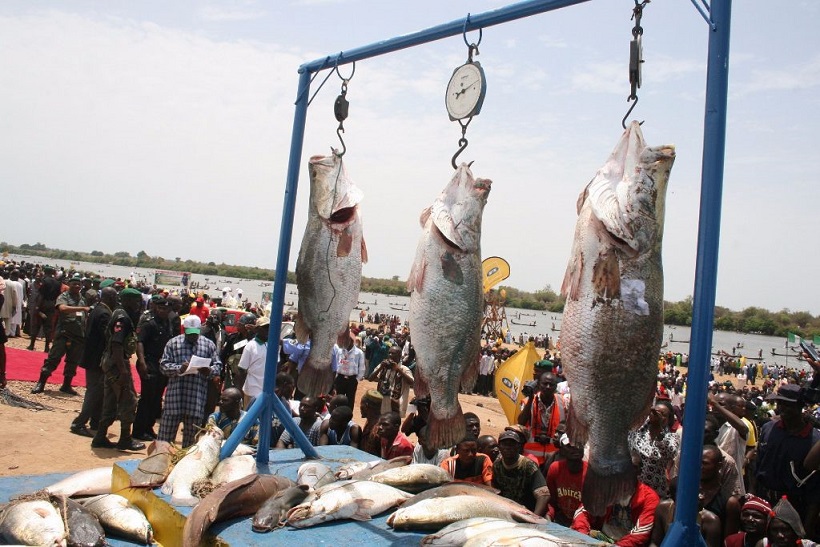
The Federal Capital Territory Administration (FCTA) has distributed assorted fishery inputs such as fish fingerlings and fish feed to 60 farmers to start fish production in various communities in the territory.
Mandate Secretary for the FCT Agriculture and Rural Development Secretariat, Alhaji Abubakar Ibrahim, said this at the inauguration of Sensitisation Workshop on Diversification of Aquaculture Production and Employment of Fish Farmers in FCT.
The event held at the FCTA Exhibition Hall, on Thursday in Abuja.
Ibrahim said the workshop was to sensitise fish farmers on the need to diversify fish production and embrace new fish varieties other than the popular catfish species.He said that available records showed that Catfish production accounted for about 80 per cent of all farmed fish in Nigeria, making the country largest producer of Catfish in sub-Saharan Africa.
Ibrahim, however, said with rapid growth and development of fisheries and aquaculture industry, there had been a sharp rise in the consumption of edible fish. He said this could be attributed to urbanisation, change in lifestyle of families and medical benefits associated with its consumption.
Ibrahim said fish farmers in Nigeria were hard working and resilience and had placed the country amongst the leading fish producing countries of the world. He said it was imperative that they began to expand their activities to accommodate other fish varieties which would grant them greater patronage and more income. “It is against this background that the Secretariat through the Department of Fisheries is inaugurating this sensitisation workshop.“The aim of the workshop is not only exposing Fisher folks to other fish varieties such as (Tilapia niloticus and Hoterotis Niloticus) but train them on effective production techniques for house-hold consumption and commercial purposes,” he said.
Ibrahim said that the secretariat would ensure that Department of Fisheries deployed its technical expertise to follow-up the progress of the participants to achieve the objective of the initiative. “I want to assure you that the secretariat will leave no stone unturned towards ensuring the success of the Grass root Developmental Initiatives of the FCT Minister of State, Dr Ramatu Aliyu,” he said.
Ibrahim said that the minister established the FCT Aquaculture and Allied Trades Centre for Women and Youth in Kwali in 2019.He said the centre had since establishment, boosted catfish production in the FCT and had already started training farmers on the production of assorted fish varieties.
Earlier, the FCT Director, Department of Fisheries and Aquaculture, Mrs Ifeoma Okeke, said the fisheries sub-sector contributed to both FCT and National economy through employment and income generation.
She said the subsector also reduced poverty, improved foreign exchange earnings and provided raw materials for the animal feed industry. Okeke said that over 10 million Nigerians were actively engaged in primary and secondary fisheries operations. The News Agency of Nigeria (NAN) reports that the 60 beneficiaries drawn from the Six Area Councils of FCT are given starter packs. (NAN)


The Kwara Government has partnered Olam Agri to curb post-harvest losses and boost farmers’ profitability across the state.
The development is contained in a statement issued on Sunday in Ilorin by Ashaolu Omotola, Press Secretary, Ministry of Agriculture.
The agreement was signed by Agriculture Commissioner, Dr Afees Alabi, and Olam Agri’s Vice President for Procurement, Noel Ferrao.
Alabi described post-harvest losses as a major constraint on farmers’ incomes and overall agricultural efficiency in the state.
He stressed the need for improved storage systems, describing them as practical tools to preserve produce and reduce avoidable waste.
The commissioner said activating storage facilities would improve preservation, support aggregation, and help farmers secure better market opportunities through flexible selling timelines.
Alabi reaffirmed the government’s commitment to strengthening agricultural support across the 16 local government areas, noting the initiative would directly benefit thousands of farmers.
“The engagement reflects the government’s focus on strengthening infrastructure, deepening private sector collaboration, and improving efficiency for long-term food security and rural development,” he said.
Ferrao said Olam Agri aimed to collaborate with the Federal Ministry of Agriculture, Kwara government, development agencies, and financial institutions.
He noted the partnership would deliver sustainable maize and soyabean outgrower programmes, providing inputs, training on best practices, and timely market access.
According to him, Olam Agri already operates a similar soyabean partnership and plans to expand with another programme this farming season.
Unstable electricity supply and rising fuel prices are placing significant strain on frozen food businesses in Lagos, as traders struggle to cope with higher operating costs and reduced customer patronage.
The traders, who spoke with in separate interviews on Wednesday, said the combined effect of unstable power supply and expensive fuel had increased their operating costs and reduced profit margins.
Frozen food businesses rely heavily on constant electricity to preserve items such as chicken, turkey, fish, and other perishable products.
However, irregular power supply has forced traders to depend on generators, which run on fuel, thereby increasing operational expenses.
There has been a nationwide drop in power generation due to insufficient gas supply.
Consequently, the country’s power sector, largely dependent on gas-fired plants, has been hit by disruptions in gas supply worsened by pipeline maintenance challenges and liquidity constraints.
Chika Oluehi, owner of Chika Frozen Foods at Ijora-Olopa, said he now factors electricity and fuel costs into his pricing to remain in business.
“Before now, a carton of turkey sold for about N85,000, but it now goes for between N105,000 and N110,000.
“A carton of chicken that used to sell for about N39,000 to N41,000, now sells for N46,000. We have to calculate our margins carefully to avoid losses,” he said.
Oluehi added that storage capacity determines how traders cope with electricity challenges.
“Suspending my frozen food business is not an option for me because of my storage facilities.
“When there is no electricity, we use fuel to power generators, but the generator does not fully carry the freezer. It only chills it and does not completely prevent spoilage,” he said.
Oluehi added that he had resorted to alternative energy sources to reduce losses.
“Where I live, I sometimes have light, and I also use a solar freezer. It helps, but it still depends on electricity, so it is not a complete solution,” he said.
According to him, the rising cost of fuel also affects the transportation of frozen foods from suppliers to markets.
“When fuel prices go up and there is no power, we spend more transporting these frozen foods.
“Once fuel increases, prices automatically rise, and customers cannot buy as much as they used to.
“Imagine having 10 customers and five stop buying, while the remaining five reduce the quantity they purchase. The business will eventually suffer,” he said.
Another trader, Mojisola Kazeem of MJ Frozen Foods in Surulere, said she had temporarily halted selling frozen items due to the cost of fuel and electricity.
“I had to pause it. I cannot cope with the electricity situation and the cost of fuel.
“Hopefully, when things return to normal, I can pick up from where I stopped,” she said.
Similarly, a fish seller in Mushin, Bose Adeyemi, said she now reduces the quantity she stocks to avoid spoilage.
“Without steady electricity, keeping large quantities is risky. If light goes off and fuel is expensive, you may lose everything.
“I now buy in small quantities even though it reduces profit,” she said.
A cold-room operator in Agege, Sulaiman Adebayo, said many traders now share storage space to cut electricity costs.
“Some traders cannot afford to run generators alone, so they rent space in cold rooms. But even cold-room owners are increasing prices because of fuel,” he said.
Adebayo noted that the situation had reduced customer patronage.
“Customers complain that frozen foods are too expensive. Many now buy smaller portions, and some switch to alternatives,” he said.
Yetunde Afolabi, a soft drink seller at Yaba Market, said poor electricity supply had affected her sales because customers prefer chilled drinks.
“People will not buy soft drinks when they are hot. Once there is no light, the drinks lose their chill, and customers walk away.
“Some of them even open the cooler, check the bottle, and drop it back when it is not cold enough.
“I spend money on fuel to run my generator, but I cannot keep it on all day because fuel is expensive. When I switch it off, the drinks become warm, and I lose sales,” she said.

The Federal Government has called for more partnerships with private sector operators in the transformation of the Correctional Farm Centres into highly productive agricultural hubs.
Minister of Interior Dr. Olubunmi Tunji-Ojo, stated yesterday in Abuja at a stakeholder dialogue on Optimising Correctional Farm Centres and Public-Private Partnership (PPP) Pathways for Inmate Reformation, organised by Hope Behind Bars Africa (HBBA), in collaboration with the Nigerian Correctional Service, with funding support from the European Union/International IDEA.
Tunji Ojo, represented by the Permanent Secretary, Federal Ministry of Interior, Dr.
Magdalene Ajani said these partnerships are the engines that would drive the scale of change needed, modernise infrastructure, and enrich rehabilitation programmes in the Nigerian Correctional Service (NCS).He said: “It is an undeniable reality that government resources alone cannot fully unlock the vast potential lying dormant within our correctional system.
“The chest scale of the vision we hold calls for a synergy of strength. This is where the Public Private Partnership (PPP) transitions from being a mere policy option to an indispensable strategic imperative.
“PPP is a powerful vehicle for sustaining development, allowing us to fuel government policy, leadership, and oversight with the private sector’s innovation, operational efficiency, and capital. When structured with intention and integrity, these partnerships create shared values.
“Nigeria is a nation blessed with immense agricultural potential; our correctional farm centres can and should be transformed into highly productive agricultural hubs.”
In her opening remarks, Funke Adeoye, Executive Director, Hope Behind Bars Africa (HBBA), said through one of the projects of the organisation-Farming Justice Project, that HBBA has been working to reposition correctional farm centres as structured, rehabilitation-focused agricultural hubs that contribute to food security within and outside prison while strengthening correctional productivity and reintegration outcomes.
Adeoye pointed out that her organisation has integrated reformation with agriculture to achieve multiple outcomes, such as addressing food insecurity within custodial centres, equipping inmates with practical skills, and reducing reoffending, which remains at the heart of the criminal justice system’s purpose.
Commenting on the implementation of the Farming Justice Project, she said, “We are currently working across multiple custodial centres, including Dukpa Custodial Centre, Kuje Custodial Centre, Kirikiri Female Custodial Centre, and Oko Custodial Centre.
“Within these facilities, residents are actively engaged in structured mind-reformation training, covering behavioural change, financial literacy, crop cultivation, and the cultivation of second chances.
“They are also participating in structured agricultural production, growing crops such as pepper, okra, watermelon, ugu, green pepper, and sweet corn.
“We have established fish ponds, the latest of which is at Kuje Custodial Centre.
“To date, the project has reached direct beneficiaries across multiple centres: in Edo State, 95 residents and 5 officers; in Abuja, 222 residents and 18 officers; and in Lagos, 448 individuals.
“Beyond these direct participants, the indirect impact is even more remarkable; families, local communities and supply chains are all experiencing the ripple effects of increased food production, skill transfer, and entrepreneurship.”
She disclosed that the goal of the project is to transform correctional agriculture from an under-utilised function into a structured pathway for rehabilitation, reintegration, and national development.
Adeoye, therefore, reiterated the need for partnerships that would drive innovative solutions, transform lives, and help in the realisation of the true essence of the correctional system.
In his welcome address, Sylvester Ndidi Nwakuche, Controller General, Nigerian Correctional Service (NCS), said the NCS currently operates 18 farm centres and 10 cottage industries, covering a total landmass of approximately 10,000 hectares across the country.
Nwakuche said the Service runs 12 agricultural projects, five piggery projects, nine fishery projects, and 11 poultry projects across its facilities in Nigeria.
He said: “These activities are not only vital for supporting inmate welfare and contributing to food production, but also serve as a practical platform for skills acquisition and vocational training.
“By aligning our programmes with market realities, we can ensure that inmates acquire relevant employable skills that will enable them to reintegrate successfully into society upon release.”



2027: Afenifere, Arewa Consultative Forum, Northern Elders Forum Back SDP
ShareBy Mike Odiakose, Abuja Ahead of Nigeria’s 2027 elections, leading socio-political groups—Afenifere, Arewa Consultative Forum, and Northern Elders Forum—have jointly...


Kogi NYSC Debunks Rumours of Corps Member’s Castration
ShareFrom Joseph Amedu Lokoja The National Youth Service Corps (NYSC), Kogi Secretariat, has dismissed reports circulating on social media claiming a corps member serving in the...

Ghana Sack Manager Addo, 72 Days Before World Cup
ShareGhana have sacked manager Otto Addo, 72 days before the start of this summer’s World Cup. Addo’s departure followed a 2-1 defeat by Germany in a friendly in Stuttgart on...

Assailants kill 73 at South Sudan Gold Mine
ShareArmed assailants killed 73 people at a gold mine in South Sudan, government officials said on Monday, in violence linked to a dispute over gold extraction. The attacks occurred on Saturday...


When Will the Bloodlettings in Nigeria Stop?
ShareBy Tochukwu Jimo Obi The latest wave of violence in Nigeria has once again exposed the fragility of the nation’s security framework....
Analysts Warn Brent Crude Price Could Surge To $200 A Barrel
ShareAnalysts have warned of significant crude oil price hikes which would further erode global economic prospects. Top grade Brent crude could surge to $200 a barrel if the Iran conflict drags on through the...


CBN Sets Three-week Deadline for Banks’ Cybersecurity Self-assessment
Share The Central Bank of Nigeria has directed banks to complete a mandatory cybersecurity self-assessment within three weeks, as part...


Jos Killings: Tinubu Meets Security Chiefs, Summons Mutfwang
ShareBy David Torough, Abuja President Bola Tinubu has summoned Plateau State Governor Caleb Mutfwang to Abuja for high-level consultations following...


Again, Senate Approves Tinubu $6bn Loan as Budget Spending Surges
ShareBy Eze Okechukwu, Abuja In a series of far-reaching fiscal decisions on Tuesday, the Senate approved a $6 billion external...


AFN Reports Major Gains against Terrorists, Rescues Over 800 Victims in Q1 2026
ShareBy David Torough, Abuja The Armed Forces of Nigeria (AFN) has announced significant operational successes across multiple conflict zones in...