
OPINION
Nigeria, a Country with Too Many Sovereigns


By Chidi Anselm Odinkalu
Colonial rule in Nigeria was conducted through indirect rule. It was a system of “native administration” patented in northern Nigeria, which became the model exported by the British across their colonies. For all practical purposes, this system of government gave to most Emirs and other rulers in Chiefly communities, “more power than they had in pre-colonial days. ” The result was the establishment of “native states” at the top of which sat these local potentates, many of whom enjoyed powers of life and death over their kinsfolk. The end of colonial rule did not much change this as they reached working accommodation with the post-colonial elite for self-preservation. Powered by twin failures of both leadership and nation-building, the result in Nigeria, where it all began, is one country with a multiplicity of sovereigns.
The ongoing dispute between the Emir of Kano, Alhaji Aminu Ado Bayero, and Air Peace, a private airline in Nigeria, dramatizes this. The claim on behalf of the Emir is that he flew Air Peace from Banjul, The Gambia to Nigeria, on 24 February, landing in Lagos about 05:45 hours. He was at the head of a ten-person traveling party who had a connecting flight to catch to his home in Kano, north-west Nigeria scheduled for 06:15 hours the same morning, a mere 30 minutes after they landed. Five out of the ten members of the Emir’s traveling party were business class passengers.
Upon landing in Lagos, the Emir’s cousin, Isa Sanusi Bayero, reportedly “personally called the chairman of Air Peace, Allen Onyema, to inform him of the precarious situation and requested him to assist by delaying their departing flight to Kano as a mark of respect to the revered Emir of Kano”. He conveniently forgot to disclose how long it took them to clear immigration. When Mallam Isa got no purchase, it is reported that he “personally took this as an insult and a flagrant show of disrespect to his highness and the Kano people at large”, whereupon he petitioned the director-general of Nigeria’s Civil Aviation Authority, NCAA, Captain Isa Nuhu, ominously demanding his “kind intervention for restitution and for appropriate measures to be taken to stop this unwholesome development from happening in the future”.
It is relevant that the flight to Kano had closed checking in by the time the Emir’s flight from Banjul landed. The passengers, each of whom had a contract with the airline, were already seated. The Emir’s traveling party had luggage that was going to take some time to retrieve from the cargo hold before they could proceed to the domestic terminal from the international airport. None of this could be concluded in anything remotely approximating the time they had before the flight was scheduled to depart. The only way to comply with the request was to keep the passengers and aircraft on the tarmac for as long as it took the Emir and his traveling party to clear immigration, extract their luggage from the international airport, and then transit to the domestic terminal.
Isa Bayero is better known as “Isa Pilot” because he is a trained pilot of considerable experience who had himself commanded Nigeria’s presidential air fleet (PAF) and, by his own admission, flew five former Nigerian presidents. Casting all that aside, Mallam Isa assessed that he had no need or heed for the rules of the NCAA. A unique neural short-circuit found only in Nigeria enabled him to fathom that the chairman of the airline could pull a rabbit out the bag in clear defiance of both contract and civil aviation law. Consider a passenger calling the chairman of British Airways or Delta Airlines to ask them to hold an aircraft with passengers fully boarded on the tarmac at London Heathrow or Hartsfield-Jackson Atlanta International for an indeterminate duration beyond departure while a royal party takes its time to saunter its merry way to the departure terminal. Isa Bayero, the faux-potentate who divined this request, is incapable of shame. Rather he feels affronted.
Three days after his initial complaint to the NCAA, Isa Bayero issued an ultimatum to Air Peace demanding that they “tender an unreserved apology to the Emir of Kano, Alhaji Aminu Ado Bayero, over alleged ‘flagrant disrespect’ to the revered institution”, darkly warning the “airline to be ready to face multiple consequences, including loss of market share in Kano, if it fails to show regret for the inconveniences metted (sic) out to the Kano Emir”. Distracted by all this, NCAA cannot find the bandwidth to address the real problem of delays and dysfunctions in civil aviation in Nigeria.
This example of a country whose rules are not good enough for its many sovereigns is not an exception. It is easily the norm. These Nigerian sovereigns, each and all of whom insist on being obeyed at the price of consequences of infinite elasticity, do not all come bedecked in turbans or royal capes. They are all citizens for whom ordinary rules are insufferable sources of inconvenience and, therefore, liable to be dispensed with at a whim. The response of the government and its institutions has been habitual abdication. The consequences are incalculable. Three of them bear brief attention.
First, these many sovereigns have succeeded in retrenching the institutions that should govern Nigeria’s public commons, with adverse results for living standards across the country. A study published 20 years ago led by Daron Acemoglu of the Massachusetts Institute of Technology (MIT) concluded among other things that “improving Nigeria’s institutions to the level of Chile could, in the long run, lead to as much as a seven-fold increase in Nigeria’s income (in practice Chile is over 11 times as rich as Nigeria)”. In 2020, Chile’s score in the Human Development Index (HDI), was 0.851 out of a maximum of 1.0, ranking it 43rd out of 189 countries globally. It was the highest performing country in South America. By contrast, Nigeria scored 0.539, placing it 161 on the same ranking (a whopping 114 places below Chile), a difference largely explained by institutional incapacities inflicted on the country by its many sovereigns.
Second, each and all of these sovereigns feel entitled to be allocated the best of the country as of right but owe it no responsibility to respect its norms. As a result, everything in Nigeria, including rules, courts, and jobs can be bought and sold in the open market. Nothing is beyond transaction or a quid pro quo. In a joint report issued at the end of 2019, the United Nations Office of Drugs and Crime (UNODC) and the National Bureau of Statistics (NBS), concluded that “[i]ndeed, almost half of all public sector applicants in Nigeria are still hired as a result of nepotism, bribery or both”. Those hired in this way feel no calling or impulsion to police boundaries to whose willful destruction their jobs bear witness.
Third, each of these sovereigns feels entitled to impunity, ensuring that the country is one in which there are no rules, and surely not rules that apply uniformly to everyone. This guarantees toxic inequality. As a 2017 OXFAM report on inequality in Nigeria points out, this is “a catalyst for social tensions within communities, with citizen frustrations manifesting in increased crime rates and violence in various forms, including communal, domestic, electoral, religious and inter-tribal violence”. These sovereigns decentralize despotism and underwrite violence in all its forms in Nigeria.
It is clear that Nigeria’s many sovereigns have no interest in the emergence of a country because if that were to happen, they would lose their claims to impunity, to buy and sell the country and everything in it, becoming subject to ordinary rules administered by mere mortals. For their convenience and conceit, the country is condemned to be celebrated as a monument to unrealized potential. With this many sovereigns, folks may be forgiven for wondering whether Nigeria is capable of forging a country. To preclude that question, the country’s rulers must confront a choice. The question is: do they even care what the options are?


By Tochukwu Jimo Obi
The latest wave of violence in Nigeria has once again exposed the fragility of the nation’s security framework. The unfortunate killing of scores of innocent people at Gari Ya Waye community in Angwan Rukuba, Jos, raises troubling questions about the seriousness and effectiveness of the country’s security architecture.
For many Nigerians, this is no longer shocking news, it is a grim and recurring reality.The attack, which occurred on Palm Sunday night, March 29, 2026, around 7:50 p.m., plunged the community into chaos. Residents fled in panic as sustained gunfire echoed through the area, leaving behind a trail of death, destruction, and trauma.
What should have been a quiet evening of reflection and worship turned into a nightmare that will linger in the memories of survivors for years to come.Even more disturbing is the fact that this tragedy did not come without warning. Reports indicate that the attackers had previously issued threats, explicitly stating that violence would follow the end of Ramadan. Despite this intelligence, and despite a few arrests reportedly made by security agencies, the attack was not prevented. This failure highlights a dangerous gap between intelligence gathering and actionable response.
The horror in Jos is not an isolated incident. Across the country, from Kaduna State to Zamfara State and Niger State, similar killings continue to occur with alarming frequency. Communities are repeatedly attacked, lives are cut short, and families are left shattered. This is one killing too many in a nation already burdened by years of insecurity.
At its core, the primary responsibility of any government is the protection of lives and property. In Nigeria, this fundamental duty has, for years, remained largely unfulfilled. Citizens increasingly feel abandoned, forced to navigate daily life under the constant threat of violence, kidnapping, and loss.
Every day, lives are lost in ways that are both avoidable and unacceptable. Many others are abducted and held for ransom, often with little or no meaningful intervention from authorities. The normalization of these incidents has created a climate of fear and helplessness, eroding public confidence in the state’s ability to protect its people.
A recurring pattern in these attacks further deepens the frustration. Armed assailants, often arriving on motorbikes, strike swiftly and escape without resistance. This raises a critical question: why have security agencies been unable to comprehensively identify these attackers, trace their origins, and dismantle their networks? Reactive responses after each attack are no longer sufficient; what is needed is a proactive, intelligence-driven strategy that takes the fight to the perpetrators.
As Commander-in-Chief of the Armed Forces, President Bola Tinubu must treat this crisis with the urgency it demands. The continued bloodshed of innocent Nigerians is unacceptable. Decisive action, backed by political will and operational efficiency, is needed to restore confidence and ensure safety across the country.
If necessary, the government should not hesitate to seek foreign assistance to strengthen its security capabilities. There is no shame in collaboration when the lives of citizens are at stake. Enough of these killings and abductions.
Nigerians deserve peace, security, and the assurance that their government will stand firmly in defense of their lives.
Tochukwu Jimo Obi, a concerned Nigerian writes from Obosi Idemili LGA in Anambra State.

By Ibironke Ariyo
Nigeria’s migration corridors are now more frequently targeted by organised criminal networks exploiting citizens seeking opportunities abroad.
Emerging evidence shows that these operations are becoming more sophisticated and driven by technology.
In recent years, authorities say migrant smuggling has evolved into a complex transnational enterprise, requiring coordinated national responses, stronger institutional frameworks and intelligence-led enforcement strategies.
At the centre of this response is the Nigeria Immigration Service (NIS).
The Service combines border surveillance, intelligence sharing, prosecution support and sustained public sensitisation to disrupt smuggling networks operating within and beyond Nigeria’s borders.
To provide context, migration experts note that migrant smuggling differs from human trafficking because migrants initially consent to movement.
However, deception, exploitation and abandonment often follow when smugglers prioritise profit over safety and legality.
According to the United Nations Office on Drugs and Crime (UNODC), West Africa remains a major origin and transit region for smuggling routes leading to North Africa, Europe and parts of the Middle East.
The UN body says this is largely driven by unemployment pressures and widespread misinformation.
More importantly, UNODC reports indicate that smugglers now rely heavily on forged travel documents, visa fraud, fake employment schemes and online recruitment platforms.
While this reduces dependence on dangerous desert crossings, it greatly increases financial exploitation risks for migrants.
Against this backdrop, NIS officials say statistics are currently guiding enforcement decisions and shaping operational priorities.
In recent operational years, immigration authorities recorded thousands of refused departures at Nigerian airports after identifying passengers travelling with suspicious documentation or inconsistent migration histories.
Explaining this shift, an NIS border commander said advanced passenger screening systems now enable officers to detect irregular travel patterns before departure.
“We are no longer reacting at borders alone; intelligence begins before passengers arrive at airports.
“Technology integration has significantly improved early detection capabilities across major international terminals,” he said.
Similarly, at a stakeholders’ sensitisation seminar held on Nov. 11, 2025, titled “Evolving Patterns in Smuggling of Migrants: Towards a Coordinated National Response,” officials highlighted changing smuggling tactics.
They stressed that smugglers are currently exploiting legal travel channels rather than relying solely on irregular border crossings.
Providing further insight, the Comptroller-General of NIS, Kemi Nandap, said the Service had strengthened its legal and institutional frameworks while expanding training programmes to improve officers’ capacity to detect and prevent smuggling activities.
“Recently, the border patrol at Seme denied entry to 332 migrants without valid travel documents.
“294 Nigerians, suspected of attempting irregular migration under the ‘Japa Syndrome,’ were stopped from leaving the country,” she said.
In addition, the NIS CG noted that 36 victims of human trafficking and child labour were rescued at the border, attributing the successes to improved surveillance, including the installation of new CCTV cameras at strategic locations.
Furthermore, during the inauguration of the 2025 Anti-Smuggling of Migrants Week in Abuja, the Federal Government pledged to further strengthen Nigeria’s intelligence architecture and border security framework to dismantle organised smuggling syndicates.
Nandap said the government was intensifying a multi-layered response to emerging smuggling trends that pose serious risks to human life and national security.
She reaffirmed the commitment of the Service, pledging that the NIS would continue to deepen border security and intelligence capabilities, dismantle smuggling networks, prosecute offenders and protect migrants, especially women and children.
In the same vein, she said the Service would strengthen domestic and international partnerships while upholding the dignity and human rights of migrants regardless of status.
Highlighting the urgency of the situation, Nandap said Nigeria, as a country of origin, transit and destination, could not afford to ignore the growing sophistication of smuggling networks.
She explained that these networks now rely heavily on digital platforms, encrypted communication, falsified documents and transnational criminal collaborations.
She warned that migrants were increasingly exposed to grave dangers, including trafficking, extortion, sexual exploitation, violence and death, especially along irregular desert and sea routes.
“The activities of smugglers threaten border integrity, public safety and internal security.
“The NIS, with the support of the Minister of Interior, Dr Olubunmi Tunji-Ojo, has adopted a technology-driven and intelligence-led strategy to combat the menace.
“The Service has strengthened surveillance across land, sea and air borders through the deployment of a Command and Control Centre that mirrors nationwide operations, alongside the Migration Information and Data Analysis System.
“Also, Advanced Passenger Information Systems, Passenger Name Records, e-gates at international airports and Huawei-powered e-border solutions installed at more than 144 border locations nationwide,” she maintained.
Beyond national efforts, Nandap added that Nigeria had continued to deepen cooperation with ECOWAS, the African Union (AU), the International Organisation for Migration (IOM), the UNODC and INTERPOL, among others.
According to her, these partnerships enhance capacity building, intelligence sharing, joint investigations and safe return programmes, while bilateral agreements with transit and destination countries have improved early warning systems and cross-border law enforcement.
Equally important, she said the Service had scaled up public sensitisation to counter false narratives used by smugglers to lure young Nigerians.
She revealed that more than 579,000 National Youth Service Corps (NYSC) members were sensitised in 2025.
“This is in addition to widespread outreach in border communities, schools, transport unions and youth associations across the country.
“The campaigns focus on exposing digital recruitment tactics, fake job offers abroad and the importance of safe, orderly and regular migration channels,” she emphasised.
Reinforcing the human dimension of the crisis, Nandap said, “The fight against the smuggling of migrants is not only a security imperative but also a moral responsibility.
“Every smuggled migrant represents a life at risk and a family disrupted”.
She urged government agencies, international organisations, civil society and the private sector to sustain collaboration.
“Our success depends on acting as one national front guided by protection, accountability, and human dignity. Together, we can build a Nigeria where safe and regular migration becomes the norm,” she maintained.
In a related development, the Chairman of the Nigerians in Diaspora Commission (NIDCOM), Abike Dabiri-Erewa, also cautioned Nigerians against embarking on dangerous and irregular migration journeys.
Speaking at an event organised by the Nigerian Bar Association Human Rights Institute to commemorate the 2025 International Human Rights Day, she highlighted the risks associated with such decisions.
Dabiri Erewa said that over the years, many Nigerians had willingly entered life-threatening situations abroad, noting that the commission was working with partners to assist stranded citizens.
“In Iraq alone, there are over 7,000 stranded. They are looking for hope and hopelessness. Citizens often underestimate the dangers of illegal migration,” she lamented.
She advised Nigerians to invest in opportunities at home, stressing that, “the grass is not greener on the other side. The grass is greener where you water it”.
To further illustrate the risks, she cited a case of a young woman who returned from Libya after using funds meant for medical care to finance her journey.
“She paid around N2.5 million to travel illegally to Libya despite lacking medical care at home; this money could have been used for better purposes.
“She came back with nothing. Such cases illustrate why advocacy and preventive measures are crucial,” she said.
Highlighting the dangers along migration routes, Dabiri-Erewa revealed that one in 24 migrants risk being killed in Libya, adding that efforts were ongoing to repatriate 10,500 stranded children.
She emphasised the need for a whole-of-government and whole-of-society approach to address the problem.
Meanwhile, experts say enforcement gains are increasingly being measured beyond arrests alone.
For instance, coordinated monitoring has helped dismantle document-fraud networks operating between Nigeria and destination countries, leading to arrests and ongoing prosecutions through inter-agency collaboration.
In addition, the IOM reports that thousands of stranded Nigerian migrants have been assisted through voluntary return programmes, many recounting deception by smugglers.
Analysts argue that such return statistics indirectly reflect prevention success, as awareness campaigns reduce vulnerability to recruitment networks.
Corroborating this view, an NIS public affairs officer said sensitisation campaigns across universities, motor parks and border communities now form a core prevention strategy addressing misinformation driving irregular migration.
The officer said enforcement alone cannot solve migrant smuggling, adding that education is essential because smugglers thrive where accurate migration information is absent.
From a broader policy perspective, experts from academia note that Nigeria’s migration governance has gradually shifted from reactive policing to preventive migration management, aligning with international best practices.
Similarly, improved coordination with neighbouring countries has strengthened intelligence exchanges targeting smuggling facilitators operating along porous land borders.
Security analysts say joint patrol arrangements and biometric verification systems have reduced identity fraud, a key enabler of migrant smuggling operations.
Migration researchers also note that biometric data integration allows authorities to track repeat migration attempts linked to organised smuggling rings, thereby strengthening investigative evidence used in prosecutions.
At the same time, the National Agency for the Prohibition of Trafficking in Persons (NAPTIP) has partnered with NIS to distinguish trafficking victims from smuggled migrants, ensuring that rescued individuals receive protection rather than punishment.
Officials say this collaboration has improved victim identification procedures at airports and border posts, preventing wrongful detention of vulnerable migrants.
Gender specialists further highlight that women and young people remain disproportionately targeted, especially through deceptive domestic work recruitment schemes.
Humanitarian agencies also report that many returnees face heavy debt burdens after paying large sums to smugglers, underscoring the economic dimension of migrant smuggling.
Given these dynamics, experts stress that measuring NIS impact must go beyond arrest figures to include prevention outcomes, reduced fraudulent departures and improved public awareness.
They argue that success indicators increasingly include behavioural change among travellers, reflected in higher compliance with documentation requirements and declining reliance on informal migration agents.
NIS officials say ongoing training programmes are equipping officers with investigative skills aligned with international migration law while ensuring respect for human rights.
In addition, the agency has adopted digital record systems to improve data accuracy, enabling policymakers to track long-term migration patterns and evaluate the effectiveness of interventions.
Observers note that Nigeria’s reforms align with broader African Union efforts promoting safe, orderly and regular migration pathways across the continent.
However, albeit these gains, experts warn that economic pressures and global labour demand will continue to sustain migrant smuggling attempts.
They therefore call for sustained investment in technology, partnerships and public education.
Ultimately, migration researchers conclude that data-driven strategies offer Nigeria a strong tool against evolving smuggling tactics, enabling authorities to anticipate trends rather than merely respond to crises. (NAN)

By Raphael Atuu
In the heart of Nigeria’s capital, a quiet but persistent appeal continues to echo from the voices of Abuja’s indigenous communities. These are the original inhabitants of the Federal Capital Territory (FCT), whose ancestral lands were acquired in the late 1970s to make way for a modern capital city.
Decades later, many of them say the promises made to their forebear’s resettlement, compensation, and inclusion—remain only partially fulfilled.Today, community leaders, youth groups, and concerned stakeholders are once again calling on the Minister of the FCT Nyemson Wike who has shown them not only love, but has done to them what no other Minister of FCT has done, to take decisive action: open up designated districts, accelerate resettlement plans, and ensure that indigenous people are not left behind in the city built on their ancestral heritage.
A History of Displacement
When Abuja was designated as Nigeria’s capital in 1976, thousands of indigenous families were displaced across areas such as Garki, Maitama, Asokoro, and beyond. While the government initiated resettlement programs, implementation has been uneven. Some communities were relocated, but many others still live in transitional settlements, lacking adequate infrastructure, access to basic services, and economic opportunities.
For these communities, the issue is not just about land it is about identity, dignity, and survival.
The Demand for District Opening
One of the central demands is the opening of new districts that have long been mapped out but remain inaccessible or underdeveloped. Indigenous groups argue that unlocking these areas would create room for proper resettlement, reduce overcrowding in existing satellite towns, and provide a pathway for integrating displaced persons into the broader urban framework of Abuja.
They insist that such development should not sideline them but instead prioritize their inclusion as rightful stakeholders.
Resettlement: A Promise Yet to Be Fully Kept
At the core of the appeal is the call for a comprehensive and transparent resettlement process. Many affected families claim that compensation has been inadequate or delayed, while others say they have been completely overlooked.
Advocates are thanking the current minister for looking in to the plight of the indigenous people and upgrading the capital into an international standard and as well appealing to the FCT administration to: Conduct a fresh audit of affected communities, Provide fair and timely compensation, Develop resettlement areas with schools, healthcare, roads, and water, Ensure community participation in planning and execution.
Without these measures, they warn, the cycle of marginalization will persist.
Balancing Development with Justice
Abuja stands as a symbol of national unity and progress. Yet, its rapid expansion continues to raise questions about who benefits from that progress. Urban development experts argue that sustainable growth must go hand in hand with social justice.
Failing to adequately resettle indigenous populations not only deepens inequality but also risks social tensions that could undermine the city’s long-term stability.
A Call for Political Will
Ultimately, stakeholders believe that the solution lies in political will and only the current minister has the capacity to do it, having demonstrated this in his ealier works in Abuja.
They are urging the Minister of the FCT who has moved beyond policy statements and took concrete, measurable steps toward fulfilling long-standing commitments.
For Abuja’s indigenous people, this is not merely a policy issue it is a test of fairness and governance.
As the capital continues to grow, they seek not charity, but recognition, inclusion, and the chance to rebuild their lives with dignity.
The story of Abuja is incomplete without its original inhabitants. Their renewed appeal serves as a reminder that development should not come at the cost of displacement without justice. As attention turns once again to the FCT administration, the hope remains that this time, action will match promises and that Abuja can truly become a city that belongs to all.

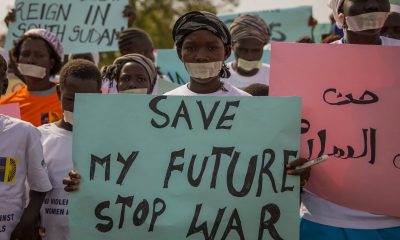

Assailants kill 73 at South Sudan Gold Mine
ShareArmed assailants killed 73 people at a gold mine in South Sudan, government officials said on Monday, in violence linked to a dispute over gold extraction. The attacks occurred on Saturday...

When Will the Bloodlettings in Nigeria Stop?
ShareBy Tochukwu Jimo Obi The latest wave of violence in Nigeria has once again exposed the fragility of the nation’s security framework....
Analysts Warn Brent Crude Price Could Surge To $200 A Barrel
ShareAnalysts have warned of significant crude oil price hikes which would further erode global economic prospects. Top grade Brent crude could surge to $200 a barrel if the Iran conflict drags on through the...


CBN Sets Three-week Deadline for Banks’ Cybersecurity Self-assessment
Share The Central Bank of Nigeria has directed banks to complete a mandatory cybersecurity self-assessment within three weeks, as part...


Jos Killings: Tinubu Meets Security Chiefs, Summons Mutfwang
ShareBy David Torough, Abuja President Bola Tinubu has summoned Plateau State Governor Caleb Mutfwang to Abuja for high-level consultations following...


Again, Senate Approves Tinubu $6bn Loan as Budget Spending Surges
ShareBy Eze Okechukwu, Abuja In a series of far-reaching fiscal decisions on Tuesday, the Senate approved a $6 billion external...
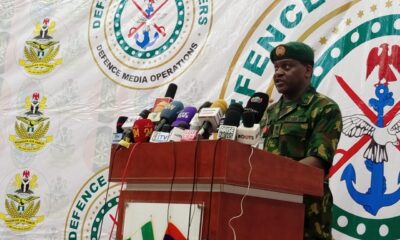

AFN Reports Major Gains against Terrorists, Rescues Over 800 Victims in Q1 2026
ShareBy David Torough, Abuja The Armed Forces of Nigeria (AFN) has announced significant operational successes across multiple conflict zones in...


Palm Sunday Killings in Jos: Nigeria Cannot Keep Bleeding Like This, CAN, insist
ShareBy Laide Akinboade, Abuja The Christian Association of Nigeria (CAN),condemned, in the strongest possible terms, the horrific attack that took...

Nasarawa Accountant General Resigns Declares for 2027 Governorship
ShareFrom Abel Zwanke, Lafia The Nasarawa state Accountant General Rt. Hon. Musa Ahmed Mohammed, has resigned his position and declared his intention to contest the 2027 governorship election....

CAF Considers Africa Cup of Nations Expansion to 28 Teams
ShareConfederation of African Football (CAF) President Patrice Motsepe has said that the Africa Cup of Nations could be expanded from 24 to 28 teams. Motsepe made the...