
NEWS
Nigeria at Sixty Five Years: A Free and Egalitarian Nation


By Uji Wilfred Terlumun
Over sixty years ago, Nigeria, like other nations of the world, set out on the journey to be an independent nation free from the shackles of slavery, oppression and inequality.Nigeria, like the United States of America, had an ambitious and utopian dream where people could be free with equal access and opportunities to development, protection and security.
In the United States of America, Independence was attained not on a platter of gold without blood and sacrifice, but, mobilized through the people in a sustained revolutionary warfare against Great Britain. The American Revolution that led to the Independence of 1774, was a mass revolution that produced a declaration of freedom, justice and human rights. The declaration of freedom simply stated that”All men are born equal with certain alienable rights endowed them by God irrespective of race, creed and nationality.”Undoubtedly, the American declaration of freedom became the basic comer stone and driving force that has continued to shape some define the struggle for the realization of freedom in America from the American Civil War leading up the Civil Rights Movement up to the Affirmative Action Movement that secured the basic human rights of minority groups in the United States of America. America is an embodiment of freedom and the struggle for freedom, whatever it entails, has been the major driving force of United States political history since the era of the founding fathers.Nigeria became an Independent Nation on the First of October, 1960, not through a revolutionary struggle, but rather, through a systematic compromise and collaboration with the International capitalist system that agreed on a transfer of political power to the ruling political class of Nigeria while the commanding heights of the economy were controlled by the international capitalist system. Nigeria’s Independence, unlike that of the United States of America, came short of a revolutionary declaration of freedom as the basic articles of freedom that all Nigerians, irrespective of ethnicity and religion, are entitled to.The founding fathers of Nigeria such as Dr Nnamdi Akiziwe, Anthony Enahoro, Obafemi Awolowo , described the Flag Independence of Nigeria as the transfer of political power to the national political ruling class, on a platter of gold. They lamented that Nigeria’s Independence struggle did not produce Martyrs and heroes as compared to other nations like the Congo, Algeria, Egypt etc. In the First, Second and Third National Development Plan, Nigeria produced a national development blueprint that expressed the ideas of freedom and justice. Upon independence, the foundation father’s of Nigeria envisaged”A free, just, egalitarian and dynamic nation full of bright and equal opportunities for all” The first acid test of a free and egalitarian society in Nigeria was the civil war between 1967 and 1971, which many analyst including some international observers described as a modern genocide war against the Ibo nationality. One of Nigeria’s founding father’s endorsed and deployed the weaponization of hunger against the Ibo nationality as a strategy of war.Whatever the misgivings and the differences, in terms of the polemics of blame and perspectives to the war, the Nigerian civil war, to some extent, did not secure freedom and justice for the Ibo nationality. The evidence for this kind of assertion is manifest in the contemporary struggle by the Movement for the Sovereign State of Biafra by the IPOD.Over fifty years after the civil war, the nostalgia and euphoria of a Biafran nation, there was a country that, in the words of Chinua Achebe, still exists in the soul and consciousness of the Ibo people.The Post civil war era came up with the policy of Reconciliation, Rehabilitation and Reconstruction, to reposition the integration of the Ibo people into mainstream Nigeria. Despite these efforts at national reconciliation and rehabilitation, people of Ibo nationality have not witnessed nor seen a free and egalitarian Nigeria where they have the kind of freedom and liberty enjoyed by the other major ethnic groups of the Fulani and Yoruba. In the military, national politics and economy, the dream of egalitarianism and freedom seems distant and isolated to the Ibo nationality.The American civil war was a defining point and compass for black African emancipation and freedom but the Nigerian civil war could not attain the objective of freedom and equality for the Ibo people. Through the institutionalization of ethnicity and religion, the Ibo have suffered marginalization and isolation from holding strategic military and leadership positions in Nigeria.We have to pause for a minute, is Nigeria a just, free and egalitarian society. On paper, we seem to have a declaration of freedom but in practice and reality, what exist is inequality and injustice. For instance, Nigeria’s national anthem, inherited from the colonial past, described and referred to Nigerians as “tribes and tongue”, a sense of disunity and unbalanced society. The national anthem further prayed and requested for God to help build a nation where no man is oppressed. From the beginning of our nationhood what the nation envisaged was the existence of tribes and tongues that were under one form of oppression and injustice. In other words, disunity and injustice which dated back to the colonial foundations that created a tripartite system which gave preponderance to the politics of regionalism and ethnicity. Arising from the contradictions of the tripartite system fueled and exacerbated by centrifugal and centripetal forces, Nigeria’s dream of a free, just and egalitarian society has remained an illusion and a sham.In contemporary times, Nigeria’s dream of a free and just society has come under further scrutiny and test. The rise of militant political Islam in the far Northern Nigeria has given birth to the Boko HaramMovement and the Islamic State, with the biggest and greatest threat to a free, just and egalitarian society.In recent times, in addition to the Nigerian civil war, militant political Islam with it’s deadly concomitant of militant herdsmen, constitutes another major acid test of Nigeria’s free and egalitarian society. How free and unjust is a nation where the Boko Haram Movement took hundreds of captives of School Children in the Chibok and Dapchi school invasion that defiled every diplomatic and military efforts by the Nigerian Government to free the captives and return them back home to their parents.The story of Leah, captured by the Chibok invasion has reminded us of the struggle for freedom and intersected by the resilience and determination of Minority Christian Groups in Nigeria to be free and just people. The Boko Haram Movement with a sense of brutality and impunity decapitated Christian Leaders who believed and exercised their fundamental right of freedom of conscience and expression.On the heels of the Boko Haram Movement, Militant Herdsmen Milita Groups led by Meyyiti Allah Katohore rolled out some of the bloodiest and gruesome genocides of the twenty first century across Northern Nigeria. The most recent episodes has been the genocide at Yelwata in July of this year that attracted the condemnation of the global community, the Papacy in the Vatican, as a massacre. Despite the prompt intervention of President Bola Ahmed Tinubu, the hideous and cruel killings of innocent and defenceless rural farmers, with the dislocations of their economy with the attending consequences of mass displacement of populations as refugees facing a looming food insecurity and hunger, all of these have continued to shape and define the political and social landscaping of Nigeria on a day to day basis.North Central of Nigeria in particular has been reduced to the worst theatres of violent conflicts and ethnic decimation that negates the idea and sense of a free and just society. In States such as Nasarawa State, Plateau State and Benue State, as well as Taraba in the North East, their is an Institutionalized process of Modern Slavery and land grabbing which has led to the displacement of minority groups in the hands ethnic majorities of the respective states. Some of the land grabbing issues and cases of genocide have attracted legal litigation in some courts of law.In conclusion, how just, free and egalitarian is Nigeria where the poverty rate is as high as seventy percent with a rising rural unemployment, food insecurity as well as a galloping inflation and interest rates that is over fifteen percent. Recent statistics from the World Bank and the International Monetary Fund, including Nigeria’s National Board of Statistics and the Central Bank, indicates growth in the informal nano sector but expressed dismay and concern at a rising poverty and unemployment in general terms. These statistics underscore the strategic consideration of the impact of poverty and helplessness against the true meaning of a just and free society.It is important to note that as a nation, we may have made progress here and there but the degree of anomie and helplessness is wide spread cutting across the entire population and segment of society and it is deplorable and deep as the days go by.President Bola Ahmed Tinubu under the Social Investment schemes of his administration has reached out to millions of Nigerians creating millions of jobs but, his reform and transformational agenda should be matched side by side with the urgent national need to protect and defend minority groups and rights especially vulnerable groups such as women, children, christians, old people etc. There is need for theFederal Government to establish a National Bureau for Ethnic Relations and Inter Group Unity to handle and manage the challenge of ethnic engineering and inter group relations.There is a need for a national agency that manages and engineers the complex and often diverse and explosive nature of ethnic relations in Nigeria moreso as it touches on the fundamental issues of a free, just and egalitarian society.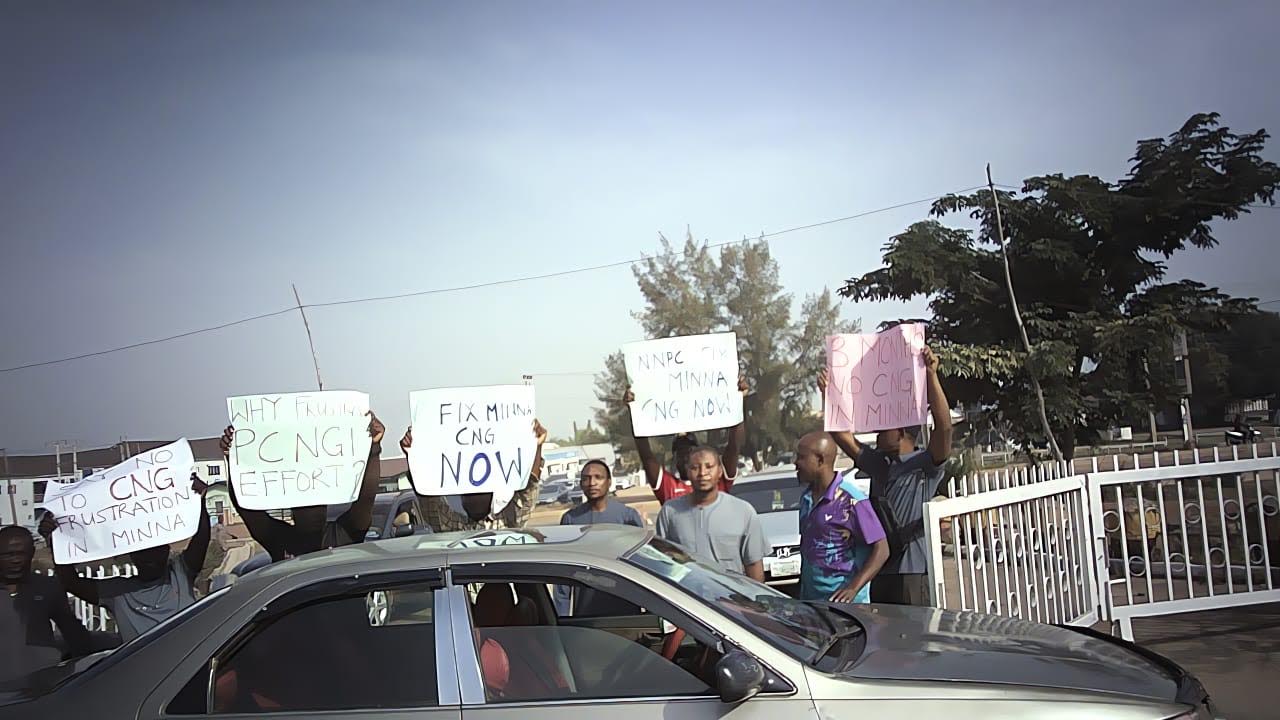
From Dan Amasingha, Minna.
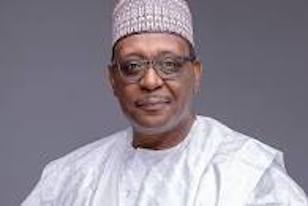
Angry vehicle owners on Sunday staged a peaceful protest at the NNPC Mega Station along the Western Bypass in Minna, Niger State, over the alleged three-month shutdown of the facility’s Compressed Natural Gas (CNG) dispensing service.
The protesters, who accused the station’s management of failing to address the persistent shortage, said the development had frustrated the Federal Government’s initiative to promote CNG as a cheaper alternative to Premium Motor Spirit (PMS), popularly known as petrol.
They lamented that despite investing hundreds of thousands of naira and, in some cases, over ₦1 million to convert their vehicles to run on CNG, they had been unable to access the product in the state capital for months.
Findings indicated that a component of the station’s CNG dispensing equipment had reportedly developed a fault but had allegedly remained unrepaired, leaving motorists who rely on the alternative fuel with little choice but to return to the more expensive petrol.
The persistent outage, the protesters said, had not only undermined the economic benefits of converting their vehicles but had also imposed additional financial burdens on vehicle owners already grappling with rising transportation and fuel costs.
Speaking during the protest, one of the motorists, Engr. Israel Ogbonnaya, described the situation as discouraging, alleging that repeated visits to the station to obtain explanations from the management had yielded no meaningful response.
“It is so discouraging that for three months now, the CNG station at NNPC Minna has not functioned. Imagine that since January, some people did conversion and have not recovered their money,” he said.
Ogbonnaya expressed disappointment that motorists had allegedly received no satisfactory explanation regarding the prolonged breakdown.
“The CNG broke down, nobody has spoken to us. We have come here several times demanding answers from the management, and nobody is talking.
“So, for now, we want to bring the attention of Nigerians and those in authority to the situation in Minna.
CNG is the heartbeat of the President. He commissioned a committee to look into this scheme, and these people are taking us for granted,” he added.
Another protester, Mohammed Doko Saidu, questioned the rationale behind encouraging motorists to convert their vehicles to CNG without ensuring the availability of adequate dispensing facilities to meet demand.
Saidu disclosed that he had spent more than ₦1 million converting his vehicle, only to discover that the product was unavailable in Minna.
“The frustrating aspect of all is that I just installed CNG, spending over a million naira, without a single gas in Minna; hoping that it is going to be fixed today, it is going to be fixed tomorrow, and up till this moment, there is nothing.
“Nobody is saying anything. The station is just lying fallow. In short, I had to disconnect some of the cylinders installed in my car because there is no gas.
What kind of government are we in? It is frustrating,” he said.
The protesters called on the NNPC Mega Station’s management and other relevant stakeholders to urgently repair the faulty equipment and restore CNG supply to Minna.
They warned that failure to resolve the problem could trigger another protest involving a larger number of aggrieved motorists, including commercial tricycle operators who also depend on CNG to reduce their operating costs.
The motorists maintained that the prolonged unavailability of the product had defeated the purpose of the conversion programme, forcing them to bear the cost of installing CNG systems while continuing to spend more on petrol.
The development raises concerns among affected motorists over the reliability of CNG supply infrastructure and the need for prompt maintenance of facilities established to support the Federal Government’s alternative-fuel initiative.
Efforts to obtain comments from the manager of the NNPC Mega Station were unsuccessful as of press time, while attendants on duty declined to speak on behalf of the management.
From Joseph Amedu, Lokoja
The Chief Medical Director of the Federal Teaching Hospital, Lokoja, Professor Abdulrahman Shehu, has called for more investment in healthcare delivery
The Chief Medical Director particularly woos philanthropists, the Federal Government and the Kogi State Government to invest more in the health sector to improve healthcare delivery and strengthen hospital infrastructure.
Prof. Shehu made the call while interacting with members of the Correspondent’s Chapel of Nigeria Union of Journalists, Kogi State Council who were in his office to clarify some issues affecting the hospital on Friday.
The renowned medical practitioner who was represented by the Chairman, Medical Advisory Committee (CMAC) Dr Raphael Odekunle, said increased private-sector and philanthropic support would complement government efforts in providing modern facilities, medical equipment and other essential resources required for hospitals to deliver quality and affordable healthcare services.
The CMD, who spoke on efforts by the new management to reposition the hospital, said the administration was committed to improving infrastructure, enhancing service delivery and ensuring that healthcare workers remained responsive to patients’ needs.
He stressed that the management would continue to introduce reforms aimed at making services more accessible, efficient and patient-friendly.
Shehu urged patients experiencing difficulties in the course of receiving treatment to channel their complaints through the hospital’s Servicom platform, describing it as an effective avenue for prompt attention to their concerns.
According to him, the platform provides patients with an opportunity to report challenges encountered while accessing healthcare services, enabling the management to identify and address such issues without unnecessary delays.
To reduce the stress of moving between departments in search of medical services, the CMD disclosed that the hospital had introduced a clinical system that brings essential service units together in one location.
He explained that the arrangement accommodates revenue, pharmacy, laboratory and National Health Insurance Scheme (NHIS) units, allowing patients to access the services they need more conveniently.
Shehu said the management planned to extend the system to other parts of the hospital to further improve service delivery and minimise the difficulties patients encounter while seeking treatment.
He, however, appealed to the Federal Government to intervene in the hospital’s infrastructure, noting that improved facilities were necessary to bring its operations in line with the standards expected of a teaching hospital.
On the hospital’s wallet payment system, the CMD defended the arrangement, describing it as a measure designed to promote transparency, accountability and curb fraudulent practices.
He explained that the system enables the hospital to manage patients’ payments in an accountable manner while ensuring that funds are used to provide the required services.
Shehu acknowledged concerns over delays in refunding patients’ unspent balances, assuring that the management was working to remove the bottlenecks associated with the process.
“We are working on how best we can remove the bottlenecks associated with delays in refunding unspent money to patients,” he said.
The CMD also appealed to the Federal and Kogi State governments to intensify public awareness and encourage more residents to enrol in the National Health Insurance Scheme to improve access to healthcare.
He noted that measures were being put in place to ensure the availability of drugs under the scheme, while clarifying that not all medications were covered by the NHIS.
Shehu urged enrollees to familiarise themselves with the scheme’s drug coverage to avoid misunderstandings when accessing prescribed medications.
On emergency care, the CMD assured that the hospital would continue to prioritise saving lives, stressing that emergency cases were attended to before payment was demanded.
He said the hospital’s primary responsibility was to preserve lives, adding that financial considerations would not take precedence over urgent medical attention in emergency situations.
The CMD further pledged that the management would sustain the training and retraining of medical and non-medical personnel to improve professionalism, strengthen patient relations and ensure that patients received satisfactory care.
He expressed confidence that the ongoing reforms, combined with improved infrastructure and support from government and private benefactors, would enhance the hospital’s capacity to provide quality healthcare services to the people.
Earlier, the Chairman of the Correspondents’ Chapel of the Nigeria Union of Journalists (NUJ), Kogi State Council, Comrade Segun Ademola Salami, commended the management of the hospital for upgrading its facilities to enhance effective healthcare delivery to residents of Kogi State and Nigerians at large.
He urged the Chief Medical Director (CMD) not to relent in his efforts to ensure that the hospital lives up to its status as a teaching hospital through the provision of quality and accessible healthcare services.
Comrade Salami, however, appealed to the management to address the challenges patients encounter while accessing medical services at the facility.

From Sylvia Udegbunam Enugu
The Commissioner of Police, Enugu State Command, CP Mamman Bitrus Giwa, has ordered a thorough investigation into the circumstances surrounding the death of Nnaji Izuchukwu (male) during an intelligence-led operation by operatives of the Anti-Cultism Section of the Violent Crime Response Unit (VCRU).
In a statement by the Police Public Relations Oficer, Enugu State command, Daniel Ndukwe said that the CP has directed the Assistant Commissioner of Police in charge of the State Intelligence Department (SID) to establish the facts of the incident and determine whether the operation and use of firearms complied with established operational standards and extant laws.
Preliminary findings indicate that operatives, acting on credible intelligence, raided Bull Hotel, Asata, Enugu, where Nworie Chidera Kelvin, a.k.a. “Akidi,” an alleged notorious drug peddler and Vikings Confraternity member, was lodged with associates. Akidi is reportedly linked to multiple cases involving unlawful firearm possession and cultism, including one in which he was charged in absentia.
He was also suspected of keeping the gang’s firearms and other criminal tools. The operation led to the arrest of Akidi and nine other suspects, comprising males and females aged 17–28. Quantities of dried weeds suspected to be “loud” cannabis, a weighing scale suspected to be used for measuring illicit drugs, and ₦43,400 in various denominations were recovered.
During the operation, Nnaji and another suspect jumped through a window in an attempt to escape. While pursuing them, an operative was confronted by both suspects, who allegedly attempted to disarm him. In the ensuing struggle, the firearm discharged, leaving Nnaji with gunshot injuries, while the other suspect escaped. Nnaji was rushed to hospital, where he was later confirmed dead. His remains have been deposited in a mortuary for preservation and autopsy.
CP Giwa has urged the deceased’s family, associates and other concerned persons to remain calm, assuring them that the circumstances surrounding the incident will be thoroughly investigated and that any officer found culpable will face appropriate disciplinary action. He reiterated that professionalism, ethical conduct and strict adherence to operational standards, particularly those governing the use of firearms, must never be compromised in any police operation.



Motorists Storm Minna NNPC Mega Station, Threaten Mass Protest Over CNG Scarcity
Share From Dan Amasingha, Minna. Angry vehicle owners on Sunday staged a peaceful protest at the NNPC Mega Station along...

Lokoja CMD Seeks More Investments in Healthcare Delivery
ShareFrom Joseph Amedu, Lokoja The Chief Medical Director of the Federal Teaching Hospital, Lokoja, Professor Abdulrahman Shehu, has called for...

Enugu CP Orders investigation into Man’s Death During Police Operation
ShareFrom Sylvia Udegbunam Enugu The Commissioner of Police, Enugu State Command, CP Mamman Bitrus Giwa, has ordered a thorough investigation...

Police Officer Shoots Female Colleague to Death, Kills Self in Kogi
ShareFrom Joseph Amedu, Lokoja Kogi State Police Command has confirmed a tragic incident that claimed the lives of two police...

2027: Benue People Are Not ‘Shenanigans’, Alia Owes You No Apology, Ex-Ambassador Tells Ortom
ShareFrom Attah Ede, Makurdi A former Nigerian Ambassador to Namibia, Terhemen Tarzoor, has criticized former Benue State Governor Samuel Ortom...

JPMorgan’s Entry into Nigeria: Turning Global Finance into a National Development Opportunity
ShareBy Uche Joe Uwaleke The proposed establishment of JPMorgan Merchant Bank Nigeria Limited presents Nigeria with an important opportunity to...

WAHO Steps Up Regional Health Surveillance After Ebola Case Confirmed in Abuja
ShareBy David Torough, Abuja The West African Health Organisation (WAHO) has intensified regional health surveillance following the confirmation of an...

2027: Don’t Call Benue People Shenanigans, Alia not answerable to you- Ex- Amb, Tarzoor Tells Ortom, Wike.
ShareFrom Attah Ede, Makurdi Ex -Nigeria’s Ambassador to Namibia, Terhemen Tarzoor, has warned the immediate past Governor of Benue State...

DBN Signs $61m Credit Deal With AfDB, Unveils Support Initiative Report
ShareBy Tony Obiechina, Abuja The Development Bank of Nigeria Plc (DBN) has launched DAWN: DBN Action for Women in Nigeria,...

NLC Threatens Nationwide Action as Talks With FG Collapse
ShareBy Tambaya Julius, Abuja The Nigeria Labour Congress (NLC) has threatened possible nationwide industrial action following the failure of talks...