
COVER
Obasanjo, Gumi Meet, Canvass Special Courts for Banditry, Kidnappings


… Niger Senator Seeks New Strategy to Stop Killings
… Kukah Blames FG for Increased Crime
From Dan Amasingha, Minna
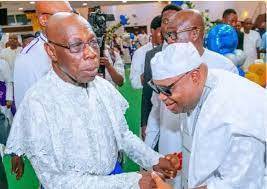
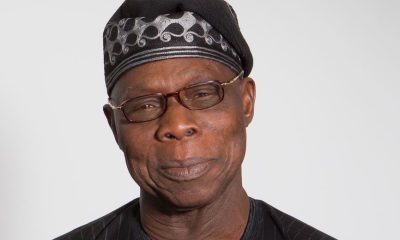
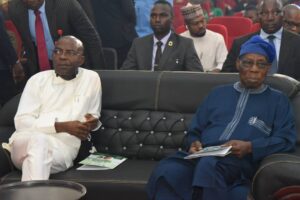
Former President Olusegun Obasanjo yesterday played host to Sheikh Ahmad Gumi led a delegation to in Abeokuta, Ogun State, over the insecurity in the country.
.He meeting demanded that all persons bearing arms illegally must be punished and that special courts should be created to handle cases of banditry, kidnapping, among other crimes.
On Gumi’s entourage were Prof. Usman Yusuf, Mallam Tukur Mamu, Dr. Umar Ardo, Dr. Ibrahim Abdullahi, Honourable Suleiman Gumi, Alhaji Suleiman Yakubu and Mallam Buba Mohammed,
Obasanjo received Gumi in the presence of Oba Babajide Bakre, Agura of Gbagura, Abeokuta; Bishop Tunde Akin-Akinsanya, Chairman of Ogun State Christian Association of Nigeria; Sheikh Sa’addallah Alade Bamigbola, Chief Imam of Egbaland; Chief Kenny Martins, Chief Ola Babajide Jaiyeoba; Rev.
Tony Ojeshina, Chief Imams of Oke-Ona, Gbagura, Owu and Mr. Vitalis Ortese.Gumi briefed Obasanjo on the measures and steps he had taken and spearheaded to stem the tide of insecurity and menace of banditry, kidnapping and ransom payment in many parts of the North.
The Islamic scholar, at the meeting, clarified some statements credited to him and insisted his intentions were genuine.
Obasanjo commended Sheikh Gumi for his initiative and encouraged him not to relent in his efforts, while Gumi thanked him for his past services emphasising the special unifying efforts.
A statement on Sunday by Obasanjo’s spokesman, Kehinde Akinyemi, made public the details of the meeting.
The participants agreed that the menace of banditry, kidnapping, other crimes and atrocities leading to general insecurity is a nationwide phenomenon.
“We acknowledge that people from different parts of the country and outside the country are involved although some people are more predominantly involved than others.
“We must not advertently or inadvertently, in words, action or inaction encourage or support criminality. We identified the crisis as micro ethnic conflict between the Fulani and many host communities mainly in the North West.
“We identified the remote causes as educational and economic disparities, and the negative use of religion and ethnicity by unscrupulous politicians.
“Solutions must be seen and provided on short, medium-, and long-term bases and must be composed of stick and carrot for the offender and the vulnerable.
“Nigerians should desist from blame game; desist from ethnicizing crimes; desist from religionizing crimes; desisting from regionalising crimes; respect one another individually, community-wise, locally, ethnically, religiously and socially;
“Show tolerance and accommodation where necessary; condemn criminal acts no matter where it is committed and by whom it is committed in Nigeria; encourage more of carrot solution as may be found necessary; share information at all levels; reject criminality as a way of life for any individual or group in our nation.
“Since the end of the civil war, the military is the strongest and most potent instrument and symbol of national unity that we have and we must keep them so.
“State governments must have adequate means of providing security for their people and as chief executives and chief security officers of their states, they must have the means at their disposal to ensure security for all within their states.
“Federal government must be proactive and secure necessary and updated intelligence to deal with organised crimes and have common policy for the nation. It is not solving the problem when one state goes for negotiation and molly-cuddling of criminals and another one goes for shooting them. Nor should one state go for ransom payment and another one going against.
“Education is one main key to solve the problem in the long run but it must start now. The 14 million children that should be in school and are out of school must be put in school with local authorities, state governments and the federal government working together.
“Wean those who are ready to be weaned out of the bushes and crime, settle and rehabilitate them, give them skills, empower them and let them have employment.
“The hardened criminals must be hard hit with sticks. Unlawful carrying of arms should be very seriously punished. Federal government should take the issue up seriously within ECOWAS to work for a regional solution.
“Every community must be encouraged and empowered to stand firm and strong against criminals. There should be protection and reward covertly for whistleblowers against criminals living in the community.”
“Special courts should be created to deal promptly with cases of banditry, kidnapping, ransom demanding and unlawful carrying of weapons.”
Niger Senator Seeks New Strategy to Stop Killings
The Senator representing Niger East Senatorial District in the National Assembly, Senator Mohammed Sani Musa, has advised Nigeria’s security agencies to adopt new strategies to fight insurgencies and banditry now prevailing in parts of the country.
Senator Musa made the suggestion against the backdrop of the massacre of seven security operatives in their Allawa security base in the Shiroro Local Government Area of Niger state on Thursday last week.
He lamented that the nation was losing too many of its trained personal to bandits and even the Boko Haram elements which requires that the top echelon of the armed forces should re-strategise to protect our soldiers ant the policemen.
He said it will not be out of place if the military and other security forces force the bandits and other criminals from their hiding places in the forests since they have turned the forests to their abodes from where the unleash mayhem on innocent and peace loving Nigerians.
Musa described as shocking and totally unacceptable the massacre of these security men by these lawless and blood thirsty bandits saying everything should be done to exterminate them once and for all.
He however said the army and police authorities should reconsider their decision to close the military camps at Allawa and Bassa as a result of Thursday’s incident.
Closing the camps is not the solution to the problem since chopping off the head has never been the solution to persistent headache, what we should do is to devise new methods of tackling insurgency and banditry.
The closing of the camps will open the communities to more attacks by bandits he said
Musa commiserated with officers and men of the Nigerian Army and those of the police as well as the families of the deceased security operatives who lost their lives in the attacks by these bandits and pray to God to grant the souls of the departed eternal rest and their families the fortitude to bare the irreparable loss.
I charge their families to take this ugly incident as an act of God and that these our loved ones died in the service to the nation.
Kukah Blames FG for Increased Crime
The Catholic Bishop of Sokoto Diocese, Bishop Matthew Kukah, has blamed the Federal Government for the increased cases of banditry, kidnapping, terrorism and armed robbery in the country.
According to him, banditry and kidnapping are on the increase in the country because those in power pay more attention to rehabilitating bandits and kidnappers, instead of the victims of such crimes.
Giving his 2021 Easter message titled, ‘Before our glory departs’, yesterday, Kukah expressed concern over the killings of security operatives and “helplessness” of the citizens, noting that Nigeria has become a massive killing field, where both government and the governed look helpless.
“Taunted by Boko Haram, ravaged by bandits, kidnappers, armed robbers, and other merchants of death across the nation, there is collective fear as to whether Nigeria’s glory is about to depart! Retired military and intelligence officers lament over what has become of their glorious profession as they watch the humiliation of our military personnel.
“Traumatised citizens are tortured daily by bandits. The nation has since become a massive killing field, as both government and the governed look on helplessly.
“A thick and suffocating cloud of desperation, despondency, desolation, gloom, and misery hangs in the hot air. We have no message and have no idea how long this will last. Our people seek solace and protection, but frustration and darkness threaten to drown them. Is their government on AWOL?
“Sadly, human life is haemorrhaging so badly in Nigeria, but the greatest tragedy is the death of empathy from those in power. Mysteriously, the government is investing billions of naira in rehabilitating so-called Boko Haram repentant members and their other partners in crime in the belief that they want to turn a new leaf.
“These criminals have waged war against their country, murdered thousands of citizens, destroyed infrastructure and rendered entire families permanently displaced and dislocated. Why should rehabilitating the perpetrator be more important than bringing succour to the victims?
“When kidnapped or killed, victims and their families are left to their wits. They cry alone, bury their loved ones alone. And our government expects us to be patriotic? The victims of violence need empathy, which the dictionary defines as the ability to understand and share the feelings of the other,” Kukah stated.
Kukah maintained that a critical deficit of empathy on the side of the government had made the healing of victims of abduction almost impossible, as the government was yet to initiate a rehabilitation programme for the schoolchildren that were victims of abduction.
“We seem to assume that their return to their schools is sufficient. Left unaddressed, the traumatic effect of their horrors will haunt them for a long time.
“Tomorrow’s parents, military generals, top security men and women, governors, senators, and ministers will come from today’s pool of traumatised children. The security quandary is the greatest indictment of this government,” he added.





By Laide Akinboade, Abuja
As part of efforts to reposition the newspaper for optimum corporate performance, the management of Asset Newspapers Limited, Publishers of DAILY ASSET, has announced the appointment of David Torough as the Editor of the Abuja-based national daily.
A statement by the management said the appointments were part of the company’s new strategy to further penetrate the various states in the country and raise its readership and patronage.
“DAILY ASSET is widely acceptable across the country and to maintain our leadership position, we need to increase management presence, hence the need to create new Bureau offices in some locations outside Abuja and Lagos,” the statement quoted the Publisher/ Editor-in-Chief, Dr Cletus Akwaya to have said.
In a statement yesterday, Publisher and Editor-in-Chief of the fast-growing daily, Dr. Cletus Akwaya said the appointment was part of the new strategy to properly situate the paper for better productivity.
“DAILY ASSET has a commitment with the Nigerian people. We are determined to weather the storm and give Nigerian readers a Newspaper that satisfies their yearnings and reading pleasure and we can only do that with the right set of professionals,” the statement said.
Akwaya, a former Commissioner of Information from Benue State said the difficult times being faced by Nigerians posed a great challenge to the media as the people deserved credible information with which to make choices.
“We have a bond with the people, to offer credible information at all times in the best tradition of the Nigerian Press and on this scale of objectivity, truth and fairness, we pledge to remain steadfast no matter the challenges,” Akwaya was quoted to have said.
He said the newspaper will maiantin its daily print run and circulation to all states of the federation and urged advertisers to take advantage of the deep penetration of the Daily Asset brand to send their messages.
Torough, the new Editor has had a steady rise in the Newspaper in the last five years.
A graduate of Mass communication of the Benue State University, Makurdi, Torough joined the company in 2022 as Benue State Correspondent. He was spotted for his brilliance and redeployed to Abuja the following year and promoted to Deputy News Editor. He was subswuently named Deputy Editor of the paper, a position he held until the recent appointment.
Torough has attended several journalistic workshops and trainings to properly equip himself for the task ahead.
The statement also said the Management named Eze Okechukwu as Deputy Editor.
Before his elevation as Deputy Editor, Eze has been Deputy Politics Editor and DAILY ASSET Newspaper correspondent covering the Senate, having joined the organization in 2021.
Born on March 10, 1975, Eze holds a Masters Degree in Mass Communication from the Enugu State University of Science and Technology.
Eze began his journalism career with Daily Star, Enugu and later worked with Daily Trust Newspaper, Abuja as sports reporter.
Aside from his journalistic excellence, he has a great deal of passion for sports.

From Ngutor Dekera, Kaduna and Aliyu Askira, Kano
Northern governors and traditional rulers yesterday called for the suspension of mining activities across the region for six months, blaming illegal mining for worsening insecurity in many states.The resolution was contained in a communiqué issued after a joint meeting of the Northern States Governors’ Forum and the Northern Traditional Rulers’ Council held at the Sir Kashim Ibrahim House, Kaduna.
The meeting, chaired by the Gombe State Governor and NSGF Chairman, Muhammadu Yahaya, had in attendance the 19 northern governors and chairmen of the 19 states’ traditional councils. The Forum expressed concern over the escalating violence in parts of the North, including the killings and abductions recently recorded in Kebbi, Kwara, Kogi, Niger, Sokoto, Jigawa and Kano states, as well as renewed Boko Haram attacks in Borno and Yobe.“The Forum extends its deepest condolences and solidarity to the governments and good people of the affected states,” the communiqué said, noting that the attacks on schoolchildren and other citizens had become “unacceptable tragedies” that required urgent collective action.It commended President Bola Tinubu for what it described as the Federal Government’s “firm response” to recent abductions and insurgency threats, especially the rescue of some abducted pupils.The governors also saluted security agencies for their sacrifices on the frontlines.“We resolved to renew our support for every step taken by the President and Commander-in-Chief to take the fight to insurgents’ enclaves in order to end the criminality,” the Forum stated.A major highlight of the meeting was the North’s renewed push for the establishment of state police, with governors and traditional rulers insisting that decentralised policing had become inevitable.“The Forum reaffirms its wholehearted support and commitment to the establishment of state police,” the communiqué added, urging federal and state lawmakers from the region to “expedite action for its actualisation.”On illegal mining, the governors said criminal mining networks were fuelling violence and providing resources for armed groups.As a corrective measure, they asked Tinubu to direct the Minister of Solid Minerals to impose a six-month suspension of mining activities in order to allow for a full audit and revalidation of licences.“The Forum observed that illegal mining has become a major contributory factor to the security crises in Northern Nigeria. “We strongly recommend a suspension of mining exploration for six months to allow proper audit and to arrest the menace of artisanal illegal mining,” it said.To strengthen the fight against insecurity, the governors also announced the creation of a regional Security Trust Fund.Under the proposed arrangement, each state and its local governments will contribute ₦1bn monthly, to be deducted at source under an agreed framework.They said the fund would help provide sustainable financing for joint operations, intelligence-driven interventions and coordinated security responses across the region.At the end of the meeting, the Forum reaffirmed its commitment to unity and collective responsibility.“Only through unity, peer review and cooperation can we overcome the pressing challenges before us,” it declared.The Forum agreed to reconvene on a date to be announced.Meanwhile, Nigeria’s worsening security crisis took a grim turn on Monday as bandits launched fresh attacks in Kano State, abducting 25 villagers, even as the Federal Government raced to secure the release of more than 300 Catholic school children kidnapped in Niger State.In the early hours of Monday, armed bandits invaded Unguwar Tsamiya—popularly called Dabawa—in Shanono Local Government Area of Kano State, whisking away nine men and two women after shooting into the air and assaulting residents. The attackers also rustled two cows.A resident lamented the community’s helplessness: “We cannot do otherwise; most of us cannot leave because we have nowhere to go. This is our place, our land and everything is here.”The assault came less than 24 hours after a similar attack on Yan Kamaye in Tsanyawa LGA, a community along the volatile Katsina border.In Niger State, National Security Adviser Nuhu Ribadu has assured distraught families of St. Mary’s Co-Education School, Kontagora that the more than 300 students and staff abducted on November 21 will return home “soon.” Ribadu, who led a high-level federal delegation to the school on Monday, said the abductees are safe, though he offered no specifics on their location or the status of rescue operations.According to Daniel Atori, spokesman for the Catholic bishop overseeing the school, the NSA reassured officials: “The children are where they are and will come back safely.”The St. Mary’s attack is part of a worrying resurgence of mass kidnappings reminiscent of the 2014 Chibok schoolgirls’ abduction. Security analysts warn that banditry has evolved into a “structured, profit-seeking industry,” with hundreds of Nigerians abducted in November alone.The Kontagora school abduction occurred the same week 25 girls were kidnapped in Kebbi State—victims who authorities say have since been rescued through “non-kinetic” means. About 50 of the St. Mary’s hostages have also managed to escape.Ribadu’s delegation, which included the Minister of Humanitarian Affairs and the Director-General of the Department of State Services (DSS), reaffirmed the government’s commitment to securing the freedom of all abducted citizens.As communities from Kano to Niger continue to bear the brunt of these violent incursions, the escalating spate of kidnappings underscores the urgent national demand for a more decisive and coordinated security response.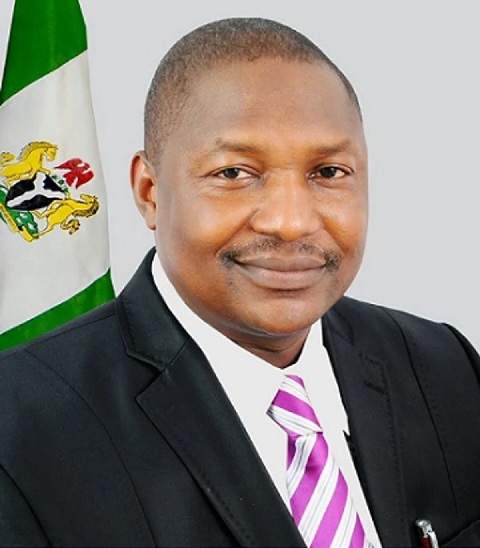
By David Torough, Abuja
The Economic and Financial Crimes Commission (EFCC) said former Attorney‑General of the Federation and Minister of Justice, Abubakar Malami, will face a team of interrogators at its office daily throughout December.A credible source in the EFCC said on Monday that the daily appearance was part of an ongoing investigation into the whereabouts of an alleged 490 million dollars Abacha loot secured through a Mutual Legal Assistance (MLAT) request.
The source said that Malami, who was summoned for interrogation by the EFCC on Saturday, was barred from leaving Nigeria for the next one month.According to the source, one of the conditions for his release on Saturday was that he should report daily to the EFCC Headquarters in Abuja for further interrogation.The source said Malami would have to appear daily at the anti-graft office due to the volume of the investigation and the seriousness of the charges against him.”We seized his passport, it is the normal routine during investigation, but he has to report at the EFCC headquarters in Abuja every day for the next month.”He will be reporting for further investigation throughout December.”He will be reporting every day, starting from Dec. 1st to Dec. 31st.He will appear before the team of investigators for the entire month of December.”He will be reporting to EFCC for investigation for the period because of the volume of the investigation and the seriousness of the charges against him,” the source added.According to the source, a fact sheet on the former minister revealed that Malami had several issues to clarify with the EFCC within the coming weeks.“We have asked him to explain the whereabouts of the $490 million Abacha loot secured through MLAT.“We didn’t say he stole money, but he should account for the loot. This is one of the issues he will clarify to our investigators.”The commission cited the large volume of documents he must review and the need for extensive interviews as reasons for seizing his passport.The source said EFCC would not engage in a war of words but would release its findings after a thorough investigation.Malami, in a statement by his media aide, Mohammed Doka, on Monday in Abuja, however, described the EFCC investigation as a political witch‑hunt.He confirmed he honored an EFCC invitation on Nov. 28, describing the engagement as fruitful and expressing confidence that the probe would vindicate him.Malami described the EFCC’s allegations as baseless, illogical and devoid of substance, insisting they collapse under factual scrutiny.


Dangote Petitions ICPC, Accuses NMDPRA Boss of Corruption, Abuses
ShareBy David Torough, Abuja President of the Dangote Group, Alhaji Aliko Dangote, has petitioned the Independent Corrupt Practices and Other Related Offences Commission...

NDIC Liquidates Aso Savings, Union Homes, Pays N2m Deposits
ShareBy Tony Obiechina, Abuja The Nigerian Deposit Insurance Corporation (NDIC) exercised its appointment as the liquidator of Aso Savings and...


Reps Launch Nationwide Probe into Drug Abuse, Trafficking Crisis
ShareBy Ubong Ukpong, Abuja The House of Representatives has commenced a nationwide investigation into Nigeria’s worsening drug abuse and trafficking...

Clement Koko Assumes Office as CIPPON President
ShareBy David Torough, Abuja Clement Koko has been inaugurated as the President and Chairman-in-Council of the Chartered Institute of Professional...

Thousands of Drivers Wrongly Fined for Speeding Since 2021
ShareThousands of drivers could have speeding fines cancelled after a fault saw some cameras falsely triggered on English A roads...


UK Unemployment Rate Rises to 5.1 Per cent
ShareThe UK unemployment rate in the three months to October has increased to 5.1%, according to official figures. That marked...


French Court Sentences Ex-DR Congo Rebel, Politician to 30 Years in Jail
ShareA French court has sentenced a former rebel leader and politician from the Democratic Republic of Congo to 30 years...


EEDC Explains Recent Decline in Power Supply across South-East
ShareThe Enugu Electricity Distribution Company (EEDC) has attributed the recent decline in power supply across the South-East to low electricity...
DMO Takes Sensitisation on Borrowing Guidelines to Northern States
ShareThe Debt Management Office (DMO) said that its World Bank-assisted workshop on borrowing guidelines was designed to intimate subnational entities...


Oborevwori Signs N1.729trn 2026 Budget, Three Other Bills into Law
ShareFrom Francis Sadhere, Delta Delta State Governor, Sheriff Oborevwori on Tuesday signed the 2026 Appropriation Bill of N1.729 trillion, tagged...