
Oil & Gas
Residents Report Fresh Oil Leak From Aiteo’s OML 29 in Nembe

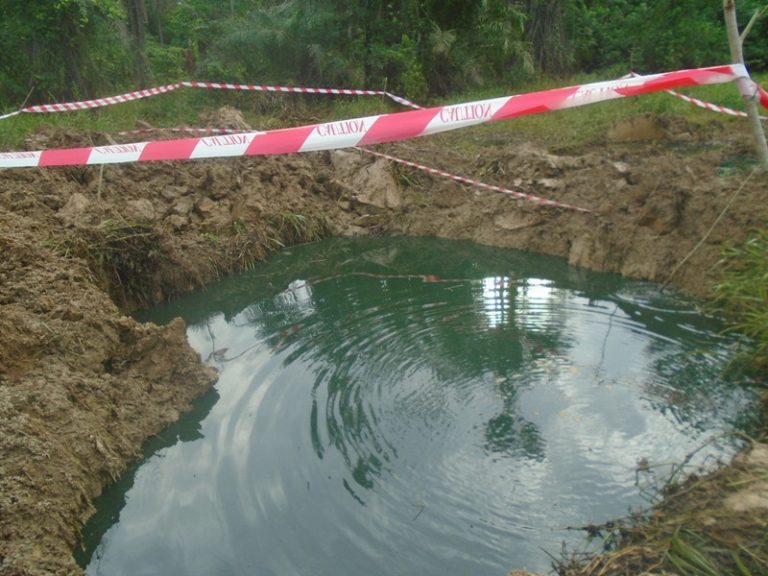
Residents of Nembe in Bayelsa have reported fresh oil leak, months after the Nov. 5 spill at Oil Mining Lease (OML) 29, the News Agency of Nigeria (NAN) reports.
OML 29, which encompasses the 97km Nembe Creek Trunk Line connecting oilfields to the Bonny Export Terminal is operated by Aiteo Eastern Exploration and Production Company, an indigenous firm.
Aiteo acquired OML 29 for $2.
4 billion following divestment by Shell Petroleum Development Company in 2015.NAN learnt that the alleged leak, which originated from a ruptured pipeline from Nembe Flow Station 4 near Ogbolomabiri, has been discharging crude into the Nembe creeks.
James Karibo, a fisherman who operates in the area, bemoaned the incident which occurred barely three months after an earlier leak from the facility and which lasted for 32 days before it was plugged.
“It is a sad news for us who depend on fishing in the creeks. We have not even recovered from the losses from the last spill which contaminated, destroyed our fishing nets. We are in distress and cannot fish in oil contaminated waters,” he said.
Chief Ebinabo Waribo of Malabo in Opu-Nembe, who confirmed the incident, expressed regrets that the company has yet to respond to the leak.
“This is a major spill at ‘Nembe 4’ and Aiteo has not responded yet. They have not mobilised a spill response team to site to contain the spilled crude.
“The oil discharge has spread to Bassambiri and its satellite communities and adversely impacted the fishing vocation of the people,” Waribo said.
Mr Ndianabasi Mathew, spokesperson for Aiteo Group has yet to respond to request for comments. (NAN)











The Managing Director of Chevron Nigeria Limited, Jim Swartz, has highlighted key areas that would sustain Nigeria’s energy transition growth pathway.
Swartz, is of the opinion that strong collaboration and partnership are key to sustain the country’s energy needs.
Speaking at the just-concluded 49th Nigerian Annual International Conference and Exhibition (NAICE) in Lagos, Swartz, said no one player can deliver the scale of projects required to achieve the goals set by the country alone.
He declared that Collaboration is essential because no single company, institution, or stakeholder can address the opportunities and challenges of the intersector alone.
And technology will remain a key driver of safer operations, stronger performance, and the future that we will deliver. For Nigeria, the opportunity is significant.The conference with the theme “Thriving in the Evolving Global Energy Landscape: Collaborative Growth and Resilience,” focused on how Nigeria can compete for capital and sustain production amid global volatility.
The managing director listed four pillars he believed are essential to define a resilient energy future.
These include continued investment, enabling long-term policies, competitive local capacity development, and strong partnerships.
He continued, “Building a resilient energy future requires continued investment, enabling policies that are resilient for the long-term, local capacity development that’s competitive and durable as well, and strong partnerships across governments, regulators, industry, and the technical community,”.
He said Chevron has invested in Nigeria for more than six decades, noting the company’s role in building the foundation of the industry and in developing technical capacity.
The firm therefore called for stronger collaboration across government, regulators and industry operators as the foundation for building a resilient oil and gas sector that can deliver growth, jobs and energy security for Nigeria.
By David Torough, Abuja
The Nigerian National Petroleum Company Limited (NNPC) said it saved $3.4bn through contract restructuring and optimisation over the past year, while increasing its contribution to government revenue to N19.
5tn and boosting crude oil and gas production.Group Chief Executive Officer, Bayo Ojulari, disclosed the figures on Tuesday while presenting the company’s one-year performance scorecard at the opening of the 25th NOG Energy Week in Abuja.
According to Ojulari, the contract optimisation programme reduced operating costs by $3.
4bn without disrupting operations, strengthening commercial efficiency and improving the competitiveness of Nigeria’s oil and gas industry.The scorecard showed that crude oil production rose by six per cent year-on-year to 569.7 million barrels, while gas production increased by 8.1 per cent to 2,576 billion standard cubic feet. NNPC’s contribution to government revenue also climbed by 21.8 per cent to N19.5tn.
Ojulari said Nigeria’s crude oil production has reached about 1.71 million barrels per day, the highest level in five years, while NNPC Exploration and Production Limited achieved a record output of 365,000 barrels per day.
He said the company aims to increase crude oil production to two million barrels per day by 2027 and three million barrels per day by 2030. Gas production is projected to rise from 7.62 billion cubic feet per day this year to 10 billion cubic feet per day in 2027 and 12 billion cubic feet per day by 2030.
The NNPC boss also reported significant improvements in export infrastructure, noting that crude export terminals recorded an average 98 per cent recovery factor between April 2025 and May 2026. He added that major evacuation pipelines, including the Trans Niger, Trans Escravos, Trans Ramos, Trans Forcados and Oando-Brass lines, are operating at 100 per cent availability.
Ojulari further disclosed that NNPC maintained 100 per cent compliance with its Joint Venture cash-call obligations throughout 2025 and into June 2026, although some partners remained in default, increasing the company’s funding responsibilities.
On the commercial front, he said NNPC signed gas sale and purchase agreements covering 1.29 billion standard cubic feet per day for long-term LNG feed gas and 750 million standard cubic feet per day for domestic industrial gas supply to DFL FZE and Dangote Refinery. The agreements are expected to attract more than $20bn in investments, with seven additional transactions under negotiation.
He also highlighted governance reforms, including the resumption of monthly remittances to the Federation Account in July 2025, the restoration of monthly business performance reporting and the company’s first earnings call in November 2025.
Ojulari urged governments, investors, regulators and operators across Africa to strengthen collaboration, arguing that strategic partnerships would be critical to unlocking the continent’s energy potential and attracting greater investment.
The Organization of the Petroleum Exporting Countries (OPEC), has revised downward its 2026 global oil demand growth estimates, citing expected slower consumption growth in advanced economies, where collective demand will rise by only 100,000 barrels per day.
The cartel said it now expects global oil demand growth to reach 1.
2 million barrels per day in 2026, down from its previous forecast of 1. 4 million barrels per day, explaining that the revision would bring total global oil consumption to 106.3 million barrels per day.In Europe, oil demand will decline by 30,000 barrels per day as weaker economic activity weighs on consumption, OPEC, said in its monthly oil market report.
The OPEC also expects some Asian economies, particularly Japan, to record slower demand growth. The organization forecast Japanese oil consumption to fall by 80,000 barrels per day.
However, strong demand from major emerging economies partly offset these weaker signals.
The OPEC said China would add 250,000 barrels per day to global demand, supported by its petrochemical industry. The organization also forecast India to increase demand by 200,000 barrels per day, driven by infrastructure spending and growth in vehicle ownership. Overall, OPEC expects emerging economies and developing countries to contribute an additional 1.1 million barrels per day to global oil consumption in 2026.
The OPEC’s revision aligns with a broader reassessment of global oil demand expectations.
In its May 2026 report, the International Energy Agency projected a much sharper downturn. The agency forecast a contraction of 420,000 barrels per day in global oil demand for the full year rather than a slowdown in growth.
The gap between the two institutions now exceeds 1 million barrels per day, highlighting the uncertainty surrounding the market outlook.
Both reports identified the near-closure of the Strait of Hormuz as a major factor behind market instability. According to the U.S. Energy Information Administration, six Gulf countries collectively reduced production by 10.5 million barrels per day in April, marking what the agency described as an unprecedented contraction outside pandemic periods.
As supply shortages intensified, oil producers outside the Middle East moved to increase production to offset part of the missing volumes. Several African producers, including Nigeria, Libya and Angola, benefited from rising demand for Atlantic Basin crude among Asian and European buyers that lost access to Gulf oil supplies, according to the IEA.
However, not all African producers can fully capitalize on the opportunity. Nigeria, Africa’s largest oil producer and an OPEC member, nonetheless showed encouraging momentum. According to provisional data published on May 15 by the Nigerian Upstream Petroleum Regulatory Commission, the country increased oil production from 1.546 million barrels per day in March to 1.663 million barrels per day in April 2026.




Akume Assures NASENI of FG Support as Agency Unveils Innovations for National Development
ShareBy David Torough, Abuja The Secretary to the Government of the Federation (SGF), Senator George Akume, has commended the National...


ONSA Begins First National Crisis Response Exercise Outside Abuja in Delta
ShareBy David Torough, Abuja The Office of the National Security Adviser (ONSA) has commenced the 2026 Rapid Response 3 (RR3)...


Information Minister Backs NIPSS Plan to Unlock Nigeria’s Orange Economy Potential
ShareBy David Torough, Abuja The Federal Government has pledged its support for the National Institute for Policy and Strategic Studies...


Akpodo Community Appreciates Lydia Memorial Hospital for Medical Outreach, Seeks Road Intervention
ShareBy David Torough, Abuja The Akpodo Community has paid a thank-you visit to the management and staff of Lydia Memorial...
NAFDAC Seeks Harsher Penalties for Counterfeiters
ShareThe National Agency for Food and Drug Administration and Control (NAFDAC) has renewed its call for harsher penalties for counterfeiters....
Nigeria’s Q2 2026 Data Narrative: A Triumph of Reforms or Just Recovery?
ShareBy Uddin Ifeanyi Against the backdrop provided by the incumbent government’s professed ambitions for the country, the 4.43 per cent...


APC, PDP Challenge Adeleke’s August Win as Osun Tribunal Posts Petitions
ShareFrom Ayinde Akintade, Osogbo The All Progressives Congress has taken Osun state Governor Ademola Adeleke’s re-election to court as the...
GOC Fadairo Reaffirms Continuous Military Action against Separatist Threat
ShareFrom Sylvia Udegbunam, Enugu The General Officer Commanding (GOC) 82 Division, Nigerian Army, and Commander, Joint Task Force South East,...


Osun NSCDC Gets New Commandant
ShareFrom Ayinde Akintade, Osogbo The Commandant General of the Nigeria Security and Civil Defence Corps (NSCDC), Prof. Ahmed Abubakar Audi,...
How Nigeria is Closing the Net on Illicit Arms
ShareBy Sumaila Ogbaje Undoubtedly, the steady flow of illegal weapons is keeping Nigeria’s security crisis alive. From rural communities to...