
NEWS
Troops Kill 40 Terrorists, Rescue Seven Kidnap Victims in Nationwide Offensive

By David Torough, Abuja
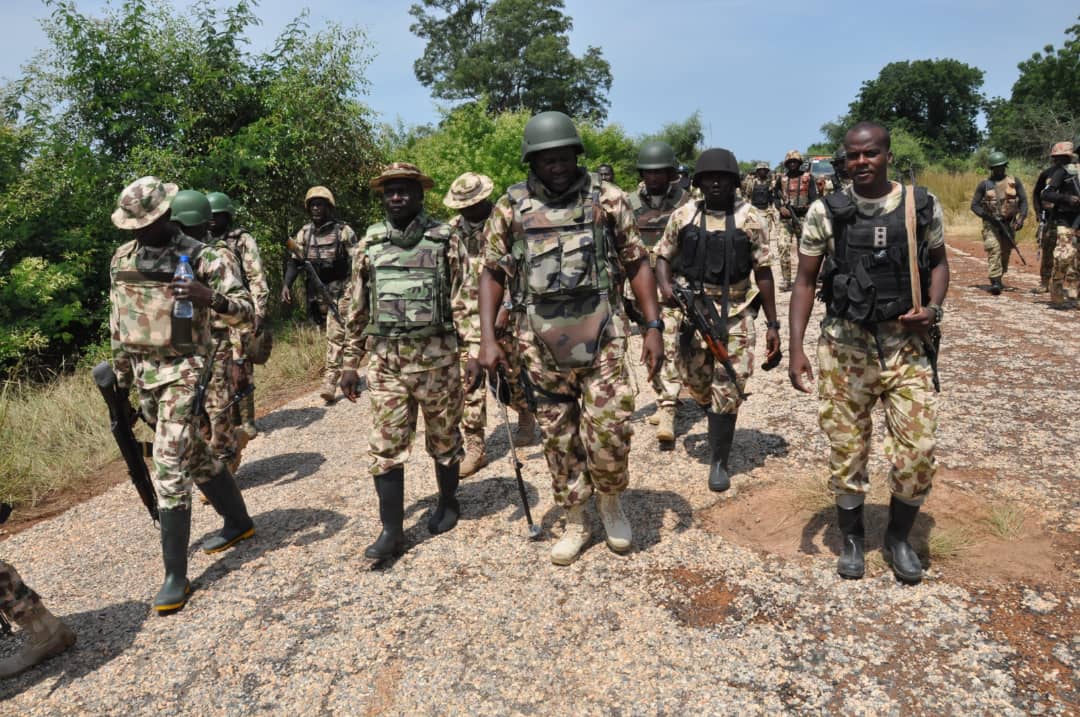
Nigerian troops have neutralised 40 suspected terrorists, rescued seven kidnapped victims, foiled attacks and recovered a cache of weapons and other criminal assets in separate operations across the country.
The military said the operations, conducted between August 19 and August 22, also resulted in the arrest of suspected kidnappers, the recovery of AK-47 rifles and ammunition, and the destruction of an improvised explosive device.
In the North-East, troops of Operation HADIN KAI received five JAS fighters who surrendered in Bama Local Government Area of Borno State.
The fighters handed over 358 rounds of 7.62mm ammunition and three rounds of 7.62mm special ammunition.Troops also foiled an attempted attack on commuters along the Gajiram-Mairari road in Nganzai Local Government Area after terrorists opened fire on a truck and damaged one of its tyres. The attackers fled following the troops’ response, while soldiers assisted the driver and safely removed the vehicle from the area.
In separate intelligence, surveillance and reconnaissance operations, military aircraft neutralised 38 suspected terrorists in precision strikes in Borno. According to the military, one strike killed 16 terrorists gathered around a makeshift hut, while a follow-up strike neutralised 10 others who fled the scene. Another operation resulted in 12 suspected terrorists being neutralised after they were tracked to a hut.
In the South-East, troops of Operation UDO KA neutralised one suspected IPOB/ESN terrorist during a dawn operation in Ogbaru Local Government Area of Anambra State. Two pump-action guns, two motorcycles and materials suspected to be for improvised explosive devices were recovered.
Meanwhile, troops of Operation FANSAN YAMMA rescued six kidnapped victims along the Dandume-Sheme Road in Katsina State after engaging terrorists who had intercepted their vehicle. The attackers abandoned the victims and fled into the bushes under superior firepower.
The troops also recovered N800,000 taken from the victims and returned the money and their vehicle to them in the presence of the Divisional Police Officer in Dandume.
In another operation in Katsina, troops engaged terrorists around the Maraban Kankara axis in Kankara Local Government Area, forcing them to flee and abandoning a motorcycle.
In Zamfara, troops responding to an attack on commuters along the Gusau-Maru-Sokoto Road recovered the body of a vehicle driver who was killed during the incident.
Under Operation SAVANNAH SHIELD in Niger State, troops recovered two AK-47 rifles and two magazines containing ammunition at the outskirts of Pissa in Borgu Local Government Area. They also discovered and detonated an IED at the location.
In Edo State, troops of Operation MESA, working with the Edo State Security Corps, rescued a kidnap victim in Etsako West Local Government Area. The troops, who had laid an ambush along the Afawosa-Iyora Road, engaged suspected kidnappers and forced them to abandon the victim and flee.
The victim told the troops that he had been abducted from his residence in South Ibie on August 20.
Also under Operation MESA, troops of Army Headquarters Garrison conducted a clearance operation around Karu in the Federal Capital Territory, where they destroyed large shanties reportedly harbouring more than 100 drug peddlers and other criminal elements.
In Plateau State, troops of Operation ENDURING PEACE recovered 16 cattle out of 75 reportedly rustled at Kefar, Jipal, in Quan’Pan Local Government Area. The military said efforts were continuing to recover the remaining cattle and apprehend those responsible.
In Benue State, troops of Operation WHIRL STROKE disrupted an alleged kidnappers’ roadblock along the Jortar-Atume axis following credible intelligence. During an exchange of fire, one suspected bandit, identified by the nickname “Cool Nigga”, was neutralised while other members of the group fled, abandoning a motorcycle.
In a separate operation at Gou Village in Logo Local Government Area, troops arrested two suspected kidnappers, identified as Terhile Iyo, 44, and Vershima Emmanuel, 32. The military said the suspects confessed to an alleged attempt to kidnap a resident of the community.
Items recovered from them included a locally made pistol, a cartridge, five Tecno torchlight phones, a MoniePoint ATM card, an identity card, multiple SIM cards and charms.
The military said the latest operations reflected its continued reliance on intelligence-led operations, sustained patrols and cooperation with local security groups to disrupt terrorist and criminal networks.
It urged members of the public to provide timely and credible information to security agencies, stressing that community support remained critical to protecting lives and property and denying criminal elements freedom of action.

China and the United Nations (UN) have discussed strengthening cooperation to support Sierra Leone’s development priorities, with emphasis on agriculture, health, education, peacebuilding, and evidence-based policymaking.
The discussions took place during a courtesy call by UN Resident Coordinator Seraphine Wakana on Chinese Ambassador to Sierra Leone Zhao Yong in the capital Freetown.
Wakana congratulated Zhao on his appointment and commended China’s support to Sierra Leone, including during the country’s tenure as a non-permanent member of the UN Security Council from 2024 to 2025.
She stressed the need for coordinated partnerships to advance Sierra Leone’s national development agenda, while highlighting constitutional reform, inclusive elections, youth and women’s empowerment and security, cross-border challenges.
Wakana also underscored the importance of strengthening national data systems to support evidence-based policymaking and development planning.
She presented the UN Sustainable Development Cooperation Framework 2025-2030, aligned with Sierra Leone’s Medium-Term National Development Plan 2024-2030, and called for stronger collaboration with China, particularly in agriculture.
Zhao reaffirmed China’s commitment to supporting Sierra Leone in partnership with the government and the UN, highlighting more than five decades of friendship between the two countries.
He said China’s development cooperation focuses on priorities under Sierra Leone’s “Big Five Game Changers,” particularly agriculture, health and education.
Zhao announced that the 15th batch of Chinese agricultural experts would soon arrive in Sierra Leone to support agricultural development and food security.
He also highlighted China’s deployment of three medical teams to Sierra Leone and its support for human capital development through training opportunities.
Both sides emphasised the value of closer coordination among Sierra Leone, the UN and China in advancing sustainable development, peace and national prosperity.
Iranian researchers have developed a plant-based biological treatment targeting the Mediterranean fruit fly.
The development offers a potential alternative to conventional chemical pesticides in the country’s agricultural sector.
It is part of a broader effort in Iran to expand biological pest-control technologies and reduce reliance on chemical treatments.
The researchers are focusing on solutions that can be deployed against economically important agricultural pests while supporting more sustainable crop protection.
The newly developed product has progressed from laboratory research towards practical agricultural applications.
The aim is to provide farmers with a locally produced tool for controlling Mediterranean fruit fly populations.
The initiative highlights the growing role of biotechnology in Iran’s efforts to strengthen food security.
Biological pest-control methods can complement conventional crop protection by targeting specific pests and potentially reducing the environmental burden associated with widespread pesticide use.
The Mediterranean fruit fly is particularly significant because it attacks a wide range of fruit and horticultural crops.
Controlling its spread is therefore important for protecting agricultural yields and limiting economic losses for producers.
Iranian efforts to develop domestic biological treatments also form part of a wider push to build technological capacity within the country’s agricultural sector.
Researchers are increasingly examining biological agents, plant-derived compounds and other non-chemical approaches as alternatives to traditional pest-control methods.
The development could provide a foundation for further research into locally adapted biological pesticides and integrated pest-management strategies.
This is particularly as agriculture faces additional pressures from climate change, water scarcity and the spread of crop pests.
By Ebuka Ukoh
Blurb: While acknowledging that marriage is a legitimate social goal, this piece ultimately calls for a shift in public spending from transient ceremonies to the foundational conditions that enable couples to achieve lasting economic independence and thrive beyond their wedding day.
Keywords: Public policy, Nigeria, governance, economic development, social welfare, marriage, government spending.
Culture has a way of shaping how societies understand responsibility.
I grew up in Lagos in a family whose roots are in southeastern Nigeria.
One phrase I heard repeatedly in Igbo whenever an adult man displayed a pattern of irresponsibility was, “Let’s find him a wife.” Let that sink.The inherent assumption was striking! Marriage was presented not as the union of two prepared adults, but as the solution to a man’s unfinished maturity. It was as though responsibility could be outsourced to an unsuspecting woman.
I do not share that view today, but I have often reflected on what it reveals about the expectations we have placed on women for generations. Too often, we have expected wives to complete the work that families, communities, and society never did.
Elsewhere in Nigeria, the conversation takes a different form but raises equally important questions. The recent mass wedding programme in Kano has once again placed marriage at the centre of public policy. This time, however, the question is not whether a wife can reform a man. It is a question of whether the government should be financing weddings. At the same time, millions of Nigerians continue to struggle with the far more fundamental challenges of poverty, education, healthcare, unemployment, and economic opportunity.
Let me be clear. There is nothing wrong with marriage. Strong marriages build strong families, and strong families strengthen society. There is also nothing wrong with helping vulnerable citizens. The real question is whether a wedding ceremony is the most effective public investment the government can make in the lives of young couples. Public policy should be judged not by how memorable a ceremony is, but by whether it leaves citizens better off years after the applause has faded.
Reports indicate that approximately ₦1.5 billion was allocated to support 1,500 weddings. Broken down, that amounts to roughly ₦1 million per couple. Every naira the government spends is also a decision not to spend it elsewhere. Economists call this opportunity cost. Public policy is therefore not only about what we choose to fund, but also about what we choose to leave unfunded. That number deserves reflection.
Imagine placing ₦1 million in front of a young couple and asking a simple question. Should it pay for one day? Or should it help build the next thirty years? The answer says everything about how we understand development. A wedding lasts a day. A marriage lasts a lifetime. Governments should certainly care about families. But governments strengthen families less by paying for ceremonies than by creating the conditions under which marriages can flourish. Decent jobs, affordable healthcare, quality education, safe communities, functional schools, access to credit, housing, reliable electricity, security, and opportunities for young couples to build stable lives together.
Weddings begin marriages. Institutions sustain them. The greatest investment the government could make is not in wedding ceremonies but in preparing young people for marriage itself. Financial literacy, conflict resolution, parenting education, reproductive health, vocational skills, and employment support are all investments that strengthen families long after the wedding celebration ends. A successful marriage depends on far more than a successful wedding.
Families struggle
Nigeria remains home to one of the world’s largest populations of people living in multidimensional poverty. It also has one of the world’s largest populations of out-of-school children. Thousands of young people graduate each year into an economy unable to absorb their talents. Families struggle with inflation, rising food prices, inadequate healthcare, and uncertain livelihoods. Against that backdrop, governments must constantly ask themselves a difficult question. What public problem are we trying to solve? If the objective is poverty reduction, then the policy should reduce poverty. If the objective is youth empowerment, then policy should increase employability and entrepreneurship. If the objective is stronger families, then policy should strengthen the economic foundations upon which healthy families are built.
A government’s budget is more than a financial document. It is a moral document. It reveals what a government believes is urgent, what it values most, and what it is willing to postpone. Supporting marriage is a legitimate social goal. But supporting marriage is not the same as supporting married people. There is a difference. Helping a couple celebrate their wedding is one thing. Helping them survive their first five years of marriage is another. Which investment is more likely to reduce poverty? Which investment is more likely to improve child welfare? Which investment is more likely to create lasting economic stability? Those are the questions public policy should answer. There is another concern that deserves careful reflection.
Politics of mass wedding
Images from the ceremony showed many of the groomsmen wearing clothing bearing a political party’s logo. Whatever the explanation, public welfare programmes should always avoid creating the perception that assistance is linked to partisan identity. Public resources belong to every citizen, irrespective of political affiliation. Programmes funded with public money should strengthen confidence in government, not raise avoidable questions about political neutrality. This conversation is ultimately about something much bigger than a single programme in a single state. It is about the difference between relief and development. Relief responds to today’s problem. Development reduces tomorrow’s. Relief is important. Development is indispensable. No nation has ever escaped poverty by investing primarily in weddings/ceremonies. Countries transform themselves by organising themselves better and investing in people. By educating children. By creating jobs. By expanding opportunities. By supporting entrepreneurs. By strengthening healthcare. By building institutions. By preparing young people not merely for weddings, but for life.
Support marriages or married couples?
Imagine if every couple leaving that ceremony also received vocational training, business startup support, financial literacy education, health insurance, access to affordable housing, and ongoing mentorship for the first five years of marriage. Imagine if the celebration became the beginning of economic independence rather than a substitute for it. That would be a different conversation. That would be nation-building. The question, therefore, is not whether the government should support marriage.
It should, the question is how. Because public policy should not simply produce beautiful wedding photographs. It should produce flourishing families. One day, the decorations will come down. The music will stop. The guests will return home. The cameras will disappear. What will remain is the marriage itself. And that is where the real work begins.
The government should be there too, not merely on the wedding day. But in the years that follow, we will create the conditions in which every family has the opportunity not merely to celebrate, but to thrive. Simply put, they should invest less in ceremonies and more in the conditions that make celebration sustainable.
When history looks back on this moment, I hope it remembers not the number of government-funded weddings but the number of families it helped flourish. The true measure of public policy is not whether it creates memorable ceremonies, but whether it creates better lives.
Mr Ukoh, a PhD student and coauthor of Built By The Ancestors, writes from his base in New York, the United States.




China, UN Agree to Strengthen Cooperation for Sierra Leone’s Development
ShareChina and the United Nations (UN) have discussed strengthening cooperation to support Sierra Leone’s development priorities, with emphasis on agriculture,...
Iran Develops Plant-based Alternatives to Chemical Pesticides
ShareIranian researchers have developed a plant-based biological treatment targeting the Mediterranean fruit fly. The development offers a potential alternative to...
Beyond Kano Mass Wedding: What Should Governments Truly be Funding?
ShareBy Ebuka Ukoh Blurb: While acknowledging that marriage is a legitimate social goal, this piece ultimately calls for a shift...


APC Sweeps Ebonyi LG Polls, Wins 13 Chairmanship Seats
ShareThe All Progressives Congress (APC) has won all the 13 chairmanship and 171 councillorship seats in the Aug. 22 Local...

Capacity Movement Hails Tinubu, Uba Sani over Shettima’s Appointment
ShareThe Capacity Movement Project 2027 has commended the Presidency and Kaduna State Governor, Senator Uba Sani, for the appointment of...
Bayelsa Receives Twon-Brass Draft Constitution
ShareFrom Mike Tayese, Yenagoa The Bayelsa State Government has received the final draft copy of the constitution of Twon-Brass Kingdom...


Oborevwori Pledges Infrastructure, Power Support to Boost Delta’s Agricultural Investments
ShareFrom Francis Sadhere, Delta Delta State Governor, Rt. Hon. Sheriff Oborevwori, has pledged stronger government support for genuine farmers and...


Tinubu to Chair Africa Minerals Summit in New York
SharePresident Bola Tinubu is set to lead a fresh continental push to stop Africa’s mineral wealth from leaving the continent...


SEC Proposes N30m Registration Fee, N2bn Capital Requirement for Digital Asset Firms
ShareBy Tony Obiechina, Abuja The Securities and Exchange Commission (SEC) has proposed a N30 million registration fee and a minimum...

Nine Die in Niger Collision, 15 Survive Kano-Zaria Trailer Crash
ShareBy Dan Amasingha, Minna At least nine people were reportedly killed in a road crash along the Kutigi–Mokwa–Bida road in...