
POLITICS
Why did Southeast Vote for Obasanjo Against Ojukwu in 2003


By Fredrick Nwabufo
Those plunking for secession and advancing hate for the north may not know that the region was once a convenient political ally of the south-east. The political establishment of the 1960’s was governed by the north and the south-east in expedient nuptials — before the January 1966 coup which opened Pandora’s Box.
The north and the south-east have had a crossed destiny.The politics of the Igbo has not always been suffused with emotions and native prejudices. A good case is the pragmatic entente Nnamdi Azikiwe’s NCNC forged with Ahmadu Bello’s NPC in the 60s – despite the two parties’ diagonal differences.
While Bello’s NPC was ultra-conservative, Azikiwe’s NCNC had a liberal character.Also, in 1979 the south-east worked with the north to see the emergence of Alex Ekwueme as Nigeria’s first vice-president under a presidential system of government — and with Shehu Shagari as president — less than 10 years after the Nigeria-Biafra civil war. In fact, while Ekwueme was a member of the National Peoples Party (NPP), Shagari was a member of the National Party of Nigeria (NPN). But this did not stop the entente cordiale.
Although the NPP/NPN alliance later became fractious in 1981, the emergence of an Igbo citizen as vice-president a few years after the war blurred the blot of the Igbo being a conquered people. It was under this arrangement that Odumegwu Ojukwu was allowed to return to Nigeria from exile in Ivory Coast in June 1982. And a year after his return (in 1983) he ran for senatorial office – but lost.
The south-east was heuristic in these instances, and played real politick. But what happened afterwards?
In the 2003 presidential election in which Ojukwu, the famed Igbo leader, vied, the south-east voted tremendously for his rival – Olusegun Obasanjo of the Peoples Democratic Party (PDP). In fact, Ojukwu’s ‘’Igbo party’’, the All Progressives Grand Alliance (APGA) could not even win governorship elections in the south-east except in Anambra — the late politician’s native home.
In Anambra, Obasanjo had 466,866 votes which represent 54 percent of the entire count while Ojukwu had 279,378 – 34 percent of the total tally. In Abia, Obasanjo had 386,748 votes (51.7 percent) while Ojukwu had 260,899 votes (34.9 percent). In Ebonyi, Obasanjo had 752,823 votes (94.5 percent) but Ojukwu polled only 20,525 votes (02.6 percent) within the same range as Muhammadu Buhari who had 16,308 votes in the state.
In Enugu, Obasanjo had 897,721 votes (79.7 percent) while Ojukwu had 177,050 votes (15.7 percent). And in Imo, Obasanjo polled 656,861 votes (64.6 percent), but Ojukwu had 281,114 votes (27.7 percent). The late Igbo leader’s second attempt in 2007 was also unsuccessful.
Obasanjo trounced Ojukwu on his own turf. Why? The election was not so much about Ojukwu, but about the centring of the south-east. The Igbo elite consorted with the PDP which at the time had a national appeal, and they were able to pivot the south-east in the nucleus of national politics.
But the south-east’s liaison with the PDP over the years has not yielded commensurate dividends in terms of economic and infrastructural developments for the region. The beneficiaries of the PDP years were the elite who had sizeable representations in government.
With the deracination of the PDP from central power, the south-east slumped into opposition – a role it has shown a lack of artistry and tact to handle. There is also the south-south quandary. With the south-south emerging as a redoubtable power bloc, the south-east lost its bearing and place as the ‘’beautiful bride’’.
The south-east regaining its place means it must look beyond a solitary party. It must put itself in the thick of things. And to sit at the table, it should discard isolationist politics and work with Nigerians across regions and parties – as it did in the past. It must forge new alliances – a political and social concordat.
Ojukwu’s Victory in Defeat
Although Ojukwu lost the election, his participation in the exercise was of consequence. His participation showed manifest belief in Nigeria. A non-believer in a united Nigeria will not seek to be the country’s president. So, the involvement of Ojukwu, being a former separatist leader, in the election exemplified a reformed mindset committed to building a Nigeria where justice and equity reigns.
In a 2017 broadcast, President Buhari revealed his conversation with the late Ojukwu on Nigeria.
He said: “In 2003 after I joined partisan politics, the late Chief Emeka Ojukwu came and stayed as my guest in my hometown Daura. Over two days we discussed in great depth till late into the night and analysed the problems of Nigeria. We both came to the conclusion that the country must remain one and united.”
Whatever change we seek is in the ballot and not in the barrel of a gun. Ojukwu’s victory is the personal example he showed by participating in elections and chaperoning a political party — APGA — long after the war. He buried the hatchet and looked to a new future in a united Nigeria. The party stands to date. We should emulate him.




By Laide Akinboade, Abuja
The Zenith Labour Party (ZLP) has endorsed its National Chairman, Chief Dan Nwanyanwu, as the party’s consensus presidential candidate for the 2027 general election.
The endorsement was announced at a meeting of party stakeholders at the weekend, in Abuja , who unanimously expressed confidence in Nwanyanwu’s leadership capacity and vision for Nigeria.
In his acceptance speech, Chief Nwanyanwu thanked party members for the confidence reposed in him and pledged to provide purposeful leadership if elected President of the Federal Republic of Nigeria.
“I must thank you for believing in me and for the confidence you have in my ability. I assure you that I will make good use of this mandate,” he said.
The ZLP presidential candidate outlined key priorities that would form the foundation of his administration, including national unity, security, anti-corruption reforms, energy development, industrialization, and youth empowerment.
Nwanyanwu identified national unity as the foremost challenge confronting Nigeria, arguing that ethnic and religious divisions have weakened the country’s cohesion over the years.
According to him, his administration would prioritize inclusive governance, restore citizens’ confidence in the nation, and implement policies aimed at strengthening patriotism and national integration.
“Our diversity ought to be a source of strength, but it has been poorly managed. My government will treat national unity as an emergency and take urgent steps to restore trust among Nigerians,” he stated.
The ZLP candidate described the current security situation as alarming and pledged to adopt a more decisive approach to tackling terrorism, banditry, kidnapping, and other criminal activities.
He promised to strengthen security agencies through improved funding, modern technology, and enhanced welfare packages for personnel.
Nwanyanwu also advocated the establishment of state and community policing structures, arguing that Nigeria’s centralized policing system is inadequate for a country of its size and population.
“If elected, I will equip and direct all security agencies to decisively confront insurgents and criminals. Those arrested will be prosecuted swiftly, while their collaborators and sponsors will also face the full weight of the law,” he said.
On corruption, Nwanyanwu promised a zero-tolerance policy, noting that corruption remains one of the greatest obstacles to Nigeria’s development.
He pledged to strengthen anti-corruption institutions, improve transparency in public finance management, and establish preventive mechanisms to curb the diversion of public resources.
“My administration will review existing anti-corruption laws to make agencies more proactive and effective. We will ensure accountability across all sectors of government,” he declared.
Chief Nwanyanwu criticized the country’s poor electricity supply despite its abundant natural resources and promised comprehensive reforms in the energy sector.
He advocated greater private-sector participation, investment in renewable energy, modernization of the national grid, and the exploration of Nigeria’s vast coal deposits as part of a broader strategy to improve power generation.
“Nigeria cannot achieve meaningful development without adequate electricity. My government will explore all available energy options to ensure stable and affordable power supply for citizens and businesses,” he said.
The ZLP flagbearer also unveiled plans to promote industrialization by improving the ease of doing business, supporting local manufacturing, and attracting foreign direct investment.
He pledged to create an enabling environment for entrepreneurs and small businesses through easier access to finance, improved infrastructure, and business-friendly policies.
Nwanyanwu stressed that empowering young entrepreneurs would be central to reducing unemployment and stimulating economic growth.
“Our young people possess enormous talent and creativity. Government must provide the environment and support needed for them to create opportunities rather than wait endlessly for jobs,” he said.
Chief Nwanyanwu concluded by expressing confidence that Nigeria can overcome its
Error Icon
Address not found
Your message wasn’t delivered to editorial@dailyasset.ng because the address couldn’t be found, or is unable to receive mail.
The response from the remote server was:
550 No Such User Here
From Abel Zwanke, Lafia
The Nasarawa State chapter of the Peoples Democratic Party (PDP) has declared that there is no faction within the party, insisting that Rt. Hon.
David Emmanuel Ombugadu remains its sole governorship candidate for the 2027 general election.The party described reports suggesting the emergence of another governorship candidate as false, illegal and misleading, warning members of the public against being deceived by what it termed the handiwork of mischief-makers.
In a statement issued in Lafia on Sunday, signed by Hon.
Musa Bako Shabu, PDP publicity Secretary stated that the claims that Arc. Mohammed Ibrahim Ja’afaru or any other individual who had emerged as the party’s governorship candidate were without legal foundation and should be disregarded.“There is no faction in the Peoples Democratic Party in Nasarawa State. The party has one recognised leadership and one governorship candidate for the 2027 general election,” the statement said.
The party maintained that all processes leading to the emergence of candidates for the forthcoming elections were conducted by the duly recognised party leadership and in line with the provisions of the law.
“Rt. Hon. David Emmanuel Ombugadu, PhD, remains the sole governorship candidate of the Peoples Democratic Party in Nasarawa State. Any contrary claim is false, illegal and of no consequence,” the statement added.
According to the PDP, the recognised leadership of the party conducted the sale of nomination forms, screening of aspirants and primary elections that produced Ombugadu and other candidates for various elective positions.
The party accused some individuals of deliberately spreading false information to create confusion among members and supporters ahead of the 2027 elections.
“These reports are nothing but a desperate attempt to mislead the public and create an impression of division where none exists. The PDP remains united, focused and committed to providing credible leadership for the people of Nasarawa State,” the statement said.
The party expressed confidence that the Independent National Electoral Commission (INEC) would, at the appropriate time, publish the names of candidates who emerged from its recognised primaries.
It further urged members to remain loyal to the party and ignore what it described as unlawful and unofficial activities being carried out in the name of the PDP.
“The public is advised to disregard all false reports and illegal claims concerning the governorship ticket of the PDP. David Emmanuel Ombugadu remains the sole and validly nominated candidate of the party,” the statement added.
The PDP reaffirmed its determination to remain united and work towards victory in the 2027 general election.

By David Torough, Abuja
Two landmark judgments delivered by the Federal High Court in Abuja on Tuesday have reshaped the political landscape ahead of the 2027 general election, with the court affirming former President Goodluck Jonathan’s eligibility to contest the presidency and upholding the powers of the Independent National Electoral Commission (INEC) to issue and adjust election timetables.
In the first ruling, Justice Peter Lifu held that Jonathan remains constitutionally qualified to seek the presidency in 2027, dismissing a suit filed by lawyer Johnmary Jideobi challenging the former president’s eligibility.
The plaintiff had argued that Jonathan, having completed the late President Umaru Musa Yar’Adua’s tenure and subsequently won the 2011 election, had exhausted the constitutional two-term limit for presidents.
Jideobi sought an order restraining Jonathan from contesting the election and stopping INEC from accepting or publishing his name as a candidate. He also argued that another term would amount to a third oath of office as president, contrary to the 1999 Constitution.
However, Justice Lifu ruled that the suit lacked merit and described it as an abuse of the court process. The judge held that the plaintiff lacked the legal standing to institute the case because he failed to show any personal injury or loss arising from Jonathan’s possible ambition.
The court further noted that previous judgments by the Federal High Court in Yenagoa and the Court of Appeal had already affirmed Jonathan’s eligibility to contest again, adding that the decisions remained binding.
Justice Lifu consequently awarded N20 million costs against the plaintiff in favour of Jonathan and an additional N1 million in favour of the Attorney-General of the Federation. He also dismissed a separate application seeking his withdrawal from the case, describing it as frivolous.
In a separate judgment, Justice James Omotosho affirmed INEC’s constitutional and statutory powers to issue election timetables and schedules of activities for political parties ahead of elections.
The ruling followed a suit filed by the Social Democratic Party (SDP), which challenged aspects of INEC’s 2027 election timetable, arguing that the electoral body lacked powers to fix timelines for party primaries and submission of membership registers.
The SDP also contended that portions of the timetable violated provisions of the Electoral Act, 2026, particularly regarding deadlines for submission, substitution and withdrawal of candidates.
Delivering judgment, Justice Omotosho held that INEC possesses the legal authority under the Constitution and the Electoral Act to issue and amend election timetables in order to ensure orderly conduct of elections.
The judge described the timetable as “a chain of events” necessary for the smooth administration of elections, including timelines for party primaries, submission of membership registers and nomination processes.
He, however, ruled that while INEC could issue and alter timetables, it could not abridge statutory timelines expressly provided in the Electoral Act.
The court specifically faulted deadlines fixed by INEC for withdrawal and substitution of candidates, holding that the commission acted beyond its powers by shortening the 90-day period stipulated by law.
Justice Omotosho therefore ordered INEC to amend aspects of the 2027 Election Timetable and Schedule of Activities to bring them in line with Sections 29(1) and 31 of the Electoral Act, 2026.
The court nevertheless upheld INEC’s authority to request political parties’ membership registers and prescribe timelines for the conduct of party primaries.



2027 election: l Nwanyanwu emerges as ZLP Consensus Presidential Candidate
ShareBy Laide Akinboade, Abuja The Zenith Labour Party (ZLP) has endorsed its National Chairman, Chief Dan Nwanyanwu, as the party’s...
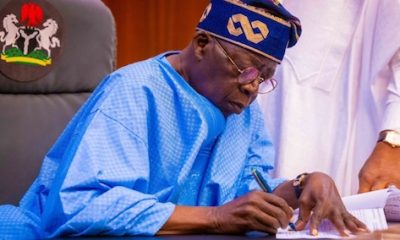

Three Years After: A Critical Evaluation of Tinubu’s Economic Reforms
ShareProf Uche Uwaleke As President Bola Ahmed Tinubu marked three years in office on May 29, 2026, Nigeria stands at a defining moment in...


Troops Neutralize Five Terrorists, Rescue 31 Kidnapped Victims in Katsina, Zamfara
ShareFrom Ifeanyichukwu Nwannah, Gusau Troops of Sector 2 Operation Fansan Yamma have rescued 31 kidnapped victims, neutralized five terrorists and dismantled several terrorists camps in a series of coordinated...
Arsenal Set Aside UCL Loss to PSG with Bus Parade Celebrating EPL Title
ShareTens of thousands of Arsenal fans put aside their pain at missing out on European glory as the club on Sunday celebrated...
Ghana’s Parliament Passes Anti-LGBTQ+ Bill
ShareThe parliament in Ghana has approved a new bill criminalising homosexuality and the promotion of LGBTQ+ activities. It proposes that identifying as lesbian, gay, bisexual, transgender or...
Kwara Community Clash Claims Two, Razes 10 Houses
ShareTwo people were killed, and about 10 houses were burnt in Ilesha Baruba, Baruten Local Government Area of Kwara State, on Saturday, after a violent clash involving an...

Declares No Faction in Nasarawa
ShareFrom Abel Zwanke, Lafia The Nasarawa State chapter of the Peoples Democratic Party (PDP) has declared that there is no faction within the party, insisting that...


Personal Loans Rise to N1.96trn in Jan 2026 – CBN
ShareBy Tony Obiechina, Abuja Personal loans granted by Nigerian banks rose to N1.96tn in January 2026, accounting for more than...


NNPC Records N481bn April Profit amid Strong Revenue Growth
ShareBy Tony Obiechina, Abuja The Nigerian National Petroleum Company Limited has recorded a significant month-on-month surge in performance, with revenue...


Oyo Abduction: Tinubu Orders Full-Scale Action After 16 Days of Agony
ShareBy David Torough, Abuja President Bola Tinubu has intensified efforts to secure the release of 46 abducted pupils and teachers...