
Education
3,658 Graduates From Federal School of Statistics

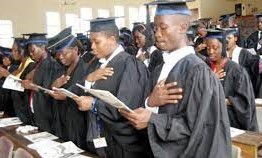
ConvocationBy Oluwaseyi Oduneye-OgunwomojuIbadan, April 9, (2021) The Federal School of Statistics (National Bureau of Statistics) Ibadan, on Friday held convocation for 3,658 graduands of six academic sessions. The delay in accreditation of the school lead to the late convocation of the graduands from the 2014/2015 academic session to date.
The Rector of the school, Dr Kayode Balogun, said that the convocation was unique because it combined six graduating sets. “ It is worthy of note that for several years, graduation ceremony has been a mirage in this institution but we thank God that this became a reality.“The school runs entirely on Internally Generated Revenue and it takes a lot to conduct convocation yearly,” Balogun said. According to him, the school has trained men and women scattered across the world in the private and public sector of the economy. He said that the alumni have added value in their areas of specialty as a result of the quality tutelage received while in the institution.“ This citadel of learning has produced bank chiefs and business merchants. It might interest you to know I am a product of this great citadel of learning.“This school was established in 1948 as a training unit for refresher courses under the Federal Office of Statistics (FOS), now known as National Bureau of Statistics, which is a merger of FOS and National Data Bank.“In 1961, its training activities was extended to other ministries and parastatals and later graduated to a full fledged school in 1971, awarding middle level statistical officer certificate for two-year programme in statistics.“ We now run both National Diploma and Higher National Diploma programmes in Statistics, Computer Science, Business Administration and Accounting.“ The importance of this certificate cannot be ove remphasised as it is acceptable locally and internationally. Our programmes are under the supervision of the National Board for Technical Education,” he said.The rector, however, urged the graduands to pursue their careers to higher levels.“Strive to know more. Insight empowers with confidence for conquest. Nothing empowers like knowledge, it is investment in knowledge that empowers unusual accomplishments.“Understand that people don’t fail because they know nothing in an examination, they fail because they don’t know enough. If you score 30 per cent in an examination you got something but not a pass mark.“People run around with failure mark saying we have done all we know, if all you know does not guarantee you success, then go and know more.“The secret of sustainable employment is an undying quest for more and more insight in your field. Know that your only competition is who you were yesterday and what are you doing to improve yourself.“Earn, save and invest before you spend. Avoid negative people, life is too short. If you don’t go after what you want, you’ll never get it,” he advised.Balogun urged the graduands to see failure as a beginning not an end, adding, ”our habit decides our future”. (NAN)







From Joseph Amedu, Lokoja
A Professor of Entrepreneurship and Corporate Strategy at the Federal University, Lokoja, John Alabi has called for more investment in the entrepreneurship/innovation sector to tackle Nigeria’s dwindling economy.
Professor Alabi who made the call while delivering the 46th Inaugural Lecture series of the University at its Felele Campus in Lokoja,on Wednesday, also stressed the need for government at all levels to prioritize investment in the sector to take care of the rising unemployment situation in Nigeria.
In his Lecture titled “Entrepreneurship Leadership through Entrepreneurial Education and Empowerment: Building an Entrepreneurial Economy in Vuca World” Professor Alabi advised that governments must provide enabling policies, universities must produce innovative graduates, industries must become active partners, financial institutions must support enterprise growth, and entrepreneurs themselves must embrace continuous learning, resilience, ethical leadership, and technological adaptation.
He explained that through entrepreneurial education and empowerment, nations can transform uncertainty into opportunity and build inclusive, resilient, and globally competitive economies.
“Governments should position entrepreneurship as a national development strategy rather than an employment intervention.
“Align entrepreneurship policies with national industrial and digital transformation agendas and investment in entrepreneurship ecosystems at federal, state, and local government levels.
“Building an entrepreneurial economy in a VUCA world requires more than increasing the number of entrepreneurs; it demands developing entrepreneurial leaders who can envision opportunities amid uncertainty, inspire innovation, mobilize resources, and create sustainable value
Professor Alabi also advocated that universities should focus on producing job creators rather than job seekers, establish functional entrepreneurship centres linked to industry, reward commercialization of research and innovation and encourage faculty-industry collaboration.
Other recommendations advanced by Professor Alabi includes, “Integration of entrepreneurship education across all levels of education, from primary to tertiary institutions.
“Shift from certificate-oriented learning to competency and problem-solving-based education.
“Promotion of interdisciplinary learning combining entrepreneurship, digital technology, leadership, and sustainability.
“Strengthen experiential learning through internships, incubators, business simulations, and enterprise projects.
“Developing a National Entrepreneurial Leadership Policy as well as establishment of a coordinated national framework for entrepreneurial leadership development.
“Encouragement of collaboration among government, academia, industry, and civil society”
In his welcome address, the Vice Chancellor of the Federal University, Lokoja, Professor Gbenga Ibileye gave an assurance that his administration would continue to encourage delivery of inaugural Lecture to ensure sustainability in the academic system.
Professor Ibileye said that the essence of the academic tradition is an opportunity for the academic staff to showcase their intellectual capacity in their field of study.
The Vice Chancellor described the topic of the lecture as timely and a welcome development that would go a long way in addressing the current economic reality in Nigeria.
He extolled Professor John Alabi, the Inaugural Lecturer, for his choice of contemporary topic that would add value to the people and the nation at large.

The Joint Admissions and Matriculation Board (JAMB) said its Central Admissions Processing System (CAPS) has been fully restored and is now operational after being unavailable for 96 hours.
The board made this known in its weekly Bulletin issued on Monday in Abuja.
It said the platform was restored on Sunday, Sept.
27, and urged tertiary institutions to speed up their admission processes to recover the time lost during the disruption.“The Board consequently urges all institutions to immediately accelerate their admission processes to recover the time lost during the period of the disruption and ensure compliance with the admission deadlines agreed at the 2026 Policy Meeting on Admissions,” it said.
It said the temporary unavailability of CAPS was caused by an administrative challenge involving its hosting organisation.
The board said it had worked with relevant service providers to restore the platform and ensure its stability.
It also apologised to candidates, institutions and other stakeholders for the inconvenience caused by the disruption.
“The Board sincerely regrets the inconvenience the temporary unavailability of the platform may have caused candidates, institutions and other stakeholders,” it said.
It said institutions should now intensify their admission processes, while candidates should promptly accept admission offers made to them.
It recalled that stakeholders at the 2026 Policy Meeting agreed that admissions for the 2026/2027 academic session should be concluded within specified deadlines.
According to the board, public universities are expected to conclude admissions on or before Oct. 31, private universities by Nov. 30, while other tertiary institutions have until Dec. 31.
“Consequently, all admissions for the 2026/2027 academic session are expected to be concluded by Dec. 31, 2026,” it said.
It particularly urged public universities to intensify their admission processes following the release of the 2026 Senior School Certificate Examination (SSCE) results by the National Examinations Council (NECO).
It said the development had provided institutions with the results needed to process more admissions before the Oct. 31 deadline.
“Following the release of the 2026 NECO results, the Board urges universities, especially public universities, to intensify admissions and meet the Oct. 31 deadline,” it said.
JAMB also advised candidates who had been waiting for their NECO results to immediately upload or verify their results on the appropriate platform.
It assured stakeholders that it would also speed up the consideration and approval of admission recommendations submitted by institutions through CAPS.
It said the Board was also working on measures to make CAPS more stable and reliable and reduce the impact of possible future disruptions.
It said the measures would include having alternative systems and arrangements to ensure that the admission process could continue if one hosting or service environment experienced problems.
“The Board remains committed to building systems that work reliably for the people we serve,” It said. (NAN)
From Dan Amasingha, Minna
The National Examinations Council (NECO) has released the results of the 2026 Senior School Certificate Examination (SSCE) Internal, with 804,948 candidates, representing 58.67 per cent of those who sat for the examination, obtaining at least five credits including English Language and Mathematics.
The figure represents a 1.
59 percentage-point decline from the 60.26 per cent recorded in 2025, when 818,492 candidates met the same benchmark.Announcing the results yesterday at the council’s headquarters in Minna, Niger State, NECO Registrar and Chief Executive, Prof.
Dantani Ibrahim Wushishi, said 1,378,048 candidates registered for the 2026 examination, comprising 682,352 males and 695,696 females.He said 1,371,992 candidates eventually sat for the examination, including 678,903 males and 693,089 females.
Wushishi, however, disclosed that the overall five-credit performance improved slightly, with 1,162,118 candidates, representing about 84.67 per cent, obtaining five credits and above irrespective of English Language and Mathematics.
The figure compares with 1,144,496 candidates, or 84.26 per cent, recorded under the same benchmark in 2025.
In absolute terms, the number of candidates who secured five credits including the two core subjects fell by 13,544, from 818,492 in 2025 to 804,948 in 2026. By contrast, the number who obtained five credits irrespective of English and Mathematics increased by 17,622.
The number of candidates who sat for the examination also rose by 13,653, from 1,358,339 in 2025 to 1,371,992 in 2026.
Malpractice records sharp decline
The council also reported a substantial reduction in examination malpractice, with 1,406 candidates implicated in various forms of malpractice in 2026, compared with 3,878 candidates in 2025.
The latest figure represents a 63.74 per cent decline from the previous year’s record. NECO had recorded 10,094 malpractice cases in 2024.
Wushishi attributed the reduction to improved examination processes, strengthened monitoring and collaboration with security agencies and other stakeholders.
He specifically acknowledged the support of the Nigeria Security and Civil Defence Corps and the Department of State Services, saying their involvement helped reinforce discipline, deter malpractice and safeguard the examination process.
Kano leads state figures
Kano State recorded the highest number of candidates who obtained five credits and above, including English Language and Mathematics, with 74,413 candidates.
Lagos followed with 72,496, while Oyo recorded 55,543 candidates under the same benchmark.
At the geopolitical-zone level, the Southwest accounted for the largest share of candidates with five credits and above irrespective of English and Mathematics, at 24.60 per cent. It was followed by the Northwest with 22.10 per cent, North Central with 19.00 per cent, Northeast with 14.70 per cent, South-South with 10.53 per cent and Southeast with 9.07 per cent.
The council also released separate state, geopolitical-zone and gender rankings based on the different performance benchmarks.
In the North Central, Benue led with 3.82 per cent, followed by Nasarawa with 3.66 per cent. Anambra led the Southeast with 2.92 per cent, ahead of Enugu with 2.14 per cent.
Rivers topped the South-South ranking with 3.03 per cent, followed by Edo with 2.17 per cent, Delta with 1.84 per cent, Akwa Ibom with 1.61 per cent and Cross River with 1.30 per cent.
Wushishi also disclosed that candidates at NECO examination centres in Saudi Arabia and Niger Republic recorded no candidate with five credits and above under the stated benchmark.
Exam held in Nigeria, six countries
The 2026 SSCE Internal examination was conducted from June 15 to July 23 across the 36 states, the Federal Capital Territory and six foreign countries—Benin Republic, Equatorial Guinea, Niger Republic, Côte d’Ivoire, Togo and Saudi Arabia.
The nationwide marking exercise was conducted between August 17 and September 4.
A total of 1,334 candidates with special needs participated in the examination, with the council maintaining that measures were put in place to promote inclusiveness.
Wushishi thanked the Federal Government, education authorities, the NECO Governing Board, National Assembly, security agencies, state governments, schools and other stakeholders for their support.
He declared the results released and said candidates could access them through the NECO website using their examination registration numbers.
The registrar urged candidates to remain focused on their academic pursuits, assuring stakeholders that the council would continue to uphold the credibility, fairness and integrity of its examinations.




Portuguese Football Federation Backs Ronaldo to Continue with Portugal
ShareThe Portuguese Football Federation has reaffirmed its support for Cristiano Ronaldo’s continued involvement with the national team, with president Pedro...

A Nation Divided as Ronaldo Left with Big Decision on Portugal Future
ShareAs Lionel Messi prepares to get a hero’s farewell for his successful international career, Cristiano Ronaldo’s could have ended with...


FG Establishes 10 Radio Diagnostic Centres to Boost Healthcare Service Delivery
ShareThe Federal Government said it has established 10 radio diagnostic centres to enhance diagnosis and treatment of diseases in the...


Customs Auctions 22,175 Litres of Seized Petrol for N32.1m
ShareBy Tambaya Julius, Abuja The Nigeria Customs Service (NCS) has auctioned 22,175 litres of Premium Motor Spirit (PMS) seized by...


NNPCL: Accounting for Fuel Subsidy
ShareBy Uddin Ifeanyi I am not an accountant, so my opinion on the NNPCL’s recently released 2025 annual financial report...

Can ECOWAS Parliament Turn Climate Commitments into Regional Action?
ShareBy Mark Longyen West Africa’s climate crisis is becoming harder to separate from the region’s familiar struggles with poverty, displacement,...


2027 Elections: INEC Voter Register Hits 103m
ShareBy Tambaya Julius, Abuja The Independent National Electoral Commission (INEC) said Nigeria’s voter register has risen to more than 103...


Niger 37: FG Pledges Accountability Over Deaths of Miners in NSCDC Custody
ShareBy Tambaya Julius, Abuja The Federal Government has assured families of the 37 suspected miners who died in the custody...


11-year-old Girl Found Dead in Suleja Well, Church Guard Arrested
ShareFrom Dan Amasingha, Minna The disappearance of 11-year-old Christabel Albert after she left home for a birthday celebration has ended...


Jonathan Receives Bayelsa East APC Candidates
ShareFrom Mike Tayese, Yenagoa Former President of Nigeria, His Excellency, Dr. Goodluck Ebele Jonathan, has commended the quality, experience and...