
BUSINESS
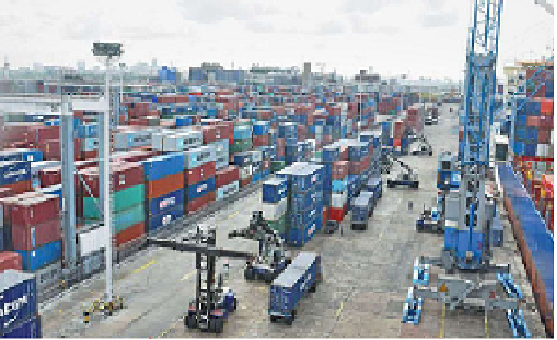
Apapa Gridlock: NPA Chief, Stakeholders Seek Solution

By Tony Obiechina, Abuja
Stakeholders in the Nigeria port system on Monday brainstormed on the
incessant Apapa gridlock with a resolution that the Nigerian port
authority should be supported in its drive to make the e-call up
system at the port works.
The occasion was the webinar on the Apapa e-call up system which was
addressed by the acting Managing Director of Nigeria Ports Authority
(NPA), Mohammed Bello-Koko, the President of Abuja Chambers of
Commerce and Industry (ACCI), Dr Al-Mujtaba Abubakar, the Executive
Director of African International Trade and Commerce Research, Mr.
Sand Kalu Mba, Port operators, importers and exporters.
The well attended webinar which had major presentations on the e-call
up system by Mr. Bello and a presentation on the assessment study on
the e-call up system by Mr. Mba, witnessed commendations for efforts
of the new NPA management to rejig the implementation of the e-call up
system.
The NPA acting MD in his presentation at the Webinar titled; “Apapa
Gridlock: Accelerating Implementation of E-call Up Policy” organized
by Abuja Chamber of Commerce and Industry (ACCI) said the traffic
Management along the access roads to the Ports in Lagos has been a
major challenge to the Nigerian Ports Authority.
He said the inadequate physical infrastructure (truck parks) has been
identified as a major constraint in the implementation of the e-call
up system and to nip this challenge in the bud, the NPA has mandated
all shipping companies involved in container operations to establish
empty container holding bays.
“The e-call up system is hinged on three components namely; Physical
Infrastructure, Information Technology and Stakeholders collaboration.
There are also hinderances to accelerating the implementation such as;
the e-call up system like any other novel project has its teething
problems and the problems faced daily by truckers requires the
intervention of Lagos State Government, Messrs. Truck Transit Park
Limited and Nigerian Ports Authority” he stated.
Earlier, the President ACCI, Dr. Abubakar in his opening remark said,
the Apapa Port is an integral part of, and a strategic gateway to
Nigerian economy but unfortunately, it has been bedevilled with
continued occurrence of gridlock.
“As a Chamber, we suggest and encourage a sustained and expanded
collaboration between the Port Authority and the Lagos state
government to dismantle the forces behind the incessant gridlock at
the Apapa port. There is need for the government to introduce
sanctions in the enforcement process. Multiple agencies operating at
the port also needs to harmonize their operations to reduce the
current hardship in the clearance of goods at ports”, he said.
According to a statement by ACCI Media/Strategy Officer, Olayemi John-
Mensah on in Abuja on Monday, the gridlock for the past six or so many
years have disrupted so many businesses and worsen Nigeria’s rating on
Ease of Doing Business (EDB) adding that ACCI had in early 2018 hosted
a roundtable on the traffic situation at the Lagos port.
“The well attended event came up with several solutions among which
were proposals for an e-call up system to manage trucking system at
Apapa. We were glad that the management of NPA eventually introduced
the digital system among other new ideas to ease traffic flow at the
port. However, the implementation of the e-call up system has not gone
as smoothly as envisaged.
“Consequently, ACCI launched a survey study on experiences of users
and stakeholders with the e-call up system. A synopsis of the report
will be presented to the NPA management at this webinar, while the
full report of the study will be presented to the NPA managing
Director in Lagos at a later date”, the statement added.
Dr. Abubakar who commended the efforts of the Federal Government to
extend rail connections to the port as a major step toward achieving
inter-modality within the national transport network also said, it
will improve the movement of containerized goods while noting that the
current efforts to complete the Lekki Deep Sea Port under a public
private partnership.
The Director General ACCI, Victoria Akai who appreciated every
participant at the webinar also lauded the Ag. MD, NPA for his
willingness to collaborate with the organised private sector through
advocacy avenues like this to discuss on moving port operations
forward even in these critical times.
“Indeed, government and the private sector are partners in progress.
Thank you for making exports a priority, this is indeed important for
the diversification efforts to improve our GDP and further create
wealth for our people by taking advantage of international trade
opportunities. The ultimate desire is to have a more functional and
efficient ports operations” she said.
She appreciated the Chamber’s President Dr. Al-Mujtaba Abubakar for
the relentless efforts in advocating for favourable policies and
initiatives for the general benefits of the private sector in Nigeria.
The DG also appreciated Mr. Sand for connecting the consequences of
operations at the ports to the real time effects on lives and families
adding that this is a fundamental point, as we carry out our daily
activities and make policies.
“This has been an engaging programme and we assure you that the report
of this webinar and the survey will be made available for all and we
will formally submit the report to the leadership of Nigeria’s Ports
Authority”, she noted.





By Tony Obiechina Abuja
Nigeria’s foreign exchange reserves rose to $58.81 billion on October 12, 2026, their highest level since November 19, 2008, when reserves stood at approximately $58.91 billion.
Data from the Central Bank of Nigeria (CBN) showed that the reserves increased from $55.
08 billion on October 9 to $58. 81 billion on October 12, representing a gain of about $3.73 billion in the latest reported movement.The latest figure extends the upward trend recorded in September and early October, strengthening Nigeria’s external reserve position amid efforts to stabilise the foreign exchange market.
Nigeria’s foreign reserves had been increasing steadily through September, moving from approximately $53.90 billion on September 1 to $54.93 billion by September 30.
The increase continued in October, with reserves reaching $54.95 billion on October 2 and $55.08 billion on October 9 before climbing to $58.81 billion on October 12.
The reserves rose from $53.90 billion on September 1 to $54.93 billion on September 30, representing an increase of $1.03 billion during the month. The reserves climbed further to $54.95 billion on October 2 and $55.08 billion on October 9 before surging to $58.81 billion on October 12.
The latest figure represents an increase of $3.73 billion between October 9 and October 12, bringing the cumulative gain since September 1 to $4.91 billion, or approximately 9.1 percent.
The latest reserve level marks a significant milestone in the country’s external reserve position, although the supplied data do not establish the specific factors behind the sharp increase between October 9 and October 12.
Nigeria’s reserves had risen by $12.76 billion year-on-year to $54.61 billion as of September 14, 2026, reflecting an improvement in the country’s external liquidity position.
Nigeria’s net foreign reserves have also risen to $46 billion. CBN Governor Olayemi Cardoso has said that stability in the foreign exchange market is helping to strengthen investor confidence.
Gross foreign reserves and net foreign reserves measure different aspects of the country’s external position, so the figures should not be treated as interchangeable.
The reserve increase comes amid changes in monetary policy and an improving economic outlook.
At its September 2026 Monetary Policy Committee meeting, the CBN reduced the Monetary Policy Rate (MPR) by 350 basis points, from 26.5 percent to 23 percent.
The committee also recalibrated the asymmetric corridor around the policy rate to +50/-300 basis points.
Meanwhile, the World Bank raised its forecast for Nigeria’s economic growth in 2026 to 4.3 percent, from 4.0 percent in 2025, and projected growth of 4.4 percent in both 2027 and 2028.

Some motorists in the Federal Capital Territory (FCT) have raised concerns over the continuous increase in the price of Premium Motor Spirit (PMS), popularly known as petrol.
The motorists said yesterday that petrol prices had continued to rise in spite of the Federal Government’s assurance to cushion the impact on consumers.
The Federal Government recently announced a 30-day discount on petrol sold by the Nigerian National Petroleum Company Limited, with public transport operators to receive priority under the arrangement.
Taiwo Oyedele, the Minister of Finance and Coordinating Minister of the Economy, said the arrangement, however, was not a return to petrol subsidy.
The minister said the government was also negotiating a ceiling of N1,350 per litre on the ex-gantry or landing cost of petrol in an effort to reduce sharp fluctuations in pump prices.
It was reported that Dangote Petroleum Refinery cut its gantry petrol price by N25 per litre to from N1,350 to N1,325.
Crude Oil Futures Price (WTI) traded at $90.41 to $90.50 per barrel for West Texas Intermediate (WTI), while international benchmark Brent crude traded near $103.33 per barrel
It showed that A.Y Shafa retail outlet increased the price from N1,370 per litre to N1,410 per litre, while MRS retail outlet increased from N1,370 per litre to N1,405 per litre.
Similarly, A.A Rano increased its pump prices from N1,380 per litre to N1,409 per litre.
A motorist, Tony Ajayi, said motorists were already grappling with rising food, transportation, household expenses, and the latest increase represented another unwelcome strain.
Ajayi said the persistent increase in fuel prices was putting growing financial pressure on families and making it increasingly difficult for many Nigerians to meet their basic needs.
Auwal Tanko, a motorist, said he bought petrol at N1,410 per litre, adding that the effect of the increase went far beyond the cost of filling his vehicle.
Tanko urged the federal government to urgently intervene by stabilising fuel prices.
Chinedu Ukadike, the National Publicity Secretary of the Independent Petroleum Marketers Association of Nigeria (IPMAN), said the Federal Government should expand access to its recently announced petroleum pricing policy.
Ukadike said the wider participation was necessary to ensure Nigerians felt the impact of an expected reduction in pump prices.
According to him, the policy’s impact will not be immediate, because the distribution of petroleum products to filling stations across the country will take time.
“Circulation of petroleum products and the quoted petroleum products is also a gradual process before it will be able to have an effect on commuters.
“The chains of distribution will be ignited by loading those products and trucks moving to their different destinations.
“The effect will not be immediately seen until within 20 days to 30 days when these products land at their destinations and in the pumps for dispensing,” he said.
He said the process involved loading the products, transporting them to various destinations and making them available for dispensing at filling stations. (NAN)

The Central Bank of Nigeria has ruled out an extension of the 1 January 2027, deadline for financial institutions to store and manage payment transaction data generated in Nigeria locally, putting pressure on banks, fintechs and payment service providers to complete their migration plans.
The disclosure was made at the CloudReady Nigeria Financial Services Roundtable, hosted in Lagos by Africa Hyperscalers Company in partnership with 100 Women in Digital Infra, Open Access Data Centres, Layer3, Nobus Cloud Services and the National Information Technology Development Agency.
Director of the CBN’s Payments System Supervision Department, Dr.
Rakiya Yusuf, reiterated the position in remarks delivered on her behalf by Assistant Director Babatunde Ajiboye at the CloudReady Nigeria Financial Services Roundtable organised by Africa Hyperscalers in Lagos. Yusuf was represented by Ajiboye, Payments Systems Supervision Division, CBN.The requirement was set out in a circular issued on 15 June 2026, directing payment service providers and other covered institutions to store and manage payment transaction data generated within Nigeria in the country. The deadline leaves affected institutions with limited time to assess their systems, review contracts with technology providers, and complete the migration of relevant data.
Yusuf said institutions must examine more than the physical location of their databases. Their compliance work should cover transaction logs, audit trails, metadata and the systems supporting payment operations.
She also warned that institutions must preserve service continuity and data integrity throughout the transition. A migration that meets the location requirement but disrupts payment services or compromises records would not adequately address the operational risks involved.
For cross-border transactions, financial institutions must ensure that records covered by the Nigerian requirement remain compliant while accounting for the needs of foreign counterparties. Institutions experiencing difficulties are expected to demonstrate the progress they have made, identify outstanding gaps and present credible plans for addressing them.
The CBN also urged financial institutions to review their agreements with cloud and technology providers to establish where data is stored, how it is processed and backed up, and whether existing arrangements can meet the new requirements.
The deadline formed part of a wider discussion about Nigeria’s push to strengthen digital sovereignty and develop local infrastructure capable of supporting sensitive financial workloads.
That would require clearer guidance on data and workload classification, resilient infrastructure, trusted service providers and coordination among regulators and industry participants, Osunrinde said.
The roundtable was intended to bring regulators, financial institutions and infrastructure providers together to discuss the practical requirements of compliance, including data residency, cybersecurity, cross-border transfers, business continuity and disaster recovery.
The discussions also highlighted the potential economic implications of the policy. More demand for locally hosted workloads could create opportunities for Nigerian cloud providers, data centre operators, cybersecurity companies and technology professionals. However, that opportunity depends on providers being able to demonstrate the security, reliability and capacity required by financial institutions.
The Chief Operating Officer of Nobus Cloud, Stephen Okoye, declared that locally developed cloud technology could support financial institutions seeking to move workloads into Nigeria while retaining the technical controls required for regulated operations.
He highlighted the role of Nigerian engineers in developing local cloud services and discussed the provider’s infrastructure, including its two availability zones. Okoye also cited the company’s compliance and assurance credentials, including ISO standards, Payment Card Industry Data Security Standard requirements, and the Nigeria Data Protection Act.
He said Nobus Cloud offered support to organisations migrating their systems, a process that can involve more than transferring information from one server to another. Institutions may need to review application dependencies, security configurations, connectivity and recovery arrangements before moving critical workloads.
Okoye also pointed to the company’s claimed 100 per cent uptime as an indication of its service reliability. For financial institutions, however, providers’ assurances must be assessed alongside their technical evidence, resilience arrangements and ability to maintain services during an outage or other disruption.
The transition is likely to require institutions to weigh local hosting options against their existing technology arrangements, particularly where applications rely on services and tools provided by international cloud platforms.
The Chief Executive Officer of Open Access Data Centres, Dr. Ayotunde Coker, said readiness for the transition would depend on the complexity and requirements of each financial institution’s workloads.
He urged institutions to assess their needs and risks before deciding what to migrate, rather than treating localisation as a straightforward relocation exercise. Financial operators need to understand the demands of their applications, the infrastructure available to support them, and the regulatory requirements that apply to their data.
Coker also highlighted the importance of local data centres, connectivity and reliable power in building a stronger digital infrastructure ecosystem. Investment in these areas will be important as demand for cloud computing and more advanced digital services, including artificial intelligence, grows.
The discussion underscored that the availability of local data centre space is only one part of readiness. Financial institutions must also consider connectivity between systems, redundancy, disaster recovery and the capacity to keep critical services running if infrastructure fails.
For institutions with applications designed around overseas cloud platforms, migration may require architectural changes and testing to ensure that systems continue to perform as expected. The process can also affect costs, depending on the complexity of the workload and the changes required.
The Nigerian Data Protection Commission also emphasised the need to protect personal data and manage the risks associated with cloud service providers.
National Commissioner and Chief Executive Officer of the commission, Dr. Vincent Olatunji, was represented at the event by Ibukunoluwa Owa. The commission’s contribution focused on the responsibilities of organisations that determine how personal data is processed and those that process it on their behalf.
Owa highlighted the need for data protection impact assessments, third-party risk assessments and appropriate data processing agreements. Institutions must understand the responsibilities of their service providers and ensure that their arrangements comply with applicable data protection requirements.
The commission’s guidance also covered breach reporting, transparent privacy policies and the need for organisations to explain how they will protect customers’ information.
Owa stressed the importance of preparing for operational disruption, including setting out appropriate remedies for possible downtime and maintaining disaster recovery plans.




Senator Abba Moro: It is Time to Go Home
ShareBy Cleopas Agada For seven years in the National Assembly, what has Benue South actually felt? For a man who...


NCDs Fastest-growing Disease Burden in Nigeria — Pate
ShareThe Coordinating Minister of Health and Social Welfare, Prof. Muhammad Pate, said Non-Communicable Diseases (NCDs) have become one of the...


2027: Adeleke Inaugurates Aare Asejere’s Campaign Council
ShareFrom Ayinde Akintade, Osogbo The Governor of Osun State, Senator Ademola Adeleke, yesterday charged newly inaugurated members of the Osun...


INEC Seeks Stakeholders’ Collaboration for Credible, Peaceful Elections
ShareThe Independent National Electoral Commission (INEC) has reaffirmed its commitment to strengthen collaboration with the National Orientation Agency (NOA), security...

Reps Reject Child Marriage, Demand Protection of Girl Child
ShareBy Ubong Ukpong, Abuja The House of Representatives on Thursday unanimously called for urgent and coordinated actions to protect Nigerian...


Court Awards N125, 000 Cost against Odumodublvck
ShareAn Abuja High Court on Wednesday awarded N125, 000 against a rapper, Tochukwu Ojogwu, popularly known as “Odumodublvck”, for asking...


Hunger Changed My Mind, Timini Egbuson on Embracing YouTube movies
ShareNollywood actor Timini Egbuson has reflected on his changing perception of YouTube movies, joking that he might have struggled financially...


Peller Announces Livestream with Peter Obi
SharePopular Nigerian TikTok streamer, Hamzat Adelaja, popularly known as Peller, has announced an upcoming livestream with the presidential candidate of...

Nigeria’s inflation drops from 15.39 Per Cent to 14.63 Per Cent in September
ShareBy Tony Obiechina, Abuja The National Bureau of Statistics (NBS) on Thursday disclosed that Nigeria’s inflation has eased from 15.39...


Senate Oders Investigation into Corps Member’s Death in Enugu
ShareBy Tambaya Julius, AbujaThe Senate has ordered an investigation into the death of a National Youth Service Corps (NYSC) member,...